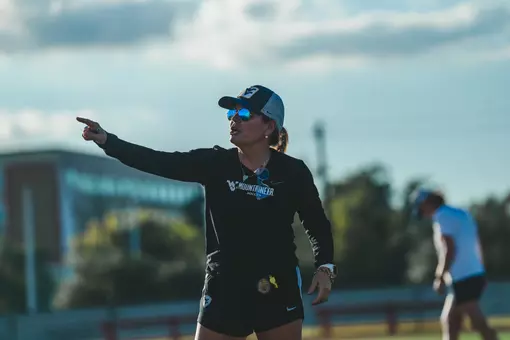
Photo by: All Pro Photography/Dale Sparks
Adaptability Key For Izzo-Brown In Preparing For Season
May 20, 2020 05:00 PM | Women's Soccer
MORGANTOWN, W.Va. – Nikki Izzo-Brown is likely going to have to lean on 25 years of coaching experience to help her navigate what could be a soccer season like no other.
NCAA women's soccer is in the same uncharted waters college football is about to navigate this fall as schools across the country look toward resuming normal activities, if that's even possible.
While there are no chapters in the women's soccer coaching manual for dealing with COVID-19, Izzo-Brown admits her biggest concern right now is actually the other football.
"We know how important football is, and not my football," she said Wednesday afternoon during a Zoom video call with media. "I think we all understand and respect what football does for us and so that's been a concern.
"During this pandemic, I've kind of watched what they are going to do with football and then after that we'll kind of fall in line and see where we fall with women's soccer," she noted. "I know all of our associations and women's soccer chairs … everybody is making sure we are thinking collectively and being safe and healthy first, but I think once football goes off, we're going to have a season, but we're just going to kind of have to wait and see what kind of season it's going to look like and how long it's going to be."
At the top of her list of concerns are injuries.
Players right now are dispersed throughout the country and the world with varying levels of activity. Some are in places where they can get outside to run and stay in shape while others are in locations still under lockdown.
And some of her Canadian players are in area where they are still experiencing abnormally cold temperatures, which have also hindered their personal conditioning.
Normally, when players report for preseason training their physical conditioning is not an issue. Missing a good portion of spring training has put them behind physically and tactically.
"That's been a huge concern of mine because of the spring season and how we are in the weight room developing them physically and with injury prevention, and we missed all of that," she said. "So, then you move into the summer months and they can't play right now and some kids don't have any access to weights or anything like that.
"The German professional league was the first league to kick off in soccer last week, and they had so many injuries. We want to play, and I know my kids want to play, but I do think we have to look at that, and I've never really had to look at that in that manner before," she said.
Izzo-Brown said a preseason camp normally consists of two weeks of training before matches begin. She believes her players will need at least that amount of time to be ready to go, if not more.
"My hope is it's not less than two weeks, and if it's a little bit more I would be happy," she said. "I do not think that the NCAA would allow us anything less than two weeks to do our preseason. Again, I don't want to be greedy because I want a season, but I am also very concerned about the health of our athletes, and we just have to be very mindful of that."
She is also mindful of the fact that some of her players will likely be returning to campus in less-than-ideal shape, to no fault of their own.
There is only so much they can do on their own without direct supervision or adequate training facilities.
"We've normally had this cookie-cut, physical testing, strength testing process and such, and we are just going to have be honest with where we are at with every athlete," she said. "Some of it is on them and some of it is on (the pandemic).
"Some of our kids up north right now, they can't even get out because it's too cold to even do some cardio. We're really going to work hand in hand and have a team effort and an understanding of where the athlete is at. We are working closely with the NCAA to see what we can do to monitor them. To me, it's embracing overall health and well-being," she said.
Another consideration will be the possibility of disruptions during the year with injuries and illness. The normal rhythms of a typical soccer season may not be realistic this year.
Izzo-Brown and her staff are also going to have to have a plan in place if that occurs.
"I think one of the best things that ever happened to me as a head coach is when I got these World Cup players," she noted. "I don't even know if Kadeisha (Buchanan) and Ashley (Lawrence) ever did a preseason with us. Then, I had Bianca (St. Georges) miss three weeks. Then, I had Riley (Foster) miss two weeks and then, I had Vanessa (Flores) miss some time so I was always adapting as a coach.
"I was so frustrated with that and finally I was like, 'I'm going to embrace this.' This is just such a part of what I had to do - and what I still have to do - with these types of high-level athletes because they are competing with their countries for World Cups and the Olympics."
She continued, "We even talked as a staff about what if we all get the virus, then what? It's things you've got to think about, but my hope is every day as we move along and as football starts their process of re-socialization that we will have a better understanding of how to deal with this."
Izzo-Brown does believe there will be an NCAA women's soccer season this fall, it may just take a little bit longer than usual to complete.
"What has been said to us from the NCAA is they want a championship," she said. "We know we have to have at least 14 games to crown a champion – I know that, but again, things can change. I'm very hopeful we will have some type of season and if it gets delayed or canceled in the fall, they have also mentioned it could pick back up in the spring."
In the meantime, she said she is planning to "sub, sub, sub" her players when the games do resume.
"I'm going to be flexible and open-minded," she said. "We might be a little bit different in moments."
NCAA women's soccer is in the same uncharted waters college football is about to navigate this fall as schools across the country look toward resuming normal activities, if that's even possible.
While there are no chapters in the women's soccer coaching manual for dealing with COVID-19, Izzo-Brown admits her biggest concern right now is actually the other football.
"We know how important football is, and not my football," she said Wednesday afternoon during a Zoom video call with media. "I think we all understand and respect what football does for us and so that's been a concern.
"During this pandemic, I've kind of watched what they are going to do with football and then after that we'll kind of fall in line and see where we fall with women's soccer," she noted. "I know all of our associations and women's soccer chairs … everybody is making sure we are thinking collectively and being safe and healthy first, but I think once football goes off, we're going to have a season, but we're just going to kind of have to wait and see what kind of season it's going to look like and how long it's going to be."
At the top of her list of concerns are injuries.
Players right now are dispersed throughout the country and the world with varying levels of activity. Some are in places where they can get outside to run and stay in shape while others are in locations still under lockdown.
And some of her Canadian players are in area where they are still experiencing abnormally cold temperatures, which have also hindered their personal conditioning.
Normally, when players report for preseason training their physical conditioning is not an issue. Missing a good portion of spring training has put them behind physically and tactically.
"That's been a huge concern of mine because of the spring season and how we are in the weight room developing them physically and with injury prevention, and we missed all of that," she said. "So, then you move into the summer months and they can't play right now and some kids don't have any access to weights or anything like that.
"The German professional league was the first league to kick off in soccer last week, and they had so many injuries. We want to play, and I know my kids want to play, but I do think we have to look at that, and I've never really had to look at that in that manner before," she said.
Izzo-Brown said a preseason camp normally consists of two weeks of training before matches begin. She believes her players will need at least that amount of time to be ready to go, if not more.
"My hope is it's not less than two weeks, and if it's a little bit more I would be happy," she said. "I do not think that the NCAA would allow us anything less than two weeks to do our preseason. Again, I don't want to be greedy because I want a season, but I am also very concerned about the health of our athletes, and we just have to be very mindful of that."
She is also mindful of the fact that some of her players will likely be returning to campus in less-than-ideal shape, to no fault of their own.
There is only so much they can do on their own without direct supervision or adequate training facilities.
"We've normally had this cookie-cut, physical testing, strength testing process and such, and we are just going to have be honest with where we are at with every athlete," she said. "Some of it is on them and some of it is on (the pandemic).
"Some of our kids up north right now, they can't even get out because it's too cold to even do some cardio. We're really going to work hand in hand and have a team effort and an understanding of where the athlete is at. We are working closely with the NCAA to see what we can do to monitor them. To me, it's embracing overall health and well-being," she said.
Another consideration will be the possibility of disruptions during the year with injuries and illness. The normal rhythms of a typical soccer season may not be realistic this year.
Izzo-Brown and her staff are also going to have to have a plan in place if that occurs.
"I think one of the best things that ever happened to me as a head coach is when I got these World Cup players," she noted. "I don't even know if Kadeisha (Buchanan) and Ashley (Lawrence) ever did a preseason with us. Then, I had Bianca (St. Georges) miss three weeks. Then, I had Riley (Foster) miss two weeks and then, I had Vanessa (Flores) miss some time so I was always adapting as a coach.
"I was so frustrated with that and finally I was like, 'I'm going to embrace this.' This is just such a part of what I had to do - and what I still have to do - with these types of high-level athletes because they are competing with their countries for World Cups and the Olympics."
She continued, "We even talked as a staff about what if we all get the virus, then what? It's things you've got to think about, but my hope is every day as we move along and as football starts their process of re-socialization that we will have a better understanding of how to deal with this."
Izzo-Brown does believe there will be an NCAA women's soccer season this fall, it may just take a little bit longer than usual to complete.
"What has been said to us from the NCAA is they want a championship," she said. "We know we have to have at least 14 games to crown a champion – I know that, but again, things can change. I'm very hopeful we will have some type of season and if it gets delayed or canceled in the fall, they have also mentioned it could pick back up in the spring."
In the meantime, she said she is planning to "sub, sub, sub" her players when the games do resume.
"I'm going to be flexible and open-minded," she said. "We might be a little bit different in moments."


Nikki Izzo-Brown & Alicia Riggins | Wagner Postgame | Nov. 14
Saturday, November 15
Nikki Izzo-Brown | Nov. 10
Monday, November 10
WSOC | Cincinnati Cinematic Recap
Friday, October 31
Ajanae Respass | Cincinnati Postgame | Oct. 30
Thursday, October 30