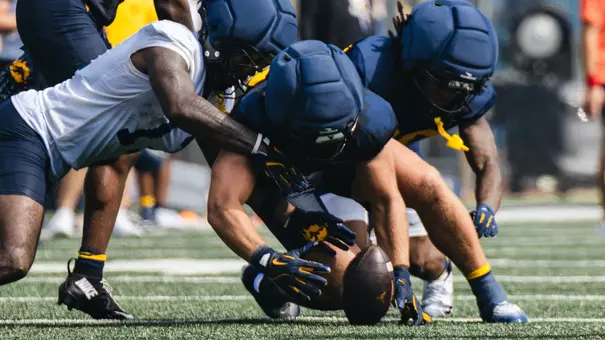
Photo by: WVU Athletic Communications
A Conversation With Shane Lyons
March 31, 2020 05:37 PM | Football, General, From the ADs Desk
MORGANTOWN, W.Va. – Tony Caridi sat down with West Virginia University Director of Athletics Shane Lyons Tuesday afternoon to go over a variety of topics in response to the recent COVID-19 outbreak.
Lyons, chairman of the NCAA Division I Football Oversight Committee, discusses some of the national issues his organization is dealing with as states across the country continue to observe social distancing practices.
Here is the complete transcript of this afternoon's 23-minute discussion.
Tony Caridi: Well, here we are with a new world going on. We've maintained our six-feet distance and it's been an amazing three weeks as we jump into this. What has this been like, since it's been so unprecedented?
Shane Lyons: It's been crazy and looking back, you talk about three weeks, three weeks we were in Kansas City and that's when it all started happening. In a lot of ways, it's been slow and in a lot of ways it's been really fast-paced. My world is just different, like a lot of people's worlds, just because there are so many decisions having to be made and there is no blueprint for this. You have to work through every issue. You're trying to make the best decisions you can based on the circumstances that we have. New information becomes available each day so you have to adjust your thinking as you work through that. We're getting there but it's been a journey.
Tony Caridi: I would imagine every day has been a series of phone calls and video conferences?
Shane Lyons: It's a new world. It was phone calls to begin with and now we've gone into Zoom and Teams video conferencing, not only within the conference, but even internally within our staff and the NCAA committees that I'm on. It's just a new way we have to approach the business and our communication styles have changed. Those things are different and we have to adjust to it in the meantime while we look toward the future.
Tony Caridi: Since you've took over, first and foremost you have always looked out for the student-athletes and you've made a lot of improvements along that line. With that being said, how have you communicated with spring-sport athletes who have seen their seasons come to an end and the winter sports athletes in the case of men's and women's basketball with their seasons almost over but not quite finished, what was the message you gave to them?
Shane Lyons: Unfortunately, my communications have not been direct. I have sent some emails about being heartbroken about how all of this has panned out for them, especially the seniors in the winter sports who didn't have a chance to compete in their championships. A lot of the communication starts with our coaching staff and my communication to them, or my senior staff's communication to them and then back to the student-athletes. I think the athletes need to understand we are in unprecedented times and it's hard. This is life, unfortunately, and sometimes you get a bad hand dealt to you and this is a bad hand. In sports we learn how to face adversity and this is adversity we have to face in life. It's not just athletics but it's our world right now from people losing their jobs and people not working to the unknowns as we move forward. This is a lesson we're working through with our student-athletes on a day-by-day basis.
Tony Caridi: On Sunday, the Big 12 announced it had extended its suspension of activities until May 31. You are involved in those discussions, what led to that decision?
Shane Lyons: It first came out until March 29th just to give us a couple of weeks to look into what's really happening in the world? What does this pandemic really mean? None of us know and we still don't know. I tried to make my decisions based upon a few people in the medical field. Clay Marsh (West Virginia's COVID-19 czar) has been instrumental in our decisions, at least from West Virginia's perspective, as far as what is happening in the world. From the NCAA and the conference standpoint they have medical doctors in the field, so it's a matter of looking at what are we doing? What does the future look like? What does this pandemic look like? Let's make sound decisions off of that? We can always back off the May 31st date, but what I didn't want to do, and I don't think the conference wanted to do, was push the date to April 15th and then shove it to May 1st and then shove it to May 15th. Let's go throughout the whole spring semester and if things do change quickly then we can back off of that date. That's not a set-in-stone date. It's a date our presidents can meet again and back off if they need. However, with the information that we are getting we're still being told probably in the next two or three weeks is when the U.S. is going to see the big spike across the country. You've seen it in New York. You hear California. You hear Georgia. So, what does it look like for the rest of the U.S.? They are telling us the spike will happen in two or three weeks and then hopefully starting in May we can start to get back to more normal lives and then in June and July during the summer months hopefully we're back to somewhat normal life as we known it before.
Tony Caridi: There are so many different pieces to this but the bottom line is the safety of everyone.
Shane Lyons: It is. My thinking hasn't changed. The core values you have to look at and who are we trying to serve? First it's our student-athletes. This situation it's about the safety of our student-athletes and it's more than just their safety. It's our coaches, our staffs and our community. It's hard. You don't realize how much sports mean to us. I work in it every day, but how much sports mean in our society and now not having it … I saw somebody tweet that if there was a whiffle ball game in the neighborhood they would pay for a ticket to go watch it. We are all craving sports and the entertainment aspect of that and hopefully we have that back soon.
Tony Caridi: Rules and regulations are changing. It's extremely fluid right now. With the latest stipulations, what are you as an institution allowed to do when it comes to student-athlete's nutrition, finances, how is all of that working?
Shane Lyons: That's what we've been doing the last three weeks. The NCAA's rulebook is not written to say here is what you do during a pandemic. What we've had to do over the last several weeks as conference commissioners as well as athletic directors of each conference is to try and come up with a pandemic policy that we're all following pretty closely that's similar. The Big 12 Conference is doing something similar to the ACC, the Big Ten, the Pac-12 and the SEC so we're kind of working from the same sheet. With that is there are certain things we can do. There is no physical activity but what we are permitting is the virtual meetings with our student-athletes to go through watching film and doing those sort of things. We can send virtual workouts and say here is what we want you to do. Hopefully they voluntarily do that on their own to stay in shape. Some of that is taking place. Nutrition? Obviously, they are still on scholarship. They get their off-campus checks and those who went home we will still provide their scholarship check back to them so they have a source of income to buy food if they need that. On top of that, a lot of our athletes need that extra nutrition so the energy bars, the supplements, the vitamins, the protein drinks and those things, based on our new policy we can send that and we are working through that right now. We also said a limited amount of supplies meaning the stretch bands and the foam rollers to work out, we can send those. What we don't want is somebody buying a whole new set of weights for a student-athlete so there have to be parameters around what we can do. We are in a very competitive business and making sure everybody is doing the same thing as close as possible is the reason we came up with the policy.
Tony Caridi: On Monday, the NCAA granted an additional year of eligibility for senior athletes who were playing spring sports. Give me your insight into that.
Shane Lyons: I am actually on the NCAA council and I was on that phone call yesterday that was scheduled for two hours and three hours later we finally got off the call. It was a matter of looking at two situations. One, it was looking at the winter sports and the winter sports were not granted an additional season of competition, or an extension of the clock. Again, this was a heartbreaking, gut-wrenching decision that had to be made but that was on the basis of 90-something percent of their seasons – and in some cases full seasons competed in some of the smaller conferences – so it was a tough decision. It can be debated one way or another but ultimately the vote of the council was the winter sports would not be granted that exception. In the spring sports, since they had just started, there was a belief that those student-athletes, seniors as well as underclassmen, should have the opportunity to extend their clock or get the opportunity to have their season back if they chose to do so. It's permissive legislation, which means if they decide to come back then they have that opportunity. For seniors only, there is an element of financial aid so they can come back and that aid would not count against the team limits for one year. Again, a lot of moving parts that go into this but that was the right decision to be made and what you have to understand is when we made these decisions it also impacts, not only our current student-athletes, but it's also impacting the high school student-athletes. If all of these students stay around that means there are less roster sports for high school students to take because you go back to your squad limits. It's not as easy as some people think as I see on social media. "Well, just make the decision because it's easy." How does that impact everything? Unfortunately, somebody is going to get hurt in that process. What we had to look at and say, what do we think is best for the student-athlete? It's a tough decision. This is what we agreed upon and that's what we will move forward with.
Tony Caridi: School started again this week online at WVU. What are your reports as far as student-athletes taking their online classes?
Shane Lyons: It's still too early to tell. I've talked to Steve Urysaz, who oversees our academic area, and I think the word that is being used right now is "awkward." I think the classes that were already scheduled online with their structure, they knew what they were getting in to and the classes that weren't online, those professors are having to tailor that to an online class. We're early on in that process but we'll get through it, but awkward is what I'm being told right now.
Tony Caridi: Let's talk money and we can go a bunch of different directions here. First off, refund. We had baseball that was in the midst of its season and the spring football game as well. Where are you with refunds? What do folks need to know?
Shane Lyons: I think we are almost through that whole process right now. Our ticket office has done a great job of looking at those tickets that were purchased, especially those purchased with a credit card, and are refunding those automatically. If they were purchased through the ticket office in a different manner, there are some loose ends that we're tying up right now to work through that. But the refund process is near completed and, again, unfortunately for the fans and our student-athletes not having that, but it was the right thing to do and we're getting through that.
Tony Caridi: Has the plan changed in regard to 2020 football season tickets? Where are you at with that?
Shane Lyons: We're looking at that as we speak. We've extended the deadline to May 1 for the Chic-fil-A (game) that mirrors our priority season ticket sales. The thing that we need to look at now is are we going to extend that date? Our ticket office has done a great job. They have worked through a lot of different scenarios so there could be some news coming out. We haven't worked all the way through that but we're looking to say, do we extend that date? If we do, obviously information will come out from our staff about that and what that looks like. We feel that is the right thing to do with everything that's going on. It's a matter of working through the logistics and making that happen.
Tony Caridi: Contact information if they want to get in touch, they can go to 1-800-WVU-GAME if they want to call or the email address WVUGAME@mail.wvu.edu. While they may not literally be in the building they will get back to you.
Shane Lyons: Yes. Obviously they are not in the building and not at their desk as they normally would be but they are picking up the emails and they are getting the messages that are being left. You will be able to have contact with them that way.
Tony Caridi: Normally the month of April starts with the season of going out and meeting with fans. In April we go to Charleston for the big MAC event there and then the month of May we hit different spots on the caravan. It's reconstituted now so how is that going to look?
Shane Lyons: It's a work in progress. We postponed them and in some situations we'll have to cancel, and that was important outreach for us to be able to go out and see the fans and have our coaches on the road. It looks like those will end up being canceled. What we've talked about is having a virtual caravan. You kind of have a town hall caravan that way that we can open it up to everybody and they get to hear from our coaches. I'm sure our coaches would be excited to have that opportunity. That would be around the same time around the middle of May when the caravans were scheduled, so be looking for more information about that as we move forward. That was our thought of doing something virtually, and then some of the golf tournaments and other MAC events that we have we'll look at moving those deeper into the summer if that's possible and the dates are open. Again, it's very fluid but we're working through those things.
Tony Caridi: Besides wearing the hat as WVU's athletic director, you also serve as the chairman of the football oversight committee. How has your role changed in that regard? I would imagine it's been constant contact.
Shane Lyons: It's constant contact and what's really changed is, one, we kind of hit the pause button a little bit for the last couple of weeks because we had to get through the spring. What were we going to do for the spring? Now we've got to look at what the summer looks like potentially and what does next fall look like? We've worked a little bit with the commissioners in terms of what does the spring look like? Unfortunately, the spring season is canceled and now we're focusing on June and July. What does that look like, assuming that we're allowed back on campus? Then what does it look like on August 1 when the fall season starts? There are a lot of moving parts depending upon the peaks of this pandemic and when people are allowed back. We are monitoring that closely. The work has changed in the sense of things that were priorities before of reviewing calendars and whether the recruiting calendar works, that's all set aside. Now we're focused on how do we come back with college football for the fall? There is a lot of things being thrown out there. We hadn't talked about moving the football season back into the summer. I saw that. Then I've seen other things that were thrown out but we're just at the beginning phases of this. First and foremost, it goes back to the safety of our student-athletes and when they return how much time is needed to prepare them to get physical ready for competition. We know that's going to take a little bit longer than normal because they haven't been on campus. They haven't been lifting and they haven't been running and doing the conditioning aspect of it. If we don't have summer conditioning, what does August look like? Our goal is to try and have college football in its normal slot it's currently in but there are a lot of uncontrollable circumstances out there that we have to work through. It's bigger than football. If campuses are closed are you still going to have college football? The bigger question is what is higher education going to look like come August? We'll know more in the coming weeks, but that's what we're working on of trying to work through those issues of coming up with dates that all schools can work through together.
Tony Caridi: Incredibly difficult questions and the answers are still not available.
Shane Lyons: Right. I go back to my earlier comments that there is not a blueprint to say, if this happens do this. We were fortunate to get two (spring) practices in. There are some that had more than two and some that had zero. Not only are you worried about the conditioning aspect but you are also worried about who got the advantage of having some workouts working in offensive and defensive schemes that other schools did not. How does that work in the summertime? We'll try and work through that, but if it doesn't happen in the summer can it happen anywhere in the fall? There are going to be situations that we've never encountered before that we have to work through and we'll try and get everybody as close to the same starting point as we can.
Tony Caridi: The conversations are ongoing, but I would imagine that you have to wait where the curve goes before you can realistically make any decisions?
Shane Lyons: Right. That's why it's important that we stay closely in touch with the NCAA's medical staff, our own medical staff here of determining what do those peaks look like? There is a lot of faith that you have to put in our medical field and our scientists. Maybe there is something in the short term – a vaccine or something that will help control this virus so those are things are obviously in the process – but you have to look at when is the peak? When will restrictions of people out socializing be lifted? What does that look like? These are tough decisions. You let 100 football student-athletes back to train and they go different places at night. What you don't want is them to come back in and one student-athlete contracts the virus and how does that spread to other individuals? Now you have 100 people that you have to quarantine. It's very touchy topics as we work through this but we'll get through it and there is going to be college football played, it's just a matter of when and what that's going to look like.
Tony Caridi: As we close, what is your message to Mountaineer Nation?
Shane Lyons: I think we are in unprecedented times. I think that we all have to stay positive as we work through this. It's a daunting era that we're in right now and not being able to do the things that we were able to do in the past – and things are taken away from us and to practice patience. I encourage people to listen to the doctors and the medical professionals about the social distancing and the importance of washing your hands. My understanding is if we do all of that it does flatten the curve and that gives us more of an opportunity to get back to our normal life faster. If we continue not to do that then you are going to have the spikes and a lot of unfortunate deaths associated with this. My thing is trying to stay positive and it's hard when you are isolated and quarantined to your house. Thankfully the weather has been somewhat decent so you can go out and take walks and stay positive. And that's the message we are trying to send to our student-athletes. It's really the mental health aspect that I worry about most. Those 500 student-athletes that compete, they go through a lot of training, they've done this for 10, 15 years of their lives and now that's taken away from them. So we've had a lot of discussions about mental health. We've talked to our coaches about it and that also goes beyond our student-athletes. It goes for our society as well.
Tony Caridi: I guess the message is you can do your part by staying away from people right now because the quicker the curve is flattened the more opportunity we'll have to get whatever it is we do back and rolling, right?
Shane Lyons: That's our hope – getting back to normal. By following the policies and procedures put in place. Following the Governor's orders to stay home … obviously there are essential needs we have to have – the grocery stores and all that. But the socializing, if we can flatten that curve we'll get back to normal life a lot quicker.
Lyons, chairman of the NCAA Division I Football Oversight Committee, discusses some of the national issues his organization is dealing with as states across the country continue to observe social distancing practices.
Here is the complete transcript of this afternoon's 23-minute discussion.
Tony Caridi: Well, here we are with a new world going on. We've maintained our six-feet distance and it's been an amazing three weeks as we jump into this. What has this been like, since it's been so unprecedented?
Shane Lyons: It's been crazy and looking back, you talk about three weeks, three weeks we were in Kansas City and that's when it all started happening. In a lot of ways, it's been slow and in a lot of ways it's been really fast-paced. My world is just different, like a lot of people's worlds, just because there are so many decisions having to be made and there is no blueprint for this. You have to work through every issue. You're trying to make the best decisions you can based on the circumstances that we have. New information becomes available each day so you have to adjust your thinking as you work through that. We're getting there but it's been a journey.
Tony Caridi: I would imagine every day has been a series of phone calls and video conferences?
Shane Lyons: It's a new world. It was phone calls to begin with and now we've gone into Zoom and Teams video conferencing, not only within the conference, but even internally within our staff and the NCAA committees that I'm on. It's just a new way we have to approach the business and our communication styles have changed. Those things are different and we have to adjust to it in the meantime while we look toward the future.
Tony Caridi: Since you've took over, first and foremost you have always looked out for the student-athletes and you've made a lot of improvements along that line. With that being said, how have you communicated with spring-sport athletes who have seen their seasons come to an end and the winter sports athletes in the case of men's and women's basketball with their seasons almost over but not quite finished, what was the message you gave to them?
Shane Lyons: Unfortunately, my communications have not been direct. I have sent some emails about being heartbroken about how all of this has panned out for them, especially the seniors in the winter sports who didn't have a chance to compete in their championships. A lot of the communication starts with our coaching staff and my communication to them, or my senior staff's communication to them and then back to the student-athletes. I think the athletes need to understand we are in unprecedented times and it's hard. This is life, unfortunately, and sometimes you get a bad hand dealt to you and this is a bad hand. In sports we learn how to face adversity and this is adversity we have to face in life. It's not just athletics but it's our world right now from people losing their jobs and people not working to the unknowns as we move forward. This is a lesson we're working through with our student-athletes on a day-by-day basis.
Tony Caridi: On Sunday, the Big 12 announced it had extended its suspension of activities until May 31. You are involved in those discussions, what led to that decision?
Shane Lyons: It first came out until March 29th just to give us a couple of weeks to look into what's really happening in the world? What does this pandemic really mean? None of us know and we still don't know. I tried to make my decisions based upon a few people in the medical field. Clay Marsh (West Virginia's COVID-19 czar) has been instrumental in our decisions, at least from West Virginia's perspective, as far as what is happening in the world. From the NCAA and the conference standpoint they have medical doctors in the field, so it's a matter of looking at what are we doing? What does the future look like? What does this pandemic look like? Let's make sound decisions off of that? We can always back off the May 31st date, but what I didn't want to do, and I don't think the conference wanted to do, was push the date to April 15th and then shove it to May 1st and then shove it to May 15th. Let's go throughout the whole spring semester and if things do change quickly then we can back off of that date. That's not a set-in-stone date. It's a date our presidents can meet again and back off if they need. However, with the information that we are getting we're still being told probably in the next two or three weeks is when the U.S. is going to see the big spike across the country. You've seen it in New York. You hear California. You hear Georgia. So, what does it look like for the rest of the U.S.? They are telling us the spike will happen in two or three weeks and then hopefully starting in May we can start to get back to more normal lives and then in June and July during the summer months hopefully we're back to somewhat normal life as we known it before.
Tony Caridi: There are so many different pieces to this but the bottom line is the safety of everyone.
Shane Lyons: It is. My thinking hasn't changed. The core values you have to look at and who are we trying to serve? First it's our student-athletes. This situation it's about the safety of our student-athletes and it's more than just their safety. It's our coaches, our staffs and our community. It's hard. You don't realize how much sports mean to us. I work in it every day, but how much sports mean in our society and now not having it … I saw somebody tweet that if there was a whiffle ball game in the neighborhood they would pay for a ticket to go watch it. We are all craving sports and the entertainment aspect of that and hopefully we have that back soon.
Tony Caridi: Rules and regulations are changing. It's extremely fluid right now. With the latest stipulations, what are you as an institution allowed to do when it comes to student-athlete's nutrition, finances, how is all of that working?
Shane Lyons: That's what we've been doing the last three weeks. The NCAA's rulebook is not written to say here is what you do during a pandemic. What we've had to do over the last several weeks as conference commissioners as well as athletic directors of each conference is to try and come up with a pandemic policy that we're all following pretty closely that's similar. The Big 12 Conference is doing something similar to the ACC, the Big Ten, the Pac-12 and the SEC so we're kind of working from the same sheet. With that is there are certain things we can do. There is no physical activity but what we are permitting is the virtual meetings with our student-athletes to go through watching film and doing those sort of things. We can send virtual workouts and say here is what we want you to do. Hopefully they voluntarily do that on their own to stay in shape. Some of that is taking place. Nutrition? Obviously, they are still on scholarship. They get their off-campus checks and those who went home we will still provide their scholarship check back to them so they have a source of income to buy food if they need that. On top of that, a lot of our athletes need that extra nutrition so the energy bars, the supplements, the vitamins, the protein drinks and those things, based on our new policy we can send that and we are working through that right now. We also said a limited amount of supplies meaning the stretch bands and the foam rollers to work out, we can send those. What we don't want is somebody buying a whole new set of weights for a student-athlete so there have to be parameters around what we can do. We are in a very competitive business and making sure everybody is doing the same thing as close as possible is the reason we came up with the policy.
Tony Caridi: On Monday, the NCAA granted an additional year of eligibility for senior athletes who were playing spring sports. Give me your insight into that.
Shane Lyons: I am actually on the NCAA council and I was on that phone call yesterday that was scheduled for two hours and three hours later we finally got off the call. It was a matter of looking at two situations. One, it was looking at the winter sports and the winter sports were not granted an additional season of competition, or an extension of the clock. Again, this was a heartbreaking, gut-wrenching decision that had to be made but that was on the basis of 90-something percent of their seasons – and in some cases full seasons competed in some of the smaller conferences – so it was a tough decision. It can be debated one way or another but ultimately the vote of the council was the winter sports would not be granted that exception. In the spring sports, since they had just started, there was a belief that those student-athletes, seniors as well as underclassmen, should have the opportunity to extend their clock or get the opportunity to have their season back if they chose to do so. It's permissive legislation, which means if they decide to come back then they have that opportunity. For seniors only, there is an element of financial aid so they can come back and that aid would not count against the team limits for one year. Again, a lot of moving parts that go into this but that was the right decision to be made and what you have to understand is when we made these decisions it also impacts, not only our current student-athletes, but it's also impacting the high school student-athletes. If all of these students stay around that means there are less roster sports for high school students to take because you go back to your squad limits. It's not as easy as some people think as I see on social media. "Well, just make the decision because it's easy." How does that impact everything? Unfortunately, somebody is going to get hurt in that process. What we had to look at and say, what do we think is best for the student-athlete? It's a tough decision. This is what we agreed upon and that's what we will move forward with.
Tony Caridi: School started again this week online at WVU. What are your reports as far as student-athletes taking their online classes?
Shane Lyons: It's still too early to tell. I've talked to Steve Urysaz, who oversees our academic area, and I think the word that is being used right now is "awkward." I think the classes that were already scheduled online with their structure, they knew what they were getting in to and the classes that weren't online, those professors are having to tailor that to an online class. We're early on in that process but we'll get through it, but awkward is what I'm being told right now.
Tony Caridi: Let's talk money and we can go a bunch of different directions here. First off, refund. We had baseball that was in the midst of its season and the spring football game as well. Where are you with refunds? What do folks need to know?
Shane Lyons: I think we are almost through that whole process right now. Our ticket office has done a great job of looking at those tickets that were purchased, especially those purchased with a credit card, and are refunding those automatically. If they were purchased through the ticket office in a different manner, there are some loose ends that we're tying up right now to work through that. But the refund process is near completed and, again, unfortunately for the fans and our student-athletes not having that, but it was the right thing to do and we're getting through that.
Tony Caridi: Has the plan changed in regard to 2020 football season tickets? Where are you at with that?
Shane Lyons: We're looking at that as we speak. We've extended the deadline to May 1 for the Chic-fil-A (game) that mirrors our priority season ticket sales. The thing that we need to look at now is are we going to extend that date? Our ticket office has done a great job. They have worked through a lot of different scenarios so there could be some news coming out. We haven't worked all the way through that but we're looking to say, do we extend that date? If we do, obviously information will come out from our staff about that and what that looks like. We feel that is the right thing to do with everything that's going on. It's a matter of working through the logistics and making that happen.
Tony Caridi: Contact information if they want to get in touch, they can go to 1-800-WVU-GAME if they want to call or the email address WVUGAME@mail.wvu.edu. While they may not literally be in the building they will get back to you.
Shane Lyons: Yes. Obviously they are not in the building and not at their desk as they normally would be but they are picking up the emails and they are getting the messages that are being left. You will be able to have contact with them that way.
Tony Caridi: Normally the month of April starts with the season of going out and meeting with fans. In April we go to Charleston for the big MAC event there and then the month of May we hit different spots on the caravan. It's reconstituted now so how is that going to look?
Shane Lyons: It's a work in progress. We postponed them and in some situations we'll have to cancel, and that was important outreach for us to be able to go out and see the fans and have our coaches on the road. It looks like those will end up being canceled. What we've talked about is having a virtual caravan. You kind of have a town hall caravan that way that we can open it up to everybody and they get to hear from our coaches. I'm sure our coaches would be excited to have that opportunity. That would be around the same time around the middle of May when the caravans were scheduled, so be looking for more information about that as we move forward. That was our thought of doing something virtually, and then some of the golf tournaments and other MAC events that we have we'll look at moving those deeper into the summer if that's possible and the dates are open. Again, it's very fluid but we're working through those things.
Tony Caridi: Besides wearing the hat as WVU's athletic director, you also serve as the chairman of the football oversight committee. How has your role changed in that regard? I would imagine it's been constant contact.
Shane Lyons: It's constant contact and what's really changed is, one, we kind of hit the pause button a little bit for the last couple of weeks because we had to get through the spring. What were we going to do for the spring? Now we've got to look at what the summer looks like potentially and what does next fall look like? We've worked a little bit with the commissioners in terms of what does the spring look like? Unfortunately, the spring season is canceled and now we're focusing on June and July. What does that look like, assuming that we're allowed back on campus? Then what does it look like on August 1 when the fall season starts? There are a lot of moving parts depending upon the peaks of this pandemic and when people are allowed back. We are monitoring that closely. The work has changed in the sense of things that were priorities before of reviewing calendars and whether the recruiting calendar works, that's all set aside. Now we're focused on how do we come back with college football for the fall? There is a lot of things being thrown out there. We hadn't talked about moving the football season back into the summer. I saw that. Then I've seen other things that were thrown out but we're just at the beginning phases of this. First and foremost, it goes back to the safety of our student-athletes and when they return how much time is needed to prepare them to get physical ready for competition. We know that's going to take a little bit longer than normal because they haven't been on campus. They haven't been lifting and they haven't been running and doing the conditioning aspect of it. If we don't have summer conditioning, what does August look like? Our goal is to try and have college football in its normal slot it's currently in but there are a lot of uncontrollable circumstances out there that we have to work through. It's bigger than football. If campuses are closed are you still going to have college football? The bigger question is what is higher education going to look like come August? We'll know more in the coming weeks, but that's what we're working on of trying to work through those issues of coming up with dates that all schools can work through together.
Tony Caridi: Incredibly difficult questions and the answers are still not available.
Shane Lyons: Right. I go back to my earlier comments that there is not a blueprint to say, if this happens do this. We were fortunate to get two (spring) practices in. There are some that had more than two and some that had zero. Not only are you worried about the conditioning aspect but you are also worried about who got the advantage of having some workouts working in offensive and defensive schemes that other schools did not. How does that work in the summertime? We'll try and work through that, but if it doesn't happen in the summer can it happen anywhere in the fall? There are going to be situations that we've never encountered before that we have to work through and we'll try and get everybody as close to the same starting point as we can.
Tony Caridi: The conversations are ongoing, but I would imagine that you have to wait where the curve goes before you can realistically make any decisions?
Shane Lyons: Right. That's why it's important that we stay closely in touch with the NCAA's medical staff, our own medical staff here of determining what do those peaks look like? There is a lot of faith that you have to put in our medical field and our scientists. Maybe there is something in the short term – a vaccine or something that will help control this virus so those are things are obviously in the process – but you have to look at when is the peak? When will restrictions of people out socializing be lifted? What does that look like? These are tough decisions. You let 100 football student-athletes back to train and they go different places at night. What you don't want is them to come back in and one student-athlete contracts the virus and how does that spread to other individuals? Now you have 100 people that you have to quarantine. It's very touchy topics as we work through this but we'll get through it and there is going to be college football played, it's just a matter of when and what that's going to look like.
Tony Caridi: As we close, what is your message to Mountaineer Nation?
Shane Lyons: I think we are in unprecedented times. I think that we all have to stay positive as we work through this. It's a daunting era that we're in right now and not being able to do the things that we were able to do in the past – and things are taken away from us and to practice patience. I encourage people to listen to the doctors and the medical professionals about the social distancing and the importance of washing your hands. My understanding is if we do all of that it does flatten the curve and that gives us more of an opportunity to get back to our normal life faster. If we continue not to do that then you are going to have the spikes and a lot of unfortunate deaths associated with this. My thing is trying to stay positive and it's hard when you are isolated and quarantined to your house. Thankfully the weather has been somewhat decent so you can go out and take walks and stay positive. And that's the message we are trying to send to our student-athletes. It's really the mental health aspect that I worry about most. Those 500 student-athletes that compete, they go through a lot of training, they've done this for 10, 15 years of their lives and now that's taken away from them. So we've had a lot of discussions about mental health. We've talked to our coaches about it and that also goes beyond our student-athletes. It goes for our society as well.
Tony Caridi: I guess the message is you can do your part by staying away from people right now because the quicker the curve is flattened the more opportunity we'll have to get whatever it is we do back and rolling, right?
Shane Lyons: That's our hope – getting back to normal. By following the policies and procedures put in place. Following the Governor's orders to stay home … obviously there are essential needs we have to have – the grocery stores and all that. But the socializing, if we can flatten that curve we'll get back to normal life a lot quicker.
Tuesday, August 11
Monday, August 10
Monday, August 10
Monday, August 10