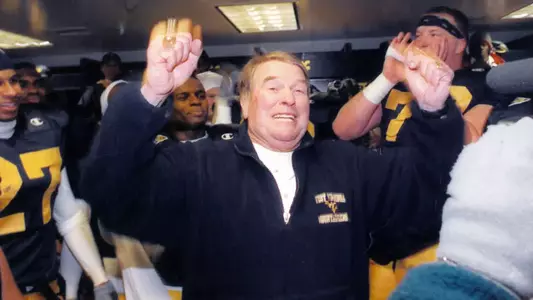
Photo by: WVU Athletic Communications
The Meaning of “Hail, West Virginia!”
August 18, 2025 11:30 AM | Football
MORGANTOWN, W.Va. – Late last week, Raquel Rodriguez of Mountaineer football's social media team, posted a video of the players learning the official school fight song, "Hail, West Virginia!" in the Milan Puskar Center team room.
Originally composed in 1915 by West Virginia alumnus Earl Miller and Ed McWhorter, with lyrics by Fred B. Deem, the chorus portion of "Hail, West Virginia!" is what is mostly remembered and sung:
It's West Virginia, it's West Virginia
The Pride of every Mountaineer
Come on, you old grads, join with us, young lads
It's West Virginia now we cheer (rah-rah-rah!)
Now is the time, boys, to make a big noise
No matter what the people say
For there is naught to fear, the gang's all here
So hail to West Virginia, hail!
The reference to "Crimson and Black" in the song lyrics represented West Virginia's primary football rival of the time, Washington & Jefferson, not the Pitt Panthers of today.
The singing of "Take Me Home, Country Roads" has become a well-known tradition after home football victories, and, of course, it involves the players and fans. It was first introduced by coach Rich Rodriguez during the 2002 season opener against Tennessee-Chattanooga.
But a much lesser-known tradition after all football victories is the players and coaches singing the school fight song in the locker room. It was a tradition coach Don Nehlen began here in 1980, and it was a product of the places he had played and coached during his Hall of Fame career.
At the time, Nehlen was looking for ways to boost team morale and establish a source of pride within his football program. West Virginia had endured consecutive losing seasons in 1976, 1977, 1978 and 1979, and the Mountaineers were just not in a very good place confidence-wise.
In fact, Nehlen was so preoccupied with wanting his players to experience any success that he once had legendary "Voice of the Mountaineers" Jack Fleming make a special recording of a "fictional" radio broadcast that was played to the team before the Rutgers game late in the season.
West Virginia had won four of its first five games and appeared headed toward breaking the streak of losing seasons until a four-game midseason slump saw its record slip to 4-5. A victory over Temple ended the skid, but Nehlen was worried about the team's remaining two games at Rutgers and a home to Syracuse.
Losing both would mean a fifth straight losing season for the Mountaineers.
To Nehlen, Rutgers was of particular concern because he was afraid his players might take them lightly. The Scarlet Knights were coached by a man named Frank Burns, who basically ran three plays – a run up the middle, a run around the end and a pass down the middle.
So, Nehlen had Fleming announce those three plays, with the final one being intercepted by defensive back Steve Newberry. As fate would have it, that's exactly what happened, and West Virginia went on to defeat the Scarlet Knights 24-15.
These were the types of things the always-positive Nehlen wanted his football players to experience, which included memorizing and singing the school fight song after all victories.
"When I went to play at Bowling Green, (coach) Doyt Perry did it," he recalled last weekend. "Then, when I went to Michigan, Bo Schembechler did it, so when I came to West Virginia, we were going to it."
The first part of winning, Nehlen correctly reasoned, is singing the fight song. When he first got here he had to learn it, and then he required everyone involved with the program to memorize it as well.
Copies of the lyrics to the chorus of "Hail, West Virginia!" were made and distributed to each member of the team, and during preseason training camp, the freshmen were required to get up in front of everyone and sing it.
Nehlen's two major requirements for his football players back then were learning the school fight song and listening to him tell the story about beating the Pitt Panther back down into the well.
It took them a few years before they were good enough to knock the Panther back down into the well, but once it happened in 1983, his players did it far more frequently than not for the remainder of his Mountaineer coaching career. Also, his teams began experiencing unprecedented success.
Of equal importance, Nehlen's tradition of singing the school fight song in the locker room after victories has continued with coaches Rich Rodriguez, Bill Stewart, Dana Holgorsen and Neal Brown, although it has taken on added significance now that Rodriguez has returned to sing it with his players.
Rodriguez was a Mountaineer player in the infancy of the tradition Nehlen began here some 45 years ago.
Today, it is Rodriguez's responsibility to teach the fight song to more than 70 new football players, which made up part of the video clip that we saw posted on football's official social media accounts last Friday afternoon.
Since it's posting, it has been viewed more than 100,000 times on all platforms and shared by many Mountaineer football players who truly understand the significance and meaning of "Hail, West Virginia!"
Among those viewing the clip was former linebacker Glenn Potter, who made this posting on X last weekend.
"After some big wins, I can remember singing the fight song so loud and hard (plus counting our point total) that I'd have a head rush/headache for a minute afterwards," he wrote. "(It was) very intense and a very rewarding acknowledgement of a week filled with high expectations."
And now you know the rest of the story!
Originally composed in 1915 by West Virginia alumnus Earl Miller and Ed McWhorter, with lyrics by Fred B. Deem, the chorus portion of "Hail, West Virginia!" is what is mostly remembered and sung:
It's West Virginia, it's West Virginia
The Pride of every Mountaineer
Come on, you old grads, join with us, young lads
It's West Virginia now we cheer (rah-rah-rah!)
Now is the time, boys, to make a big noise
No matter what the people say
For there is naught to fear, the gang's all here
So hail to West Virginia, hail!
The reference to "Crimson and Black" in the song lyrics represented West Virginia's primary football rival of the time, Washington & Jefferson, not the Pitt Panthers of today.
The singing of "Take Me Home, Country Roads" has become a well-known tradition after home football victories, and, of course, it involves the players and fans. It was first introduced by coach Rich Rodriguez during the 2002 season opener against Tennessee-Chattanooga.
But a much lesser-known tradition after all football victories is the players and coaches singing the school fight song in the locker room. It was a tradition coach Don Nehlen began here in 1980, and it was a product of the places he had played and coached during his Hall of Fame career.
At the time, Nehlen was looking for ways to boost team morale and establish a source of pride within his football program. West Virginia had endured consecutive losing seasons in 1976, 1977, 1978 and 1979, and the Mountaineers were just not in a very good place confidence-wise.
In fact, Nehlen was so preoccupied with wanting his players to experience any success that he once had legendary "Voice of the Mountaineers" Jack Fleming make a special recording of a "fictional" radio broadcast that was played to the team before the Rutgers game late in the season.
West Virginia had won four of its first five games and appeared headed toward breaking the streak of losing seasons until a four-game midseason slump saw its record slip to 4-5. A victory over Temple ended the skid, but Nehlen was worried about the team's remaining two games at Rutgers and a home to Syracuse.
Losing both would mean a fifth straight losing season for the Mountaineers.
To Nehlen, Rutgers was of particular concern because he was afraid his players might take them lightly. The Scarlet Knights were coached by a man named Frank Burns, who basically ran three plays – a run up the middle, a run around the end and a pass down the middle.
So, Nehlen had Fleming announce those three plays, with the final one being intercepted by defensive back Steve Newberry. As fate would have it, that's exactly what happened, and West Virginia went on to defeat the Scarlet Knights 24-15.
These were the types of things the always-positive Nehlen wanted his football players to experience, which included memorizing and singing the school fight song after all victories.
"When I went to play at Bowling Green, (coach) Doyt Perry did it," he recalled last weekend. "Then, when I went to Michigan, Bo Schembechler did it, so when I came to West Virginia, we were going to it."
The first part of winning, Nehlen correctly reasoned, is singing the fight song. When he first got here he had to learn it, and then he required everyone involved with the program to memorize it as well.
Copies of the lyrics to the chorus of "Hail, West Virginia!" were made and distributed to each member of the team, and during preseason training camp, the freshmen were required to get up in front of everyone and sing it.
Nehlen's two major requirements for his football players back then were learning the school fight song and listening to him tell the story about beating the Pitt Panther back down into the well.
It took them a few years before they were good enough to knock the Panther back down into the well, but once it happened in 1983, his players did it far more frequently than not for the remainder of his Mountaineer coaching career. Also, his teams began experiencing unprecedented success.
Of equal importance, Nehlen's tradition of singing the school fight song in the locker room after victories has continued with coaches Rich Rodriguez, Bill Stewart, Dana Holgorsen and Neal Brown, although it has taken on added significance now that Rodriguez has returned to sing it with his players.
Rodriguez was a Mountaineer player in the infancy of the tradition Nehlen began here some 45 years ago.
Today, it is Rodriguez's responsibility to teach the fight song to more than 70 new football players, which made up part of the video clip that we saw posted on football's official social media accounts last Friday afternoon.
"It's West Virginia, It's West Virginia" ?? pic.twitter.com/foOpobfBt3
— West Virginia Football (@WVUfootball) August 16, 2025
Since it's posting, it has been viewed more than 100,000 times on all platforms and shared by many Mountaineer football players who truly understand the significance and meaning of "Hail, West Virginia!"
Among those viewing the clip was former linebacker Glenn Potter, who made this posting on X last weekend.
"After some big wins, I can remember singing the fight song so loud and hard (plus counting our point total) that I'd have a head rush/headache for a minute afterwards," he wrote. "(It was) very intense and a very rewarding acknowledgement of a week filled with high expectations."
And now you know the rest of the story!



Gold-Blue Spring Festival Fan Recap
Sunday, April 19
John Neider | April 18
Saturday, April 18
Coach Zac Alley | April 18
Saturday, April 18
Coach Rich Rodriguez | April 18
Saturday, April 18