Photo by: WVU Athletic Communications
Curt Cignetti’s No. 1 Influence Has Always Been His Father, Frank Cignetti
January 20, 2026 09:56 AM | Football
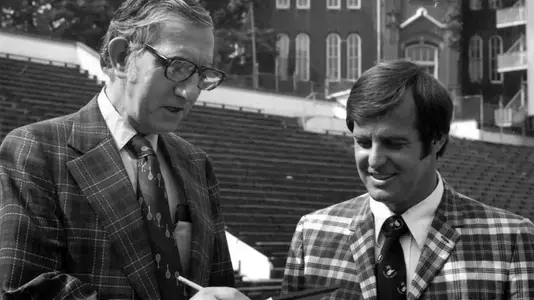
MORGANTOWN, W.Va. – This is a story about Frank Cignetti, the father of former Morgantown High and West Virginia University quarterback Curt Cignetti, whose Indiana football team defied great odds to win last night's national championship game over Miami.
Frank Cignetti was West Virginia's football coach from 1976-79 whose tenure here has been mostly defined by his 17-27 record.
Whenever a Mountaineer football team is struggling these days, those Cignetti squads of 1976, 1977, 1978 and 1979 are usually recalled by anyone old enough to remember them.
"You are what your record says you are," Bill Parcells once said, but, sadly, your record doesn't always tell the full story.
The headwinds Frank Cignetti faced at West Virginia University in the mid-to-late 1970s following Bobby Bowden's abrupt departure to Florida State would have been difficult for any coach to navigate - even the great Nick Saban, who actually spent two years working for Frank at WVU in 1978-79.
When Cignetti took over for Bowden in January of 1976, West Virginia was lacking in three key areas – funding, facilities and most importantly, personnel.
The 1975 team that defeated N.C. State in the Peach Bowl was dominated by seniors, requiring Cignetti to start over from scratch. The football stadium on the downtown campus was in disrepair and needed replaced – not an easy lift for a university dealing with budgetary and enrollment issues in a state besieged by high unemployment as a result of a crippled coal mining industry.
Local rival Penn State was considered a college football superpower during that period of time and dominated Eastern recruiting. West Virginia's most bitter rival, Pitt, was also enjoying its best run of success since the Jock Sutherland days of the 1930s.
And on a regional level, Maryland and Kentucky were operating solid programs, not to mention Ohio State, Michigan and Notre Dame always being just close enough to swoop in and steal good prospects whenever they wanted.
West Virginia, not an Eastern school, not a Southern school and not a Midwestern school, was surrounded by all of them.
Therefore, when Cignetti took the WVU job, he was already operating from behind the eight-ball.
At the time, one of the few advantages that Cignetti's predecessors Jim Carlen and Bobby Bowden had over their regional rivals was a sliding-scale enrollment policy that enabled them to get good football players into school with lower test scores than their competitors.
That's how West Virginia was able to pry Dale Farley and Marshall Mills, two big-time prep prospects out of Tennessee, away from the Volunteers, and that's how it was able to sign sprint champion Danny Buggs out of Atlanta and Parade All-American offensive tackle John "Tree" Adams out of Bethesda, Maryland.
Top Pennsylvania running back prospect Artie Owens also fell into this category.
Some of the talented players Carlen and Bowden were bringing to West Virginia this way even forced pious Joe Paterno to reconsider his "Grand Experiment" and led to him asking and receiving some presidential exceptions to Penn State's more stringent admittance policies. It's one thing to produce educated, well-rounded young men, but never at the expense of winning football games!
But that one big advantage WVU had over its primary rivals went away the year Cignetti took the Mountaineer job in 1976 when the NCAA regulated its academic standards.
On a bigger scale, Cignetti's behind-the-scenes role in getting the new football stadium constructed in 1980 has never fully been appreciated. He had to walk a fine line between those wanting to remodel and expand old Mountaineer Field and those wanting to build a new stadium in another part of town.
Those favoring a refurbished stadium were mostly downtown business owners who benefited from the foot traffic they received on football weekends. They felt losing that could put them in economic peril.
Cignetti's boss, Dr. Leland Byrd, was among those supporting a remodeled and expanded Mountaineer Field.
But the politicians in Charleston, tired of the long drives to Morgantown and the even longer time it took finding a decent place to park on the downtown campus near the stadium, wanted it built in another part of town with plenty of room for parking.
Cignetti, too, understood the importance of getting the stadium built off campus for future university expansion and played a key role in getting this accomplished.
During his first two years at WVU, Cignetti experienced some recruiting successes, including the signing of the nation's No. 1-ranked recruit, Robert Alexander, out of South Charleston High, but a disastrous season in 1978 that saw his team win just two games put everything on shaky ground.
Then, in the midst of this, Cignetti was diagnosed with a rare form of cancer that nearly killed him. At the time, the mortality rate for the type of cancer he had was nearly 100%, which meant his survival was a modern medical miracle.
For the two months he was bedridden, Cignetti was forced to leave most of the recruiting to his assistant coaches, and one of them bungled the recruitment of Pineville star running back Curt Warner beyond repair.
Would Warner have considered West Virginia more seriously had Cignetti been healthy enough to have a more personal relationship with him?
Who knows?
But losing the in-state star to Penn State on top of a disastrous season on top of Cignetti's poor health on top of a crumbling football stadium put Mountaineer football in an untenable situation.
By 1979, it would have taken an even greater miracle for Cignetti to keep his job.
And despite these things, Frank chose to stay the course and continued to rebuild the program by playing younger players.
When he was eventually fired following a season-ending 42-7 defeat at Arizona State, West Virginia's starting lineup against the Sun Devils was littered with freshmen and sophomores.
So, not only did Frank Cignetti hand his successor, Don Nehlen, the keys to a new football stadium, but he also left many young and talented football players who just needed a little more seasoning and someone with the enthusiasm and energy to get the most out of them.
In fact, one of those youngsters happened to be the best football player that Nehlen ever coached at West Virginia University – Hall of Fame linebacker Darryl Talley.
Frank Cignetti never got to enjoy the fruits of his labor at West Virginia because he ran out of time, not because he was a poor football coach.
He proved his mastery of coaching years later with the success he enjoyed at Indiana University of Pennsylvania that led to him being inducted into the College Football Hall of Fame in 2013.
The easy story today is to marry Curt Cignetti's success at Indiana with the four years he spent working for Nick Saban at Alabama.
Certainly, being on Nick Saban's coaching tree can open a lot of doors, but the No. 1 football influence in Curt's life has always been his father.
You can hear Frank Cignetti whenever you listen to Curt doing interviews - the same rhythm and tempo, the same phrasing and many of the same words – with the exception of "Google me, I win!"
His father would have never said anything like that.
And now you know the rest of the story!
Frank Cignetti was West Virginia's football coach from 1976-79 whose tenure here has been mostly defined by his 17-27 record.
Whenever a Mountaineer football team is struggling these days, those Cignetti squads of 1976, 1977, 1978 and 1979 are usually recalled by anyone old enough to remember them.
"You are what your record says you are," Bill Parcells once said, but, sadly, your record doesn't always tell the full story.
The headwinds Frank Cignetti faced at West Virginia University in the mid-to-late 1970s following Bobby Bowden's abrupt departure to Florida State would have been difficult for any coach to navigate - even the great Nick Saban, who actually spent two years working for Frank at WVU in 1978-79.
When Cignetti took over for Bowden in January of 1976, West Virginia was lacking in three key areas – funding, facilities and most importantly, personnel.
The 1975 team that defeated N.C. State in the Peach Bowl was dominated by seniors, requiring Cignetti to start over from scratch. The football stadium on the downtown campus was in disrepair and needed replaced – not an easy lift for a university dealing with budgetary and enrollment issues in a state besieged by high unemployment as a result of a crippled coal mining industry.
Local rival Penn State was considered a college football superpower during that period of time and dominated Eastern recruiting. West Virginia's most bitter rival, Pitt, was also enjoying its best run of success since the Jock Sutherland days of the 1930s.
And on a regional level, Maryland and Kentucky were operating solid programs, not to mention Ohio State, Michigan and Notre Dame always being just close enough to swoop in and steal good prospects whenever they wanted.
West Virginia, not an Eastern school, not a Southern school and not a Midwestern school, was surrounded by all of them.
Therefore, when Cignetti took the WVU job, he was already operating from behind the eight-ball.
At the time, one of the few advantages that Cignetti's predecessors Jim Carlen and Bobby Bowden had over their regional rivals was a sliding-scale enrollment policy that enabled them to get good football players into school with lower test scores than their competitors.
That's how West Virginia was able to pry Dale Farley and Marshall Mills, two big-time prep prospects out of Tennessee, away from the Volunteers, and that's how it was able to sign sprint champion Danny Buggs out of Atlanta and Parade All-American offensive tackle John "Tree" Adams out of Bethesda, Maryland.
Top Pennsylvania running back prospect Artie Owens also fell into this category.
Some of the talented players Carlen and Bowden were bringing to West Virginia this way even forced pious Joe Paterno to reconsider his "Grand Experiment" and led to him asking and receiving some presidential exceptions to Penn State's more stringent admittance policies. It's one thing to produce educated, well-rounded young men, but never at the expense of winning football games!
But that one big advantage WVU had over its primary rivals went away the year Cignetti took the Mountaineer job in 1976 when the NCAA regulated its academic standards.
On a bigger scale, Cignetti's behind-the-scenes role in getting the new football stadium constructed in 1980 has never fully been appreciated. He had to walk a fine line between those wanting to remodel and expand old Mountaineer Field and those wanting to build a new stadium in another part of town.
Those favoring a refurbished stadium were mostly downtown business owners who benefited from the foot traffic they received on football weekends. They felt losing that could put them in economic peril.
Cignetti's boss, Dr. Leland Byrd, was among those supporting a remodeled and expanded Mountaineer Field.
But the politicians in Charleston, tired of the long drives to Morgantown and the even longer time it took finding a decent place to park on the downtown campus near the stadium, wanted it built in another part of town with plenty of room for parking.
Cignetti, too, understood the importance of getting the stadium built off campus for future university expansion and played a key role in getting this accomplished.
During his first two years at WVU, Cignetti experienced some recruiting successes, including the signing of the nation's No. 1-ranked recruit, Robert Alexander, out of South Charleston High, but a disastrous season in 1978 that saw his team win just two games put everything on shaky ground.
Then, in the midst of this, Cignetti was diagnosed with a rare form of cancer that nearly killed him. At the time, the mortality rate for the type of cancer he had was nearly 100%, which meant his survival was a modern medical miracle.
For the two months he was bedridden, Cignetti was forced to leave most of the recruiting to his assistant coaches, and one of them bungled the recruitment of Pineville star running back Curt Warner beyond repair.
Would Warner have considered West Virginia more seriously had Cignetti been healthy enough to have a more personal relationship with him?
Who knows?
But losing the in-state star to Penn State on top of a disastrous season on top of Cignetti's poor health on top of a crumbling football stadium put Mountaineer football in an untenable situation.
By 1979, it would have taken an even greater miracle for Cignetti to keep his job.
And despite these things, Frank chose to stay the course and continued to rebuild the program by playing younger players.
When he was eventually fired following a season-ending 42-7 defeat at Arizona State, West Virginia's starting lineup against the Sun Devils was littered with freshmen and sophomores.
So, not only did Frank Cignetti hand his successor, Don Nehlen, the keys to a new football stadium, but he also left many young and talented football players who just needed a little more seasoning and someone with the enthusiasm and energy to get the most out of them.
In fact, one of those youngsters happened to be the best football player that Nehlen ever coached at West Virginia University – Hall of Fame linebacker Darryl Talley.
Frank Cignetti never got to enjoy the fruits of his labor at West Virginia because he ran out of time, not because he was a poor football coach.
He proved his mastery of coaching years later with the success he enjoyed at Indiana University of Pennsylvania that led to him being inducted into the College Football Hall of Fame in 2013.
The easy story today is to marry Curt Cignetti's success at Indiana with the four years he spent working for Nick Saban at Alabama.
Certainly, being on Nick Saban's coaching tree can open a lot of doors, but the No. 1 football influence in Curt's life has always been his father.
You can hear Frank Cignetti whenever you listen to Curt doing interviews - the same rhythm and tempo, the same phrasing and many of the same words – with the exception of "Google me, I win!"
His father would have never said anything like that.
And now you know the rest of the story!
Thursday, October 15
Wednesday, October 14
Tuesday, October 13
Tuesday, October 13