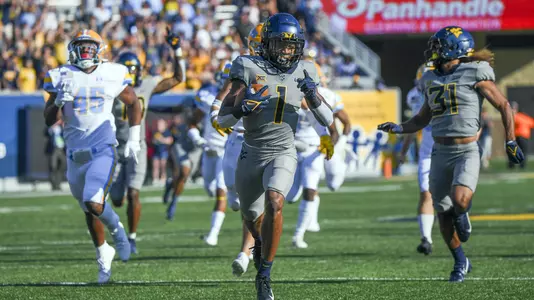
Photo by: All Pro Photography/Dale Sparks
Wright Jr. Weaponizing Kickoff Returns for the Mountaineers
September 13, 2021 02:00 PM | Football, Blog
MORGANTOWN, W.Va. – Winston Wright Jr. is quickly putting his name among some of the most explosive kickoff returners in WVU history - great players such as Mario Alford, Shelton Gibson, Tavon Austin, Shawn and Nate Terry, Adam "Pacman" Jones, Willie Drewrey, Artie Owens and Kerry Marbury.
Some were tall and lean, such as the Terry brothers and Gibson, while others were smallish and shifty like Austin, Drewrey, Owens and Marbury.
As for Wright Jr., he certainly falls into the latter category.
"He has been a difference maker for us," West Virginia coach Neal Brown said after last Saturday's 66-0 victory over Long Island.
Wright demonstrated his kickoff return potential two years ago at Baylor by returning one 95 yards for a touchdown, and two weeks ago at Maryland, he brought back five for a school-record 217 yards.
And if Isaiah Esdale had been more alert - or if Maryland's video board was just a little bit bigger - Esdale would have been able to wall off a hustling Deonte Banks, who managed to haul down Wright at the Maryland 2. So, instead of a 100-yard touchdown Wright had to settle for a 98-yard return. Later in the game, Wright brought one back 48 yards to midfield, which helped put the Mountaineers in position for an opportunity to retake the lead.
Then last Saturday against Long Island, Wright took the game's opening kickoff on a dead run at the 10 and brought it back 90 yards for a touchdown, putting him in a select group of just five WVU players who have returned multiple kickoffs for touchdowns.
The others are Shawn Terry and Tavon Austin (four each), Nate Terry (three) and Mario Alford (two).
Incidentally, former West Virginia assistant coach Tyron Carrier is recognized as having the most kickoff returns for touchdowns in college football with seven while playing for Houston from 2008-11. NCAA kickoff return statistics only date back to 1976.
What all of these great kickoff returners have in common is it didn't take them long to get to where they were going, and they did so by heading in one direction – straight ahead!
"There is a knack to it," Brown said of being a kickoff return threat. "You have to have a certain amount of patience. You don't want to rush it. You can't get right up in the back of your blockers, but at the same time, you know you have to hit it with speed because you don't have enough people to block them."
Marbury's 100-yard kickoff return to open the 1972 Penn State game happened that way, as did Drewrey's 93-yard return right up the middle of the field that flipped the 1984 Syracuse game.
If Pacman Jones doesn't bring back a fourth-quarter kickoff, or make his 49-yard pick six, West Virginia doesn't win at Boston College in 2003.
You've got lots to choose from among the Terry brothers' biggest returns. Nate's 100-yard kickoff return late in the third quarter was the difference in West Virginia's 24-17 victory over East Carolina in 1997, and Shawn's bring-back to begin the third quarter put a nail in Ole Miss' coffin in the 2000 Music City Bowl.
Shawn had two other kickoff returns for touchdowns during the 2000 season, against Syracuse and Pitt, and he also brought one back against Maryland in 2001.
Three of Tavon's four kickoff returns for touchdowns contributed to West Virginia victories against Connecticut in 2009, and against Marshall and USF in 2011.
Not only did their returns impact games, they also heavily influenced preparation leading into them. This week, Virginia Tech is going to have to spend a significant amount of time in practice working on its kickoff coverage units based on what Wright has done in West Virginia's two games so far this year.
Having a 51.2 yards-per-return average is certainly worth noting!
"The thing (Wright) has done in the kickoff return game is that he has not stopped his feet," Brown noted. "If you look at the great returners, they never stop their feet and he hasn't stopped his feet; every move he's made has been forward. I know it felt good for him to finally take it to the house."
 Again, actually!
In that respect, it's no different than the time down in Blacksburg in 2000 when Andre Davis' 76-yard punt return for a touchdown in the third quarter flipped the game completely in Virginia Tech's favor.
The Hokies went on to win 48-20.
I couldn't locate any analytical data for college games, but consider this NFL stat posted a decade ago on the website Pro Football Reference.com: Between 1978 and 2008, teams that returned a kickoff for a touchdown won 52% of the time. The winning percentage increased to 69% for punt returns, which demonstrates the value touchdown returns can have on the outcome of football games.
The numbers are somewhat similar throughout WVU's history. West Virginia's winning percentage when it returns a kickoff for a touchdown is 56%, but when it comes to punt returns for scores, the number increases dramatically to 85.7%.
I know Wright Jr. muffed his one punt return attempt at Maryland two weeks ago, but based on those figures, perhaps Neal Brown might want to reconsider putting Winston back out there for punts as well.
Nevertheless, the return game is a weapon that can make a big difference when all other areas are equal, which is why West Virginia spends so much time working on it and emphasizing it during practice.
Some were tall and lean, such as the Terry brothers and Gibson, while others were smallish and shifty like Austin, Drewrey, Owens and Marbury.
As for Wright Jr., he certainly falls into the latter category.
"He has been a difference maker for us," West Virginia coach Neal Brown said after last Saturday's 66-0 victory over Long Island.
Wright demonstrated his kickoff return potential two years ago at Baylor by returning one 95 yards for a touchdown, and two weeks ago at Maryland, he brought back five for a school-record 217 yards.
And if Isaiah Esdale had been more alert - or if Maryland's video board was just a little bit bigger - Esdale would have been able to wall off a hustling Deonte Banks, who managed to haul down Wright at the Maryland 2. So, instead of a 100-yard touchdown Wright had to settle for a 98-yard return. Later in the game, Wright brought one back 48 yards to midfield, which helped put the Mountaineers in position for an opportunity to retake the lead.
Then last Saturday against Long Island, Wright took the game's opening kickoff on a dead run at the 10 and brought it back 90 yards for a touchdown, putting him in a select group of just five WVU players who have returned multiple kickoffs for touchdowns.
The others are Shawn Terry and Tavon Austin (four each), Nate Terry (three) and Mario Alford (two).
Incidentally, former West Virginia assistant coach Tyron Carrier is recognized as having the most kickoff returns for touchdowns in college football with seven while playing for Houston from 2008-11. NCAA kickoff return statistics only date back to 1976.
What all of these great kickoff returners have in common is it didn't take them long to get to where they were going, and they did so by heading in one direction – straight ahead!
"There is a knack to it," Brown said of being a kickoff return threat. "You have to have a certain amount of patience. You don't want to rush it. You can't get right up in the back of your blockers, but at the same time, you know you have to hit it with speed because you don't have enough people to block them."
Marbury's 100-yard kickoff return to open the 1972 Penn State game happened that way, as did Drewrey's 93-yard return right up the middle of the field that flipped the 1984 Syracuse game.
If Pacman Jones doesn't bring back a fourth-quarter kickoff, or make his 49-yard pick six, West Virginia doesn't win at Boston College in 2003.
You've got lots to choose from among the Terry brothers' biggest returns. Nate's 100-yard kickoff return late in the third quarter was the difference in West Virginia's 24-17 victory over East Carolina in 1997, and Shawn's bring-back to begin the third quarter put a nail in Ole Miss' coffin in the 2000 Music City Bowl.
Shawn had two other kickoff returns for touchdowns during the 2000 season, against Syracuse and Pitt, and he also brought one back against Maryland in 2001.
Three of Tavon's four kickoff returns for touchdowns contributed to West Virginia victories against Connecticut in 2009, and against Marshall and USF in 2011.
Not only did their returns impact games, they also heavily influenced preparation leading into them. This week, Virginia Tech is going to have to spend a significant amount of time in practice working on its kickoff coverage units based on what Wright has done in West Virginia's two games so far this year.
Having a 51.2 yards-per-return average is certainly worth noting!
"The thing (Wright) has done in the kickoff return game is that he has not stopped his feet," Brown noted. "If you look at the great returners, they never stop their feet and he hasn't stopped his feet; every move he's made has been forward. I know it felt good for him to finally take it to the house."
Again, actually!In that respect, it's no different than the time down in Blacksburg in 2000 when Andre Davis' 76-yard punt return for a touchdown in the third quarter flipped the game completely in Virginia Tech's favor.
The Hokies went on to win 48-20.
I couldn't locate any analytical data for college games, but consider this NFL stat posted a decade ago on the website Pro Football Reference.com: Between 1978 and 2008, teams that returned a kickoff for a touchdown won 52% of the time. The winning percentage increased to 69% for punt returns, which demonstrates the value touchdown returns can have on the outcome of football games.
The numbers are somewhat similar throughout WVU's history. West Virginia's winning percentage when it returns a kickoff for a touchdown is 56%, but when it comes to punt returns for scores, the number increases dramatically to 85.7%.
I know Wright Jr. muffed his one punt return attempt at Maryland two weeks ago, but based on those figures, perhaps Neal Brown might want to reconsider putting Winston back out there for punts as well.
Nevertheless, the return game is a weapon that can make a big difference when all other areas are equal, which is why West Virginia spends so much time working on it and emphasizing it during practice.


Rich Rodriguez | Dec. 3
Wednesday, December 03
Reid Carrico | Nov. 29
Saturday, November 29
Jeff Weimer | Nov. 29
Saturday, November 29
Rich Rodriguez | Nov. 29
Saturday, November 29