WVU Football Innovators – Rich Rodriguez and Jeff Casteel
August 30, 2020 09:00 AM | Football, Blog
MORGANTOWN, W.Va. – Long before his tumultuous departure from West Virginia University, which alone generated several manila file folders full of news clippings, Marion County’s Rich Rodriguez was considered one of the most innovative coaches in college football.
His unique no-huddle, spread offense, born out of Mouse Davis’ Run and Shoot, had transformed tiny Glenville State into an NAIA power in the mid-1990s.
The spread was a product of necessity for Rodriguez because the Glenville program he inherited in 1990 was downright awful. Each year, Rodriguez tinkered with his offense by introducing new plays, formations, terms, signals … you name it.
If his tight end got hurt, Rich Rod would just put another wide receiver into the game and not miss a beat. He ran the dive option, the speed option, the mid-line option or anything else he could think of to move the ball.
And his Glenville teams threw the football – a lot.
“They were a throwing team back then,” Jeff Casteel recalled last month. Casteel used to match wits against Rodriguez’ Glenville teams when he was Shepherd’s defensive coordinator.
Sometime in the 1990s, Rodriguez got hooked up with the Bowden family through the Bowden Academy and that eventually resulted in him getting a job as Tommy Bowden’s offensive coordinator at Tulane in 1997.
Two successful seasons at Tulane led Bowden and Rodriguez to Clemson, where Rodriguez’ Tiger offenses rewrote the ACC record books and gave his unique spread offense a national platform. In the meantime, Rodriguez’ offense transformed from being predominantly pass at Glenville to a 50-50 pass-run split by the end of his Clemson tenure.
“I think he saw the advantages he could get in the running game,” Casteel postulated. “Football is still a game of if you can run the ball it will give you a great chance to win.”
At the turn of this century, Rodriguez’ immense success at Clemson had him set up for a Division I head coaching job.
It looked like it was going to be at Texas Tech, but he eventually declined the Red Raiders’ offer to take a chance and wait on the West Virginia job, which ultimately opened up when Don Nehlen announced he was retiring late in the 2000 season.
“I think he saw the advantages he could get in the running game. Football is still a game of if you can run the ball it will give you a great chance to win.-- Jeff Casteel
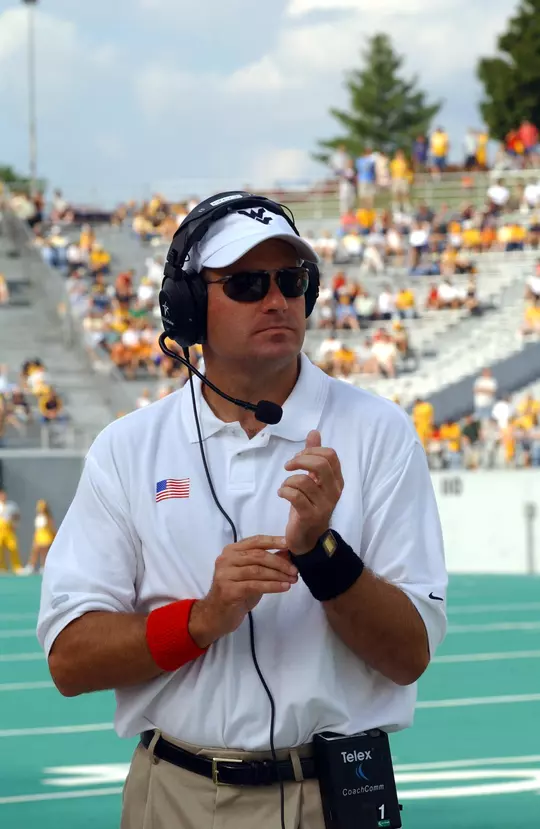
Once the regular season was finished, Rodriguez returned to his alma mater and hired Casteel to be a part of a WVU defensive staff that was led by Phil Elmassian, a coaching veteran who seemingly changed jobs just about every other year.
Speaking of changes, the alterations Rodriguez introduced to West Virginia football were swift and dramatic.
He wanted to play fast with fast guys. It was sort of football’s version of a blitzkrieg attack.
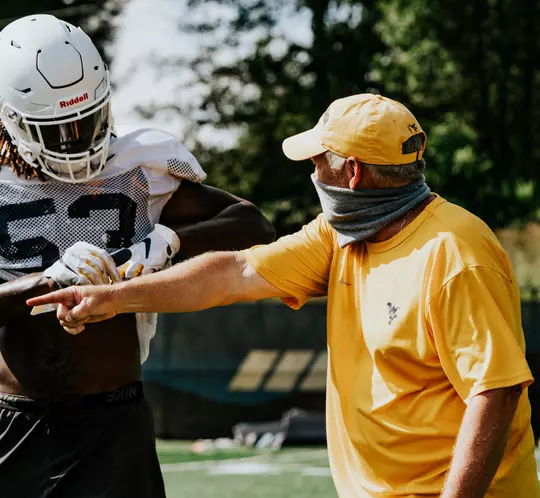
“First of all, the tempo and the speed in which they did things they would force defenses to get lined up and then they could have a chance to see what the defense looked like up in the booth and either run the play or check it,” Casteel recalled. “With the speed of it and their tempo, hurrying up and getting to the line of scrimmage before the defense could get lined up, that was all pretty much new. Back in the day, everyone was pretty much in a huddle and Rich was ahead of the curve with those things.”
It took Rodriguez a year at West Virginia to fully get things sorted out on offense and another year to get the right people in place to run the defense he wanted to complement his high-speed offense.
That meant Elmassian was out, and Casteel and the ambitious Todd Graham were in as co-defensive coordinators. Graham stuck around until the end of the 2002 season before returning to his native Southwest to coach at Tulsa, leaving Casteel solely in charge of the defense Rodriguez wanted to use at WVU.
Casteel had to learn a version of the unorthodox odd-stack defense that Joe Lee Dunn used to run at Mississippi State that gave Rodriguez great fits when he was at Clemson - and he wasn’t too enthusiastic about it.
Casteel was an even-front guy, and he wanted to use a version of the 3-4 defense that Dick LeBeau was using with the Pittsburgh Steelers. He had developed a good relationship with LeBeau’s staff and it was an easy drive for him to get to Pittsburgh to pick LeBeau’s brain on the 3-4.
The odd-stack could just be a sub package out of the 3-4, Casteel argued.
“My thoughts were why don’t we base out of a 3-4 and because the Steelers being right up the road would be a big help to us,” he explained. “We would go visit them every year and Dick LeBeau had a pretty good handle on the 3-4. That was my suggestion.”
But Rodriguez wasn’t swayed. He wanted to go full bore with the odd-stack just as he had gone full bore with the no-huddle, spread. He could sense college football was changing to more of an open-space game requiring more athletes on the field.
And he wanted his defense to reflect that as well.
That meant Casteel and his defensive assistants had to learn something completely new from scratch, and they didn’t have a whole bunch of people to talk to about it. Dean Hood was running a version of it at Wake Forest as was Charlie Strong at South Carolina, and perhaps a couple of others, but that was it.
“Those first couple of years, especially, we were not sure what was going to happen and were not sure we had all of the answers to it,” Casteel admitted.
Casteel’s solution was to construct his version of the odd-stack off of the four-down principles with which he was more familiar.
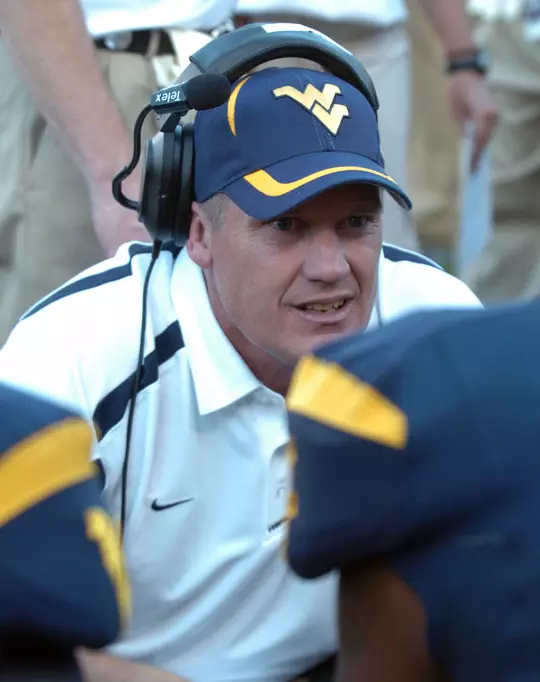
That gave West Virginia’s odd-stack a little more versatility and flexibility.
“Our background was an even front so we tried to build it with even-front principles and tried to take a second-level guy and introduce him into the front to play an over or under front, a Bear look or whatever,” Casteel noted. “At that time, that posed some problems for people.”
Even though the stack was a three-safety defense, Casteel chose to do most of his tweaking with the linebackers – the position group he coached.
That enabled him to make Will linebacker Grant Wiley the focal point of the defense during the early years of the stack, and then years later when he was at Arizona, he highlighted middle linebacker Scooby Wright.
Both turned out to be tremendous college football players.
Linebacker Jay Henry was another important player in Casteel’s scheme because he was intelligent enough to think on his feet and get his teammates lined up properly.
Again, even though the unique characteristic of the stack were those three safeties moving around all over the place, each with vitally important roles, it was the linebackers who were required to make those unorthodox run fits work.
Casteel explains.
“We tried to do some things, ‘backer wise, that wouldn’t affect some of the other kids,” he said. “They could play simple techniques, and we could change the way (the linebackers) fit things and have the linebackers make calls among each other that could change the way people would have to block us.
“We could communicate a front and coverage really quick, but I could also change it from series to series with the linebackers from the sideline,” he continued. “I’d say, ‘Hey, on this series if you get the back away let’s play this’ and so they could gap exchange things off of a call and for everybody else it was still the same.”
Casteel’s twist to the odd-stack really set West Virginia apart from other college programs in the mid-2000s, just as the no-huddle spread gave the Mountaineer offense a big boost.
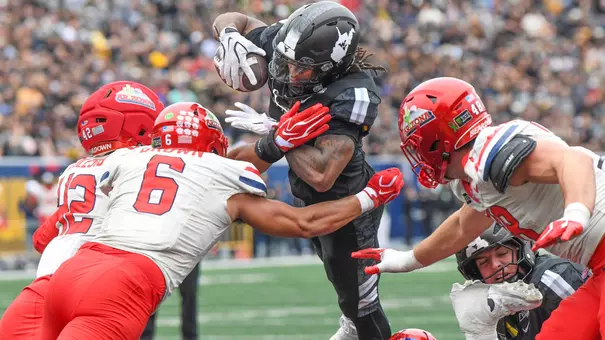
Rodriguez also tweaked his attack to emphasize more the run game at West Virginia once he got athletic quarterback Pat White and paired him with running backs Steve Slaton, Noel Devine and Owen Schmitt.
Together, they put unbelievable stress on defenses.
“They get a step or two on you and you don’t get lined up, or your angles are bad, and Pat White, Stevie Slaton or Noel Devine are putting a big play on you,” Casteel said.
“In reality, the zone-read and all of those things are offsets of option football,” he continued. “Instead of having the wishbone or three backs in there they just spread people out, and instead of having a guy go out of the backfield and have to block a guy, they could block a guy by running a bubble screen.”
In lay terms, that meant if the defender doesn’t cover the bubble screen throw the ball to him. And if he does, then White could either take off and run the ball (oftentimes for a touchdown) or throw it to a wide receiver releasing down the field.
This one play put defenders in constant conflict.
“He really couldn’t be right,” Casteel admitted. “That’s where they made you defend the width and the length of the field. That’s why it put so much stress on defenses.”
They get a step or two on you and you don’t get lined up, or your angles are bad, and Pat White, Stevie Slaton or Noel Devine are putting a big play on you.-- Jeff Casteel
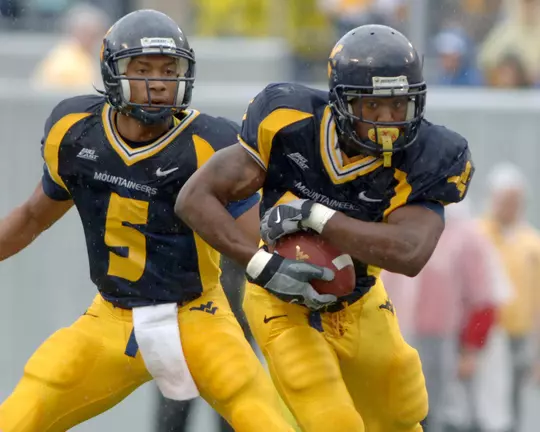
By the mid-2000s, Rodriguez’ cutting-edge style had turned West Virginia into a Top 10 football program. The Mountaineers stunned Georgia in the 2006 Sugar Bowl, made a second-half comeback to defeat Georgia Tech in the 2007 Gator Bowl and was on the cusp of earning a berth into the national championship game in 2007.
It was also around this time when Casteel finally felt like his staff had a firm handle on the odd-stack defense.
“That’s probably when we started understanding it a little bit more and being a little bit more diverse with it,” he said. “Our kids had been in the thing and they knew what to do.”
These two unique schemes also made it easier for Rodriguez to recruit at West Virginia. Both didn’t require massive players on either side of the ball, which are the most difficult players to recruit.
“With that style of offense, you didn’t have to have the big, huge offensive lineman, and it was easier for us to go get kids that maybe were an inch or two shorter or 20, 30 pounds lighter,” Casteel said. “Those kids could still have success doing that.”
It worked the same way on defense.
“We could recruit ‘tweener guys and not have to go get the big defensive linemen that you need, and we could highlight some of our speed,” Casteel added. “That went hand-in-hand with what Rich wanted to do offensively. We tried to get as much speed on the field as we could defensively, the same as Rich was trying to do offensively.”
It was a brilliant strategy that led to one of the most successful periods in West Virginia football history, resulting in a 33-5 record over a three-year span in the mid-2000s and success that spilled over into the next decade.
Rich Rodriguez had provided a template in the 1990s and early 2000s that many other successful coaches copied, including Urban Meyer at Florida and Ohio State.
And, many offshoots of Rodriguez’ no-huddle, spread are still around today.
The odd-stack is no different. Watch any college game now and count the number of safeties and hybrid linebackers you see running around out there.
College football changed dramatically 20-some years ago, and Rich Rodriguez and Jeff Casteel were clearly at the forefront of that change.
As a result, Mountaineer football was an obvious beneficiary of their cutting-edge tactics.
This concludes our four-part series on WVU football innovators.