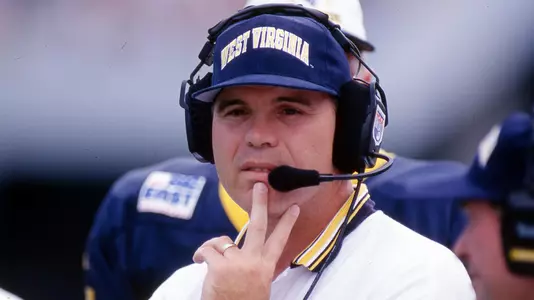
Photo by: WVU Athletic Communications
Former Standout Legg Pleased to be Back at WVU
June 20, 2020 10:00 AM | Football, Blog
MORGANTOWN, W.Va. – They don't make 'em any more Gold and Blue than Billy Legg.
Earlier this spring, Legg returned to his alma mater when he was appointed assistant to head coach Neal Brown. It marks Legg's third different role on the West Virginia football staff after his outstanding Mountaineer career ended in 1984 in Houston against TCU in the Bluebonnet Bowl.
Legg served six seasons as Don Nehlen's interior offensive line coach, taking over the position held for years by Mike Jacobs, and he also coordinated the offense during Nehlen's final year working the Mountaineer sidelines in 2000.
He also spent three seasons on Nehlen's staff in the mid-1980s as a graduate assistant coach.
The Poca, West Virginia, native also happened to be Nehlen's first-ever West Virginia recruit soon after he took over the WVU job in 1979.
"I think a lot of people say I was Don Nehlen's first recruit because I was the first player he visited," Legg recalled recently. "I have no idea when anybody else committed or didn't commit or whatever the case may be.
"Recruiting was a lot different back then. You didn't get started recruiting until the fall of your senior year. Then, you found out who was really recruiting you and who wasn't," Legg noted.
When Nehlen was hired it became immediately obvious to him that the biggest thing the WVU football program lacked was big, physical linemen.
The Mountaineers had plenty of running backs and wide receivers, plenty of defensive backs and linebackers, but not enough big guys up front.
That's why the first thing he did after he became head coach was to hop into a car with Donnie Young to head down to Poca to try and convince Legg to become a Mountaineer.
 But just because Legg was from West Virginia didn't make it a guarantee he was going to be a West Virginia Mountaineer.
"Coach (Frank) Cignetti was the head coach when I was in high school and Coach Cignetti was having a lot of health issues," Legg recalled. "I loved West Virginia, being from West Virginia, but at the time, West Virginia was the last place I was thinking of going because of all of the circumstances."
Those circumstances included playing in an old, dilapidated football stadium for a coach who was about to lose his job.
Then, Nehlen arrived and immediately a ray of light shined on West Virginia football.
"At the time, I was not even aware that they were building a new stadium, and the first I heard about it was when Coach Nehlen took over the job in December, and then came and visited me," Legg said. "He started selling the program, so that kind of inflamed my interest."
Legg's No. 1 choice was South Carolina where former West Virginia coach Jim Carlen was turning around the Gamecock program with Heisman Trophy winner George Rogers.
Carlen also had a couple of West Virginians on his coaching staff.
"With the help of my family, I drew a radius around Charleston and all of the schools I was interested in was within a half-day's drive, the exception being South Carolina," Legg said. "I loved (assistant coach) Dale Evans when he was recruiting me."
In the end, Legg picked West Virginia and became part of the group of players in 1980 who helped turned Mountaineer football into what we've come to know and love today - developmental guys such as Tim Agee, Jeff Deem, Steve Hathaway, Rich Hollins, Ed Hughes, Kurt Kehl, Steve Newberry, Dave Preston and Rich Walters.
All of them, including Legg, turned into rock-solid major college football players.
"Coach did a great job setting the culture, that was the No. 1 thing he did," Legg explained. "When he came in we had the mentality that we were going to become the strongest team in the country. Of course, after one offseason that wasn't going to happen but the guys bought into that.
"When I came in as a true freshman the older guys had bought in and were working really hard and that transferred down to the younger guys and it built from there," he said.
And build they did.
After a 6-6 season in 1980 that snapped West Virginia's four-year streak of losing seasons, the Mountaineers won nine games the next as Legg worked his way into the lineup as the team's starting center.
He was on the field for the Mountaineers' great Peach Bowl victory over Florida that really jumpstarted the program, and he was also on the field in Norman, Oklahoma, nine months later when West Virginia fired its biggest warning shot across Pitt's and Penn State's bows.
That nine-month span of victories over Florida and Oklahoma between 1981 and 1982 is really the birth of modern-day Mountaineer football.
"I can remember everybody putting a blue dot on their (Peach Bowl) watches so that every time we looked at our watches that offseason we took five seconds to visualize ourselves making a great play against Oklahoma," Legg said.
What Nehlen laid out for his team before the Oklahoma game was a script that ended up turning into reality.
At that moment, Don Nehlen's believers turned into disciples.
"He said, 'It's going to take a while to get used to their speed. There's a good chance we're going to fall behind, but if we stay the course, our defense will get accustomed to their speed' and it almost played out exactly the way he said it would," Legg recalled. "We fell behind early and came right back before the end of the half. Then we pulled away in the second half. There are hundreds of stories like that with individual players and the team as a whole.
"He had a great plan he put together, and he was very demanding, but I would find it hard to believe that any player during my generation did not believe that Don Nehlen didn't have their best interests at heart," he said.
When Legg's West Virginia career began in 1980 Mountaineer football was considered among the bottom-third programs in the country.
After his final season in 1984, West Virginia had risen near the top.
In between, the Mountaineers closed the gap with Pitt and Penn State, beat Boston College four straight times and Maryland three, knocked off Oklahoma on the road and won three out of their four bowl games against Florida, Kentucky and TCU.
"We were kind of the foundation," Legg admitted. "The '88 team did phenomenal things and then the '93 team did phenomenal things and there were other great teams – better than us – but the foundation was kind of laid during those first four or five years."
Once he left West Virginia following the 1987 season, Legg's young coaching career included stops at West Virginia Tech, Eastern Illinois and VMI before he returned to WVU in 1995.
Legg was offensive coordinator during Nehlen's final season in 2000, and he called the game that ended the Mountaineers' eight-game bowl losing streak in the Music City Bowl in Nashville, Tennessee, beating Ole Miss 49-38 that frigid afternoon.
Legg and others on Nehlen's staff were not being retained by new coach Rich Rodriguez, so they were in the process of looking for new jobs once the season was completed.
"That win was meaningful for a lot of reasons," Legg noted. "One, anybody in a competitive environment has a little bit of pride and wants to win. I was at the front end of coach's career when we went to those four straight bowl games, and we won three of the four, and then all of a sudden the bowl performances started to fall off.
"When I came back, we went to bowl games but would find a way to lose them," he continued. "That last year, that group of kids really bought in to finishing the year right. We really didn't have much else to focus on other than getting ready for the bowl game.
"I told the kids, 'Look, if you will commit to the game I will commit to the game and I will worry about finding a new job after the game.' To their credit, the kids were solely committed to that football game, and I felt like that I had to reciprocate. That was the avenue we took and it worked out," he said.
Mountaineer fans could tell the outcome of that bowl game was going to be different when 250-pound fullback Wes Our caught a 40-yard touchdown pass coming out of the backfield early in the first quarter.
By halftime, West Virginia had scored 35 points and led 49-9 just 10 minutes into the third quarter.
"We had game planned what we felt like they were going to do, and essentially, they did what we thought they were going to do," Legg said. "We were able to put individual players in positions to make plays, and those kids made plays. It's all fine and well to put a game plan together, but if the right guard doesn't make his block then the play doesn't work regardless of the fact. The kids played great."
In the ensuing years, Legg spent two different tenures on Doc Holliday's staff at Marshall and worked five seasons at Purdue where he advanced to co-offensive coordinator. He also spent two seasons at Florida International and one year each at Mississippi State and Mercer.
Including his most recent move to Morgantown, Legg and his family have been to 11 different places during his 33-year college coaching career.
He admits a couple of the moves caught him off guard.
 "I wasn't blind to the profession, but there were some things that happened along the way that created some of those moves," he said. "College athletics have changed dramatically through the years and things are a lot different now than when I first started.
"Don retiring without us anticipating he was retiring and Joe Tiller retiring without us anticipating he was retiring … those were a couple of times I wasn't anticipating going anywhere and all of a sudden now we've got to go somewhere," Legg said.
His latest move back to his alma mater comes with great anticipation, however.
"At the end of the day, what made it exciting to come back was Neal Brown," Legg said. "Home is home, but at the same time you want home to be a place you enjoy being 24/7. The opportunity to come back to WVU, as exciting as it was, would not have been nearly as exciting had it not been for Neal Brown.
"I knew I was coming back to a place where I had deep roots and also to a place where I was going to get to work for and with people that are really good human beings as well as being really good football coaches.
"I feel like they have a plan in place to make this place just like I remember it," Legg concluded.
Earlier this spring, Legg returned to his alma mater when he was appointed assistant to head coach Neal Brown. It marks Legg's third different role on the West Virginia football staff after his outstanding Mountaineer career ended in 1984 in Houston against TCU in the Bluebonnet Bowl.
Legg served six seasons as Don Nehlen's interior offensive line coach, taking over the position held for years by Mike Jacobs, and he also coordinated the offense during Nehlen's final year working the Mountaineer sidelines in 2000.
He also spent three seasons on Nehlen's staff in the mid-1980s as a graduate assistant coach.
The Poca, West Virginia, native also happened to be Nehlen's first-ever West Virginia recruit soon after he took over the WVU job in 1979.
"I think a lot of people say I was Don Nehlen's first recruit because I was the first player he visited," Legg recalled recently. "I have no idea when anybody else committed or didn't commit or whatever the case may be.
"Recruiting was a lot different back then. You didn't get started recruiting until the fall of your senior year. Then, you found out who was really recruiting you and who wasn't," Legg noted.
When Nehlen was hired it became immediately obvious to him that the biggest thing the WVU football program lacked was big, physical linemen.
The Mountaineers had plenty of running backs and wide receivers, plenty of defensive backs and linebackers, but not enough big guys up front.
That's why the first thing he did after he became head coach was to hop into a car with Donnie Young to head down to Poca to try and convince Legg to become a Mountaineer.
But just because Legg was from West Virginia didn't make it a guarantee he was going to be a West Virginia Mountaineer."Coach (Frank) Cignetti was the head coach when I was in high school and Coach Cignetti was having a lot of health issues," Legg recalled. "I loved West Virginia, being from West Virginia, but at the time, West Virginia was the last place I was thinking of going because of all of the circumstances."
Those circumstances included playing in an old, dilapidated football stadium for a coach who was about to lose his job.
Then, Nehlen arrived and immediately a ray of light shined on West Virginia football.
"At the time, I was not even aware that they were building a new stadium, and the first I heard about it was when Coach Nehlen took over the job in December, and then came and visited me," Legg said. "He started selling the program, so that kind of inflamed my interest."
Legg's No. 1 choice was South Carolina where former West Virginia coach Jim Carlen was turning around the Gamecock program with Heisman Trophy winner George Rogers.
Carlen also had a couple of West Virginians on his coaching staff.
"With the help of my family, I drew a radius around Charleston and all of the schools I was interested in was within a half-day's drive, the exception being South Carolina," Legg said. "I loved (assistant coach) Dale Evans when he was recruiting me."
In the end, Legg picked West Virginia and became part of the group of players in 1980 who helped turned Mountaineer football into what we've come to know and love today - developmental guys such as Tim Agee, Jeff Deem, Steve Hathaway, Rich Hollins, Ed Hughes, Kurt Kehl, Steve Newberry, Dave Preston and Rich Walters.
All of them, including Legg, turned into rock-solid major college football players.
"Coach did a great job setting the culture, that was the No. 1 thing he did," Legg explained. "When he came in we had the mentality that we were going to become the strongest team in the country. Of course, after one offseason that wasn't going to happen but the guys bought into that.
"When I came in as a true freshman the older guys had bought in and were working really hard and that transferred down to the younger guys and it built from there," he said.
And build they did.
After a 6-6 season in 1980 that snapped West Virginia's four-year streak of losing seasons, the Mountaineers won nine games the next as Legg worked his way into the lineup as the team's starting center.
He was on the field for the Mountaineers' great Peach Bowl victory over Florida that really jumpstarted the program, and he was also on the field in Norman, Oklahoma, nine months later when West Virginia fired its biggest warning shot across Pitt's and Penn State's bows.
That nine-month span of victories over Florida and Oklahoma between 1981 and 1982 is really the birth of modern-day Mountaineer football.
"I can remember everybody putting a blue dot on their (Peach Bowl) watches so that every time we looked at our watches that offseason we took five seconds to visualize ourselves making a great play against Oklahoma," Legg said.
What Nehlen laid out for his team before the Oklahoma game was a script that ended up turning into reality.
At that moment, Don Nehlen's believers turned into disciples.
"He said, 'It's going to take a while to get used to their speed. There's a good chance we're going to fall behind, but if we stay the course, our defense will get accustomed to their speed' and it almost played out exactly the way he said it would," Legg recalled. "We fell behind early and came right back before the end of the half. Then we pulled away in the second half. There are hundreds of stories like that with individual players and the team as a whole.
"He had a great plan he put together, and he was very demanding, but I would find it hard to believe that any player during my generation did not believe that Don Nehlen didn't have their best interests at heart," he said.
When Legg's West Virginia career began in 1980 Mountaineer football was considered among the bottom-third programs in the country.
After his final season in 1984, West Virginia had risen near the top.
In between, the Mountaineers closed the gap with Pitt and Penn State, beat Boston College four straight times and Maryland three, knocked off Oklahoma on the road and won three out of their four bowl games against Florida, Kentucky and TCU.
"We were kind of the foundation," Legg admitted. "The '88 team did phenomenal things and then the '93 team did phenomenal things and there were other great teams – better than us – but the foundation was kind of laid during those first four or five years."
Once he left West Virginia following the 1987 season, Legg's young coaching career included stops at West Virginia Tech, Eastern Illinois and VMI before he returned to WVU in 1995.
Legg was offensive coordinator during Nehlen's final season in 2000, and he called the game that ended the Mountaineers' eight-game bowl losing streak in the Music City Bowl in Nashville, Tennessee, beating Ole Miss 49-38 that frigid afternoon.
Legg and others on Nehlen's staff were not being retained by new coach Rich Rodriguez, so they were in the process of looking for new jobs once the season was completed.
"That win was meaningful for a lot of reasons," Legg noted. "One, anybody in a competitive environment has a little bit of pride and wants to win. I was at the front end of coach's career when we went to those four straight bowl games, and we won three of the four, and then all of a sudden the bowl performances started to fall off.
"When I came back, we went to bowl games but would find a way to lose them," he continued. "That last year, that group of kids really bought in to finishing the year right. We really didn't have much else to focus on other than getting ready for the bowl game.
"I told the kids, 'Look, if you will commit to the game I will commit to the game and I will worry about finding a new job after the game.' To their credit, the kids were solely committed to that football game, and I felt like that I had to reciprocate. That was the avenue we took and it worked out," he said.
Mountaineer fans could tell the outcome of that bowl game was going to be different when 250-pound fullback Wes Our caught a 40-yard touchdown pass coming out of the backfield early in the first quarter.
By halftime, West Virginia had scored 35 points and led 49-9 just 10 minutes into the third quarter.
"We had game planned what we felt like they were going to do, and essentially, they did what we thought they were going to do," Legg said. "We were able to put individual players in positions to make plays, and those kids made plays. It's all fine and well to put a game plan together, but if the right guard doesn't make his block then the play doesn't work regardless of the fact. The kids played great."
In the ensuing years, Legg spent two different tenures on Doc Holliday's staff at Marshall and worked five seasons at Purdue where he advanced to co-offensive coordinator. He also spent two seasons at Florida International and one year each at Mississippi State and Mercer.
Including his most recent move to Morgantown, Legg and his family have been to 11 different places during his 33-year college coaching career.
He admits a couple of the moves caught him off guard.
"I wasn't blind to the profession, but there were some things that happened along the way that created some of those moves," he said. "College athletics have changed dramatically through the years and things are a lot different now than when I first started."Don retiring without us anticipating he was retiring and Joe Tiller retiring without us anticipating he was retiring … those were a couple of times I wasn't anticipating going anywhere and all of a sudden now we've got to go somewhere," Legg said.
His latest move back to his alma mater comes with great anticipation, however.
"At the end of the day, what made it exciting to come back was Neal Brown," Legg said. "Home is home, but at the same time you want home to be a place you enjoy being 24/7. The opportunity to come back to WVU, as exciting as it was, would not have been nearly as exciting had it not been for Neal Brown.
"I knew I was coming back to a place where I had deep roots and also to a place where I was going to get to work for and with people that are really good human beings as well as being really good football coaches.
"I feel like they have a plan in place to make this place just like I remember it," Legg concluded.

Rich Rodriguez | Dec. 3
Wednesday, December 03
Reid Carrico | Nov. 29
Saturday, November 29
Jeff Weimer | Nov. 29
Saturday, November 29
Rich Rodriguez | Nov. 29
Saturday, November 29