WVU’s Lyons Participates in NCAA Video Discussion With Katz, Herbstreit and Hainline
May 18, 2020 10:18 AM | Football, Blog
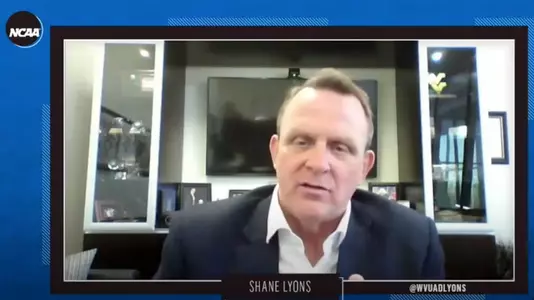
MORGANTOWN, W.Va. – West Virginia University director of athletics Shane Lyons was a Friday evening guest on the NCAA Social Series program: A Focus on College Football.
Andy Katz moderated a video chat discussion that included Lyons, Chair of the College Football Oversight Committee, ESPN college football analyst Kirk Herbstreit and NCAA chief medical officer Dr. Brian Hainline.
In late March, Herbstreit was the first football authority to express concerns about a college and professional football season telling ESPN Radio on March 27, "I'll be shocked if we have NFL football this fall, if we have college football. Just because from what I understand, people that I listen to, you're 12 to 18 months from a (coronavirus) vaccine. I don't know how you let these guys go into the locker rooms and let stadiums be filled up and how you can play ball. I just don't know how you can do that with the optics of it."
Herbstreit said last Friday those remarks were misconstrued by some.
"The way it was portrayed by many it was if I stood on top of a mountain with a lightning bolt and said there will not be football in 2020, which had nothing to do with reality," he said. "It was more me just thinking out loud. We were actually talking about MLB opening day being suspended and I was almost thinking out loud, 'Man this thing is real. This thing could go into the fall and there is a chance we don't have football' and I think it became that I was saying there wasn't going to be football.
"What do I know? I'm looking to doctors like (Hainline) to help me understand what is happening, I am very open minded. I am listening to the experts and to the people who study this and do this for a living and respond to what they are saying," he added. "I'm one of these guys who follows the rules and if they say 'this is what you need to do' who am I to say no.
"As far as football is concerned, nobody wants football more than me. It's not only how I make my living but it's also my passion, but like everybody else I want everybody to be safe and do this the smartest way we can."
Lyons said the NCAA Football Oversight Committee is presently focusing on the return of student-athlete activities, whenever that date is established, and then developing criteria that allows for a safe return to play.
"I think as an athletic director we do this as a business but at the same time we do it for young people. First and foremost is the health and safety of those young people as we move toward a football season," Lyons said. "Football season is important to us financially as an athletic department. At the same time, it's important to these young people. (Football) is their passion and they also want to play football.
"How do we do it with this pandemic? We use the information and the data we get from the medical experts to help guide us as we go down that path. The first thing we've focused on is the student-athlete well-being. What does that actually mean? And then the competitive equity standpoint … we are in a very competitive business and we understand different states are going to open up at different times and what does that look like? Where does the competitive equity fall into play? What we've kind of grouped this as is let's look at the return to practice and return to play. What does that look like?
"We've had time to talk about different models, from a six- to four-week model with six being optimal and four being the minimum that we need prior to the first contest, whenever that may be," Lyons added.
Lyons said the decision to resume student-athlete activities will be a collaborative effort among the conferences, the NCAA, the medical experts and local health departments.
"There are a lot of different entities that are going to play a part in this so it's really working together," Lyons said. "Our group will provide our recommendations and thoughts, but what it really boils down to is what does the season look like? I really do think there are going to be situations where there is not 100 percent participation. Do we all wait until it's 100 percent? If 80 percent of the schools are ready to go do we start the season? I think that's the discussion the conference commissioners are going to have to have.
"I don't have the crystal ball to say this is how it's going to be – I think that's still very fluid," Lyons noted.
Lyons cautions about rushing to a quick judgement on what the football season is going to look like until more data and information is collected. He said contingency planning will also be a part of the College Football Oversight Committee decision making process moving forward.
Hainline indicated some of the current issues and concerns will be resolved as the testing process continues to be perfected.
You can watch the complete 40-minute interview here:
Andy Katz moderated a video chat discussion that included Lyons, Chair of the College Football Oversight Committee, ESPN college football analyst Kirk Herbstreit and NCAA chief medical officer Dr. Brian Hainline.
In late March, Herbstreit was the first football authority to express concerns about a college and professional football season telling ESPN Radio on March 27, "I'll be shocked if we have NFL football this fall, if we have college football. Just because from what I understand, people that I listen to, you're 12 to 18 months from a (coronavirus) vaccine. I don't know how you let these guys go into the locker rooms and let stadiums be filled up and how you can play ball. I just don't know how you can do that with the optics of it."
Herbstreit said last Friday those remarks were misconstrued by some.
"The way it was portrayed by many it was if I stood on top of a mountain with a lightning bolt and said there will not be football in 2020, which had nothing to do with reality," he said. "It was more me just thinking out loud. We were actually talking about MLB opening day being suspended and I was almost thinking out loud, 'Man this thing is real. This thing could go into the fall and there is a chance we don't have football' and I think it became that I was saying there wasn't going to be football.
"What do I know? I'm looking to doctors like (Hainline) to help me understand what is happening, I am very open minded. I am listening to the experts and to the people who study this and do this for a living and respond to what they are saying," he added. "I'm one of these guys who follows the rules and if they say 'this is what you need to do' who am I to say no.
"As far as football is concerned, nobody wants football more than me. It's not only how I make my living but it's also my passion, but like everybody else I want everybody to be safe and do this the smartest way we can."
Lyons said the NCAA Football Oversight Committee is presently focusing on the return of student-athlete activities, whenever that date is established, and then developing criteria that allows for a safe return to play.
"I think as an athletic director we do this as a business but at the same time we do it for young people. First and foremost is the health and safety of those young people as we move toward a football season," Lyons said. "Football season is important to us financially as an athletic department. At the same time, it's important to these young people. (Football) is their passion and they also want to play football.
"How do we do it with this pandemic? We use the information and the data we get from the medical experts to help guide us as we go down that path. The first thing we've focused on is the student-athlete well-being. What does that actually mean? And then the competitive equity standpoint … we are in a very competitive business and we understand different states are going to open up at different times and what does that look like? Where does the competitive equity fall into play? What we've kind of grouped this as is let's look at the return to practice and return to play. What does that look like?
"We've had time to talk about different models, from a six- to four-week model with six being optimal and four being the minimum that we need prior to the first contest, whenever that may be," Lyons added.
Lyons said the decision to resume student-athlete activities will be a collaborative effort among the conferences, the NCAA, the medical experts and local health departments.
"There are a lot of different entities that are going to play a part in this so it's really working together," Lyons said. "Our group will provide our recommendations and thoughts, but what it really boils down to is what does the season look like? I really do think there are going to be situations where there is not 100 percent participation. Do we all wait until it's 100 percent? If 80 percent of the schools are ready to go do we start the season? I think that's the discussion the conference commissioners are going to have to have.
"I don't have the crystal ball to say this is how it's going to be – I think that's still very fluid," Lyons noted.
Lyons cautions about rushing to a quick judgement on what the football season is going to look like until more data and information is collected. He said contingency planning will also be a part of the College Football Oversight Committee decision making process moving forward.
Hainline indicated some of the current issues and concerns will be resolved as the testing process continues to be perfected.
You can watch the complete 40-minute interview here:

Rich Rodriguez | Dec. 3
Wednesday, December 03
Reid Carrico | Nov. 29
Saturday, November 29
Jeff Weimer | Nov. 29
Saturday, November 29
Rich Rodriguez | Nov. 29
Saturday, November 29