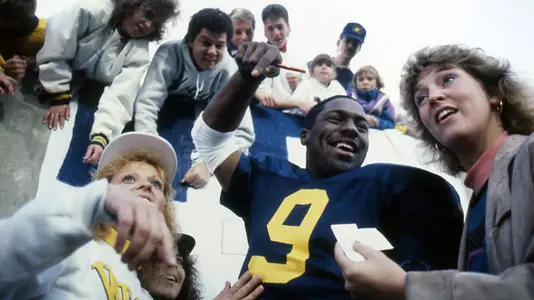
Photo by: WVU Athletic Communications
Harris WVU’s Most Marketable Athlete in Recent History
May 02, 2020 09:00 AM | Football
MORGANTOWN, W.Va. – It looks like the words name, image and likeness are about to become a permanent part of the NCAA sports experience – at least for some.
Earlier this week, the NCAA Board of Governors released its 31-page report on the commercial usage of a student-athlete's name, image and likeness. What this means is that in the near future, a small percentage of NCAA athletes are going to be able to negotiate their own endorsement deals without jeopardizing their collegiate eligibility.
Many details still need to be ironed out, for sure, but a tentative 2020-21 target date has now been established.
Had this been in place, say 30 or 35 years ago, which West Virginia University athletes would have benefited most?
Will Grier is one who immediately comes to mind, as do Jevon Carter, Tavon Austin, Geno Smith and Stedman Bailey.
I could envision Kevin Pittsnogle endorsing anything from pizzas to tattoos to four-wheelers during his Mountaineer heyday in the mid-2000s, and I think Da'Sean Butler would have been a great pitchman, too!
The same goes for Mike Gansey, Patrick Beilein and Johannes Herber.
How about the dynamic duo of Pat White and Steve Slaton? I could see those two in tandem being extremely marketable as product peddlers.
Owen Schmitt? Jake "The Snake" Kelchner? They fit our West Virginia culture and demographic perfectly.
Noel Devine? Pat McAfee? Rasheed Marshall? Grant Wiley? Marc Bulger? Amos Zereoue? Mike Logan?
Yes, yes, yes, yes, yes, yes and yes.
There are many, many others for sure, including a handful of varsity sports athletes with the potential to land endorsement deals.
But there was one modern-era West Virginia University performer above all others who possessed the greatest endorsement power of them all – Major Harris.
 With the exception of Hot Rod Hundley and Jerry West, no West Virginia athlete has had a firmer grip on this state than Major Harris did when he played here in the late 1980s.
Just start with his name – Major Harris, not to be mistaken for the R&B singer from the Delfonics in the early 1970s – that alone is unusual and attention-getting.
Not only was he a remarkable athlete with futuristic skills on the football field, but Harris also possessed an effervescent and magnetic personality off it.
A room immediately brightened once Major entered. He was, hands down, the most approachable star athlete I've ever encountered.
Everybody loved Major, and his charisma transcended races, too.
Teammate Dale Wolfley recalled the great on-field presence Harris possessed. Once, a teammate had forgotten the play he was instructed to send into the huddle and instead of wasting a timeout, the Maj decided to do a little freelancing.
Realizing it was probably another running play that coach Don Nehlen had called, Harris opted to call a pass instead. The one he ended up choosing wide receiver Reggie Rembert didn't know, so Harris had to tell Reggie what to do.
"Just run a post, Reg, and run fast!" Harris told him in his raspy-voiced Pittsburgh accent.
Wolfley said Harris ended up completing it to Rembert.
Another time Harris walked up to the line of scrimmage and got behind Wolfley, who was playing offensive guard, rather than behind center Jeff Price. The defenders across the line of scrimmage started laughing, as did the line judge and umpire.
Harris began laughing too and said, "My bad."
"I think he ripped off like a 30-yard run right after that," Wolfley chuckled.
During a West Virginia game at Maryland, Harris walked up behind his center, but this time he refused to take the snap. It was so hot and humid that early September afternoon that his center had vomited on the football, causing the Terrapin player lined up across from him to puke as well.
"I ain't touching that ball!" Harris told the referee.
Wolfley said the bus rides with Major in the back, busting on his teammates and coaches after victories, rank among his fondest memories as a Mountaineer player.
Nobody was spared, not even Nehlen.
The Maj would start telling stories using some of Nehlen's favorite expressions such as "dadgum" and "Holy Criminy!" and the entire bus would erupt in laughter.
I believe it was Harris who first began calling assistant coaches Dwight and Mike Wallace the "Smothers Brothers."
And they laughed right along with everyone else.
Plus, he could rap!
A young music producer named Tony Caridi came up with the great idea of having Harris sing a Fiesta Bowl rap song to benefit the Ronald McDonald House, similar to the Chicago Bears Super Bowl Shuffle of a few years prior.
The cassette tape ended up generating more than $17,000, which amounts to about $37,000 in today's dollars.
Keep in mind, this was back during the pre-internet days when things were still stuffed in envelopes and addresses were written out by hand!
Caridi believes Harris' jersey sales would have been off the charts today.
 During the 1988 West Virginia gubernatorial election when Gaston Caperton defeated Arch Moore, coming in third place that year was none other than Major Harris.
That's right, the Maj received write-in votes for governor!
Greg Hunter and Bob Bucy launched their Blue & Gold News publication in 1988 to cover Mountaineer sports and Hunter is convinced that Harris' immense popularity gave it the big boost it needed to survive. Hunter said he always made sure he got good action photography of Harris to use on the cover of their magazine because they always sold more copies with Harris' picture on it.
A full-color retrospective of Harris' career the Blue & Gold News published before the 1989 Gator Bowl game against Clemson sold out immediately.
"We took cases and cases of those down to Jacksonville and we sold them all," Hunter recalled.
How popular was Major?
Well, consider this: the ONLY two seasons West Virginia football has ever averaged more than 60,000 fans per game occurred during Major's sophomore and junior seasons in 1988 and 1989.
And five of the 17 largest crowds in Mountaineer Field history still involve games Harris played.
Caridi recalled once doing some late-evening work over at the Puskar Center, then known as the Facilities Building, and noticing a young family touring the complex with their son, who had just been released from Children's Hospital.
Harris happened to be in the building at the time and the family was overcome with joy when they saw him.
Major, having nothing to hand his young fan, told him to wait a minute and excused himself. He jogged over to the trailer park where he was living across the street from the stadium, pulled out a windbreaker that he received from the Heisman Trophy award ceremony he attended in 1989 and brought it back to sign for the young boy.
It was an act of pure kindness and generosity that Caridi will never forget.
"Major, to this day, has a heart of gold," Caridi said.
More than 30 years since he last took a snap for the Mountaineers, a 52-year-old Major Harris can still come down to West Virginia and turn out big crowds at any event he attends.
That's because West Virginians adored Harris when he played, and they still adore him today!
Earlier this week, the NCAA Board of Governors released its 31-page report on the commercial usage of a student-athlete's name, image and likeness. What this means is that in the near future, a small percentage of NCAA athletes are going to be able to negotiate their own endorsement deals without jeopardizing their collegiate eligibility.
Many details still need to be ironed out, for sure, but a tentative 2020-21 target date has now been established.
Had this been in place, say 30 or 35 years ago, which West Virginia University athletes would have benefited most?
Will Grier is one who immediately comes to mind, as do Jevon Carter, Tavon Austin, Geno Smith and Stedman Bailey.
I could envision Kevin Pittsnogle endorsing anything from pizzas to tattoos to four-wheelers during his Mountaineer heyday in the mid-2000s, and I think Da'Sean Butler would have been a great pitchman, too!
The same goes for Mike Gansey, Patrick Beilein and Johannes Herber.
How about the dynamic duo of Pat White and Steve Slaton? I could see those two in tandem being extremely marketable as product peddlers.
Owen Schmitt? Jake "The Snake" Kelchner? They fit our West Virginia culture and demographic perfectly.
Noel Devine? Pat McAfee? Rasheed Marshall? Grant Wiley? Marc Bulger? Amos Zereoue? Mike Logan?
Yes, yes, yes, yes, yes, yes and yes.
There are many, many others for sure, including a handful of varsity sports athletes with the potential to land endorsement deals.
But there was one modern-era West Virginia University performer above all others who possessed the greatest endorsement power of them all – Major Harris.
With the exception of Hot Rod Hundley and Jerry West, no West Virginia athlete has had a firmer grip on this state than Major Harris did when he played here in the late 1980s.Just start with his name – Major Harris, not to be mistaken for the R&B singer from the Delfonics in the early 1970s – that alone is unusual and attention-getting.
Not only was he a remarkable athlete with futuristic skills on the football field, but Harris also possessed an effervescent and magnetic personality off it.
A room immediately brightened once Major entered. He was, hands down, the most approachable star athlete I've ever encountered.
Everybody loved Major, and his charisma transcended races, too.
Teammate Dale Wolfley recalled the great on-field presence Harris possessed. Once, a teammate had forgotten the play he was instructed to send into the huddle and instead of wasting a timeout, the Maj decided to do a little freelancing.
Realizing it was probably another running play that coach Don Nehlen had called, Harris opted to call a pass instead. The one he ended up choosing wide receiver Reggie Rembert didn't know, so Harris had to tell Reggie what to do.
"Just run a post, Reg, and run fast!" Harris told him in his raspy-voiced Pittsburgh accent.
Wolfley said Harris ended up completing it to Rembert.
Another time Harris walked up to the line of scrimmage and got behind Wolfley, who was playing offensive guard, rather than behind center Jeff Price. The defenders across the line of scrimmage started laughing, as did the line judge and umpire.
Harris began laughing too and said, "My bad."
"I think he ripped off like a 30-yard run right after that," Wolfley chuckled.
During a West Virginia game at Maryland, Harris walked up behind his center, but this time he refused to take the snap. It was so hot and humid that early September afternoon that his center had vomited on the football, causing the Terrapin player lined up across from him to puke as well.
"I ain't touching that ball!" Harris told the referee.
Wolfley said the bus rides with Major in the back, busting on his teammates and coaches after victories, rank among his fondest memories as a Mountaineer player.
Nobody was spared, not even Nehlen.
The Maj would start telling stories using some of Nehlen's favorite expressions such as "dadgum" and "Holy Criminy!" and the entire bus would erupt in laughter.
I believe it was Harris who first began calling assistant coaches Dwight and Mike Wallace the "Smothers Brothers."
And they laughed right along with everyone else.
Plus, he could rap!
A young music producer named Tony Caridi came up with the great idea of having Harris sing a Fiesta Bowl rap song to benefit the Ronald McDonald House, similar to the Chicago Bears Super Bowl Shuffle of a few years prior.
The cassette tape ended up generating more than $17,000, which amounts to about $37,000 in today's dollars.
Keep in mind, this was back during the pre-internet days when things were still stuffed in envelopes and addresses were written out by hand!
Caridi believes Harris' jersey sales would have been off the charts today.
During the 1988 West Virginia gubernatorial election when Gaston Caperton defeated Arch Moore, coming in third place that year was none other than Major Harris.That's right, the Maj received write-in votes for governor!
Greg Hunter and Bob Bucy launched their Blue & Gold News publication in 1988 to cover Mountaineer sports and Hunter is convinced that Harris' immense popularity gave it the big boost it needed to survive. Hunter said he always made sure he got good action photography of Harris to use on the cover of their magazine because they always sold more copies with Harris' picture on it.
A full-color retrospective of Harris' career the Blue & Gold News published before the 1989 Gator Bowl game against Clemson sold out immediately.
"We took cases and cases of those down to Jacksonville and we sold them all," Hunter recalled.
How popular was Major?
Well, consider this: the ONLY two seasons West Virginia football has ever averaged more than 60,000 fans per game occurred during Major's sophomore and junior seasons in 1988 and 1989.
And five of the 17 largest crowds in Mountaineer Field history still involve games Harris played.
Caridi recalled once doing some late-evening work over at the Puskar Center, then known as the Facilities Building, and noticing a young family touring the complex with their son, who had just been released from Children's Hospital.
Harris happened to be in the building at the time and the family was overcome with joy when they saw him.
Major, having nothing to hand his young fan, told him to wait a minute and excused himself. He jogged over to the trailer park where he was living across the street from the stadium, pulled out a windbreaker that he received from the Heisman Trophy award ceremony he attended in 1989 and brought it back to sign for the young boy.
It was an act of pure kindness and generosity that Caridi will never forget.
"Major, to this day, has a heart of gold," Caridi said.
More than 30 years since he last took a snap for the Mountaineers, a 52-year-old Major Harris can still come down to West Virginia and turn out big crowds at any event he attends.
That's because West Virginians adored Harris when he played, and they still adore him today!
Gold-Blue Spring Festival Fan Recap
Sunday, April 19
John Neider | April 18
Saturday, April 18
Coach Zac Alley | April 18
Saturday, April 18
Coach Rich Rodriguez | April 18
Saturday, April 18