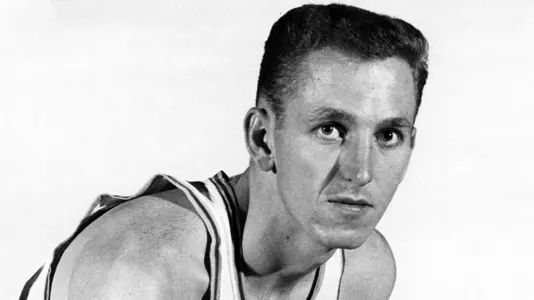
Photo by: WVU Athletic Communications
Thorn’s No. 44 to Be Officially Retired Saturday
February 28, 2020 02:11 PM | Men's Basketball
MORGANTOWN, W.Va. – Another No. 44 will be hanging up in the WVU Coliseum after tomorrow's Oklahoma men's basketball game.
Jerry West's No. 44 is prominently displayed in the Coliseum along with Rod Hundley's No. 33, and soon, Rod Thorn's No. 44 will be right next to them.
Thorn, once declared a natural resource by the West Virginia Legislature, will officially have his jersey No. 44 retired during a halftime ceremony on Saturday afternoon.
"It's long overdue," West Virginia coach Bob Huggins said. "You have this, 'Who is your Mount Rushmore?' The first three are really easy and the last one is really hard because it's two guys who are really close, and it's probably a matter of personal preference."
Thorn, of course, is one of the three "really easy" ones.
He is considered one of the school's all-time great players who also became one of the most influential figures in professional basketball as a front office executive. The Princeton, West Virginia, native led West Virginia to the NCAA Tournament in 1962 and '63 and earned consensus All-America honors as a senior in 1963 after averaging 22.5 points per game.
He was a first-round draft choice of the Baltimore Bullets and played eight NBA seasons with the Bullets, Detroit Pistons, St. Louis Hawks and Seattle Supersonics. His finest campaign came in 1967 with Seattle when he averaged 15.2 points, four rebounds and 3.5 assists per game.
His career in the NBA continued as an assistant coach before he transitioned to the front office where he eventually became general manager of the Chicago Bulls in 1978. He spent seven years with the Bulls and was responsible for selecting Michael Jordan in the 1984 NBA Draft and helping set up a franchise that won six NBA titles during a seven-year period in the 1990s.
In 1986, Thorn joined the NBA league office in New York City and for years served as the NBA's executive vice president of basketball operations under the late David Stern. In 2000, Thorn returned to front office work as president of the New Jersey Nets and helped them to four Atlantic Division titles and two Eastern Conference championships.
The 2002 NBA Executive of the Year later became president of the Philadelphia 76ers until 2013 when he returned to the NBA office to resume his role in league operations.
Huggins said Thorn has always been a great supporter of West Virginia University and Mountaineer athletics.
"He's been good to me since I played here - all three of them," Huggins said. "Hundley used to mess with me all of the time, but it was a term of endearment. And Jerry has been great to me. Those guys have always done everything I've asked. They got the Fantasy Camp started, which has been great for us. The reality is our biggest boosters come from Fantasy Camp. Those are the guys who built the locker room (in the Coliseum) and redid the locker room (at the practice facility)."
Thorn was inducted into the West Virginia University Sports Hall of Fame in 2002 and was named inaugural member of the Mountaineer Legends Society in 2017. He was inducted into the Naismith Memorial Basketball Hall of Fame as an executive and contributor in 2018.
Thorn will become the third West Virginia University men's basketball player and just the sixth Mountaineer great to have his jersey number retired – all since 2005.
Pro football Hall of Famer Sam Huff was the first to get his uniform No. 75 retired during an on-field ceremony at halftime of West Virginia's 2005 home football game against Pitt.
Jerry West's famous No. 44 was retired on Nov. 26, 2005 at halftime of the men's basketball game against LSU, and Hot Rod Hundley's No. 33 was celebrated five years later during halftime of the Mountaineers' home game against Ohio State on Jan. 23, 2010.
Consensus All-America football player Bruce Bosley's No. 77 was retired during the 2016 season opener against Missouri on Sept. 3, 2016, and the great Ira Errett Rodgers, the school's first consensus All-American football player who was later named to the 22-member Newspaper Enterprise Association (NEA) all-time college football team in 1969, had his jersey No. 21 officially retired before the start of the 2009 season.
That was the number Rodgers wore during his senior season in 1919. He also wore jersey numbers 27, 2 and 36 during his outstanding Mountaineer career.
The decision to retire jerseys are voted on by the WVU Athletics Council.
Thorn and his family are scheduled to arrive in Morgantown later today. He will meet with media tomorrow afternoon prior to the Mountaineers' 4 p.m. game against the Sooners.
Jerry West's No. 44 is prominently displayed in the Coliseum along with Rod Hundley's No. 33, and soon, Rod Thorn's No. 44 will be right next to them.
Thorn, once declared a natural resource by the West Virginia Legislature, will officially have his jersey No. 44 retired during a halftime ceremony on Saturday afternoon.
"It's long overdue," West Virginia coach Bob Huggins said. "You have this, 'Who is your Mount Rushmore?' The first three are really easy and the last one is really hard because it's two guys who are really close, and it's probably a matter of personal preference."
Thorn, of course, is one of the three "really easy" ones.
He is considered one of the school's all-time great players who also became one of the most influential figures in professional basketball as a front office executive. The Princeton, West Virginia, native led West Virginia to the NCAA Tournament in 1962 and '63 and earned consensus All-America honors as a senior in 1963 after averaging 22.5 points per game.
He was a first-round draft choice of the Baltimore Bullets and played eight NBA seasons with the Bullets, Detroit Pistons, St. Louis Hawks and Seattle Supersonics. His finest campaign came in 1967 with Seattle when he averaged 15.2 points, four rebounds and 3.5 assists per game.
His career in the NBA continued as an assistant coach before he transitioned to the front office where he eventually became general manager of the Chicago Bulls in 1978. He spent seven years with the Bulls and was responsible for selecting Michael Jordan in the 1984 NBA Draft and helping set up a franchise that won six NBA titles during a seven-year period in the 1990s.
In 1986, Thorn joined the NBA league office in New York City and for years served as the NBA's executive vice president of basketball operations under the late David Stern. In 2000, Thorn returned to front office work as president of the New Jersey Nets and helped them to four Atlantic Division titles and two Eastern Conference championships.
Pick up a free copy of tomorrow's commemorative Rod Thorn program when you enter the Coliseum.
— WVU Basketball (@WVUhoops) February 28, 2020
The Mountaineers and Sooners will tip at 4 p.m. on ESPN2. pic.twitter.com/eH85bDTT15
The 2002 NBA Executive of the Year later became president of the Philadelphia 76ers until 2013 when he returned to the NBA office to resume his role in league operations.
Huggins said Thorn has always been a great supporter of West Virginia University and Mountaineer athletics.
"He's been good to me since I played here - all three of them," Huggins said. "Hundley used to mess with me all of the time, but it was a term of endearment. And Jerry has been great to me. Those guys have always done everything I've asked. They got the Fantasy Camp started, which has been great for us. The reality is our biggest boosters come from Fantasy Camp. Those are the guys who built the locker room (in the Coliseum) and redid the locker room (at the practice facility)."
Thorn was inducted into the West Virginia University Sports Hall of Fame in 2002 and was named inaugural member of the Mountaineer Legends Society in 2017. He was inducted into the Naismith Memorial Basketball Hall of Fame as an executive and contributor in 2018.
Thorn will become the third West Virginia University men's basketball player and just the sixth Mountaineer great to have his jersey number retired – all since 2005.
Pro football Hall of Famer Sam Huff was the first to get his uniform No. 75 retired during an on-field ceremony at halftime of West Virginia's 2005 home football game against Pitt.
Jerry West's famous No. 44 was retired on Nov. 26, 2005 at halftime of the men's basketball game against LSU, and Hot Rod Hundley's No. 33 was celebrated five years later during halftime of the Mountaineers' home game against Ohio State on Jan. 23, 2010.
Consensus All-America football player Bruce Bosley's No. 77 was retired during the 2016 season opener against Missouri on Sept. 3, 2016, and the great Ira Errett Rodgers, the school's first consensus All-American football player who was later named to the 22-member Newspaper Enterprise Association (NEA) all-time college football team in 1969, had his jersey No. 21 officially retired before the start of the 2009 season.
That was the number Rodgers wore during his senior season in 1919. He also wore jersey numbers 27, 2 and 36 during his outstanding Mountaineer career.
The decision to retire jerseys are voted on by the WVU Athletics Council.
Thorn and his family are scheduled to arrive in Morgantown later today. He will meet with media tomorrow afternoon prior to the Mountaineers' 4 p.m. game against the Sooners.
College Basketball Crown Recap
Thursday, April 16
Ross Hodge, Honor Huff & Brenen Lorient | Oklahoma Postgame
Sunday, April 05
Ross Hodge, Treysen Eaglestaff & Brenen Lorient | Creighton Postgame
Saturday, April 04
Ross Hodge & Honor Huff | Stanford Postgame
Thursday, April 02