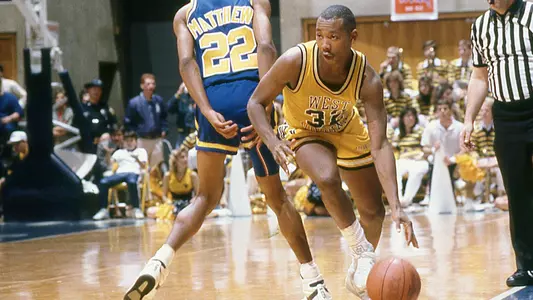
Backyard Brawl Win Paves the Way to Memorable ’89 Hoops Season
December 24, 2020 06:30 PM | Men's Basketball
MORGANTOWN, W.Va. – How often is it that you see a memorable basketball season begin with a loss to Robert Morris?
Bobby Mo, of all teams!!!
Well, it happened in 1989 when Gale Catlett’s Mountaineers shook off that defeat, and another loss eight days later to Bradley, to run off 22 straight wins on the way to a 26-5 season and a No. 17 national ranking.
This one ranks among the three best teams Catlett had at West Virginia, right there with his 1982 squad that won 23 straight games and posted a 27-4 record, and the 1998 club that went 24-9 and came within a couple of possessions of knocking off seventh-ranked Utah in the Sweet 16 round of the NCAA Tournament.
The nucleus of West Virginia’s 1988 team that won 18 games– guards Herbie Brooks and Steve Berger, and forwards Darryl Prue and Chris Brooks – were returning in 1989.
What Catlett lacked in ‘88 he found on the transfer market in 1989 when Cleveland State center Ray Foster became immediately available after the Vikings were placed on probation.
The 6-foot-10 Foster was by no means the second coming of Patrick Ewing, but he did give the Mountaineers a physical presence in the paint they sorely lacked. Remember, college basketball back then was still a big man’s game and if you didn’t have some size near the basket you were dead in the water.
Catlett had spent a couple of unsuccessful years exploring the junior college market for posts, and ended up moving Prue, a 6-foot-7 forward, to center to complete a front line that included skinny 6-foot-7 forward Tyrone Shaw and explosive 6-foot-6 forward Chris Brooks.
All three were exceptional college players, but they just weren’t big enough to handle the size Atlantic 10 leaders Temple and Rhode Island possessed during the 1988 season.
“I should have never played center that year. We were undersized, and that was the only thing I was ever mad at Catlett about,” Prue recalled recently.
But the addition of Foster eventually fixed that.
“He took a lot of weight off of me,” Prue admitted. “Just like when Darrell Pinckney was there, (Foster) protected the rim. He was a bigger body and he could handle some of the bigger guys. I don’t know how serious he took it, but he was serious enough.”
“Prue, Chris Brooks, Berger and myself, we started the previous year,” Herbie Brooks said. “Getting a center that was big and could slow down the other center, get a bucket or two and grab some rebounds with a nasty attitude on the court was a key.”
And Foster checked all of those boxes.
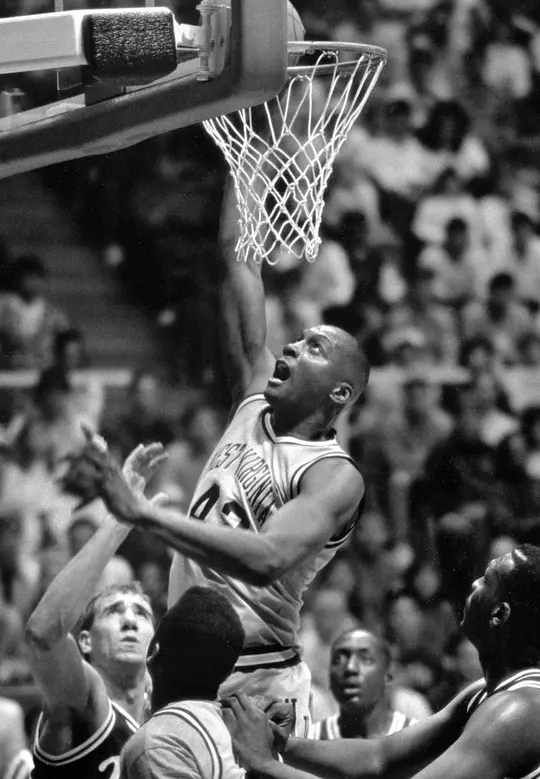
Getting a center that was big and could slow down the other center, get a bucket or two and grab some rebounds with a nasty attitude on the court was a key.-- West Virginia guard Herbie Brooks on the addition of center Ray Foster
The emergence of 6-foot-10 center Wade Smith also helped a great deal. Smith, from the Virgin Islands, barely got into games before his senior year in 1989, and when he did he usually tried to make up for lost time by jacking up ill-advised shots.
“There is a natural tendency to catch up on all of those years and prove people wrong,” Prue said. “But he came on board and became a key piece of our group.”
Catlett spent the first couple weeks of the ’89 season moving his pieces around seeking the right fit. In the process, he watched 6-foot-5 Robert Morris forward Vaughn Luton drop 27 on the Mountaineers in the opener.
After that, an uninspiring four-point win over Fresno State didn’t do the trick, nor did a two-point home loss to Bradley. It was then when Herbie Brooks and Prue arranged a players-only meeting in the locker room to clear the air.
“We needed to talk,” Brooks said. “We just talked about doing things right and explaining everyone’s roles on the team. We just talked each other up and gave each other confidence and let everyone know that we were all in it together.”
“We aired some things out, and I think we became a better group,” Prue added.
What resulted was a 17-point win over Mount St. Mary’s two days later with points equally distributed among six different players, including 10 from Smith off the bench.
WVU played better against Mount St. Mary’s, but it still wasn’t quite up to the team’s potential - particularly Foster, whom Catlett was considering benching in favor of Smith. Foster scored just three points and grabbed three rebounds against a much smaller Mount St. Mary’s front line.
That’s where West Virginia was when it bused up Interstate 79 to play Pitt on Dec. 10 at Fitzgerald Field House.
Pitt wasn’t quite the same team it was a year prior when it reached No. 2 in the polls and knocked off West Virginia 70-64 in Morgantown (just Pitt’s second win ever at the Coliseum), but the Panthers were still pretty good.
Gone to the NBA were 6-foot-10 center Charles Smith and 6-foot-6 forward Jerome Lane, but Pitt returned center Bobby Martin, forward Rod Brookin and guards Jason Matthews and Sean Miller.
It also had high school All-American forward Brian Shorter from the same Oak Hill Academy that produced West Virginia’s Chris Brooks, also a prep All-American.
Whenever these two played against each other, Brooks always had a huge chip on his shoulder because he once read that his high school coach said Shorter was the best forward he ever coached.
“That pissed Chris off,” Prue laughed, “but he was always mad about something anyway.”
“Intimidating, and naturally strong,” is how Herbie Brooks described Chris Brooks, who was no relation to Herbie. “When he got the ball near the basket he always wanted to jump over everybody and dunk the ball in their face. That was him.”
“Honestly, he should have probably been a defensive end in football like Renaldo Turnbull because he had that kind of strength and athleticism,” Prue mentioned. “He was born in England, and he started playing basketball late, and he took advantage of his jumping and athletic ability. He was a physical freak.”
Prue distinctly remembers the Pitt game at the Coliseum in 1987 when Brookin dunked on Brooks and let everybody on the floor know about it. Prue said that was the only talking going on in the game, other than Charles Smith whining to the refs that he was always getting fouled.
Two possessions later, Brooks got the ball near the basket and went up for a vicious slam that nearly pulled down the backboard and everything with it.
“Chris dunked it on all of them,” Prue laughed.
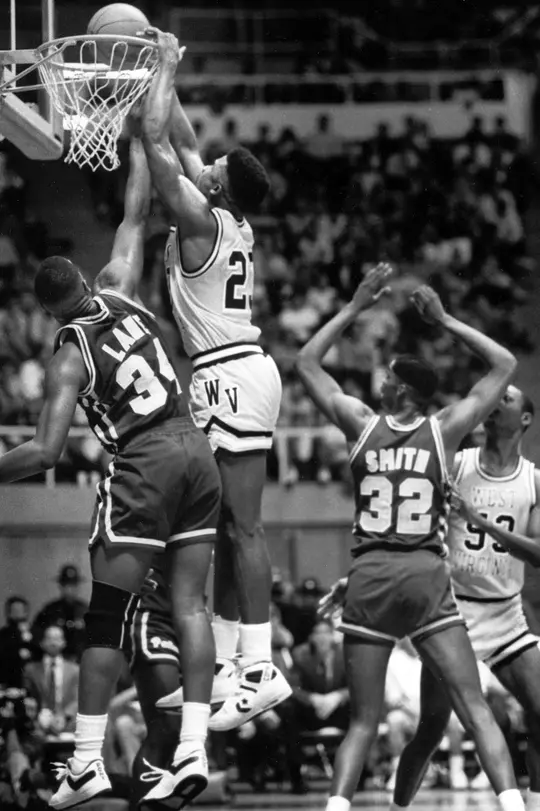
That’s how the Backyard Brawl games were played back then. The two teams had a healthy respect for each other that was not always shared by the Pittsburgh media.
Pitt was recruiting nationally in the mid-1980s, with a roster full of high-profile players such as Smith from Bridgeport, Connecticut, Demetreus Gore from Detroit, Lane from Akron, Ohio, Martin from Atlantic City, New Jersey, Shorter from Philadelphia, Jason Mathews from Los Angeles and nationally known ballhandling guard Sean Miller from nearby Blackhawk High.
“I don’t know how they were getting their players to go there, but they were getting them,” Prue said. “(Coach Paul) Evans did a great job of recruiting. I never thought he was that great of a coach, though, and I think that’s what Catlett usually beat them at.”
West Virginia also had some really good players on its roster back then as a result of five NCAA Tournament trips during a six-year span in the mid-1980s.
Prue signed with Georgetown out of high school and when that fell through he landed at West Virginia. Chris Brooks was Catlett’s most heavily recruited signee with offers from most of the major programs in the country, while Herbie Brooks was a prolific high school scorer in West Virginia with ACC and SEC offers.
The narrative played up in the Pittsburgh media at the time that the Panther program was better than West Virginia’s because it was in the Big East and West Virginia was in the Atlantic 10 simply didn’t hold water with the Mountaineer players.
“Of course, they were in the Big East and we were in the Atlantic 10, but as far as them being superior to us, I never thought that at all,” Brooks said. “I never played anybody I thought was superior.
“We wanted to beat Pitt, but as far as it being our Super Bowl or World Series by beating Pitt … no. That’s like saying if we beat them and lose every other game everything was still all right. That’s not how we thought,” Brooks added.
West Virginia needed overtime to defeat Pitt 84-81, and if you take a quick glance at the box score you have a hard time figuring out why it was only a three-point Mountaineer victory.
West Virginia shot a sizzling 61% from the floor and forced 20 Panther turnovers, the result of WVU’s veteran backcourt of Brooks and Berger taking advantage of Pitt’s youthful and inexperienced guards Miller and Matthews.
Herbie Brooks led all scorers with a career-high 26 points on 11-of-19 shooting, but he said it actually should have been two more points than he was credited.
“They gave Chris Brooks a tip-in that was actually mine,” Brooks laughed. “I saw it on tape later on and it was definitely me and not Chris!”
So put an asterisk next to Herbie Brooks’ name for that one.
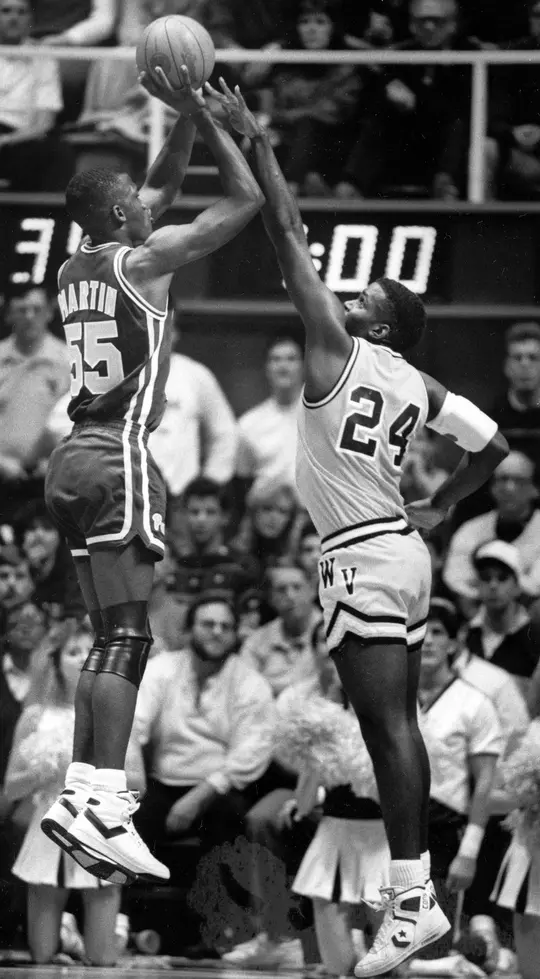
We wanted to beat Pitt, but as far as it being our Super Bowl or World Series by beating Pitt … no. That’s like saying if we beat them and lose every other game everything was still all right. That’s not how we thought.-- West Virginia guard Herbie Brooks
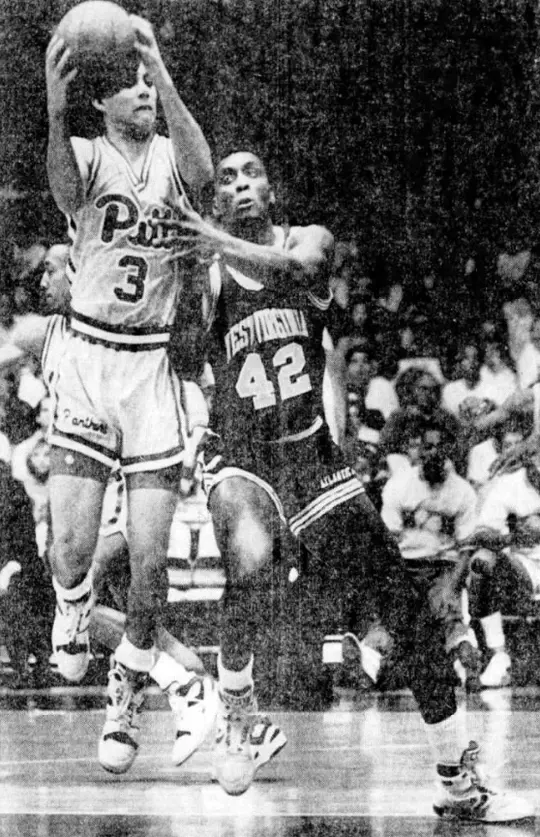
Wade Smith also gave West Virginia a big boost coming off the bench with 12 points. With Prue and Chris Brooks canceling out Shorter and Martin, Smith’s production really made a big difference in the game, especially when Foster and Brooks fouled out.
The game finally turned in the Mountaineers’ favor with about three minutes left in overtime after Pitt had taken a 79-76 lead. Prue scored a layup on a nice set play designed by Catlett, and Herbie Brooks knocked down a jumper after coming up with a steal.
Herbie added two more on a driving layup and Smith sealed the win with 21 seconds to go on a pair of free throws.
Had West Virginia been a better free throw shooting team the victory would have been by a more comfortable margin. The Mountaineers bricked 17 of their 28 free throw attempts - many of those misses the front end of one-and-ones.
Free throw shooting was West Virginia’s Achilles heel back in those days - far, far worse than what fans are complaining about today with some of Bob Huggins’ players.
“Unfortunately, we had a couple of guys who really struggled from the free throw line, but that’s just the way it was,” Herbie Brooks said. “I will tell you something about those guys, though. People used to ask, ‘Don’t you practice free throws?’ We practiced and practiced free throws. Coach Catlett demanded it and in practice those guys made 60, 65% of their free throws and sometimes 70%.
“It was just an in-your-head-game kind of thing, I guess,” he shrugged.
That Pitt victory really lit the fuse for the 1989 season. A week later, West Virginia ran a pretty good Virginia Tech team right out of the Coliseum. The Mountaineers had the Hokies down by 29 at halftime and beat them by 49.
Virginia Tech guard Bimbo Coles had the worst day of his life that afternoon. The Greenbrier East star made just three of his 18 field goal attempts, and Coles went on to eventually play 14 years in the NBA!
“Now we got up for that game, Steve, Tracy (Shelton) and myself because we knew all about Bimbo, who was a bad cat,” Brooks recalled. “I’ll never forget, every time he touched the ball the entire Coliseum started yelling, ‘Bimbo … Bimbo … Bimbo.’ I’m sorry, but to an 18-, 19-, 20-year-old kid, that’s got to bother you.
“Come on now, once he missed those first two or three shots in the Coliseum it was a wrap!” Brooks laughed.
Ten days after the Virginia Tech victory, West Virginia won at Maryland as the snowball began picking up speed. It took the Mountaineers two months before they lost another basketball game at Temple near the end of February.
It was the only regular season defeat WVU experienced in Atlantic 10 play.
An upset loss to Penn State in the Atlantic 10 Tournament quarterfinals hurt West Virginia’s NCAA Tournament seeding, which eventually put it against ninth-ranked Duke in what was basically a second-round home game for the Blue Devils in Greensboro, North Carolina.
The Blue Devils got some favorable calls late to hold off West Virginia 70-63.
“That year I would have taken our chances against anybody,” Prue said. “If we would have gotten past Duke we were looking at Georgetown.”
Prue certainly thought the second-ranked Hoyas were beatable, based on the way Pitt handled them in Pittsburgh earlier that season. Pitt, by the way, finished 17-13 and was one of four Big East teams to make the NCAA Tournament that year.
Herbie Brooks said he still keeps in touch with many of his Mountaineer teammates. He’s still tight with Steve Berger, now living in Salisbury, North Carolina, and usually meets up with him whenever he’s in the Charlotte area.
Prue is a high school basketball coach in his native Washington, D.C., while Tracy Shelton is also living in the D.C. area.
The last Brooks heard, Wade Smith was working in the tourism industry in his native Virgin Islands while Chris Brooks was back living in New York City.
Forward Tyrone Shaw, a teammate of Brooks’ in 87-88, has worked for FEMA for 20-plus years and is also living in the Washington, D.C. area.
Herbie has returned to his native Mullens and works as a sales rep in the mining industry. He also helps out his son, Derek, the boy’s basketball coach at Wyoming East High.
As for Ray Foster, the final piece to West Virginia’s outstanding 1989 basketball team, his end credits sort of read like Daniel Simpson Day’s at the conclusion of Animal House – “whereabouts unknown.”
“He’s the only one I haven’t talked to since we all left Morgantown,” Brooks sighed. “I don’t know where he is, but I’d love to talk to him again.”
This special Backyard Brawl Rewind was presented by EQT.