CFB150 – Mountaineer Football Firsts
July 26, 2019 12:03 PM | Football, Blog
Editor's note: Each Friday throughout the remainder of July, West Virginia University is celebrating the 150th anniversary of college football. WVU has been playing the sport since 1891 and is currently the 14th winningest program in NCAA history. This week, we examine some of the innovations West Virginia has been involved with in the game.
Does the name Harold Arlin ring a bell?
Arlin worked at 50,000-watt KDKA in Pittsburgh and was one of the pioneering sports broadcasters in the early 1920s.
In the summer of 1921, he described the first professional baseball game to ever air on commercial radio (Pirates versus Phillies), the first professional tennis match at Pittsburgh's Allegheny County Club when Australia defeated Great Britain in the Davis Cup and the first professional boxing match when Jack Dempsey defeated Luis Angel Firpo in New York City.
Arlin produced the broadcast to Western Pennsylvania boxing fans by recreating wire service reports in his KDKA studio in Pittsburgh.
He was also on hand at Forbes Field on Saturday, Oct. 8, 1921, to air the first commercial radio broadcast of a college football game when Pitt played host to West Virginia.
There is considerable debate as to whom actually broadcast the first college football game. For years, the University of Pennsylvania boasted that it was the first to host a radio broadcast when the Quakers lost 9-0 to Cornell on Saturday, Nov. 22, 1922.
Michigan said its first game broadcast was 19 years prior in 1903 when UM student Jack Mattice used the Bell Telephone Company to announce a live account of Michigan's game at Minnesota to a group of students inside the University Hall Auditorium.
It was a similar deal with the Kansas-Missouri football game in 1911 when Missouri fans set up a Western Union telegraph wire in Columbia to announce what was going on over in Lawrence to a small gathering of Tiger fans.
A year later, Minnesota professor F.W. Springer did something similar to small audiences of Golden Gopher rooters.
In 1919, Dallas radio station WTAW used wire service updates to broadcast the Texas-Texas A&M game at Clark Field in Austin, and that is generally considered to be the first radio broadcast of a college football game, but the updates were not instantaneous nor was the announcer on-site.
But Arlin was the first broadcaster to actually go to the event and describe the action from the stadium. What he witnessed that afternoon was a 21-13 Pitt victory over West Virginia on a cold, rainy day.
 He was among the 15,000 there to see if young, upstart WVU coach Clarence Spears could knock off Pop Warner's Pitt juggernaut. The Panthers were crowned national champion three times under Warner during a four-year period in 1915, 1916 and 1918, and Pitt was undefeated with two ties in 1920.
Meanwhile, rebounding West Virginia had raised some eyebrows in the summer of 1921 when it was able to pry Spears away from Dartmouth. The rotund coach with the unflattering nickname "Fats" was considered among the game's top young mentors in the early 1920s, and he didn't take too kindly to constructive criticism.
It was said that Spears immediately despised opinionated WVU alum Fielding Yost after Yost returned to Morgantown to observe Spears' team lose the big homecoming game to arch rival Washington & Jefferson to conclude the 1921 season.
Afterward, when Yost tried to point out to Spears some of his coaching blunders, Spears told him to go take a hike, among other things. Thus, an intense coaching rivalry was born, later to be amplified when Spears moved on to Minnesota and faced Michigan on a yearly basis.
As for Pitt, it would take Fats only one year to knock off the powerful Panthers in 1922 - a 9-6 victory that was achieved when a Dayton, Ohio, ringer named Armin Mahrt dropped-kicked a 39-yard field goal to win the game. It was at the William Penn Hotel following WVU's big victory where the memorable phrase "West By Gawd Virginia!" originated.
As the story goes, "West By Gawd Virginia!" was all an inebriated West Virginia fan could blurt out upon seeing Spears and his victorious Mountaineer football team.
Radio didn't become an integral part of WVU football until the early 1940s when a group of West Virginia stations owned by John Kennedy (no, the other John Kennedy) carried the Mountaineer games in Charleston, Huntington, Clarksburg and Parkersburg.
New York native Ernie Saunders was hired to do the broadcasts.
Because radio rights were not exclusive, WAJR also aired football games locally with Charlie Snowden teaming up with former Mountaineer quarterback Kelly Moan to describe the action. Huntington's Jack Bradley and Sid Goldberg also called some games for the West Virginia Network, but it wasn't until 1947 when Jack Fleming began his tenure as the exclusive "Voice of the Mountaineers" while working for WAJR.
Since then, there have been just four regular play-by-play men for Mountaineer football – Fleming, Jay Randolph for two years in 1960-61 when his rival station WHAR pried the broadcasting rights away from WAJR, Jack Tennant for a brief time in the early 1970s when Fleming left to do play-by-play for the Chicago Bulls and now Tony Caridi.
That's amazing.
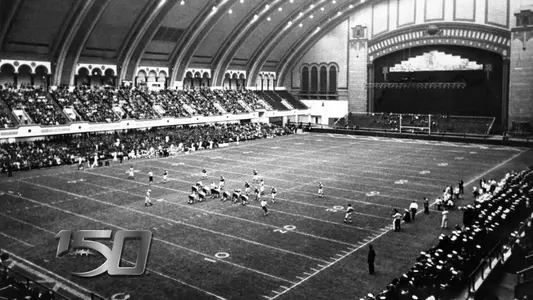
Speaking of firsts, Mountaineer football was involved in another first on Dec. 19, 1964 when it faced Utah in the Liberty Bowl in Atlantic City, New Jersey.
The venue was the Atlantic City Convention Hall, well-known site of the annual Miss America Pageant. It was the first time a major college football bowl game was ever played indoors, and wisecracking Northeastern sports reporters forced to cover the game six days before Christmas had a lot of fun with it.
Because Astroturf had yet to be invented (that would come a year later when the Houston Astrodome opened) the Atlantic City Convention Hall brought in a four-inch-thick grass surface and installed special artificial lighting to keep it alive until game time.
"Hard as hell," is how Mountaineer player Donnie Young once described it.
When Phil Pepe of the New York World Telegram found out that the Atlantic Convention Center was paying $16,000 to make sure the grass was somewhat green he quipped, "If the game is dull you can just sit there and watch the grass grow!"
The game was dull; Utah blew out West Virginia 32-6.
Philadelphia Inquirer columnist Red Smith joked, "West Virginia chose to defend the boardwalk while Utah picked the Miss America Pageant stage!"
When the contest was mercifully coming to an end, well-known Philadelphia public address announcer Dave Zinkoff wisecracked to the 6,059 in attendance, "Only two minutes left in the game … thank God!"
But what made this event significant in the history of college football was that it was the first time a postseason game had been established solely for television.
When Bud Dudley moved the Liberty Bowl from 100,000-seat JFK Stadium in Philadelphia to the 12,000-seat Convention Hall in Atlantic City, he was doing so at ABC's urging. The network used its top announcing crew, Curt Gowdy, Paul Christman and Jim McKay, to work the game. Seven cameras were utilized, which were double the camera coverage for a typical college football telecast during that time period.
In this respect, the 1964 Liberty Bowl probably established the template for the future expansion of made-for-TV college football bowl games, of which there are now 39 as of this year.
 West Virginia football was involved in one other key broadcasting innovation that took place in 1998 when it opened the season against Ohio State.
That was the first college football game ever aired in high definition, going to a small number of viewers in Columbus, Ohio. Mike Parsons, West Virginia's former deputy athletics director, recalled a separate truck, crew and announcers were used for the special HD broadcast.
"It was an experimental broadcast that aired on the CBS affiliate in Columbus only," Parsons recalled. "It was a side-by-side broadcast with CBS. There were separate cameras and announcers."
So, while Sean McDonough, Terry Donahue and Mike Mayock were calling the game on our "low-def" TVs, a handful of college football fans in Columbus got a crystal-clear view of top-ranked Ohio State's 34-17 victory over 10th-ranked West Virginia.
Today, could you imagine watching a college football game that wasn't televised in high definition?
That would be like watching Gilligan's Island in black and white, or, during those pre-Harold Arlin days at KDKA when industrious students or nutty professors used to broadcast wire service reports to information-starved football fans who couldn't wait to read about it in the Sunday morning paper.
Does the name Harold Arlin ring a bell?
Arlin worked at 50,000-watt KDKA in Pittsburgh and was one of the pioneering sports broadcasters in the early 1920s.
In the summer of 1921, he described the first professional baseball game to ever air on commercial radio (Pirates versus Phillies), the first professional tennis match at Pittsburgh's Allegheny County Club when Australia defeated Great Britain in the Davis Cup and the first professional boxing match when Jack Dempsey defeated Luis Angel Firpo in New York City.
Arlin produced the broadcast to Western Pennsylvania boxing fans by recreating wire service reports in his KDKA studio in Pittsburgh.
He was also on hand at Forbes Field on Saturday, Oct. 8, 1921, to air the first commercial radio broadcast of a college football game when Pitt played host to West Virginia.
There is considerable debate as to whom actually broadcast the first college football game. For years, the University of Pennsylvania boasted that it was the first to host a radio broadcast when the Quakers lost 9-0 to Cornell on Saturday, Nov. 22, 1922.
Michigan said its first game broadcast was 19 years prior in 1903 when UM student Jack Mattice used the Bell Telephone Company to announce a live account of Michigan's game at Minnesota to a group of students inside the University Hall Auditorium.
It was a similar deal with the Kansas-Missouri football game in 1911 when Missouri fans set up a Western Union telegraph wire in Columbia to announce what was going on over in Lawrence to a small gathering of Tiger fans.
A year later, Minnesota professor F.W. Springer did something similar to small audiences of Golden Gopher rooters.
In 1919, Dallas radio station WTAW used wire service updates to broadcast the Texas-Texas A&M game at Clark Field in Austin, and that is generally considered to be the first radio broadcast of a college football game, but the updates were not instantaneous nor was the announcer on-site.
But Arlin was the first broadcaster to actually go to the event and describe the action from the stadium. What he witnessed that afternoon was a 21-13 Pitt victory over West Virginia on a cold, rainy day.
He was among the 15,000 there to see if young, upstart WVU coach Clarence Spears could knock off Pop Warner's Pitt juggernaut. The Panthers were crowned national champion three times under Warner during a four-year period in 1915, 1916 and 1918, and Pitt was undefeated with two ties in 1920.Meanwhile, rebounding West Virginia had raised some eyebrows in the summer of 1921 when it was able to pry Spears away from Dartmouth. The rotund coach with the unflattering nickname "Fats" was considered among the game's top young mentors in the early 1920s, and he didn't take too kindly to constructive criticism.
It was said that Spears immediately despised opinionated WVU alum Fielding Yost after Yost returned to Morgantown to observe Spears' team lose the big homecoming game to arch rival Washington & Jefferson to conclude the 1921 season.
Afterward, when Yost tried to point out to Spears some of his coaching blunders, Spears told him to go take a hike, among other things. Thus, an intense coaching rivalry was born, later to be amplified when Spears moved on to Minnesota and faced Michigan on a yearly basis.
As for Pitt, it would take Fats only one year to knock off the powerful Panthers in 1922 - a 9-6 victory that was achieved when a Dayton, Ohio, ringer named Armin Mahrt dropped-kicked a 39-yard field goal to win the game. It was at the William Penn Hotel following WVU's big victory where the memorable phrase "West By Gawd Virginia!" originated.
As the story goes, "West By Gawd Virginia!" was all an inebriated West Virginia fan could blurt out upon seeing Spears and his victorious Mountaineer football team.
Radio didn't become an integral part of WVU football until the early 1940s when a group of West Virginia stations owned by John Kennedy (no, the other John Kennedy) carried the Mountaineer games in Charleston, Huntington, Clarksburg and Parkersburg.
New York native Ernie Saunders was hired to do the broadcasts.
Because radio rights were not exclusive, WAJR also aired football games locally with Charlie Snowden teaming up with former Mountaineer quarterback Kelly Moan to describe the action. Huntington's Jack Bradley and Sid Goldberg also called some games for the West Virginia Network, but it wasn't until 1947 when Jack Fleming began his tenure as the exclusive "Voice of the Mountaineers" while working for WAJR.
Since then, there have been just four regular play-by-play men for Mountaineer football – Fleming, Jay Randolph for two years in 1960-61 when his rival station WHAR pried the broadcasting rights away from WAJR, Jack Tennant for a brief time in the early 1970s when Fleming left to do play-by-play for the Chicago Bulls and now Tony Caridi.
That's amazing.
Speaking of firsts, Mountaineer football was involved in another first on Dec. 19, 1964 when it faced Utah in the Liberty Bowl in Atlantic City, New Jersey.
The venue was the Atlantic City Convention Hall, well-known site of the annual Miss America Pageant. It was the first time a major college football bowl game was ever played indoors, and wisecracking Northeastern sports reporters forced to cover the game six days before Christmas had a lot of fun with it.
Because Astroturf had yet to be invented (that would come a year later when the Houston Astrodome opened) the Atlantic City Convention Hall brought in a four-inch-thick grass surface and installed special artificial lighting to keep it alive until game time.
"Hard as hell," is how Mountaineer player Donnie Young once described it.
When Phil Pepe of the New York World Telegram found out that the Atlantic Convention Center was paying $16,000 to make sure the grass was somewhat green he quipped, "If the game is dull you can just sit there and watch the grass grow!"
The game was dull; Utah blew out West Virginia 32-6.
Philadelphia Inquirer columnist Red Smith joked, "West Virginia chose to defend the boardwalk while Utah picked the Miss America Pageant stage!"
When the contest was mercifully coming to an end, well-known Philadelphia public address announcer Dave Zinkoff wisecracked to the 6,059 in attendance, "Only two minutes left in the game … thank God!"
But what made this event significant in the history of college football was that it was the first time a postseason game had been established solely for television.
When Bud Dudley moved the Liberty Bowl from 100,000-seat JFK Stadium in Philadelphia to the 12,000-seat Convention Hall in Atlantic City, he was doing so at ABC's urging. The network used its top announcing crew, Curt Gowdy, Paul Christman and Jim McKay, to work the game. Seven cameras were utilized, which were double the camera coverage for a typical college football telecast during that time period.
In this respect, the 1964 Liberty Bowl probably established the template for the future expansion of made-for-TV college football bowl games, of which there are now 39 as of this year.
West Virginia football was involved in one other key broadcasting innovation that took place in 1998 when it opened the season against Ohio State.That was the first college football game ever aired in high definition, going to a small number of viewers in Columbus, Ohio. Mike Parsons, West Virginia's former deputy athletics director, recalled a separate truck, crew and announcers were used for the special HD broadcast.
"It was an experimental broadcast that aired on the CBS affiliate in Columbus only," Parsons recalled. "It was a side-by-side broadcast with CBS. There were separate cameras and announcers."
So, while Sean McDonough, Terry Donahue and Mike Mayock were calling the game on our "low-def" TVs, a handful of college football fans in Columbus got a crystal-clear view of top-ranked Ohio State's 34-17 victory over 10th-ranked West Virginia.
Today, could you imagine watching a college football game that wasn't televised in high definition?
That would be like watching Gilligan's Island in black and white, or, during those pre-Harold Arlin days at KDKA when industrious students or nutty professors used to broadcast wire service reports to information-starved football fans who couldn't wait to read about it in the Sunday morning paper.
Gold-Blue Spring Festival Fan Recap
Sunday, April 19
John Neider | April 18
Saturday, April 18
Coach Zac Alley | April 18
Saturday, April 18
Coach Rich Rodriguez | April 18
Saturday, April 18