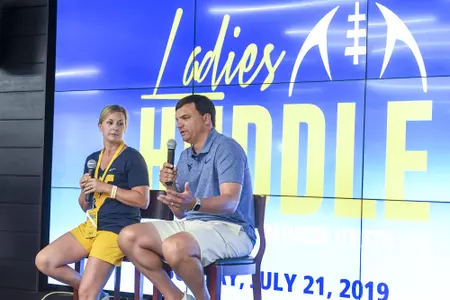
Photo by: All Pro Photography/Dale Sparks
WVU’s Brown Establishing A Foundation For Winning
July 23, 2019 12:16 PM | Football
MORGANTOWN, W.Va. – When Don Nehlen joined Bo Schembechler's Michigan coaching staff in 1977 he learned a valuable lesson about winning.
It's strictly a mind game.
Winning programs expect to win, the rest simply hope to win.
He once recalled a game Michigan played against Northwestern to illustrate his point. Nehlen was upset with the way his quarterback, Rick Leach, and the offense were going through the motions during pregame warmups and when they got back into the locker room before kickoff he ripped into his quarterback.
"Ricky was about 6-feet tall and weighed about 180 pounds, but he thought he could conquer the world," Nehlen recalled.
When Nehlen was finished yelling at Leach, the quarterback startled the coach with his response.
"Hey coach, you've got to understand something," Leach told Nehlen. "This is Michigan and at Michigan we do nothing but win. We'll be ahead by 35 or 40 at halftime and Bo can take the rest of the guys out. That's the way we think. We KNOW we're going to win and those guys HOPE they're going to win. That's the difference."
It was really no different during all of those years when Penn State used to beat West Virginia like a drum, and each year reporters would invariably ask Joe Paterno when the Mountaineers were finally going to defeat the Nittany Lions.
His answer became almost robotic: "When West Virginia gets better players than Penn State," he parroted.
It's become a similar deal now with Oklahoma – the only Big 12 program Dana Holgorsen couldn't defeat during his eight-year tenure at West Virginia.
I bring up winning because expectations are somewhat tempered in 2019 for first-year coach Neal Brown, who is overseeing West Virginia's first significant makeover since 2001 when Rich Rodriguez arrived in Morgantown.
If you recall, Rich Rod that year took over a WVU program that had somewhat plateaued during Nehlen's final four seasons in 1997, 1998, 1999 and 2000, although West Virginia did end its long bowl drought by defeating Ole Miss in the 2000 Music City Bowl.
Yet even though Nehlen's tenure had ended on a successful note, Rodriguez chose to blow things up and start over from scratch. He said West Virginia was going to "play like it's hair is on fire," and he came up with now-forgotten terms such as the "Beanie Bowl" and catchy nicknames for all of his special teams units.
Do you remember these? Punt unit – "Bomb Squad"; punt return team – "Sharks"; kickoff team – "Fire Ants"; kickoff return team – "Brick Layers."
Those terms weren't used much after the opening game of the 2001 season – a 34-10 road loss at Boston College – but it was all part of the foundation Rodriguez was laying for a program that eventually achieved the first major bowl victory in school history in 2006 (Sugar Bowl) and was on the cusp of reaching the national championship game in 2007.
Brown doesn't necessarily have to blow things up the way Rich Rod did in 2001, despite only having a handful of starters returning on each side of the ball. He says he sees the advantages of having some players in the program who are used to having some success, although perhaps not to the level that Brown expects to reach in the coming years.
"The expectations at West Virginia are you win," he said during last Tuesday's Big 12 media day in Arlington, Texas. "Those expectations translate. Our guys in our locker room expect to win. One reason they expect to win, well, we're the 14th winningest program in college football, and they've been to bowl games all but one year over the last 17."
 One of those guys in the locker room, wide receiver T.J. Simmons, was also part of a winning culture at Alabama before transferring to West Virginia.
Simmons said the winning attitude at Alabama wasn't necessarily about coach Nick Saban, but rather about the supremely confident players Saban has brought into his program.
"I remember my freshman year we were playing Ole Miss and Ole Miss went up about 17 points right before halftime," Simmons recalled. "Then we got a scoop-and-score fumble return and then somebody ran a punt back and it was like the older guys making the plays when a play needed to be made.
"It was just a routine play turning into a (game-changing) play like a sack that turns into a fumble and a touchdown."
Doesn't that sound familiar? Oklahoma game, 2019 AD, for instance.
The Sooners knew they were going to win that football game - and eventually they did!
That's what Neal Brown established at Troy and that's what he wants to establish here at West Virginia. In order to do that he's spent the last seven months listening and learning.
"I think one of the things leaders make mistakes sometimes is when they immediately go in and try and fix things and make changes," Brown explained. "I think you've got to get a good understanding first. You've got to understand who the people are, what is the organizational structure? What things have gone well? What things need improving? We've listened and now over the last four or five months we're putting in the foundation of what we want our program to be."
And those fundamental building blocks are?
"We want to build a program that's sustainable for the foreseeable future," he said. "We talk about three goals all of the time – developing men, No. 1, graduating and placing them, No. 2, and No. 3 is winning, and doing that over a long period of time.
"What does winning mean? Winning means in the month of November that you are competing for conference championships. We want to be able to do that on an annual basis and if we're doing that on an annual basis then we're going to win our share and have an opportunity to play here (AT&T Stadium) at some point."
Brown expects to win today, tomorrow and on into the future.
"I don't know how I'd feel about him if he didn't expect to win," Simmons says.
Will it happen this year? Next year? Two years from now?
Brown isn't certain.
"I've never coached a game with these guys," he said. "I've never gone through the Big 12 Conference with these guys so I really have no idea where we're at right now. I like our work ethic but I have no idea how we're going to handle adversity. We try to create adversity, whether it's workouts, spring ball or whatever it is, but when you go on the road and all of a sudden you're behind or you're at home and maybe things aren't going well and your fans are getting a little uneasy, how do you handle that?
"You don't know until you go through those things."
Even at places like Alabama there is adversity. For a while, Ole Miss for whatever reason had the Crimson Tide's number, Simmons recalled.
"Saban was always preaching that Alabama was always good after they lost a game," Simmons said. "Then they would go on a streak and he would say, 'Why do we need to go through a loss in order to get fired up to play our best ball?'"
T.J. believes the teams that are able to adapt during games are the ones that are ultimately the most successful. He insists the pathway to success this year for the Mountaineers is likely going to be through the closeness of the players.
"When the game gets down to the wire, I think we're going to be able to jell and come together as a team instead of pointing fingers or saying 'that's on you.' We're going to be a close-knit team so when things get rough we'll be good," he said.
That's good, for sure, but it's also good to have some of those players like Rick Leach running around out there as well.
Brown and his coaching staff are in the process of getting those types of guys in the program right now.
"When you have a bunch of kids who believe in themselves and believe in the program, you have a chance to win," Nehlen concluded.
Not hoping to win but expecting to win, just like their football coach.
It's strictly a mind game.
Winning programs expect to win, the rest simply hope to win.
He once recalled a game Michigan played against Northwestern to illustrate his point. Nehlen was upset with the way his quarterback, Rick Leach, and the offense were going through the motions during pregame warmups and when they got back into the locker room before kickoff he ripped into his quarterback.
"Ricky was about 6-feet tall and weighed about 180 pounds, but he thought he could conquer the world," Nehlen recalled.
When Nehlen was finished yelling at Leach, the quarterback startled the coach with his response.
"Hey coach, you've got to understand something," Leach told Nehlen. "This is Michigan and at Michigan we do nothing but win. We'll be ahead by 35 or 40 at halftime and Bo can take the rest of the guys out. That's the way we think. We KNOW we're going to win and those guys HOPE they're going to win. That's the difference."
It was really no different during all of those years when Penn State used to beat West Virginia like a drum, and each year reporters would invariably ask Joe Paterno when the Mountaineers were finally going to defeat the Nittany Lions.
His answer became almost robotic: "When West Virginia gets better players than Penn State," he parroted.
It's become a similar deal now with Oklahoma – the only Big 12 program Dana Holgorsen couldn't defeat during his eight-year tenure at West Virginia.
I bring up winning because expectations are somewhat tempered in 2019 for first-year coach Neal Brown, who is overseeing West Virginia's first significant makeover since 2001 when Rich Rodriguez arrived in Morgantown.
If you recall, Rich Rod that year took over a WVU program that had somewhat plateaued during Nehlen's final four seasons in 1997, 1998, 1999 and 2000, although West Virginia did end its long bowl drought by defeating Ole Miss in the 2000 Music City Bowl.
Yet even though Nehlen's tenure had ended on a successful note, Rodriguez chose to blow things up and start over from scratch. He said West Virginia was going to "play like it's hair is on fire," and he came up with now-forgotten terms such as the "Beanie Bowl" and catchy nicknames for all of his special teams units.
Do you remember these? Punt unit – "Bomb Squad"; punt return team – "Sharks"; kickoff team – "Fire Ants"; kickoff return team – "Brick Layers."
Those terms weren't used much after the opening game of the 2001 season – a 34-10 road loss at Boston College – but it was all part of the foundation Rodriguez was laying for a program that eventually achieved the first major bowl victory in school history in 2006 (Sugar Bowl) and was on the cusp of reaching the national championship game in 2007.
Brown doesn't necessarily have to blow things up the way Rich Rod did in 2001, despite only having a handful of starters returning on each side of the ball. He says he sees the advantages of having some players in the program who are used to having some success, although perhaps not to the level that Brown expects to reach in the coming years.
"The expectations at West Virginia are you win," he said during last Tuesday's Big 12 media day in Arlington, Texas. "Those expectations translate. Our guys in our locker room expect to win. One reason they expect to win, well, we're the 14th winningest program in college football, and they've been to bowl games all but one year over the last 17."
One of those guys in the locker room, wide receiver T.J. Simmons, was also part of a winning culture at Alabama before transferring to West Virginia.Simmons said the winning attitude at Alabama wasn't necessarily about coach Nick Saban, but rather about the supremely confident players Saban has brought into his program.
"I remember my freshman year we were playing Ole Miss and Ole Miss went up about 17 points right before halftime," Simmons recalled. "Then we got a scoop-and-score fumble return and then somebody ran a punt back and it was like the older guys making the plays when a play needed to be made.
"It was just a routine play turning into a (game-changing) play like a sack that turns into a fumble and a touchdown."
Doesn't that sound familiar? Oklahoma game, 2019 AD, for instance.
The Sooners knew they were going to win that football game - and eventually they did!
That's what Neal Brown established at Troy and that's what he wants to establish here at West Virginia. In order to do that he's spent the last seven months listening and learning.
"I think one of the things leaders make mistakes sometimes is when they immediately go in and try and fix things and make changes," Brown explained. "I think you've got to get a good understanding first. You've got to understand who the people are, what is the organizational structure? What things have gone well? What things need improving? We've listened and now over the last four or five months we're putting in the foundation of what we want our program to be."
And those fundamental building blocks are?
"We want to build a program that's sustainable for the foreseeable future," he said. "We talk about three goals all of the time – developing men, No. 1, graduating and placing them, No. 2, and No. 3 is winning, and doing that over a long period of time.
"What does winning mean? Winning means in the month of November that you are competing for conference championships. We want to be able to do that on an annual basis and if we're doing that on an annual basis then we're going to win our share and have an opportunity to play here (AT&T Stadium) at some point."
Brown expects to win today, tomorrow and on into the future.
"I don't know how I'd feel about him if he didn't expect to win," Simmons says.
Will it happen this year? Next year? Two years from now?
Brown isn't certain.
"I've never coached a game with these guys," he said. "I've never gone through the Big 12 Conference with these guys so I really have no idea where we're at right now. I like our work ethic but I have no idea how we're going to handle adversity. We try to create adversity, whether it's workouts, spring ball or whatever it is, but when you go on the road and all of a sudden you're behind or you're at home and maybe things aren't going well and your fans are getting a little uneasy, how do you handle that?
"You don't know until you go through those things."
Even at places like Alabama there is adversity. For a while, Ole Miss for whatever reason had the Crimson Tide's number, Simmons recalled.
"Saban was always preaching that Alabama was always good after they lost a game," Simmons said. "Then they would go on a streak and he would say, 'Why do we need to go through a loss in order to get fired up to play our best ball?'"
T.J. believes the teams that are able to adapt during games are the ones that are ultimately the most successful. He insists the pathway to success this year for the Mountaineers is likely going to be through the closeness of the players.
"When the game gets down to the wire, I think we're going to be able to jell and come together as a team instead of pointing fingers or saying 'that's on you.' We're going to be a close-knit team so when things get rough we'll be good," he said.
That's good, for sure, but it's also good to have some of those players like Rick Leach running around out there as well.
Brown and his coaching staff are in the process of getting those types of guys in the program right now.
"When you have a bunch of kids who believe in themselves and believe in the program, you have a chance to win," Nehlen concluded.
Not hoping to win but expecting to win, just like their football coach.
Players Mentioned

WR
/ FootballGold-Blue Spring Festival Fan Recap
Sunday, April 19
John Neider | April 18
Saturday, April 18
Coach Zac Alley | April 18
Saturday, April 18
Coach Rich Rodriguez | April 18
Saturday, April 18