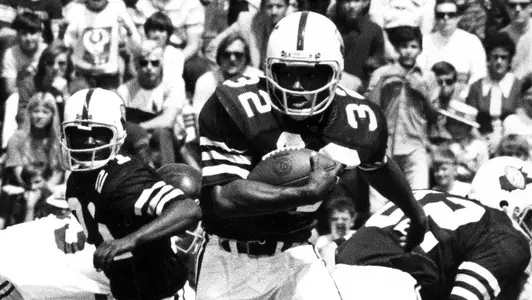
Photo by: WVU Athletic Communications
Early 1970s Star Running Back Marbury Passes Away
June 24, 2019 02:25 PM | Football
MORGANTOWN, W.Va. – One of the most explosive running backs in West Virginia University football history has died.
Kerry Marbury, who finished second in the nation in scoring to Ohio State's Harold Henson in 1972, died Sunday in Fairmont, according to social media posts and confirmed by former Mountaineer basketball player Warren Baker, who taught with Marbury at Fairmont State University.
A cause of death was not immediately known.
Marbury, a native of Carolina, West Virginia, was one of the most prolific prep running backs in Mountain State history, and the 5-foot-10, 180-pounder teamed with quarterback Nick Saban to lead Monongah High to back-to-back Class A state championships over Paden City in 1968-69.
He once gained 402 yards rushing in a game against Kingwood High for the Lions.
"Easily one of the 10 best running backs to ever play football in West Virginia," retired Wheeling Intelligencer sports editor and noted state high school sports historian Doug Huff once said.
 Marbury, also a two-time state 100-yard sprint champion in track, was recruited to WVU by Jim Carlen, but he instead played for Bobby Bowden when Carlen left West Virginia following the 1969 Peach Bowl victory over South Carolina to coach at Texas Tech.
After spending the 1970 season on the freshman team, Marbury broke into a crowded Mountaineer backfield in 1971 that included Pete Wood and Brian Chiles. Marbury ran for a school-record 291 yards in West Virginia's exciting 43-33 victory over Temple, and he finished the year leading WVU with 890 yards rushing and six touchdowns in 11 games.
During that Temple victory, Marbury had eclipsed 200 yards rushing by halftime and could have easily finished the game with more than 300 if not for suffering a leg injury in the third quarter that kept him on the sidelines for most of the period.
His single-game rushing record lasted 33 years until Kay-Jay Harris topped it with 337 yards against East Carolina in the 2004 season opener.
"I always felt I could run the trap well," Marbury once said. "If you could get past the line of scrimmage and you had any speed at all, you had an opportunity to gain a good deal of yards."
Marbury certainly had the speed, once clocking 9.6 in the 100-yard dash.
His junior campaign in 1972 saw him spend a good portion of it leading the country in touchdowns. He crossed the goal line 18 times that year, including taking the opening kickoff against Penn State 100 yards for a touchdown.
That game against the 11th-ranked Nittany Lions was televised regionally on ABC, a rarity for WVU in those days.
"I always thought that Kerry had more natural God-given ability than any other running back at West Virginia University," longtime assistant coach Donnie Young once said. "He could go from a standstill to a full sprint quicker than anyone I'd ever seen."
Marbury, quarterback Bernie Galiffa and receivers Danny Buggs, Marshall Mills and Nate Stephens gave West Virginia one of the most explosive offenses in the country in 1972. The Mountaineers ranked fourth in scoring, averaging 36.5 points per game, and eighth in total offense at 411.9 yards per contest.
Marbury's team-best 775 yards rushing that season included a season-high 175 yards against Richmond, and he led the team with 1,456 all-purpose yards – which were nearly 100 more than Buggs had that season.
West Virginia won eight regular season games before falling to NC State in the 1972 Peach Bowl in Atlanta.
Shortly after the season, Marbury opted to forgo his senior year to play professionally in the Canadian Football League. His pro career consisted of three seasons in Canada with Toronto and Ottawa and one year in the World Football League playing for the Birmingham Vulcans before the league folded in 1975.
Marbury endured heavy criticism for his decision to leave West Virginia prior to his senior season in 1973.
"I didn't have the foresight to see all of the politics involved in sports, especially at the college level," Marbury once said. "It was very confusing for me at the time. If I had known, or had better guidance, I would have stayed and finished school."
Marbury's post-professional career included a stint in prison for drugs.
"I don't mind talking about my prison experience," Marbury told reporter Bob Hertzel in 2011. "I always say prison was not an abyss for me, but the most important turning point in my life."
Soon after being paroled, Marbury began to turn his life around.
He earned his undergraduate degree at Fairmont State, where he taught a class in Race, Class and Gender, and he also worked as safety director for the university until retiring after 21 years of service in 2011.
For years, Marbury couldn't bring himself to watch West Virginia football games on television and had little contact with WVU, but his feelings for the program began to soften when Marion County native Rich Rodriguez became the coach in 2001.
Prior to his employment at Fairmont State in 1993, he even returned to WVU to complete work on a master's degree.
Marbury was 67.
Kerry Marbury, who finished second in the nation in scoring to Ohio State's Harold Henson in 1972, died Sunday in Fairmont, according to social media posts and confirmed by former Mountaineer basketball player Warren Baker, who taught with Marbury at Fairmont State University.
A cause of death was not immediately known.
Marbury, a native of Carolina, West Virginia, was one of the most prolific prep running backs in Mountain State history, and the 5-foot-10, 180-pounder teamed with quarterback Nick Saban to lead Monongah High to back-to-back Class A state championships over Paden City in 1968-69.
He once gained 402 yards rushing in a game against Kingwood High for the Lions.
"Easily one of the 10 best running backs to ever play football in West Virginia," retired Wheeling Intelligencer sports editor and noted state high school sports historian Doug Huff once said.
Marbury, also a two-time state 100-yard sprint champion in track, was recruited to WVU by Jim Carlen, but he instead played for Bobby Bowden when Carlen left West Virginia following the 1969 Peach Bowl victory over South Carolina to coach at Texas Tech.After spending the 1970 season on the freshman team, Marbury broke into a crowded Mountaineer backfield in 1971 that included Pete Wood and Brian Chiles. Marbury ran for a school-record 291 yards in West Virginia's exciting 43-33 victory over Temple, and he finished the year leading WVU with 890 yards rushing and six touchdowns in 11 games.
During that Temple victory, Marbury had eclipsed 200 yards rushing by halftime and could have easily finished the game with more than 300 if not for suffering a leg injury in the third quarter that kept him on the sidelines for most of the period.
His single-game rushing record lasted 33 years until Kay-Jay Harris topped it with 337 yards against East Carolina in the 2004 season opener.
"I always felt I could run the trap well," Marbury once said. "If you could get past the line of scrimmage and you had any speed at all, you had an opportunity to gain a good deal of yards."
Marbury certainly had the speed, once clocking 9.6 in the 100-yard dash.
His junior campaign in 1972 saw him spend a good portion of it leading the country in touchdowns. He crossed the goal line 18 times that year, including taking the opening kickoff against Penn State 100 yards for a touchdown.
That game against the 11th-ranked Nittany Lions was televised regionally on ABC, a rarity for WVU in those days.
"I always thought that Kerry had more natural God-given ability than any other running back at West Virginia University," longtime assistant coach Donnie Young once said. "He could go from a standstill to a full sprint quicker than anyone I'd ever seen."
Marbury, quarterback Bernie Galiffa and receivers Danny Buggs, Marshall Mills and Nate Stephens gave West Virginia one of the most explosive offenses in the country in 1972. The Mountaineers ranked fourth in scoring, averaging 36.5 points per game, and eighth in total offense at 411.9 yards per contest.
Marbury's team-best 775 yards rushing that season included a season-high 175 yards against Richmond, and he led the team with 1,456 all-purpose yards – which were nearly 100 more than Buggs had that season.
West Virginia won eight regular season games before falling to NC State in the 1972 Peach Bowl in Atlanta.
Shortly after the season, Marbury opted to forgo his senior year to play professionally in the Canadian Football League. His pro career consisted of three seasons in Canada with Toronto and Ottawa and one year in the World Football League playing for the Birmingham Vulcans before the league folded in 1975.
Marbury endured heavy criticism for his decision to leave West Virginia prior to his senior season in 1973.
"I didn't have the foresight to see all of the politics involved in sports, especially at the college level," Marbury once said. "It was very confusing for me at the time. If I had known, or had better guidance, I would have stayed and finished school."
Marbury's post-professional career included a stint in prison for drugs.
"I don't mind talking about my prison experience," Marbury told reporter Bob Hertzel in 2011. "I always say prison was not an abyss for me, but the most important turning point in my life."
Soon after being paroled, Marbury began to turn his life around.
He earned his undergraduate degree at Fairmont State, where he taught a class in Race, Class and Gender, and he also worked as safety director for the university until retiring after 21 years of service in 2011.
For years, Marbury couldn't bring himself to watch West Virginia football games on television and had little contact with WVU, but his feelings for the program began to soften when Marion County native Rich Rodriguez became the coach in 2001.
Prior to his employment at Fairmont State in 1993, he even returned to WVU to complete work on a master's degree.
Marbury was 67.
Gold-Blue Spring Festival Fan Recap
Sunday, April 19
John Neider | April 18
Saturday, April 18
Coach Zac Alley | April 18
Saturday, April 18
Coach Rich Rodriguez | April 18
Saturday, April 18