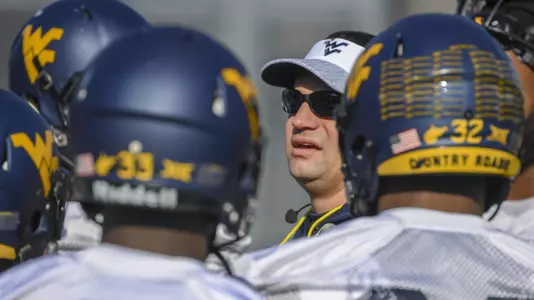
Photo by: All Pro Photography/Dale Sparks
Accountability Teams Helping Brown Learn About His Players
March 25, 2019 03:49 PM | Football
MORGANTOWN, W.Va. – West Virginia coach Neal Brown is big on accountability, so much so that he has developed an accountability system he administers to his players throughout the year.
What this entails is Brown breaking down the entire roster into 10 different competition teams with captains and assistant captains.
"They basically drafted their own teams, and then everything within the whole semester is scored and evaluated - anything from academics, strength and conditioning, community service to nutrition," Brown explained. "We try to identify some leaders to where they hold their teammates accountable."
All aspects of the Mountaineer football program are recorded, evaluated and graded.
Accountability teams earn points for each category and at the end of the semester when the final grades are posted, the winning squads will receive a small prize package.
"Basically, within the NCAA rules, we give them some gear for first, second and third," Brown said. "We carry it all the way through so we give it to them when they come back from the summer.
"So, when drafting teams, you have to draft intelligently," Brown pointed out. "You've got to think, 'Okay, who are my community service guys? Who are my academic guys? Who is going to make the biggest gains in the weight room?' Teams can gain points and lose points throughout the year."
 What Brown is doing with his accountability teams is in line with what some of the other successful coaches here at WVU once did with their players.
Many, many years ago, Bobby Bowden sort of did something similar to this with the Bomb Squad. The Bomb Squad wasn't a competition per se, but the bombers on the team were identified by the players based on their missteps over an entire year.
Each spring, the team conducted a Bomber Draft and every guy on the roster was rated from 1 to 100 based on the stupid and foolish things that they did during the year.
In the players' eyes, it was a badge of honor to be near the middle of the bomber list. Obviously, players didn't want to be the No. 1 bomber because that meant they were the team's biggest screw-up, but they also didn't want to be last on the list either because that meant they were regarded by their peers as the biggest suck-ups on the team.
The Bomb Squad was something Bowden viewed with amusement, and he thought it helped build team chemistry, much like the mat drills he later organized during the offseason at Florida State that also promoted team competition.
Don Nehlen used to have offseason basketball tournaments and weight-lifting competitions organized by strength and conditioning coach Allan Johnson.
Rich Rodriguez, too, had an offseason superstars competition that evolved from the absurd, such as the tobacco-spitting contest they once had at Glenville State, to such things as basketball tournaments at the Rec Center or belly-flop contests at the Natatorium.
These were ways to promote competition and team bonding throughout the year, particularly during the idle months when players' attention spans can sometimes wander.
But beyond the obvious, there was a hidden component to what the coaches were doing that was even more valuable to them than team bonding or figuring out which guys hate to lose.
Much like giving out your personal information to marketers when you sign up for these online contests and polls, leading to those seemingly mysterious emails promoting product X or product Y, what Brown's accountability teams are revealing is which guys are the most dependable.
"It's about doing the little things right," junior wide receiver T.J. Simmons, one of the 10 team captains, said after Saturday's practice. "Me, being one of the team captains, it's making me become more of a leader because I'm pushing guys that are on my accountability team to do more community service when they can. Make sure they are getting to their tutor appointments on time, or make sure they go to class and stay in class and not leave early.
"It's making us better overall," he explained.
 Who knows player accountability better than the players?
The coaches can guess which players are the most accountable and oftentimes they are right, but the players are almost always right on target because they are around each other all of the time.
Which guys can be counted on in the fourth quarter of a tight football game and which guys can't be counted on in similar situations?
Who is smart enough to handle information and who can't?
Who functions well under pressure; who doesn't?
Who are the true leaders on the team and who are the guys the others are willing to listen to and follow? Who are the pretenders?
Those were the things that Bobby Bowden learned when the team's No. 1 bomber was listed on the bulletin board in the locker room, or perhaps even the 15th bomber down on the list as well.
That's what Don Nehlen and Rich Rodriguez were keeping an eye on during their offseason team-bonding exercises, and that's what Neal Brown is going to figure out about this year's football team.
These accountability teams won't give Brown all of the answers he's seeking, but it does eliminate some of the guesswork that goes on each year.
It's probably better to figure some of these things out in June, July and August instead of September, October and November when the season is on the line.
What this entails is Brown breaking down the entire roster into 10 different competition teams with captains and assistant captains.
"They basically drafted their own teams, and then everything within the whole semester is scored and evaluated - anything from academics, strength and conditioning, community service to nutrition," Brown explained. "We try to identify some leaders to where they hold their teammates accountable."
All aspects of the Mountaineer football program are recorded, evaluated and graded.
Accountability teams earn points for each category and at the end of the semester when the final grades are posted, the winning squads will receive a small prize package.
"Basically, within the NCAA rules, we give them some gear for first, second and third," Brown said. "We carry it all the way through so we give it to them when they come back from the summer.
"So, when drafting teams, you have to draft intelligently," Brown pointed out. "You've got to think, 'Okay, who are my community service guys? Who are my academic guys? Who is going to make the biggest gains in the weight room?' Teams can gain points and lose points throughout the year."
What Brown is doing with his accountability teams is in line with what some of the other successful coaches here at WVU once did with their players.Many, many years ago, Bobby Bowden sort of did something similar to this with the Bomb Squad. The Bomb Squad wasn't a competition per se, but the bombers on the team were identified by the players based on their missteps over an entire year.
Each spring, the team conducted a Bomber Draft and every guy on the roster was rated from 1 to 100 based on the stupid and foolish things that they did during the year.
In the players' eyes, it was a badge of honor to be near the middle of the bomber list. Obviously, players didn't want to be the No. 1 bomber because that meant they were the team's biggest screw-up, but they also didn't want to be last on the list either because that meant they were regarded by their peers as the biggest suck-ups on the team.
The Bomb Squad was something Bowden viewed with amusement, and he thought it helped build team chemistry, much like the mat drills he later organized during the offseason at Florida State that also promoted team competition.
Don Nehlen used to have offseason basketball tournaments and weight-lifting competitions organized by strength and conditioning coach Allan Johnson.
Rich Rodriguez, too, had an offseason superstars competition that evolved from the absurd, such as the tobacco-spitting contest they once had at Glenville State, to such things as basketball tournaments at the Rec Center or belly-flop contests at the Natatorium.
These were ways to promote competition and team bonding throughout the year, particularly during the idle months when players' attention spans can sometimes wander.
But beyond the obvious, there was a hidden component to what the coaches were doing that was even more valuable to them than team bonding or figuring out which guys hate to lose.
Much like giving out your personal information to marketers when you sign up for these online contests and polls, leading to those seemingly mysterious emails promoting product X or product Y, what Brown's accountability teams are revealing is which guys are the most dependable.
"It's about doing the little things right," junior wide receiver T.J. Simmons, one of the 10 team captains, said after Saturday's practice. "Me, being one of the team captains, it's making me become more of a leader because I'm pushing guys that are on my accountability team to do more community service when they can. Make sure they are getting to their tutor appointments on time, or make sure they go to class and stay in class and not leave early.
"It's making us better overall," he explained.
Who knows player accountability better than the players? The coaches can guess which players are the most accountable and oftentimes they are right, but the players are almost always right on target because they are around each other all of the time.
Which guys can be counted on in the fourth quarter of a tight football game and which guys can't be counted on in similar situations?
Who is smart enough to handle information and who can't?
Who functions well under pressure; who doesn't?
Who are the true leaders on the team and who are the guys the others are willing to listen to and follow? Who are the pretenders?
Those were the things that Bobby Bowden learned when the team's No. 1 bomber was listed on the bulletin board in the locker room, or perhaps even the 15th bomber down on the list as well.
That's what Don Nehlen and Rich Rodriguez were keeping an eye on during their offseason team-bonding exercises, and that's what Neal Brown is going to figure out about this year's football team.
These accountability teams won't give Brown all of the answers he's seeking, but it does eliminate some of the guesswork that goes on each year.
It's probably better to figure some of these things out in June, July and August instead of September, October and November when the season is on the line.


Players Mentioned
WR
/ FootballRich Rodriguez | Dec. 3
Wednesday, December 03
Reid Carrico | Nov. 29
Saturday, November 29
Jeff Weimer | Nov. 29
Saturday, November 29
Rich Rodriguez | Nov. 29
Saturday, November 29