Photo by: WVU Athletic Communications
Injuries, Suspensions and Tragedy Once Wrecked ‘72 Hoop Season
February 28, 2019 09:00 AM | Men's Basketball, Blog
MORGANTOWN, W.Va. – Bob Hertzel recently got me thinking, as he typically does ... when was the last time injuries and suspensions had such a significant impact on a West Virginia University men's basketball season?
Of course, injuries and suspensions have played a major role in this year's disappointing record for a team that once began the year ranked 13th in the country.
A healthy Sagaba Konate and a healthy Beetle Bolden would have surely meant four or five more wins for the Mountaineers this season, maybe more. Rarely have injuries and suspensions impacted a season as they have this year for Bob Huggins' unfortunate Mountaineers.
"You are talking about four starters," he said.
Fifteen years ago, guard Drew Schifino's dismissal during John Beilein's second season at WVU certainly had an impact on the team finishing 17-14 that year.
Schifino, West Virginia's last player to average 20 points per game for a season, was once again leading the Mountaineers in scoring when he was dismissed from the team following a loss at Notre Dame.
Prior to that, WVU was sitting at 7-3 with a nice non-conference win over Maryland. Would a Schifino-in-good-standing with John Beilein have been enough to get West Virginia to the NCAA Tournament that season instead of the NIT?
Maybe.
Damian Owens' injured back during a late-season home victory over Seton Hall in 1998 contributed to the Mountaineers dropping their final two regular season games of the year at Boston College and Miami, as well as to lowly Rutgers in the Big East Tournament.
But while the loss to the Scarlet Knights damaged WVU's NCAA Tournament seeding, it actually helped give Owens the extra rest he needed to recover enough to help West Virginia make it to the Sweet 16 with victories over Temple and Cincinnati.
In 1994, 19th-ranked WVU was riding high with a 13-2 record that included big wins over Pitt, Ohio State and seventh-ranked Temple before guard Mike Boyd injured his knee.
After Boyd's injury, the Mountaineers won just three regular season games the rest of the way and a sure-fire NCAA Tournament team was relegated to making its second straight NIT appearance.
The 1993 team could have possibly been an NCAA Tournament team as well if not for the automobile accident the prior spring that claimed the leg of promising center Wilfred Kirkaldy and severely limited the effectiveness of shooting guard Lawrence Pollard for the remainder of his college career.
 Kirkaldy, a 6-foot-10, 240-pound enforcer from Brooklyn, New York, would have provided the muscle and size Gale Catlett's mid-1990s Mountaineer teams really lacked in the paint.
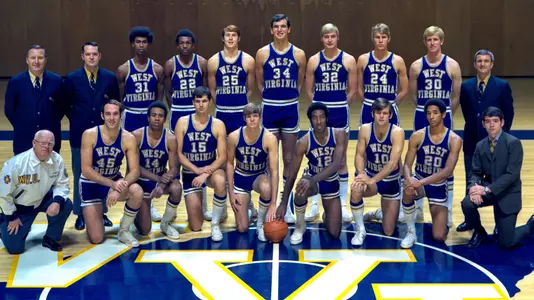
But as far as injuries and suspensions go, what Sonny Moran's team endured in 1972 probably had the most profound impact on the Mountaineer program. Moran had spent two years recruiting the necessary pieces to surround All-America guard Wil Robinson, from nearby Uniontown, Pennsylvania.
In 1970, Moran signed Charleston High stars Larry "Deacon" Harris and Levi Phillips, who led the Mountain Lions to a 72-3 record and the AAA state title in 1968.
A year later, junior college forwards Sam Oglesby and Dave Werthman were added to the Mountaineer roster to join 7-foot center Mike Heitz in the paint. By 1972, Moran had two quick guards out on the perimeter in Robinson and Phillips, athleticism on the wing in Harris and nice size near the basket with Heitz and the 6-foot-7-inch Werthman at the other forward position.
Athletic Curtis Price was Moran's first sub off the bench in the backcourt, while Oglesby was the top reserve among the forwards. Meanwhile, 6-8 Gary Reichenbecher was Heitz's backup, giving Moran a reliable replacement at each position.
This group led West Virginia to an impressive 6-0 record and a return to the top 20 following an 87-75 triumph over Norm Sloan's NC State team that featured 7-foot-4-inch center Tom Burleson. Victories over Columbia, Northwestern and a fine Terry Holland-coached Davidson team ensued.
Then, tragically, it all came crashing down in a two-week period once the calendar flipped to January. First, Moran was informed that Harris and Phillips were academically ineligible for the remainder of the season even though both players had passing grades, according to the late coach.
"All of a sudden, John Semon (head of the Physical Education department) walks into my office and told me I was going to lose two of my players," Moran recalled in 2010. "I said, 'John, damn it, we didn't have a single failing grade on our ballclub. What are you talking about losing them?'"
Semon informed Moran the department had a curriculum that required students to make adequate progress toward their degrees and neither player had done so.
"I said, 'Now wait a minute, John. Football has the entire spring semester and the whole summer to get eligible for the next year and you're hitting me at midterm with two of my players?'" Moran recalled.
In the meantime, after scoring 17 points and grabbing 12 rebounds in a close loss to Lafayette, Oglesby turned an ankle and Moran gave him permission to miss practice to join Harris for a drive down to Fairmont to have dinner with Deacon's aunt.
 The two were returning in Harris' 1961 Corvair when he lost control and struck a bridge abutment on I-79 two miles south of the U.S. 250 Interchange. Harris was killed instantly while Oglesby survived but was rendered a paraplegic.
"The state police called and said, 'Coach, we've got terrible news for you. There was an accident and Sam Oglesby is up at your hospital now, and we think the other person is Deacon Harris, but we're not sure. We want you to come down and identify him,'" Moran said. "Herb Warden was the chairman of our athletic committee, and he also worked at the hospital, so I went to the emergency room where they had drilled a hole in Sam's head and put a steel rod down his spine.
"Herb told me Sam would survive but would never walk again," Moran said. "Then I jumped in the car and took Curtis Price with me and we got over to the Fairmont Hospital. The state policeman asked me, 'Are you sure you want to do this?' I said, 'No, not particularly, but I understand you can't identify him.' We went in, and they took the sheet down, and it was Deacon. It was a terrible, terrible situation."
In a two-week period, Moran had lost his two best rebounders, Oglesby and Harris, and his top playmaker and second leading scorer Phillips.
Then, Reichenbecher broke his leg and later, emerging center Bob Hornstein suffered a collapsed lung.
Price, despite having bad knees that required him to miss a lot of practice time, had to start in the backcourt with Robinson while Heitz, who was more of a finesse player, was WVU's only remaining scoring option near the basket.
Consequently, Robinson was forced to take most of the shots – once attempting 37 in a late-season loss at Furman – and West Virginia's once promising season ended at 13-11.
It was one of only two winning seasons Moran had at WVU.
"I lost five of my top seven players and the bad part about it was they were all underclassmen," Moran explained. "It hurt us for the next two years because those were the guys waiting in the wings. Wil Robinson was once quoted in the paper saying 'Sonny had the team exactly where he wanted it' and he was right.
"I remember (the late) Mickey Furfari asking me, 'Sonny, what do you think West Virginia would have done that year if you wouldn't have lost all of those players?' I said, 'Oh, we probably would have been like 20-4.' He said, 'Who in the hell was going to beat you with that team?'" Moran said.
 To make matters worse, athletic director Red Brown had secured the Coliseum as the host site for the NCAA Tournament East Regional in 1972 and Moran felt it was made-to-order for his team that year.
"We had the ballclub we wanted," he said. "We had the right people in the right places and then to be completely wiped out like that, it destroyed us."
Ironically, the tragic car accident and Moran's inability to sign top area prospects such as Billy Knight and Tom McMillen opened the door for West Virginia to pursue Ohio University guard Bob Huggins, who transferred in the following year.
Still, Moran said he was never able to overcome what his program had endured in 1972.
"Our recruiting went downhill after that," he admitted. "Somebody once wrote me a letter that read, 'Lefty Driesell can recruit but can't coach, and you can coach but can't recruit' – and we did have trouble recruiting, there was no question about it."
Two years later, Moran was out of a job, having won just 57 of 125 games during his five seasons at West Virginia from 1970-74. He is one of only five Mountaineer coaches in school history to have a losing career record.
"That was an awful thing and I think coach Moran was right in that they didn't give him enough time to recover from it," Huggins said.
Incidentally, 27 times Moran's West Virginia teams lost by five points or less.
"We were close," he sighed.
And extremely unfortunate, too.
Of course, injuries and suspensions have played a major role in this year's disappointing record for a team that once began the year ranked 13th in the country.
A healthy Sagaba Konate and a healthy Beetle Bolden would have surely meant four or five more wins for the Mountaineers this season, maybe more. Rarely have injuries and suspensions impacted a season as they have this year for Bob Huggins' unfortunate Mountaineers.
"You are talking about four starters," he said.
Fifteen years ago, guard Drew Schifino's dismissal during John Beilein's second season at WVU certainly had an impact on the team finishing 17-14 that year.
Schifino, West Virginia's last player to average 20 points per game for a season, was once again leading the Mountaineers in scoring when he was dismissed from the team following a loss at Notre Dame.
Prior to that, WVU was sitting at 7-3 with a nice non-conference win over Maryland. Would a Schifino-in-good-standing with John Beilein have been enough to get West Virginia to the NCAA Tournament that season instead of the NIT?
Maybe.
Damian Owens' injured back during a late-season home victory over Seton Hall in 1998 contributed to the Mountaineers dropping their final two regular season games of the year at Boston College and Miami, as well as to lowly Rutgers in the Big East Tournament.
But while the loss to the Scarlet Knights damaged WVU's NCAA Tournament seeding, it actually helped give Owens the extra rest he needed to recover enough to help West Virginia make it to the Sweet 16 with victories over Temple and Cincinnati.
In 1994, 19th-ranked WVU was riding high with a 13-2 record that included big wins over Pitt, Ohio State and seventh-ranked Temple before guard Mike Boyd injured his knee.
After Boyd's injury, the Mountaineers won just three regular season games the rest of the way and a sure-fire NCAA Tournament team was relegated to making its second straight NIT appearance.
The 1993 team could have possibly been an NCAA Tournament team as well if not for the automobile accident the prior spring that claimed the leg of promising center Wilfred Kirkaldy and severely limited the effectiveness of shooting guard Lawrence Pollard for the remainder of his college career.
Kirkaldy, a 6-foot-10, 240-pound enforcer from Brooklyn, New York, would have provided the muscle and size Gale Catlett's mid-1990s Mountaineer teams really lacked in the paint.But as far as injuries and suspensions go, what Sonny Moran's team endured in 1972 probably had the most profound impact on the Mountaineer program. Moran had spent two years recruiting the necessary pieces to surround All-America guard Wil Robinson, from nearby Uniontown, Pennsylvania.
In 1970, Moran signed Charleston High stars Larry "Deacon" Harris and Levi Phillips, who led the Mountain Lions to a 72-3 record and the AAA state title in 1968.
A year later, junior college forwards Sam Oglesby and Dave Werthman were added to the Mountaineer roster to join 7-foot center Mike Heitz in the paint. By 1972, Moran had two quick guards out on the perimeter in Robinson and Phillips, athleticism on the wing in Harris and nice size near the basket with Heitz and the 6-foot-7-inch Werthman at the other forward position.
Athletic Curtis Price was Moran's first sub off the bench in the backcourt, while Oglesby was the top reserve among the forwards. Meanwhile, 6-8 Gary Reichenbecher was Heitz's backup, giving Moran a reliable replacement at each position.
This group led West Virginia to an impressive 6-0 record and a return to the top 20 following an 87-75 triumph over Norm Sloan's NC State team that featured 7-foot-4-inch center Tom Burleson. Victories over Columbia, Northwestern and a fine Terry Holland-coached Davidson team ensued.
Then, tragically, it all came crashing down in a two-week period once the calendar flipped to January. First, Moran was informed that Harris and Phillips were academically ineligible for the remainder of the season even though both players had passing grades, according to the late coach.
"All of a sudden, John Semon (head of the Physical Education department) walks into my office and told me I was going to lose two of my players," Moran recalled in 2010. "I said, 'John, damn it, we didn't have a single failing grade on our ballclub. What are you talking about losing them?'"
Semon informed Moran the department had a curriculum that required students to make adequate progress toward their degrees and neither player had done so.
"I said, 'Now wait a minute, John. Football has the entire spring semester and the whole summer to get eligible for the next year and you're hitting me at midterm with two of my players?'" Moran recalled.
In the meantime, after scoring 17 points and grabbing 12 rebounds in a close loss to Lafayette, Oglesby turned an ankle and Moran gave him permission to miss practice to join Harris for a drive down to Fairmont to have dinner with Deacon's aunt.
The two were returning in Harris' 1961 Corvair when he lost control and struck a bridge abutment on I-79 two miles south of the U.S. 250 Interchange. Harris was killed instantly while Oglesby survived but was rendered a paraplegic."The state police called and said, 'Coach, we've got terrible news for you. There was an accident and Sam Oglesby is up at your hospital now, and we think the other person is Deacon Harris, but we're not sure. We want you to come down and identify him,'" Moran said. "Herb Warden was the chairman of our athletic committee, and he also worked at the hospital, so I went to the emergency room where they had drilled a hole in Sam's head and put a steel rod down his spine.
"Herb told me Sam would survive but would never walk again," Moran said. "Then I jumped in the car and took Curtis Price with me and we got over to the Fairmont Hospital. The state policeman asked me, 'Are you sure you want to do this?' I said, 'No, not particularly, but I understand you can't identify him.' We went in, and they took the sheet down, and it was Deacon. It was a terrible, terrible situation."
In a two-week period, Moran had lost his two best rebounders, Oglesby and Harris, and his top playmaker and second leading scorer Phillips.
Then, Reichenbecher broke his leg and later, emerging center Bob Hornstein suffered a collapsed lung.
Price, despite having bad knees that required him to miss a lot of practice time, had to start in the backcourt with Robinson while Heitz, who was more of a finesse player, was WVU's only remaining scoring option near the basket.
Consequently, Robinson was forced to take most of the shots – once attempting 37 in a late-season loss at Furman – and West Virginia's once promising season ended at 13-11.
It was one of only two winning seasons Moran had at WVU.
"I lost five of my top seven players and the bad part about it was they were all underclassmen," Moran explained. "It hurt us for the next two years because those were the guys waiting in the wings. Wil Robinson was once quoted in the paper saying 'Sonny had the team exactly where he wanted it' and he was right.
"I remember (the late) Mickey Furfari asking me, 'Sonny, what do you think West Virginia would have done that year if you wouldn't have lost all of those players?' I said, 'Oh, we probably would have been like 20-4.' He said, 'Who in the hell was going to beat you with that team?'" Moran said.
To make matters worse, athletic director Red Brown had secured the Coliseum as the host site for the NCAA Tournament East Regional in 1972 and Moran felt it was made-to-order for his team that year."We had the ballclub we wanted," he said. "We had the right people in the right places and then to be completely wiped out like that, it destroyed us."
Ironically, the tragic car accident and Moran's inability to sign top area prospects such as Billy Knight and Tom McMillen opened the door for West Virginia to pursue Ohio University guard Bob Huggins, who transferred in the following year.
Still, Moran said he was never able to overcome what his program had endured in 1972.
"Our recruiting went downhill after that," he admitted. "Somebody once wrote me a letter that read, 'Lefty Driesell can recruit but can't coach, and you can coach but can't recruit' – and we did have trouble recruiting, there was no question about it."
Two years later, Moran was out of a job, having won just 57 of 125 games during his five seasons at West Virginia from 1970-74. He is one of only five Mountaineer coaches in school history to have a losing career record.
"That was an awful thing and I think coach Moran was right in that they didn't give him enough time to recover from it," Huggins said.
Incidentally, 27 times Moran's West Virginia teams lost by five points or less.
"We were close," he sighed.
And extremely unfortunate, too.
Players Mentioned
F
/ Men's BasketballCollege Basketball Crown Recap
Thursday, April 16
Ross Hodge, Honor Huff & Brenen Lorient | Oklahoma Postgame
Sunday, April 05
Ross Hodge, Treysen Eaglestaff & Brenen Lorient | Creighton Postgame
Saturday, April 04
Ross Hodge & Honor Huff | Stanford Postgame
Thursday, April 02