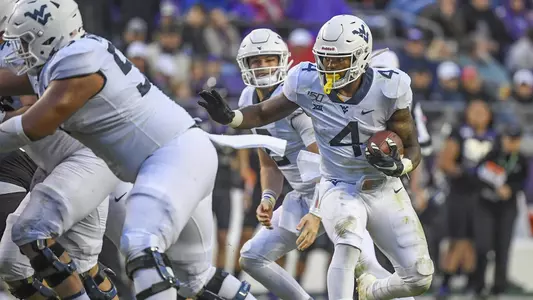
Photo by: All Pro Photography/Dale Sparks
Brown’s Top Offseason Priority – Fix WVU’s Ground Game
December 03, 2019 02:13 PM | Football, Blog
MORGANTOWN, W.Va. - Nineteen sixty eight has personal importance to me because that was the year I was born.
I don't remember anything about it – the Tet offensive, the assassinations of Dr. Martin Luther King Jr. and Robert F. Kennedy, the street riots in Chicago during the Democratic National Convention or the Apollo 8 flight that successfully circumnavigated the moon – but it was clearly a significant year in the history of our country.
It was also significant to West Virginia University football because that was the only time the Mountaineers failed to rush for at least 1,000 yards in a season.
That is until this year.
Extensive research spanning back to 1919 when team statistics were first consistently reported in newspapers reveals just six instances when West Virginia didn't rush for at least 1,200 yards in a season – 1945 (1,168), 1939 (1,161), 1960 (1,059), 1967 (1,053), 1968 (993) and this year (879).
During a two-year period in 1967 and 1968, it was nearly impossible for the Mountaineers to advance the ball on the ground in an era when running was the primary way for teams to move it. Young Mountaineer offensive coordinator Bobby Bowden had to use guile and moxie to compensate for a struggling ground attack that failed to average at least 2.5 yards per carry either season.
In '68, Bowden turned to the arm of sophomore quarterback Mike Sherwood, who responded with a then-school-record 1,998 yards passing that included a career-high 416 yards in a 38-15 victory at Pitt. But defensive-oriented head coach Jim Carlen knew his football team needed to have the ability to run the football to protect his defense and better control games, so in 1969 he ordered Bowden to switch to a veer offense that eventually morphed into the wishbone for the Peach Bowl.
Years ago, I once wrote erroneously that Bowden was the person responsible for switching to the wishbone a month before West Virginia's surprising 14-3 victory over South Carolina in Atlanta and when the late Carlen saw what I wrote, he immediately telephoned me to set the record straight.
Carlen did this quite frequently during his coaching days - Bluefield's Stubby Currence's number being the one he called most frequently. I still have the hand-scribbled notes from our conversation.
"JIM CARLEN WAS THE ONE WHO ORDERED BOBBY BOWDEN TO PUT IN THE WISHBONE FOR THE GAME!" Carlen, who died in 2012, growled.
"I made him do it because he didn't want to do it. We had running backs that year and you can't just throw the ball on every down!"
West Virginia's '68 offense ran the football 440 times for just 993 yards, which averaged out to 2.3 yards per carry and 99.3 yards per game. A year later, the rushing total more than tripled to 3,281 yards and 32 touchdowns with a talented backfield that included three professional-caliber running backs in Bob Gresham, Jim Braxton and Canadian League performer Eddie Williams.
The 10-1 Mountaineers were just one poor performance at fifth-ranked Penn State away from going to the Orange Bowl that season, so an ailing rushing attack can be fixed in a year's time - which I fully expect coach Neal Brown to do.
Actually, he's done it before.
His first team at Troy in 2015 struggled mightily to run the football, averaging 3.8 yards per rush and 119.1 yards per game that season. A year later, Brown's guys upped it to 4.5 yards per carry and 169.2 yards per game. In his final season at Troy, the rushing numbers swelled to 4.7 yards per rush and 174.1 yards per game.
Brown's first Mountaineer team averaged 2.6 yards per carry, putting them in a dubious category with just eight other teams in school history – 1929 (2.9), 1933 (2.8), 1936 (2.8), 1950 (2.3), 1960 (2.8), 1967 (2.4), 1968 (2.3) and 1978 (2.8).
Three of those – 1950, 1960 and 1978 – are considered among the worst teams in school history.
So, for Brown to win five football games in the Big 12 Conference with a team that had this level of difficulty running the football speaks volumes to his resourcefulness as a coach.
Look at what some other first-year coaches did with struggling ground games.
Bill Snyder took over a dumpster fire at Kansas State in 1989 and his first Wildcat team rushed for just 657 yards to average 59.7 yards per game. Snyder's lone victory that season was against I-AA North Texas.
His solution was to find a running quarterback until he could develop linemen big enough and strong enough to knock people off the ball. By the mid-1990s, everybody was copying Snyder's inside-zone quarterback running game, including Urban Meyer.
"The idea is I'm going to equate numbers by reading one defender," Meyer once said. "The perfect spread run has a way to attack the inside and the perimeter."
It was also an epic struggle for Kirk Ferentz's first Iowa team to run the football in 1999. The Hawkeyes averaged just 93.5 yards per contest on the ground with their only win coming against Northern Illinois.
Three years later, Ferentz had Iowa in the Rose Bowl, and he's still going strong 17 years later.
It was a similar deal with Matt Rhule at Baylor in 2017. If you recall, the Bears that season averaged just 117.3 yards per game rushing and won once, against Kansas.
This Saturday, 11-1 Baylor is playing Oklahoma in the Big 12 Championship Game with an opportunity to advance to the College Football Playoffs.
Bear in mind, West Virginia this year averaged 44 yards less per game on the ground and won four more games than the Bears did two years ago.
Speaking of the College Football Playoffs, the top four teams in this week's top 25 are all averaging better than 170 yards per game on the ground, with three of the four averaging better than 200 yards in this era of Air Raid offenses.
Back to the point, though. WVU's issues running the football actually predate Brown to 2017 when former coach Dana Holgorsen didn't renew offensive line coach Ron Crook's contract. During Crook's last season overseeing the O-line in 2016, the Mountaineers ran for 228.4 yards per game leading to 10 victories – easily West Virginia's highest win total since joining the Big 12 seven years ago.
Then came a major philosophical change and WVU's rushing total plunged to 150.6 yards per game two years ago before increasing slightly to 160.9 yards per game last season.
That was the trend going on here before Brown's arrival last January.
I had a very knowledgeable football guy, after watching one spring football practice last year, tell me that Neal Brown should be named Big 12 Coach of the Year if he can win six games with the inexperienced football team that he inherited.
Guess what?
Brown was a replay review away from winning six, and his guys were in every Big 12 game heading into the fourth quarter with the exception of Oklahoma and Texas Tech.
That bodes well for the future, as does the momentum gained from last Friday's 20-17 upset victory over two-touchdown favorite TCU that had veteran Horned Frogs coach Gary Patterson so frazzled.
And judging from the way Brown is working it right now in recruiting, reinforcements are on the way!
Indeed, it's been many, many years since 1968 when West Virginia last failed to rush for at least 1,000 yards in a season.
I know - I've lived them!
I don't remember anything about it – the Tet offensive, the assassinations of Dr. Martin Luther King Jr. and Robert F. Kennedy, the street riots in Chicago during the Democratic National Convention or the Apollo 8 flight that successfully circumnavigated the moon – but it was clearly a significant year in the history of our country.
It was also significant to West Virginia University football because that was the only time the Mountaineers failed to rush for at least 1,000 yards in a season.
That is until this year.
Extensive research spanning back to 1919 when team statistics were first consistently reported in newspapers reveals just six instances when West Virginia didn't rush for at least 1,200 yards in a season – 1945 (1,168), 1939 (1,161), 1960 (1,059), 1967 (1,053), 1968 (993) and this year (879).
During a two-year period in 1967 and 1968, it was nearly impossible for the Mountaineers to advance the ball on the ground in an era when running was the primary way for teams to move it. Young Mountaineer offensive coordinator Bobby Bowden had to use guile and moxie to compensate for a struggling ground attack that failed to average at least 2.5 yards per carry either season.
In '68, Bowden turned to the arm of sophomore quarterback Mike Sherwood, who responded with a then-school-record 1,998 yards passing that included a career-high 416 yards in a 38-15 victory at Pitt. But defensive-oriented head coach Jim Carlen knew his football team needed to have the ability to run the football to protect his defense and better control games, so in 1969 he ordered Bowden to switch to a veer offense that eventually morphed into the wishbone for the Peach Bowl.
Years ago, I once wrote erroneously that Bowden was the person responsible for switching to the wishbone a month before West Virginia's surprising 14-3 victory over South Carolina in Atlanta and when the late Carlen saw what I wrote, he immediately telephoned me to set the record straight.
Carlen did this quite frequently during his coaching days - Bluefield's Stubby Currence's number being the one he called most frequently. I still have the hand-scribbled notes from our conversation.
"JIM CARLEN WAS THE ONE WHO ORDERED BOBBY BOWDEN TO PUT IN THE WISHBONE FOR THE GAME!" Carlen, who died in 2012, growled.
"I made him do it because he didn't want to do it. We had running backs that year and you can't just throw the ball on every down!"
West Virginia's '68 offense ran the football 440 times for just 993 yards, which averaged out to 2.3 yards per carry and 99.3 yards per game. A year later, the rushing total more than tripled to 3,281 yards and 32 touchdowns with a talented backfield that included three professional-caliber running backs in Bob Gresham, Jim Braxton and Canadian League performer Eddie Williams.
The 10-1 Mountaineers were just one poor performance at fifth-ranked Penn State away from going to the Orange Bowl that season, so an ailing rushing attack can be fixed in a year's time - which I fully expect coach Neal Brown to do.
Actually, he's done it before.
His first team at Troy in 2015 struggled mightily to run the football, averaging 3.8 yards per rush and 119.1 yards per game that season. A year later, Brown's guys upped it to 4.5 yards per carry and 169.2 yards per game. In his final season at Troy, the rushing numbers swelled to 4.7 yards per rush and 174.1 yards per game.
Brown's first Mountaineer team averaged 2.6 yards per carry, putting them in a dubious category with just eight other teams in school history – 1929 (2.9), 1933 (2.8), 1936 (2.8), 1950 (2.3), 1960 (2.8), 1967 (2.4), 1968 (2.3) and 1978 (2.8).
Three of those – 1950, 1960 and 1978 – are considered among the worst teams in school history.
So, for Brown to win five football games in the Big 12 Conference with a team that had this level of difficulty running the football speaks volumes to his resourcefulness as a coach.
Look at what some other first-year coaches did with struggling ground games.
Bill Snyder took over a dumpster fire at Kansas State in 1989 and his first Wildcat team rushed for just 657 yards to average 59.7 yards per game. Snyder's lone victory that season was against I-AA North Texas.
His solution was to find a running quarterback until he could develop linemen big enough and strong enough to knock people off the ball. By the mid-1990s, everybody was copying Snyder's inside-zone quarterback running game, including Urban Meyer.
"The idea is I'm going to equate numbers by reading one defender," Meyer once said. "The perfect spread run has a way to attack the inside and the perimeter."
It was also an epic struggle for Kirk Ferentz's first Iowa team to run the football in 1999. The Hawkeyes averaged just 93.5 yards per contest on the ground with their only win coming against Northern Illinois.
Three years later, Ferentz had Iowa in the Rose Bowl, and he's still going strong 17 years later.
It was a similar deal with Matt Rhule at Baylor in 2017. If you recall, the Bears that season averaged just 117.3 yards per game rushing and won once, against Kansas.
This Saturday, 11-1 Baylor is playing Oklahoma in the Big 12 Championship Game with an opportunity to advance to the College Football Playoffs.
Bear in mind, West Virginia this year averaged 44 yards less per game on the ground and won four more games than the Bears did two years ago.
Speaking of the College Football Playoffs, the top four teams in this week's top 25 are all averaging better than 170 yards per game on the ground, with three of the four averaging better than 200 yards in this era of Air Raid offenses.
Back to the point, though. WVU's issues running the football actually predate Brown to 2017 when former coach Dana Holgorsen didn't renew offensive line coach Ron Crook's contract. During Crook's last season overseeing the O-line in 2016, the Mountaineers ran for 228.4 yards per game leading to 10 victories – easily West Virginia's highest win total since joining the Big 12 seven years ago.
Then came a major philosophical change and WVU's rushing total plunged to 150.6 yards per game two years ago before increasing slightly to 160.9 yards per game last season.
That was the trend going on here before Brown's arrival last January.
I had a very knowledgeable football guy, after watching one spring football practice last year, tell me that Neal Brown should be named Big 12 Coach of the Year if he can win six games with the inexperienced football team that he inherited.
Guess what?
Brown was a replay review away from winning six, and his guys were in every Big 12 game heading into the fourth quarter with the exception of Oklahoma and Texas Tech.
That bodes well for the future, as does the momentum gained from last Friday's 20-17 upset victory over two-touchdown favorite TCU that had veteran Horned Frogs coach Gary Patterson so frazzled.
And judging from the way Brown is working it right now in recruiting, reinforcements are on the way!
Indeed, it's been many, many years since 1968 when West Virginia last failed to rush for at least 1,000 yards in a season.
I know - I've lived them!
Gold-Blue Spring Festival Fan Recap
Sunday, April 19
John Neider | April 18
Saturday, April 18
Coach Zac Alley | April 18
Saturday, April 18
Coach Rich Rodriguez | April 18
Saturday, April 18