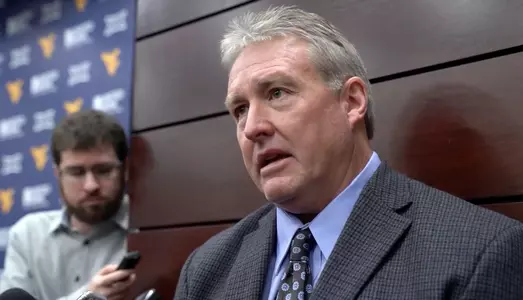
Photo by: WVU Athletic Communications
WVU’s Koenning Ready To Take on The Big 12
January 14, 2019 12:20 PM | Football, Blog
MORGANTOWN, W.Va. - The 3-3 stack defense West Virginia football fans have watched for the better part of the last 17 years is being retired.
Mountaineer football has long been known for their odd-front defenses, even during the two years Joe DeForest and Keith Patterson ran a 3-4 in 2012 and 2013.
Prior to 2002, Phil Elmassian used an even front defense during his one season at WVU in 2001, and Steve Dunlap also ran even fronts when he coordinated Don Nehlen's Mountaineer defenses in the 1990s although he did occasionally sprinkle in some odd at times.
New defensive coordinator Vic Koenning, Neal Brown's first hire last week, prefers playing a 4-2-5 alignment popularized by Bud Foster at Virginia Tech. The 4-2-5's roots actually date back to the 1970s at Murray State, Koenning explained recently.
"I'm kind of a football junkie, and I know where things came from like how you do practices schedules," he said. "Some came from Bear Bryant and others came from Hayden Fry. All of them go back to those two guys."
Koenning, 58, goes back a ways, too.
The Owasso, Oklahoma, native was a defensive lineman for Jim Dickey at Kansas State in the early 1980s before spending a couple of years in the United States Football League (USFL) with the Oklahoma and Arizona Outlaws.
Charlie Bailey gave Koenning his first coaching opportunity as a graduate assistant at Memphis State in 1986.
"I worked for a guy named Charlie Bailey, and I'll never forget what he once said - 'You get your bad players to use up all of the blockers so you can get your good players to make plays.' There's a lot of truth to that," Koenning said.
Koenning was elevated to defensive backs coach in 1991, and he spent six more seasons at Memphis before assuming the Wyoming defensive coordinator role in 1999. That eventually led to a three-year coaching tenure with the Cowboys ending in 2002.
Koenning moved back to defense where he led that side of the ball at Troy for two seasons under Larry Blakeney before Tommy Bowden hired him to coordinate Clemson's defense in 2005. At Clemson, he worked with top draft picks Tye Hill, Gaines Adams and Phillip Merling.
Koenning worked one season at his alma mater in 2009 working for Bill Snyder and then moved to Illinois where he joined Ron Zook's Illini staff. One year as Zook's defensive coordinator and another with a portion of it serving as Illinois' interim coach preceded three seasons working for Larry Fedora at North Carolina.
Koenning's last four years of employment were at Troy working for Brown.
"Vic has coached in many different conferences including the Big 12, Big Ten, ACC and Sun Belt," Brown said. "He has been a head coach at the collegiate level, and I am excited to bring his coaching experience to West Virginia."
Now, Koenning gets an opportunity to defend some of the most dynamic and explosive offenses in the country in the Big 12.
"I interviewed at Oklahoma State last year and didn't get the job, they hired (Jim) Knowles, and a friend of mine on that staff said it's (the Big 12) a graveyard (for defensive coaches), so we'll see," Koenning said.
His defenses are known for being aggressive and creating turnovers. The Trojans' 106 takeaways over the last four years were second among FBS schools and his defense's 20.8 points per game gave over the last three seasons ranks fourth-best among non-Power 5 schools.
Last year, Troy had the best red zone defense in the Sun Belt and also ranked first in in the conference in sacks, interceptions and total turnovers.
"The best way of saying what we're going to do is to try and make the other team feel like they're playing against 13, 14 guys," he said. "We're going to try and be everywhere and nowhere – show this and be that.
"In today's college football you have to play with a minus box a lot, which means you've got to be susceptible to the run just to be able to cover the perimeter," Koenning explained. "Spread offenses like to use that 53 1/3 yards, so you have to be able to put backstops to it somewhere."
Koenning said it's no secret the success to any defense is predicated by how your players perform up front. The main reason West Virginia went to a three-man defensive front 17 years ago under Rich Rodriguez was because the Mountaineers struggled to attract talented defensive linemen.
The 3-3 stack scheme was able to mask some of that a little bit.
"We're going to have to get really, really good up front," Koenning explained. "We're a gap-control (defense). I'm not a two-gap guy. When I was at Clemson I tried to make sure we were blitzing 27 percent of the time – I always wanted to hit 27. A prime example, in our bowl game (against Buffalo) I blitzed more and played more man against the best quarterback and the best receivers we saw all year. It really depends on what your game plan in and what you're trying to accomplish."
Koenning said he will develop a more concrete plan for his defense once he gets an opportunity to evaluate what his players can do on the field.
"It's going to be a process," he said. "Let's not lose sight of this. You've got to be able to bend your knees, you've got to be able to have balance, you've got to be able to tackle and if you are a defensive back you've got to be able to play the ball. And you can't be a coward. There are three kinds of football players – ones that seek contact, ones that tolerate contact and ones that avoid contact."
Koenning continued, "I can't do with the avoiders. Those who tolerate we can kind of shame them into being seekers, but you've got to be able to play the ball. You've got to be able to use your hands on the defensive line and we don't need guys that have dead legs and just take up space."
The veteran coach mentioned that it's also important to practice tackling every day. Today, a lot of coaches are steering clear of having too much contact during practice for fear of getting key players hurt before they reach Saturday.
It's kind of like teaching your kids how to drive in snow. If you have them avoid driving in snow for fear of getting into an accident, how are they ever going to learn how to drive in the snow?
To be a good tackler, you have to tackle.
"We're going to tackle every day," Koenning said. "Coach Brown is going to have something in the practice schedule for that and there will be something called a 'program period' when we're learning how to get the ball out. We'll practice that every day.
"You work on those fundamentals and you work on transition in the secondary, you work on pad level, hip flexibility … there is more that goes into that. That's why all of these buildings are here and that's why that weight room is here. All of this stuff is to teach these guys how to be better and we're going to make sure they get every opportunity to get better."
Koenning predicted the players will experience a smooth transition to Neal Brown because his approach is so nurturing.
"People are not going to believe his plan," Koenning said. "It's so intricate and so detailed. It's so parenting.
"We're going to get our guys playing hard - and I think they've done that here," Koenning added. "Coach (Tony) Gibson did a lot of fundamental stuff really well. It's going to be a fun transition. It's going to be different, but the caring part, the nurturing part and the loving part … I don't think I've had five players in my whole career who didn't feel good about their experience."
Mountaineer football has long been known for their odd-front defenses, even during the two years Joe DeForest and Keith Patterson ran a 3-4 in 2012 and 2013.
Prior to 2002, Phil Elmassian used an even front defense during his one season at WVU in 2001, and Steve Dunlap also ran even fronts when he coordinated Don Nehlen's Mountaineer defenses in the 1990s although he did occasionally sprinkle in some odd at times.
New defensive coordinator Vic Koenning, Neal Brown's first hire last week, prefers playing a 4-2-5 alignment popularized by Bud Foster at Virginia Tech. The 4-2-5's roots actually date back to the 1970s at Murray State, Koenning explained recently.
"I'm kind of a football junkie, and I know where things came from like how you do practices schedules," he said. "Some came from Bear Bryant and others came from Hayden Fry. All of them go back to those two guys."
Koenning, 58, goes back a ways, too.
The Owasso, Oklahoma, native was a defensive lineman for Jim Dickey at Kansas State in the early 1980s before spending a couple of years in the United States Football League (USFL) with the Oklahoma and Arizona Outlaws.
Charlie Bailey gave Koenning his first coaching opportunity as a graduate assistant at Memphis State in 1986.
"I worked for a guy named Charlie Bailey, and I'll never forget what he once said - 'You get your bad players to use up all of the blockers so you can get your good players to make plays.' There's a lot of truth to that," Koenning said.
Koenning was elevated to defensive backs coach in 1991, and he spent six more seasons at Memphis before assuming the Wyoming defensive coordinator role in 1999. That eventually led to a three-year coaching tenure with the Cowboys ending in 2002.
Koenning moved back to defense where he led that side of the ball at Troy for two seasons under Larry Blakeney before Tommy Bowden hired him to coordinate Clemson's defense in 2005. At Clemson, he worked with top draft picks Tye Hill, Gaines Adams and Phillip Merling.
Koenning worked one season at his alma mater in 2009 working for Bill Snyder and then moved to Illinois where he joined Ron Zook's Illini staff. One year as Zook's defensive coordinator and another with a portion of it serving as Illinois' interim coach preceded three seasons working for Larry Fedora at North Carolina.
Koenning's last four years of employment were at Troy working for Brown.
"Vic has coached in many different conferences including the Big 12, Big Ten, ACC and Sun Belt," Brown said. "He has been a head coach at the collegiate level, and I am excited to bring his coaching experience to West Virginia."
Now, Koenning gets an opportunity to defend some of the most dynamic and explosive offenses in the country in the Big 12.
"I interviewed at Oklahoma State last year and didn't get the job, they hired (Jim) Knowles, and a friend of mine on that staff said it's (the Big 12) a graveyard (for defensive coaches), so we'll see," Koenning said.
His defenses are known for being aggressive and creating turnovers. The Trojans' 106 takeaways over the last four years were second among FBS schools and his defense's 20.8 points per game gave over the last three seasons ranks fourth-best among non-Power 5 schools.
Last year, Troy had the best red zone defense in the Sun Belt and also ranked first in in the conference in sacks, interceptions and total turnovers.
"The best way of saying what we're going to do is to try and make the other team feel like they're playing against 13, 14 guys," he said. "We're going to try and be everywhere and nowhere – show this and be that.
"In today's college football you have to play with a minus box a lot, which means you've got to be susceptible to the run just to be able to cover the perimeter," Koenning explained. "Spread offenses like to use that 53 1/3 yards, so you have to be able to put backstops to it somewhere."
Koenning said it's no secret the success to any defense is predicated by how your players perform up front. The main reason West Virginia went to a three-man defensive front 17 years ago under Rich Rodriguez was because the Mountaineers struggled to attract talented defensive linemen.
The 3-3 stack scheme was able to mask some of that a little bit.
"We're going to have to get really, really good up front," Koenning explained. "We're a gap-control (defense). I'm not a two-gap guy. When I was at Clemson I tried to make sure we were blitzing 27 percent of the time – I always wanted to hit 27. A prime example, in our bowl game (against Buffalo) I blitzed more and played more man against the best quarterback and the best receivers we saw all year. It really depends on what your game plan in and what you're trying to accomplish."
Koenning said he will develop a more concrete plan for his defense once he gets an opportunity to evaluate what his players can do on the field.
"It's going to be a process," he said. "Let's not lose sight of this. You've got to be able to bend your knees, you've got to be able to have balance, you've got to be able to tackle and if you are a defensive back you've got to be able to play the ball. And you can't be a coward. There are three kinds of football players – ones that seek contact, ones that tolerate contact and ones that avoid contact."
Koenning continued, "I can't do with the avoiders. Those who tolerate we can kind of shame them into being seekers, but you've got to be able to play the ball. You've got to be able to use your hands on the defensive line and we don't need guys that have dead legs and just take up space."
The veteran coach mentioned that it's also important to practice tackling every day. Today, a lot of coaches are steering clear of having too much contact during practice for fear of getting key players hurt before they reach Saturday.
It's kind of like teaching your kids how to drive in snow. If you have them avoid driving in snow for fear of getting into an accident, how are they ever going to learn how to drive in the snow?
To be a good tackler, you have to tackle.
"We're going to tackle every day," Koenning said. "Coach Brown is going to have something in the practice schedule for that and there will be something called a 'program period' when we're learning how to get the ball out. We'll practice that every day.
"You work on those fundamentals and you work on transition in the secondary, you work on pad level, hip flexibility … there is more that goes into that. That's why all of these buildings are here and that's why that weight room is here. All of this stuff is to teach these guys how to be better and we're going to make sure they get every opportunity to get better."
Koenning predicted the players will experience a smooth transition to Neal Brown because his approach is so nurturing.
"People are not going to believe his plan," Koenning said. "It's so intricate and so detailed. It's so parenting.
"We're going to get our guys playing hard - and I think they've done that here," Koenning added. "Coach (Tony) Gibson did a lot of fundamental stuff really well. It's going to be a fun transition. It's going to be different, but the caring part, the nurturing part and the loving part … I don't think I've had five players in my whole career who didn't feel good about their experience."

Ryan Ward | April 6
Monday, April 06
Coach Ryan Garrett | April 6
Monday, April 06
Coach Rich Rodriguez | April 6
Monday, April 06
Geimere Latimer | April 2
Thursday, April 02