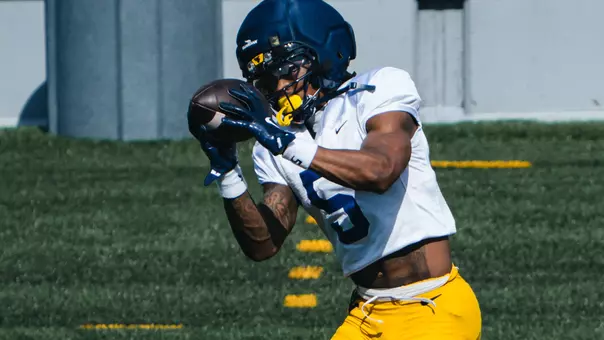
Photo by: Ben Queen
Holgorsen Hopes Bigelow, Robinson Continue WVU's Grad Transfer Success
May 15, 2018 12:51 PM | Football
MORGANTOWN, W.Va. - There are no trademarks on good ideas in college football. If somebody comes up with something good, you can bet others will soon copy it.
A few years ago, West Virginia's Dana Holgorsen decided he was going to reclaim his sanity by not sweating out signing day anymore.
He chose to take a pass on all those hat-flippers whose desire for attention was getting a little over the top. Besides, most of the hat-flippers were often putting down the flying WV to put on another team's hat, usually Alabama, Clemson, Oklahoma, Ohio State, USC, Michigan, Georgia, etc.
So why waste all the time, energy and resources on those players, Holgorsen reasoned?
"Signing day used to be stressful for me," he explained earlier this spring. "I was like, 'We've got to get 20 guys. We've got to get 25 guys and if we came up three or four short I would go home and be all stressed out. Now, I don't even care anymore on signing day because whatever we get we're going to have it."
His solution: look for other ways to build his roster. And build it throughout the entire year, not just on signing day.
Keep your eyes open for good players who are buried deep on the depth charts at other four-year schools, guys such as quarterback Clint Trickett, who became a two-year letterman for the Mountaineers in 2013-14 after graduating early at Florida State.
Trickett passed for 3,285 yards and 18 touchdowns in 11 games before a late-season concussion ended his college career before WVU's Liberty Bowl loss to Texas A&M.
Keep an eye out for guys with skills that match your system, such as Houston's Charles Sims, who decided to see how his skills would stack up in the Big 12.
Sims spent his final year of college at West Virginia in 2013 and became Holgorsen's first 1,000-yard rusher at WVU with 1,095 yards and an impressive 5.3 yards-per-carry average. He also caught 45 passes for 401 yards and that versatility is still on display in the NFL with the Tampa Bay Buccaneers.
Look for players at smaller schools with a hunger to shine on a much bigger stage, such as Gardner-Webb defensive end Shaq Riddick. The Akron, Ohio, resident was brought here in 2014 to rush the passer and he delivered by leading the team with seven sacks and finishing second on the team in tackles for losses with 11.
Riddick was a fifth-round draft choice of the Arizona Cardinals and spent two seasons there before being released last year.
Hunt for guys capable of filling an immediate need, such as Iowa's Maurice Fleming, who was in on 48 tackles and a couple of TFLs. His interception at the goal line late in the game helped preserve West Virginia's 35-32 victory over BYU at FedEx Field in 2016.
Devon Brown did something similar during Holgorsen's first season at WVU in 2011 when the Mountaineers lacked wide receiver depth. Brown, a graduate transfer from Wake Forest, caught 29 passes for 401 yards and scored one of West Virginia's many touchdowns in the 70-33 victory over Clemson in the 2012 Orange Bowl.
Perhaps West Virginia's most successful graduate transfer was free safety Ryan Mundy, who predated Holgorsen by a couple of years in 2007, but not current defensive coordinator Tony Gibson.
Gibson was WVU's secondary coach that year, and he watched Mundy make 62 tackles and pick off three passes to help the Mountaineers to a Big East championship and a Fiesta Bowl victory over Oklahoma. Mundy played eight years in the NFL with the Pittsburgh Steelers, New York Giants and Chicago Bears before retiring after the 2015 season.
Mundy's background at Michigan was somewhat similar to the two graduate transfers West Virginia has signed so far this spring - USC defensive lineman Kenny Bigelow and Clemson defensive lineman Jabril Robinson - talented players from high-major programs looking for a change of scenery.
Bigelow was a top-25 national recruit who never quite lived up to his lofty high school reputation for the Trojans, mostly because of two major knee injuries. He considered retiring from football until the NCAA awarded him a sixth season of eligibility last fall so he decided to take advantage of West Virginia's offer to come in and fortify its defensive line this season.
Bigelow is just like his name suggests - a very big football player standing 6-feet-3 inches and weighing 303 pounds. A lack of size up front was one of the biggest detriments to West Virginia's defense in 2017, and Bigelow will certainly help there if he can remain healthy.
Robinson is another intriguing defender brought in to give WVU much-needed athleticism on the D-line. The 270-pounder had 19 tackles in 11 games last year at Clemson, but he was playing behind four guys expected to go high in next year's NFL Draft.
One reporter who covers the Tigers recently stated that Robinson was probably good enough to start at 127 out of the 129 Division I programs in the country. Besides Clemson, presumably the other one he was inferring was national champion Alabama.
Robinson is not quite as tall as the 6-foot-6-inch Riddick, but he is expected to be the same type of disruptive player on the edge that Riddick was.
Other Big 12 schools have taken notice of the success West Virginia has had with graduate transfers and are now following suit. All but Oklahoma and Iowa State have brought in graduate transfers this year, including two each at Texas, Texas Tech, Baylor and Kansas.
Oklahoma State has added just one so far, but the one they are adding may end taking over the Cowboy offense in Hawaii quarterback Dru Brown.
 "It's incredibly competitive and it's getting more competitive," Holgorsen said of recruiting graduate transfers. "That market is continuing to grow. There have been talks in our head coach meetings of getting rid of the rule, and I think it's going to continue to be talked about, but it's not going to go away, which makes it more competitive. I think we're marked as a program that's had success with those guys and will continue to be marked when it comes to those guys coming in and being successful."
Holgorsen may not have been the first coach to start pursuing graduate transfers, but he was among the early ones who has had an impressive track record of success with them.
The two he's added so far this spring should supplement an already talented returning roster and give West Virginia's defense a big boost this fall.
At least that's Holgorsen's hope, anyway.
Either way he's not going to lose much sleep over signing day anymore, thanks to the success he's had with graduate transfers.
A few years ago, West Virginia's Dana Holgorsen decided he was going to reclaim his sanity by not sweating out signing day anymore.
He chose to take a pass on all those hat-flippers whose desire for attention was getting a little over the top. Besides, most of the hat-flippers were often putting down the flying WV to put on another team's hat, usually Alabama, Clemson, Oklahoma, Ohio State, USC, Michigan, Georgia, etc.
So why waste all the time, energy and resources on those players, Holgorsen reasoned?
"Signing day used to be stressful for me," he explained earlier this spring. "I was like, 'We've got to get 20 guys. We've got to get 25 guys and if we came up three or four short I would go home and be all stressed out. Now, I don't even care anymore on signing day because whatever we get we're going to have it."
His solution: look for other ways to build his roster. And build it throughout the entire year, not just on signing day.
Keep your eyes open for good players who are buried deep on the depth charts at other four-year schools, guys such as quarterback Clint Trickett, who became a two-year letterman for the Mountaineers in 2013-14 after graduating early at Florida State.
Trickett passed for 3,285 yards and 18 touchdowns in 11 games before a late-season concussion ended his college career before WVU's Liberty Bowl loss to Texas A&M.
Keep an eye out for guys with skills that match your system, such as Houston's Charles Sims, who decided to see how his skills would stack up in the Big 12.
Sims spent his final year of college at West Virginia in 2013 and became Holgorsen's first 1,000-yard rusher at WVU with 1,095 yards and an impressive 5.3 yards-per-carry average. He also caught 45 passes for 401 yards and that versatility is still on display in the NFL with the Tampa Bay Buccaneers.
Look for players at smaller schools with a hunger to shine on a much bigger stage, such as Gardner-Webb defensive end Shaq Riddick. The Akron, Ohio, resident was brought here in 2014 to rush the passer and he delivered by leading the team with seven sacks and finishing second on the team in tackles for losses with 11.
Riddick was a fifth-round draft choice of the Arizona Cardinals and spent two seasons there before being released last year.
Hunt for guys capable of filling an immediate need, such as Iowa's Maurice Fleming, who was in on 48 tackles and a couple of TFLs. His interception at the goal line late in the game helped preserve West Virginia's 35-32 victory over BYU at FedEx Field in 2016.
Devon Brown did something similar during Holgorsen's first season at WVU in 2011 when the Mountaineers lacked wide receiver depth. Brown, a graduate transfer from Wake Forest, caught 29 passes for 401 yards and scored one of West Virginia's many touchdowns in the 70-33 victory over Clemson in the 2012 Orange Bowl.
Perhaps West Virginia's most successful graduate transfer was free safety Ryan Mundy, who predated Holgorsen by a couple of years in 2007, but not current defensive coordinator Tony Gibson.
Gibson was WVU's secondary coach that year, and he watched Mundy make 62 tackles and pick off three passes to help the Mountaineers to a Big East championship and a Fiesta Bowl victory over Oklahoma. Mundy played eight years in the NFL with the Pittsburgh Steelers, New York Giants and Chicago Bears before retiring after the 2015 season.
Mundy's background at Michigan was somewhat similar to the two graduate transfers West Virginia has signed so far this spring - USC defensive lineman Kenny Bigelow and Clemson defensive lineman Jabril Robinson - talented players from high-major programs looking for a change of scenery.
Bigelow was a top-25 national recruit who never quite lived up to his lofty high school reputation for the Trojans, mostly because of two major knee injuries. He considered retiring from football until the NCAA awarded him a sixth season of eligibility last fall so he decided to take advantage of West Virginia's offer to come in and fortify its defensive line this season.
Bigelow is just like his name suggests - a very big football player standing 6-feet-3 inches and weighing 303 pounds. A lack of size up front was one of the biggest detriments to West Virginia's defense in 2017, and Bigelow will certainly help there if he can remain healthy.
Robinson is another intriguing defender brought in to give WVU much-needed athleticism on the D-line. The 270-pounder had 19 tackles in 11 games last year at Clemson, but he was playing behind four guys expected to go high in next year's NFL Draft.
One reporter who covers the Tigers recently stated that Robinson was probably good enough to start at 127 out of the 129 Division I programs in the country. Besides Clemson, presumably the other one he was inferring was national champion Alabama.
Robinson is not quite as tall as the 6-foot-6-inch Riddick, but he is expected to be the same type of disruptive player on the edge that Riddick was.
Other Big 12 schools have taken notice of the success West Virginia has had with graduate transfers and are now following suit. All but Oklahoma and Iowa State have brought in graduate transfers this year, including two each at Texas, Texas Tech, Baylor and Kansas.
Oklahoma State has added just one so far, but the one they are adding may end taking over the Cowboy offense in Hawaii quarterback Dru Brown.
"It's incredibly competitive and it's getting more competitive," Holgorsen said of recruiting graduate transfers. "That market is continuing to grow. There have been talks in our head coach meetings of getting rid of the rule, and I think it's going to continue to be talked about, but it's not going to go away, which makes it more competitive. I think we're marked as a program that's had success with those guys and will continue to be marked when it comes to those guys coming in and being successful."Holgorsen may not have been the first coach to start pursuing graduate transfers, but he was among the early ones who has had an impressive track record of success with them.
The two he's added so far this spring should supplement an already talented returning roster and give West Virginia's defense a big boost this fall.
At least that's Holgorsen's hope, anyway.
Either way he's not going to lose much sleep over signing day anymore, thanks to the success he's had with graduate transfers.


Mic'd Up with Coach Rich Rodriguez
Wednesday, April 15
Jaden Bray | April 13
Monday, April 13
Coach Travis Trickett | April 13
Monday, April 13
Coach Rich Rodriguez | April 13
Monday, April 13