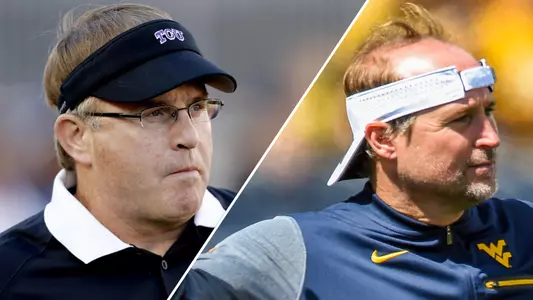
WVU-TCU Similarities Run Deep
October 02, 2017 07:18 PM | Football
West Virginia probably has more in common with TCU than it does any other football program in the Big 12.
In the 2000s, West Virginia and TCU were among the most successful teams not affiliated with one of today's Power 5 conferences. The Horned Frogs frequently ruled the roost in the Mountain West while West Virginia usually finished near the top of the Big East.
Then in 2011, when conference switching was becoming the norm, TCU first opted to go to the Big East before Texas A&M announced it was leaving the Big 12 for the SEC.
That opened the door for the Horned Frogs to get back to their geographical roots in the Big 12.
A couple of months later, Missouri's departure for the SEC provided an avenue for West Virginia to return to college football's big table in the Big 12.
"What is funny is that TCU actually joined the Big East before we left to go to the Big 12," West Virginia coach Dana Holgorsen recalled Monday morning. "We were at the Big East media day in (Newport, Rhode Island) and TCU was a part of that for about two months and then they went to the Big 12. We went about two months after that."
The Mountaineers had their seat at the big table during the years they played as Eastern independents in the 1970s and 1980s, and then once again in the 1990s and early 2000s when the Big East was still the Big East.
TCU was in a similar situation during all those years it was in the Southwest Conference until the league dissolved after the 1995 season. After that it was the WAC, then Conference USA and finally the Mountain West for 17 years of purgatory before finally making it back to the pearly gates of football heaven.
"As a university and as a city, I think going into the Big 12 totally changed the outlook of everything that has happened in Fort Worth and at TCU - not just in athletics but in academics and all the rest," TCU coach Gary Patterson explained. "I don't know where TCU would be right now if we weren't in the Big 12; I don't think it's close to being a comparison."
Since 2012, both programs have had their moments in the league - the Horned Frogs in 2014-15 and West Virginia last season.
The two teams had identical records in 2012 (7-6) and 2013 (4-8) before TCU rediscovered its dominance with quarterback Trevone Boykin, who led it to a 23-3 overall record and a pair of top 10 finishes in 2014-15.
Then, the Frogs took a step back with another losing campaign in 2016, although they did play in the Liberty Bowl.
"I said the day it was announced that we were let into the Big 12 that the foundation of TCU was set and it was so much better," Patterson said. "My job and probably the basketball coach's job got a lot harder just because of the level of talent and the level of competition and the things you have to do, but that was okay with me."
West Virginia, meanwhile, plodded along with 7-6 and 8-5 records in 2014-15 before finally breaking through with 10 regular season victories, a trip to the Russell Athletic Bowl and its first top 25 finish in five years in 2016.
"We both came in with high expectations, used to winning, winning tradition and all that," Holgorsen noted. "We finished 7-5 the first year and then the next year we were both 4-8 and I just think it took a couple of years to get the depth where we needed it to be.
"I look at TCU's roster right now and they're playing two- and three-deep. They've just really done a great job with their depth, built it up the right way and increased their facilities and their recruiting as well, which is the same stuff we've done, honestly," he added. "We've had some good battles and I think we've both grown the same way, which has been cool to watch."
"Just like coach Holgorsen said … depth and the amount of players you have access to," Patterson said. "I think we're still in the process. We're only six years into this whole situation. For us it's about continuing to grow and being able to do it every year instead of doing it every couple of years. Then your twos and your threes are a lot better. We've always had good ones through the years - we've had some really good players - the key is the guy that took their place.
"We've got to continue to recruit and to market our brand and grow and do those kinds of things," Patterson said.
The overall records are also very similar. TCU has a 44-24 record since joining the Big 12, including a 26-20 mark in league play. West Virginia is now 39-29 with a 23-23 mark in conference action following its 56-34 win at Kansas two weeks ago.
Both programs have made four bowl appearances. For TCU, it was the Buffalo Wild Wings in 2012, Chick-fil-A in 2014, Alamo in 2015 and the Liberty last year. WVU's four trips were to the Pinstripe in 2012, Liberty in 2014, Cactus in 2015 and Russell Athletic last season.
Both are still seeking their first trips to college football's playoff.
And, of course, three of the five head-to-head games have been extremely close.
TCU overcame a 24-14 third-quarter deficit to defeat West Virginia, 39-38, in double overtime in Morgantown in 2012.
In 2013, West Virginia won the battle of two losing teams when it outlasted the Horned Frogs, 30-27, in overtime, overcoming a 17-3 first-quarter deficit in the process.
Three years ago, 10th-ranked TCU roared back from 13 points down midway through the third quarter to defeat West Virginia in Morgantown on the game's final play when Jaden Oberkrom kicked a 37-yard field goal.
The last two meetings have been blowouts - TCU winning by 30 in Fort Worth in 2015 and West Virginia returning the favor with a 24-point victory in Morgantown in 2016.
So, will Saturday's game in Fort Worth end in similar fashion, or will it be another one of those down-to-the-wire affairs?
In the 2000s, West Virginia and TCU were among the most successful teams not affiliated with one of today's Power 5 conferences. The Horned Frogs frequently ruled the roost in the Mountain West while West Virginia usually finished near the top of the Big East.
Then in 2011, when conference switching was becoming the norm, TCU first opted to go to the Big East before Texas A&M announced it was leaving the Big 12 for the SEC.
That opened the door for the Horned Frogs to get back to their geographical roots in the Big 12.
A couple of months later, Missouri's departure for the SEC provided an avenue for West Virginia to return to college football's big table in the Big 12.
"What is funny is that TCU actually joined the Big East before we left to go to the Big 12," West Virginia coach Dana Holgorsen recalled Monday morning. "We were at the Big East media day in (Newport, Rhode Island) and TCU was a part of that for about two months and then they went to the Big 12. We went about two months after that."
The Mountaineers had their seat at the big table during the years they played as Eastern independents in the 1970s and 1980s, and then once again in the 1990s and early 2000s when the Big East was still the Big East.
TCU was in a similar situation during all those years it was in the Southwest Conference until the league dissolved after the 1995 season. After that it was the WAC, then Conference USA and finally the Mountain West for 17 years of purgatory before finally making it back to the pearly gates of football heaven.
"As a university and as a city, I think going into the Big 12 totally changed the outlook of everything that has happened in Fort Worth and at TCU - not just in athletics but in academics and all the rest," TCU coach Gary Patterson explained. "I don't know where TCU would be right now if we weren't in the Big 12; I don't think it's close to being a comparison."
Since 2012, both programs have had their moments in the league - the Horned Frogs in 2014-15 and West Virginia last season.
The two teams had identical records in 2012 (7-6) and 2013 (4-8) before TCU rediscovered its dominance with quarterback Trevone Boykin, who led it to a 23-3 overall record and a pair of top 10 finishes in 2014-15.
Then, the Frogs took a step back with another losing campaign in 2016, although they did play in the Liberty Bowl.
"I said the day it was announced that we were let into the Big 12 that the foundation of TCU was set and it was so much better," Patterson said. "My job and probably the basketball coach's job got a lot harder just because of the level of talent and the level of competition and the things you have to do, but that was okay with me."
West Virginia, meanwhile, plodded along with 7-6 and 8-5 records in 2014-15 before finally breaking through with 10 regular season victories, a trip to the Russell Athletic Bowl and its first top 25 finish in five years in 2016.
"We both came in with high expectations, used to winning, winning tradition and all that," Holgorsen noted. "We finished 7-5 the first year and then the next year we were both 4-8 and I just think it took a couple of years to get the depth where we needed it to be.
"I look at TCU's roster right now and they're playing two- and three-deep. They've just really done a great job with their depth, built it up the right way and increased their facilities and their recruiting as well, which is the same stuff we've done, honestly," he added. "We've had some good battles and I think we've both grown the same way, which has been cool to watch."
"Just like coach Holgorsen said … depth and the amount of players you have access to," Patterson said. "I think we're still in the process. We're only six years into this whole situation. For us it's about continuing to grow and being able to do it every year instead of doing it every couple of years. Then your twos and your threes are a lot better. We've always had good ones through the years - we've had some really good players - the key is the guy that took their place.
"We've got to continue to recruit and to market our brand and grow and do those kinds of things," Patterson said.
The overall records are also very similar. TCU has a 44-24 record since joining the Big 12, including a 26-20 mark in league play. West Virginia is now 39-29 with a 23-23 mark in conference action following its 56-34 win at Kansas two weeks ago.
Both programs have made four bowl appearances. For TCU, it was the Buffalo Wild Wings in 2012, Chick-fil-A in 2014, Alamo in 2015 and the Liberty last year. WVU's four trips were to the Pinstripe in 2012, Liberty in 2014, Cactus in 2015 and Russell Athletic last season.
Both are still seeking their first trips to college football's playoff.
And, of course, three of the five head-to-head games have been extremely close.
TCU overcame a 24-14 third-quarter deficit to defeat West Virginia, 39-38, in double overtime in Morgantown in 2012.
In 2013, West Virginia won the battle of two losing teams when it outlasted the Horned Frogs, 30-27, in overtime, overcoming a 17-3 first-quarter deficit in the process.
Three years ago, 10th-ranked TCU roared back from 13 points down midway through the third quarter to defeat West Virginia in Morgantown on the game's final play when Jaden Oberkrom kicked a 37-yard field goal.
The last two meetings have been blowouts - TCU winning by 30 in Fort Worth in 2015 and West Virginia returning the favor with a 24-point victory in Morgantown in 2016.
So, will Saturday's game in Fort Worth end in similar fashion, or will it be another one of those down-to-the-wire affairs?
Gold-Blue Spring Festival Fan Recap
Sunday, April 19
John Neider | April 18
Saturday, April 18
Coach Zac Alley | April 18
Saturday, April 18
Coach Rich Rodriguez | April 18
Saturday, April 18