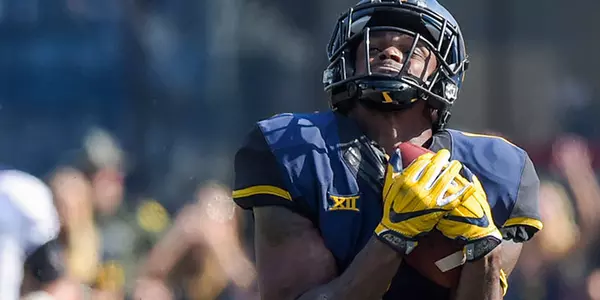
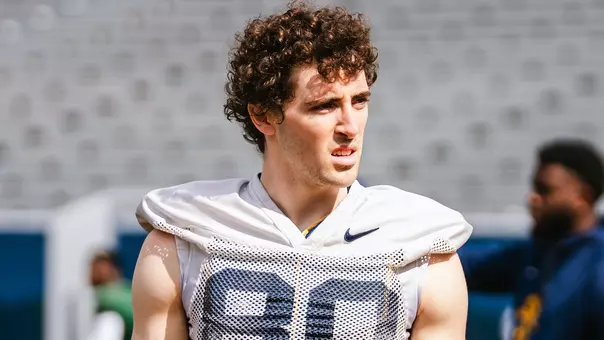
Gibson-Main-91116.jpg
Saturday's Result - Just as Holgorsen Expected
September 11, 2016 11:43 AM | Football
MORGANTOWN, W.Va. - If you were paying attention, all week long Dana Holgorsen said yesterday’s Youngstown State game would very likely unfold just as it did.
“We were prepared for this,” admitted Holgorsen following Saturday's 38-21 victory over the Penguins.
The fired-up Penguins, with a number of Power 5 conference transfers in the lineup, were equipped to hang with West Virginia for a while but eventually the Mountaineers’ depth was going to take over, which is exactly what happened.
Youngstown State took the lead early in the second quarter when senior running back Martin Ruiz crossed the goal line from the one, but West Virginia answered two possessions later when Skyler Howard hooked up with Shelton Gibson for a 54-yard touchdown pass to tie the game.
Then, in the third quarter WVU's depth took over, West Virginia outscoring the Penguins 17-0 in that period and the matter was settled.
“Our guys didn’t panic when it was close. I thought we had a good halftime, came in, made some good adjustments, came out and played hard in the second half,” said Holgorsen.
“Fourteen to 14 (the halftime score) did not surprise me so it confirmed a couple of things; we challenged the guys up front, we knew what they were doing, I thought the play calls were good and I thought we went out there and executed better in the third quarter,” added Holgorsen.
Still, when you drill down a little deeper, it was West Virginia’s willingness to run the football on first down - and stick to the run when it wasn’t always successful - that opened up the downfield passing game later on.
It was clear from the outset that West Virginia’s strategy was to saddle up Rushel Shell III and Justin Crawford and wear down the Penguins’ defense, the Mountaineers toting the ball 25 times out of 34 total first-down plays on Saturday.
Yet despite West Virginia’s success rate on those first-down runs being roughly 32 percent (gaining five yards or more), those first-down runs eventually gave Shelton Gibson and Ka’Raun White enough room to exploit Youngstown State’s secondary.
“Our depth, us being able to rotate some guys and play some different guys, we were hoping we would be able to wear them out more in the second half and we did,” admitted Holgorsen.
The very first pass the Mountaineers tried on first down came late in the second quarter (after 14 consecutive first-down runs) and resulted in Howard’s 54-yard bomb to Gibson when Howard saw those over-the-top safeties cheating down toward the box.
More first-down runs loosened up the secondary for West Virginia’s next big play in the third quarter, another Howard bomb to Gibson when he ran right past the corner and the safety help overtop was late getting over.
That score effectively settled the affair with 1:40 left in the third quarter.
Guess when it happened? First down, of course, when Youngstown State was expecting another run.
“They were funneling everything in to the safeties and those safeties had to come down to get involved in the run game,” explained Holgorsen. “We really didn’t make them come down on the run game very often, but our play action was good. We did a good job up front of keeping our pads low, Skyler rode the back, we just got a clean release on the outside and just out ran them.”
Actually, three of Howard’s five touchdown passes happened on first down when Youngstown State was either expecting run or a play close to the line of scrimmage - Kennedy McKoy’s 21-yard touchdown reception late in the game also taking place on first down when the safety flew up to help defend a wide receiver screen, leaving McKoy wide open on a wheel route to walk into the end zone.
That’s what happens when defenses are expecting one thing and get hit with another.
Therefore, just because the Mountaineers weren’t overly effective running the ball against what Holgorsen referred to as a “soft box” on Saturday, it ended up being effective because West Virginia was able to capitalize on some big passing plays down field later in the game.
That’s balance with a capital B.
Think back to all of those times in the past when run-heavy West Virginia teams didn’t have an answer in the downfield passing game, or, vice versa when pass-heavy Mountaineer teams couldn’t run the ball effectively against light boxes and those safeties were too deep to throw the ball down the field.
Last week against Missouri, West Virginia ran for 241 yards and passed for 253 - about as close to 50-50 as an offense can get - and because of that Youngstown State was forced to bring its safeties up to help support the run and take its chances that WVU would miss on the deep balls.
Howard didn’t and he made Youngstown State pay.
Gibson and Ka’Raun White were free to work the outside, Daikiel Shorts Jr. was open to work the deep middle when it was clear, and West Virginia took advantage of what the defense was giving it.
Of West Virginia’s 624 total yards, 207 of those came on four big pass plays - the direct result of Holgorsen’s patience and willingness to run the football on first down ... just as he expected.
Gold-Blue Spring Festival Fan Recap
Sunday, April 19
John Neider | April 18
Saturday, April 18
Coach Zac Alley | April 18
Saturday, April 18
Coach Rich Rodriguez | April 18
Saturday, April 18