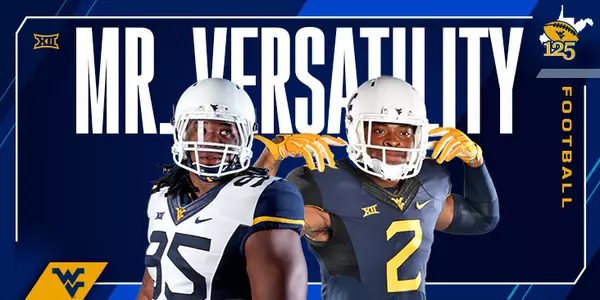
Main-Versatility-82216.jpg
Player Versatility Brings Value to a Team
August 22, 2016 05:06 PM | Football
MORGANTOWN, W.Va. - There is an old saying well-known to almost anyone who has ever picked up a book: “A jack of all trades is a master of none.”
Well, West Virginia University’s Dana Holgorsen certainly adheres to that figure of speech, particularly as it relates to his football players.
“In the 20-something years I’ve been doing this, I haven’t had success having guys doing multiple things and being great at it,” Holgorsen said recently. “You have to kind of lock in on something to be great at it.”
So true, but having versatile football players sure can come in handy, especially on the defensive side of the ball.
A lot of what West Virginia defensive coordinator Tony Gibson does there is predicated by the versatility of his players.
“The perfect example with that would be like (last year’s spur safety) KJ Dillon,” Gibson said. “He was a versatile spur and maybe our best cover guy across the board, counting corners, so we kind of fit our scheme around him and what he could do. If we don’t find that guy who can play man and do all those things, then we have to sub him out and get in one who can.”
Consider what happened a week ago when the secondary was rocked by the sudden loss of talented junior free safety Dravon Askew-Henry. Fortunately for Gibson, he has enough experience and versatility back there with bandit safeties Jeremy Tyler and Jarrod Harper to keep the defense on track, at least from what we saw during the first scrimmage of preseason camp two weekends ago.
Where would Bruce Tall’s defensive line be without Christian Brown and Jon Lewis right now, two players versatile enough to play all three positions, including the all-important nose tackle spot?
Keep in mind, Tall was already down two players before preseason camp even began.
Versatility is often overlooked and undervalued until something bad happens. It’s kind of like that old reliable car sitting in your driveway. It may not be as flashy as the new red sports car you’d like to have parked next to it, but it always gets you where you need to go, never breaking down along the side of the highway.
In other words, the old reliable sitting in the driveway has a lot of underappreciated value, just like versatile football players.
Tall is fond of using the phrase “a pair and a spare” when talking about his needs for the three defensive line positions he coaches, and having players capable of playing two or three different positions goes right along with that line of thinking.
Actually, a player who can play multiple positions is like basically adding extra scholarships to your roster.
“If you bring in a guy in and he can do multiple things he brings more value than a guy that is just a one-position type player,” Tall explained. “I’d rather recruit an end and think of him more as a tackle because he can play end or nose as opposed to just a nose because if he can’t play nose, where does he play?”
Tall’s No. 1 nose right now, Darrien Howard, began his college career at middle linebacker before moving down. It takes versatility to do that.
Perhaps the best nose tackle this defense has ever had, former Washington Redskin Chris Neild, was a tight end in high school before coming to WVU. Of course, it takes a lot of versatility going from playing tight end in high school to playing a zero technique in college.
Therefore, having versatile football players clearly adds a lot of value to your team.
“There is no question you take what those guys can do within the structure of the calls we’re going to make - and we don’t change our calls so much by each individual - but we’re trying to bring in guys that fit what we’re doing and I think we have,” Tall noted.
Tall says it’s easy to be seduced by that 4.3 edge rusher who is at the top of everyone’s recruiting lists, but how much does having one really help in the big scheme of things if that’s all he can do?

Former prep tight end Chris Neild demonstrated his versatility in college by becoming a standout nose tackle for the Mountaineers.
It certainly helped five years ago when dynamic pass rusher Bruce Irvin was around because those 23 sacks he produced clearly impacted a lot of football games. But what about the players brought in after Bruce - the guys who were supposed to be the next Bruce Irvins but couldn’t match his ability to get to the passer and weren’t versatile enough to remain on the field during run downs?
That’s when things get tricky.
“Everybody wants to have that 4.3, flashy end and they look good on tape and it’s hard not to want to take that guy, but if he doesn’t want to get in and line up head-up on that tackle, well, I can use him on third down and that’s about it,” Tall admitted. “They can rush the quarterback, and we all want that, but there are a lot of plays that happen between those times, too.”
It’s pretty much the same deal with the three safety spots Matt Caponi oversees. He wants guys with enough versatility to play bandit or free, or spurs who can move down to linebacker if they outgrow that position.
That’s what happened with former linebackers Nick Kwiatkoski and Wes Tonkery, two very productive college football players.
“(Versatility) his huge nowadays,” Caponi said. “Not only the football field, but we like guys that play multiple sports. You can get a feel for things beyond just watching a highlight tape of them. When we’re evaluating, just from a football standpoint, as a safety you want a guy who can play in space, who is capable of short-area movement, quick twitch, got to be able to play some man coverage and, obviously, if they can blitz and do things like that they fit even better in our scheme and what we do.”
That means Caponi is looking for guys who also run track for speed and explosiveness or guys who played basketball for footwork and hand-eye coordination.
How many times have we heard about a college football coach falling in love with a prospect after watching him perform on the basketball court?
That takes versatility, and when you get enough of those types of players on your roster, they can almost become interchangeable, based on what we’ve seen already with Tyler and Harper.
“We will recruit almost the same type of kid and feel like they can help us at all three positions,” Caponi said. “Sometimes you want just a spur because he’s got to line up on a tight end every once in a while and he needs to be a little bit bigger body, but as they develop and start to learn everything that’s when versatility of going from maybe being two-deep in your room to being three-deep because you can move some guys around and do some things.”
In addition to the obvious physical components that come along with having versatile football players, there is also the mental aspect, too, of being able to handle the different responsibilities that come with playing multiple positions.
That is perhaps the biggest inhibitor to a coach’s willingness or unwillingness to move a player to an area of need.
If a player can’t handle it mentally, he’s not moving. Period.
Unfortunately, the way the recruiting rules are structured today it is becoming increasingly difficult for coaches to fully gauge the intelligence of the players they are recruiting until they get here because of the limitations placed on them during the evaluation process.
Many of these kids also have advisors or advocates now who don’t always provide accurate information the way high school coaches, guidance counselors and teachers once did when they were much more involved in the recruiting process.
“It’s an unknown factor a lot of times with some of these guys coming in,” Tall admitted. “(Advisors and advocates) speak from their hearts and not from their minds so all of a sudden a guy is much smarter and then when they get here you realize they are not quite as smart as you were told,” Tall laughed.
That’s why the limited time coaches are allowed to spend with prospects is so valuable for them, as Caponi explains.
“We can talk to him about football and ask him questions to understand what they do defensively at their high school and see if he can tell you, ‘Hey, this is what I do and this is what the guy beside me does.’ What is their base defense? What schemes do they use? You can kind of get a feel from a football IQ standpoint by being able to sit down and talk to them when they come on a visit.”
The person tasked with discovering versatile players, director of player personnel Ryan Dorchester, said one of his biggest jobs is trying to prepare for any worst-case scenarios that pop up during the year by trying to get as much depth as possible before preseason practice starts.
Of course, the easiest way to do that is by recruiting versatile football players. Dorchester said he’s seen a repeat of the same scenario occur during all of the preseason camps he’s been involved with so far at WVU.
“Every camp I’ve been a part of some coach comes up to me and says we are not repping enough young guys. They say it in the meetings, and then we go out in practice and they put the young guys in and all they do is screw things up and then they are mad because we can’t get anything done,” Dorchester laughed. “That’s 12 for 12 right now for every camp I’ve been involved with - 100 percent. It’s the same movie.”
Corners coach Blue Adams, who recently spent time in the NFL with the Miami Dolphins, loves versatile players with this caveat - they have to be able to perform at a high level.
“It’s always the more you can do,” he said. “Versatility is a good thing. But it’s not only being versatile, it’s about being good at what you do, too. Everybody can do a little bit of everything but being productive at those different things is as important as well.”
Perhaps the jack of all trades can't master all, but sometimes he can help your football team - as we’ve already seen so far this fall.
Gold-Blue Spring Festival Fan Recap
Sunday, April 19
John Neider | April 18
Saturday, April 18
Coach Zac Alley | April 18
Saturday, April 18
Coach Rich Rodriguez | April 18
Saturday, April 18