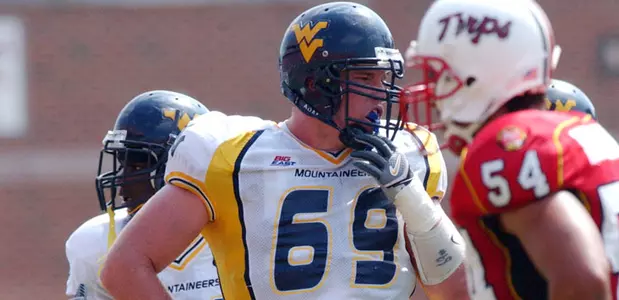
Justice-Main-72415.jpg
2006 Sugar Bowl: Garin Justice
July 24, 2015 08:53 AM | Football
As a college football player, Garin Justice was just like that humungous tree sitting out in the backyard – big, sturdy and dependable. Therefore, it’s not surprising Justice was known as “Big Oak” by his 2005 West Virginia University football teammates.
“We called him ‘Big Oak’ for one reason,” recalled teammate Dan Mozes, who won the Rimington Award in 2006 as college football’s top center. “That oak tree has a big base and no matter how far that tree leans in one direction it is always going to stay very sturdy, and that’s the way Garin’s game was.”
As a West Virginia University player, Justice wasn’t going to beat you with his feet, his hands or his overwhelming athletic ability – he was going to wear you down and beat you with his mind.
“He never made crazy, amazing athletic plays, but he never did anything that was bad,” said Mozes. “He did the same thing over and over.”
And that includes continuing to return to practice as a freshman when offensive line coach Rick Trickett was trying to run him off because he didn’t think he was good enough to play in West Virginia’s offense.
“Instead of Garin saying, ‘Yeah, you’re probably right I’m transferring’ he said, ‘Forget that, I’m staying here and I’m going to show you guys,’” said Mozes.
Show them he did.
In two years Justice went from an unwanted player to the team’s starting right tackle in 2004, and a year after that, he became a Sporting News second team All-American in 2005. You can kick the tires and measure how fast or how strong a player is, but you can never measure what’s underneath the hood in their heart.
Justice not only became one of West Virginia’s most dependable players in 2005, he also was the guy the younger guys always looked up to for wisdom and advice.
“We had a lot of younger guys on that team, and we didn’t really have a lot of egos coming through the door,” Justice recalled. “The young guys fell in line, and the older guys weren’t going to tolerate doing something other than wanting to try and win.”
Justice thought the 2004 WVU team he played on was probably just as talented as the one he played on as a senior that defeated Georgia in the 2006 Nokia Sugar Bowl, but for a variety of reasons the ’04 team couldn’t get over the hump.
It wasn’t until West Virginia lost a competitive game against talented Florida State in the 2005 Gator Bowl when Justice believes the West Virginia players became convinced they could hang with the best teams in the country.
“All of us growing up through high school we looked at Florida State, ‘Wow, that’s Florida State!’ These guys were the 1999 National Champions and they were as good as it gets,” he remembered. “They had all of these guys getting drafted in the NFL. After the way we played against them, going into the fall it made us believe, ‘Hey, we’re good nationally.’ We can compete with some of these national programs, and I think that was something that was not really talked about but it kind of gave us a springboard as far as confidence wise heading into that next year.”
What cinched it for the team was the way they ran over a pretty good Maryland team in College Park. West Virginia didn’t just beat the Terps, the Mountaineers that sunny afternoon stuffed the football right into their ear holes.
Justice said the entire fourth quarter the Mountaineers went with freshman Pat White at quarterback and a pair of 230-plus pounders in Jason Gwaltney and Owen Schmitt in the backfield and ran the ball right down the Terps’ throats.
“Split-gun, 20-personnel,” Justice said. “We had Owen and Gwaltney in the backfield and we just checked iso to the bubble. We may have called six or seven isos in a row. That was the first time we all realized, ‘We’re physical.’ With those two bears in the backfield we can run over anyone.”
What made that 2005 team so special, in the eyes of Justice, was a combination of experienced, development guys who blended perfectly with a handful of young, talented players on the path toward superstardom.
“We had some highlight players who put us over the hump, but our core group of players were no-name, do-right brand of developmental guys,” he said.
Justice, now head coach at Division II football power Concord, has a unique understanding of that 2005 team and the outstanding coaches Rich Rodriguez had assembled at WVU during that period of time.
“Rich prided himself on wanting to be different and being an innovator and I think that’s why I didn’t think he wanted to be a true triple-option team because that didn’t give him the flexibility to be explosive, but he wanted to be different enough to where people had to go outside the box a little bit to prepare for him,” explained Justice.
Rodriguez’s innovative ways included an odd-stack defense run by young, up-and-coming defensive coordinator Jeff Casteel, and some unconventional things the Mountaineers also did on special teams as well.
“The odd stack was probably more innovative than the spread offense was at the time,” admitted Justice. “We did the roll, rugby punt and nobody else was doing that so there were a lot of things that people had to prepare for when you played us and that’s a sign of good coaching.”
The story has been told here many times about how Rodriguez ordered his defensive coaches to go down to Wake Forest to learn the 3-3 stack from Dean Hood because Rodriguez had always had trouble attacking it when he was Tommy Bowden’s offensive coordinator at Clemson.
Justice also believes safety Angel Estrada may have have had something to do with the decision to change direction on defense.
“When Rich first got there and saw their workouts and watched things going on he took a guy like Angel Estrada and said, ‘This guy needs to play but I don’t really know where to put him. Do we put him at a traditional strong safety spot where he’s probably a little too big and maybe a hair too slow? Do we put him at outside linebacker where he’s maybe a little bit too small? Other than (linebacker) Grant Wiley, this guy might be the best player on our defense and I think that spur position was created for a guy like Angel Estrada.”
Whether or not that was the case, the 3-3 stack was good to the Mountaineers in the mid-2000s. In fact, it’s been so good to WVU football that current defensive coordinator Tony Gibson revived it two years ago.
Justice believes playing on that 2005 team did wonders for his budding coaching career.
“On a personal level, it’s probably what enabled me to be able to come to Concord and us being top-five nationally in the country, whereas six years ago we were one of the worst programs in Division II,” he noted.
Many of the lessons Justice learned about building successful football teams he learned playing for Rich Rodriguez. Justice knows Rodriguez is still a polarizing figure in the state, but even his harshest critics can’t deny that Rodriguez set the trajectory of Mountaineer football on a much different course.
“Since I’ve gotten into the coaching profession I’ve come to realize the biggest thing you want to be able to do is to leave something better than when you found it,” he said. “Rich did that. West Virginia University is ultimately in a much better place now because Rich Rodriguez was once there.”
Justice now hopes to do the same at Concord.

Geimere Latimer | April 2
Thursday, April 02
Coach Deke Adams | April 2
Thursday, April 02
Coach Rich Rodriguez | April 2
Thursday, April 02
Cam Cook | March 30
Monday, March 30