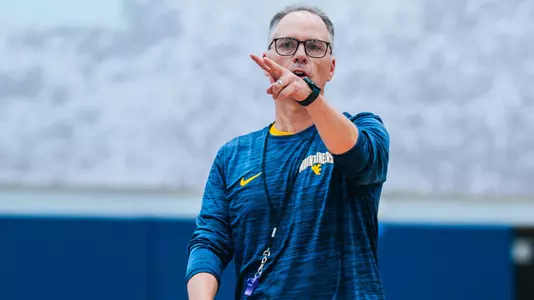
Photo by: WVU Athletic Communications
Kellogg’s ‘Moneyball’ Approach to Recruiting Draws Praise
July 17, 2026 01:35 PM | Women's Basketball
MORGANTOWN, W.Va. – Mark Kellogg said it took his coaching staff just 18 days to piece together one of the best transfer portal classes in the Big 12.
That's what beating Duke at The Greenbrier and selling out NCAA Tournament games at Hope Coliseum can do for an upward-trending women's basketball program these days.
But he also concedes those two-and-a-half weeks were extremely stressful and hectic on everyone involved with the Mountaineer program.
On3 national women's basketball reporter and recruiting analyst Talia Goodman has certainly taken notice of their efforts. She recently rated West Virginia's transfer portal haul third-best in the Big 12 behind just big-spending Oklahoma State and TCU.
"Oklahoma State was definitely the biggest winner in the portal out of the Big 12, in my opinion," she said. "They spent a lot of money to get it, and they had more money than anybody else did, so they were the one who obviously stood out in terms of getting names."
And while TCU didn't sign an Olivia Miles or a Hailey Van Lith during this cycle, Goodman said the Horned Frogs had the budget to go out and piece together another strong transfer haul.
What West Virginia and Arizona State did, according to Goodman, was assemble high-value classes, what she calls "Money-balling."
"They weren't necessarily going after the big-name (transfers), but they Moneyballed it a little bit and got players who fit their systems really well," she explained. "From my understanding, they didn't have to spend the same amount of money as some of those top-tier programs, so they did a really strong job.
"I think (West Virginia's) class went a little bit underrated because their big gets are players the casual fan hasn't heard before like the two players they got from George Mason (Zaza Walton and Kennedy Harris). But I think they are going to be really valuable for West Virginia, as are the kid from BYU (Marya Hudgins) and the kid who hasn't played from Pitt (Divine Tumba).
"I think they got some players that their value is higher than maybe what they had to spend for them," Goodman added.
West Virginia's marquee addition this spring was Marquette senior forward Skylar Forbes, an All-Big East player who represented Team Canada in FIBA's U23 3x3 event in Chile earlier this month.
When she committed to the Mountaineers in late April, there was a lot of high-fiving going on in the Basketball Practice Facility.
"She's fantastic," Goodman said. "I think they got some really talented players who just fit what they do really well."
Kellogg is typically reluctant to go too far out on a limb when talking about his team, but when pressed, he believes the talent level assembled this year is reflective of a program that has finished ranked in the Top 25 three straight seasons and averaged 26 wins per year.
"I really like the group that we have," he said last month. "We set out with some goals in mind and players we felt comfortable with in the recruiting process, and throughout the summer so far, they've kind of lived up to everything that we thought they would."
Across the board, whether it's women's basketball, men's basketball, football, baseball or whichever sport you follow, the general talent level in all Mountaineer programs is improving.
Naturally, increased funding and support from the administration has helped, but WVU director of athletics Wren Baker believes that's only part of it.
You have to spend what you have wisely.
"I think our coaches have gotten much better at their maneuvering of the process," he said during an exclusive sit-down interview late last month. "You have to do so much evaluating in such a short period of time now, so I think they've become much better at pre-evaluating (prospects).
"When you go over to football," he continued, "they are evaluating underclassmen on every roster in the country right now, because they know once the portal opens it's already too late to evaluate them. And that's going on in every sport, and every sport is learning in this new world that you have to reset your recruiting footprint a little bit, and it's a broader footprint for the most part."
Baker maintains using a shotgun approach to recruiting the transfer portal is not a recipe for success these days.
"You have to have a little bit more of a rifle approach, but to do that takes some honing and understanding who you can get across the finish line," he explained. "Sometimes, you are chasing prospects you won't be able to close at the expense of ones you are able to close.
"And our coaches are learning these lessons," he noted. "I know (women's basketball was) a year or two behind the men, but it's getting to the same place, so coach Kellogg spent time with our men's basketball coaches heading into the portal season to see how they attacked it and what they did. And I think the men's basketball staff has spent time with Chuck (Lillie), our football general manager, to see how he manages agents and contracts."
Kellogg admits roster management and player-valuation were not on his bingo card 21 years ago when he became a first-time head coach at Fort Lewis College.
ChatGPT is probably not the way to go about learning either, he joked.
"I don't have any GM experience, and I never thought I was going to be doing that as a coach when I got into this business, but you have to adapt, and that's okay," the coach explained. "I've used it and just tried to flip my mindset and say, 'Hey, this is a great area that I can improve and grow.' I'm learning a new skill, and I choose to look at it that way as opposed to being bummed out about it, mad or upset that I have to become part-GM now."
In April, shortly after his team came within a 12-foot jump shot of reaching the NCAA Tournament Sweet 16, Kellogg's 2026-27 roster was in a massive state-of-flux. He chose to hang on to his resources in the fall, not overpay for prospects, and bet on himself and the program's success during the springtime transfer portal window.
It paid off handsomely.
"I think there was one day when I think I had 13 or 14 tabs open of different spread sheets and I was the GM trying to figure out, 'Oh, if this kid comes it changes this …' Then I would have to go to the next spread sheet because if this (player) commits, this is what it now looks like," he said. "It was ever changing in those 18 days unlike anything I had ever been through."
Goodman sees more of this ahead for coaches in the future. The word "value" is beginning to have as much meaning as "talent" in today's sports recruiting vernacular.
"Pure talent is not enough, especially when money comes into play," she said. "Some of these players are asking for a lot, so every coach is a GM now. You really have to construct your team in kind of a Moneyball kind of way, which I think West Virginia did a really good job of this year.
"I talked to someone the other day who said, 'There is always someone willing to pay more – always,'" she added.
From his perspective, Baker is clearly aware of how much more resource-driven the college recruiting process has become today, which is why he hired Don Robinson to oversee Gold & Blue Enterprises and assigned senior deputy director of athletics Rob Alsop and deputy director of athletics Ben Murray to keep close tabs on revenue sharing and over-the-cap Name, Image and Likeness budgets.
"What we had budgeted for our men's and women's basketball roster in March, versus what it ended up being in June, was vastly different," Baker conceded, adding no spending guardrails in place for college sports is going to lead to even more spending in the future.
"It's like everybody is sitting at the poker table, and as long as there is a school sitting there with the best hand, they are kind of incentivized to flush everybody else out of the game," he explained. "People who think this will all level out and regulate itself, it will not just because the competitive and ego side of college athletics will not allow that."
The way college sports is structured today, it is basically working against its best interests.
"You would think (schools) would talk to each other to make sure they aren't way overspending on some of these kids," Goodman said.
Until that happens, if it ever happens, coaches at places like West Virginia better have great plans in place because if they don't, poor roster decisions and bad investments will sink their programs quickly.
"That's a philosophical question – how are you going to put your roster together? Are you paying high-end money? Are you trying to pay half your roster and then maybe not pay as much and try and spread it out? Those are all philosophical discussions we are having, and we have our thoughts and other coaches have different thoughts," Kellogg observed. "We've had to put together a game plan and a strategy."
Goodman believes what West Virginia is doing is working.
"The first few years of the portal, it felt like it was more name over fit than anything else, and this year I felt a shift for the most part. Obviously, there are outliers, but it felt like coaches are really prioritizing the value to their specific program and not necessarily the value they had to their previous school or their place in the national scheme of things," she concluded.
That's what beating Duke at The Greenbrier and selling out NCAA Tournament games at Hope Coliseum can do for an upward-trending women's basketball program these days.
But he also concedes those two-and-a-half weeks were extremely stressful and hectic on everyone involved with the Mountaineer program.
On3 national women's basketball reporter and recruiting analyst Talia Goodman has certainly taken notice of their efforts. She recently rated West Virginia's transfer portal haul third-best in the Big 12 behind just big-spending Oklahoma State and TCU.
"Oklahoma State was definitely the biggest winner in the portal out of the Big 12, in my opinion," she said. "They spent a lot of money to get it, and they had more money than anybody else did, so they were the one who obviously stood out in terms of getting names."
And while TCU didn't sign an Olivia Miles or a Hailey Van Lith during this cycle, Goodman said the Horned Frogs had the budget to go out and piece together another strong transfer haul.
What West Virginia and Arizona State did, according to Goodman, was assemble high-value classes, what she calls "Money-balling."
"They weren't necessarily going after the big-name (transfers), but they Moneyballed it a little bit and got players who fit their systems really well," she explained. "From my understanding, they didn't have to spend the same amount of money as some of those top-tier programs, so they did a really strong job.
"I think (West Virginia's) class went a little bit underrated because their big gets are players the casual fan hasn't heard before like the two players they got from George Mason (Zaza Walton and Kennedy Harris). But I think they are going to be really valuable for West Virginia, as are the kid from BYU (Marya Hudgins) and the kid who hasn't played from Pitt (Divine Tumba).
"I think they got some players that their value is higher than maybe what they had to spend for them," Goodman added.
West Virginia's marquee addition this spring was Marquette senior forward Skylar Forbes, an All-Big East player who represented Team Canada in FIBA's U23 3x3 event in Chile earlier this month.
When she committed to the Mountaineers in late April, there was a lot of high-fiving going on in the Basketball Practice Facility.
"She's fantastic," Goodman said. "I think they got some really talented players who just fit what they do really well."
Kellogg is typically reluctant to go too far out on a limb when talking about his team, but when pressed, he believes the talent level assembled this year is reflective of a program that has finished ranked in the Top 25 three straight seasons and averaged 26 wins per year.
"I really like the group that we have," he said last month. "We set out with some goals in mind and players we felt comfortable with in the recruiting process, and throughout the summer so far, they've kind of lived up to everything that we thought they would."
Across the board, whether it's women's basketball, men's basketball, football, baseball or whichever sport you follow, the general talent level in all Mountaineer programs is improving.
Naturally, increased funding and support from the administration has helped, but WVU director of athletics Wren Baker believes that's only part of it.
You have to spend what you have wisely.
"I think our coaches have gotten much better at their maneuvering of the process," he said during an exclusive sit-down interview late last month. "You have to do so much evaluating in such a short period of time now, so I think they've become much better at pre-evaluating (prospects).
"When you go over to football," he continued, "they are evaluating underclassmen on every roster in the country right now, because they know once the portal opens it's already too late to evaluate them. And that's going on in every sport, and every sport is learning in this new world that you have to reset your recruiting footprint a little bit, and it's a broader footprint for the most part."
Baker maintains using a shotgun approach to recruiting the transfer portal is not a recipe for success these days.
"You have to have a little bit more of a rifle approach, but to do that takes some honing and understanding who you can get across the finish line," he explained. "Sometimes, you are chasing prospects you won't be able to close at the expense of ones you are able to close.
"And our coaches are learning these lessons," he noted. "I know (women's basketball was) a year or two behind the men, but it's getting to the same place, so coach Kellogg spent time with our men's basketball coaches heading into the portal season to see how they attacked it and what they did. And I think the men's basketball staff has spent time with Chuck (Lillie), our football general manager, to see how he manages agents and contracts."
Kellogg admits roster management and player-valuation were not on his bingo card 21 years ago when he became a first-time head coach at Fort Lewis College.
ChatGPT is probably not the way to go about learning either, he joked.
"I don't have any GM experience, and I never thought I was going to be doing that as a coach when I got into this business, but you have to adapt, and that's okay," the coach explained. "I've used it and just tried to flip my mindset and say, 'Hey, this is a great area that I can improve and grow.' I'm learning a new skill, and I choose to look at it that way as opposed to being bummed out about it, mad or upset that I have to become part-GM now."
In April, shortly after his team came within a 12-foot jump shot of reaching the NCAA Tournament Sweet 16, Kellogg's 2026-27 roster was in a massive state-of-flux. He chose to hang on to his resources in the fall, not overpay for prospects, and bet on himself and the program's success during the springtime transfer portal window.
It paid off handsomely.
"I think there was one day when I think I had 13 or 14 tabs open of different spread sheets and I was the GM trying to figure out, 'Oh, if this kid comes it changes this …' Then I would have to go to the next spread sheet because if this (player) commits, this is what it now looks like," he said. "It was ever changing in those 18 days unlike anything I had ever been through."
Goodman sees more of this ahead for coaches in the future. The word "value" is beginning to have as much meaning as "talent" in today's sports recruiting vernacular.
"Pure talent is not enough, especially when money comes into play," she said. "Some of these players are asking for a lot, so every coach is a GM now. You really have to construct your team in kind of a Moneyball kind of way, which I think West Virginia did a really good job of this year.
"I talked to someone the other day who said, 'There is always someone willing to pay more – always,'" she added.
From his perspective, Baker is clearly aware of how much more resource-driven the college recruiting process has become today, which is why he hired Don Robinson to oversee Gold & Blue Enterprises and assigned senior deputy director of athletics Rob Alsop and deputy director of athletics Ben Murray to keep close tabs on revenue sharing and over-the-cap Name, Image and Likeness budgets.
"What we had budgeted for our men's and women's basketball roster in March, versus what it ended up being in June, was vastly different," Baker conceded, adding no spending guardrails in place for college sports is going to lead to even more spending in the future.
"It's like everybody is sitting at the poker table, and as long as there is a school sitting there with the best hand, they are kind of incentivized to flush everybody else out of the game," he explained. "People who think this will all level out and regulate itself, it will not just because the competitive and ego side of college athletics will not allow that."
The way college sports is structured today, it is basically working against its best interests.
"You would think (schools) would talk to each other to make sure they aren't way overspending on some of these kids," Goodman said.
Until that happens, if it ever happens, coaches at places like West Virginia better have great plans in place because if they don't, poor roster decisions and bad investments will sink their programs quickly.
"That's a philosophical question – how are you going to put your roster together? Are you paying high-end money? Are you trying to pay half your roster and then maybe not pay as much and try and spread it out? Those are all philosophical discussions we are having, and we have our thoughts and other coaches have different thoughts," Kellogg observed. "We've had to put together a game plan and a strategy."
Goodman believes what West Virginia is doing is working.
"The first few years of the portal, it felt like it was more name over fit than anything else, and this year I felt a shift for the most part. Obviously, there are outliers, but it felt like coaches are really prioritizing the value to their specific program and not necessarily the value they had to their previous school or their place in the national scheme of things," she concluded.

Players Mentioned
F
/ Women's Basketball
G
/ Women's Basketball
G
/ Women's Basketball
F
/ Women's BasketballSaturday, October 10
Thursday, September 24
Thursday, September 24
Thursday, September 24