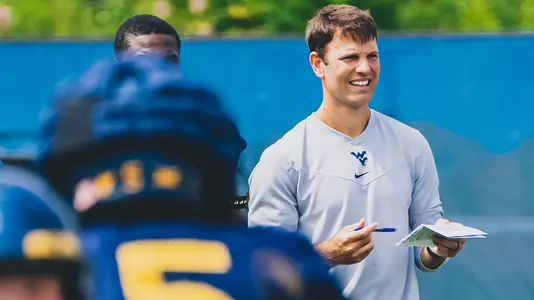
Photo by: WVU Athletic Communications
Football Notebook: WVU’s Harrell Lists Two Basic Principles of Air Raid System
September 27, 2022 04:06 PM | Football, Blog
MORGANTOWN, W.Va. – There are two primary principles that really bind all of those who come from Hal Mumme's and Mike Leach's offensive systems – leverage and open grass.
Earlier today, West Virginia offensive coordinator Graham Harrell detailed what that means.
"If you look at Leach, and when he talks about stuff and a lot of guys who come from him, he always says, 'Just attack grass,'" he said. "What does that mean? Leach will tell you there is no such thing as coverage, and he will come up with some crazy stuff sometimes, but really when he talks about it, it comes down to two things – leverage and grass. Where is the leverage and where is the grass?
"Attack that."
When you think about it, hasn't that really been the essence of football ever since Walter Camp transitioned the game from rugby nearly 150 years ago? Woody Hayes, Bobby Bowden and Ben Schwartzwalder used to put it in military terms – "Attack the weakest part of their flank."
Baseball's Willie Keeler used to say, "hit it where they ain't," and that's basically the same concept of offensive football – "call it where they ain't."
West Virginia did precisely that last Thursday night on its final offensive touchdown of the game when Justin Johnson Jr. scored from the 6. Quarterback JT Daniels noticed the Hokies overloaded to one side of the ball, and he just flipped the run to the other side.
No analytics, obscure stats, tendencies or consulting massive playcall sheets, just simple, instinctive football.
"There are a lot of people over there and there's not a lot of people over here, so do something to get the ball (where there are fewer defenders)," Harrell explained. "I think at times we overcomplicate the game of football, especially coaching quarterbacks and stuff. You can cloud their mind with information overload and that's the game of football, too."
For the years Dana Holgorsen was at West Virginia calling plays, that's basically what he did. Do you remember the Texas game in 2012 when it was clear that the Longhorns were going to use extra defenders to take away wide receivers Stedman Bailey and Tavon Austin, giving West Virginia a light box and daring the Mountaineers to run it?
What did Holgorsen do?
He ran it, no matter the situation. Andrew Buie ended up running 31 times for 207 yards and two touchdowns in West Virginia's 48-45 victory.
Third-and-10 with a light box showing? Run it. Call what you see.
That's what all of these Leach guys have been doing, no matter how they choose to do it. Some do it by throwing the ball all over the place, looking for the weakest areas on the football field, while others choose to be more balanced.
Harrell is from the Air Raid wing that prefers to be more balanced.
He says the basic premise of his system is to pick out about 25 or 30 core plays, dress them up many different ways, run them over and over and then look for grass and leverage.
"If you look at all of the people tagged with the Air Raid, not all of them run the same offense. You turn on Leach or anyone who came from Leach, it's not the same offense. I don't think any of us are arrogant enough to think our plays are the best plays or the only good plays," he said.
"What most people who left Leach believe in is you can't be good at everything. If there are a thousand great plays out there, I don't have time to practice a thousand great plays and get good at a thousand great plays," he continued. "Pick the 30 or so that fit your team best that year, go get really good at those 30 and dress it up and present it differently, but make it the same for your guys by running them over and over and over again.
"It doesn't matter if that's in the run game or the pass game," Harrell noted.
A couple of weeks ago, Daniels said what really drew him to Harrell's system last spring when he was looking around for other schools was the freedom it allowed his players to play and offer their input.
Some play callers want to control everything, right down to signaling in the checks. Harrell is willing to let his quarterbacks make checks, especially if he's got one smart enough to see the same thing he's seeing from up above.
JT Daniels is smart enough to do that.
"If a quarterback feels really comfortable with a play, it usually works," Harrell explained. "I asked JT on the headsets during the (Virginia Tech) game if he wanted to throw something and he said, 'Well, we're running the ball pretty well,' so we ended up calling a run play. He might be the only quarterback I've ever asked what he wanted to throw, and he said run it."
"Having that freedom as a quarterback, and having a quarterback that's smart enough to do that I think is a big step for a Power 5 program," senior offensive guard James Gmiter said. "There are not a lot of people who can pick apart a defense like that."
Apparently, that also applies to the NFL for anyone who has been following the drama surrounding the Pittsburgh Steelers' offense and quarterback Mitch Trubisky, who says he is not afforded the freedom to change plays at the line of scrimmage.
"It takes a lot of stress off (the offensive linemen)," Gmiter explained. "There was a play last Thursday where they had seven defenders on one side of the ball, we flipped it to the opposite side, and it made a huge difference. In the past, we've never done that so we would have run the play into those seven guys and been outnumbered."
Sometimes, play calling is simply about trusting your gut and, more importantly, trusting your eyes.
"It's kind of like playing a video game in the box. You get a pretty good angle of what you're seeing and just go with what you feel," Harrell admitted. "I think other people are a lot more analytically driven, I guess as far as, 'Hey, this is what we're going to call in this situation, and I've already got it planned before I get into the game.'
"I don't do that quite as much as other people, and part of that is probably my background. In high school, my dad (Sam Harrell) didn't have a giant play sheet with every situation scripted, and coach Leach obviously doesn't have every play scripted, so it's kind of what I grew up in and what I know."
Earlier today, West Virginia offensive coordinator Graham Harrell detailed what that means.
"If you look at Leach, and when he talks about stuff and a lot of guys who come from him, he always says, 'Just attack grass,'" he said. "What does that mean? Leach will tell you there is no such thing as coverage, and he will come up with some crazy stuff sometimes, but really when he talks about it, it comes down to two things – leverage and grass. Where is the leverage and where is the grass?
"Attack that."
When you think about it, hasn't that really been the essence of football ever since Walter Camp transitioned the game from rugby nearly 150 years ago? Woody Hayes, Bobby Bowden and Ben Schwartzwalder used to put it in military terms – "Attack the weakest part of their flank."
Baseball's Willie Keeler used to say, "hit it where they ain't," and that's basically the same concept of offensive football – "call it where they ain't."
West Virginia did precisely that last Thursday night on its final offensive touchdown of the game when Justin Johnson Jr. scored from the 6. Quarterback JT Daniels noticed the Hokies overloaded to one side of the ball, and he just flipped the run to the other side.
No analytics, obscure stats, tendencies or consulting massive playcall sheets, just simple, instinctive football.
"There are a lot of people over there and there's not a lot of people over here, so do something to get the ball (where there are fewer defenders)," Harrell explained. "I think at times we overcomplicate the game of football, especially coaching quarterbacks and stuff. You can cloud their mind with information overload and that's the game of football, too."
For the years Dana Holgorsen was at West Virginia calling plays, that's basically what he did. Do you remember the Texas game in 2012 when it was clear that the Longhorns were going to use extra defenders to take away wide receivers Stedman Bailey and Tavon Austin, giving West Virginia a light box and daring the Mountaineers to run it?
What did Holgorsen do?
He ran it, no matter the situation. Andrew Buie ended up running 31 times for 207 yards and two touchdowns in West Virginia's 48-45 victory.
Third-and-10 with a light box showing? Run it. Call what you see.
That's what all of these Leach guys have been doing, no matter how they choose to do it. Some do it by throwing the ball all over the place, looking for the weakest areas on the football field, while others choose to be more balanced.
Harrell is from the Air Raid wing that prefers to be more balanced.
He says the basic premise of his system is to pick out about 25 or 30 core plays, dress them up many different ways, run them over and over and then look for grass and leverage.
"If you look at all of the people tagged with the Air Raid, not all of them run the same offense. You turn on Leach or anyone who came from Leach, it's not the same offense. I don't think any of us are arrogant enough to think our plays are the best plays or the only good plays," he said.
"What most people who left Leach believe in is you can't be good at everything. If there are a thousand great plays out there, I don't have time to practice a thousand great plays and get good at a thousand great plays," he continued. "Pick the 30 or so that fit your team best that year, go get really good at those 30 and dress it up and present it differently, but make it the same for your guys by running them over and over and over again.
"It doesn't matter if that's in the run game or the pass game," Harrell noted.
A couple of weeks ago, Daniels said what really drew him to Harrell's system last spring when he was looking around for other schools was the freedom it allowed his players to play and offer their input.
Some play callers want to control everything, right down to signaling in the checks. Harrell is willing to let his quarterbacks make checks, especially if he's got one smart enough to see the same thing he's seeing from up above.
JT Daniels is smart enough to do that.
"If a quarterback feels really comfortable with a play, it usually works," Harrell explained. "I asked JT on the headsets during the (Virginia Tech) game if he wanted to throw something and he said, 'Well, we're running the ball pretty well,' so we ended up calling a run play. He might be the only quarterback I've ever asked what he wanted to throw, and he said run it."
"Having that freedom as a quarterback, and having a quarterback that's smart enough to do that I think is a big step for a Power 5 program," senior offensive guard James Gmiter said. "There are not a lot of people who can pick apart a defense like that."
Apparently, that also applies to the NFL for anyone who has been following the drama surrounding the Pittsburgh Steelers' offense and quarterback Mitch Trubisky, who says he is not afforded the freedom to change plays at the line of scrimmage.
"It takes a lot of stress off (the offensive linemen)," Gmiter explained. "There was a play last Thursday where they had seven defenders on one side of the ball, we flipped it to the opposite side, and it made a huge difference. In the past, we've never done that so we would have run the play into those seven guys and been outnumbered."
Sometimes, play calling is simply about trusting your gut and, more importantly, trusting your eyes.
"It's kind of like playing a video game in the box. You get a pretty good angle of what you're seeing and just go with what you feel," Harrell admitted. "I think other people are a lot more analytically driven, I guess as far as, 'Hey, this is what we're going to call in this situation, and I've already got it planned before I get into the game.'
"I don't do that quite as much as other people, and part of that is probably my background. In high school, my dad (Sam Harrell) didn't have a giant play sheet with every situation scripted, and coach Leach obviously doesn't have every play scripted, so it's kind of what I grew up in and what I know."

Players Mentioned



A Special Announcement for No. 5 Pat White
Friday, June 05
NCAA Super Regional (Steve Sabins, Chansen Cole, Tyrus Hall) - WVU Baseball | June 5
Friday, June 05
Pat White No. 5 Retirement
Friday, June 05
Gold-Blue Spring Festival Fan Recap
Sunday, April 19