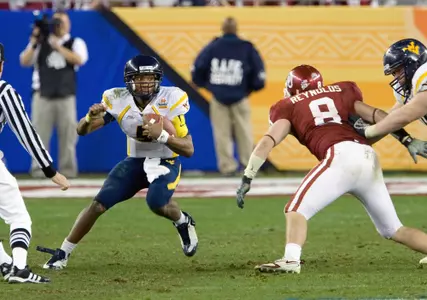
Photo by: Brent Kepner
Hot Reads: Almost History
June 15, 2021 09:20 AM | Football
Radio sideline reporter Jed Drenning provides periodic commentary on the Mountaineer football program for WVUsports.com. Be sure to follow him on Twitter @TheSignalCaller.
MORGANTOWN, W.Va. - I've always been spellbound by what ifs.
Be it in sports or in life, the cause-and-effect possibility of minor tweaks impacting larger outcomes has always intrigued me.
In his book "Almost History," scholar Roger Bruns analyzed a substantial list of what ifs, hypothetical situations that had never materialized, but easily could have. What if German forces had held their ground on D-Day? What if Kennedy's diplomacy had failed during the Cuban Missile Crisis? What if the Apollo 11 mission had ended in disaster?
Almost history. Even the title scratches a particular itch I've always had. But I'm not alone. Somewhere between natural curiosity and unhealthy fascination resides the strange inclination in most of us to wonder what might've happened had one of life's chess pieces been moved differently.
As such, when news broke last week that could significantly impact the College Football Playoff in the near future, I found myself looking to the distant past. My mind almost immediately began feeding scenarios into the what-if-o-meter, wondering how the history of WVU football might be different if these potential changes had always been in place.
Unless you've been bird watching in Kiribati for the last week, you've probably heard by now that a 12-team playoff format might be on the horizon. The news spread like prairie fire across sports talk radio. When the College Football Playoff management committee meets in Chicago on June 17-18, it will explore the possibility of expanding beyond the current four-team configuration. It's a critical opportunity for a playoff tournament growing stale through repetition and a perceived lack of championship access to boldly veer outside the guard rails and reset the narrative.
The proposal does not include automatic bids for conference champions, nor is there a limit on the number of teams a conference can send to the tournament. It would populate the 12-team bracket with the six highest ranked conference champions and the six other highest ranked teams as determined by the CFP selection committee. Moreover, the top four seeds would be awarded to the four highest ranked league champions, each receiving a first-round bye as teams five through eight would host (on campus) teams nine through 12 in the opening round of the tournament.
That former point bears repeating. To be seeded among the top four in this playoff and receive a bye in the opening round, a team would need to be a conference champ. No at-large teams in the top four – and no independents. You hear that, Notre Dame?
My approach to determining where WVU would have figured into such a playoff format, historically, was pretty simple. I looked at the specific poll following the conclusion of the conference championship games and/or the regular season, whichever applied. For playoff seeding, I used the BCS poll/CFP rankings as those seemed the most applicable. In past seasons, before those existed, (pre-1999) I applied the Associated Press (AP) Poll as my measurement to dictate seeding.
To that end, I explored only the seasons that have been played since the AP poll era began in 1936. For a playoff-oriented dive into the even more distant past (pre-AP), be on the lookout for John Antonik's story on those West Virginia teams of yesteryear to come later this week right here at WVUsports.com.
Meanwhile, buckle up and let's get started. Be warned, however, that you're going to read the words "would have" a lot from this point forward.
Make that a whole lot.
According to the (unofficial) conclusions of my (unofficial) research, WVU would have realistically been in the hunt for the proposed playoff many times thru the years. Again, these numbers are confined to seasons played since the mid-1930s. By my count, the Mountaineers, 17 times, would have landed in the Top 20 in the regular season-ending poll and in the Top 16 a dozen times.
But in how many seasons during this span would West Virginia have climbed into the top 12 when things mattered most and actually advanced to such a playoff?
Seven.
Breaking down what would've been WVU's seven seasons qualifying for the proposed 12-team playoff format -- three would have come under Don Nehlen, two under Art "Pappy" Lewis and two under Rich Rodriguez.
Moving back in time, starting with the most recent, let's take a look at each of those seven seasons.
2007. Despite suffering the loss of which we dare not speak, West Virginia landed at No. 9 in the BCS poll following championship weekend in early December 2007. That slot would've put them in the playoffs and sent them on the road in the opening round to (Wait for it)…
Lawrence, Kansas.
That's right. Back when Kansas was more than a basketball school, No. 9 WVU would've traveled to face QB Todd Reesing and the No. 8 Jayhawks in a fun matchup that would've pitted Pat White and the nation's No. 3 rushing attack against KU's 8th ranked rush defense. Instead, the Mountaineers, of course, went on to upend Oklahoma in the Fiesta Bowl behind Bill Stewart and Kansas won the Orange Bowl.
2005. In this alternate reality where a 12-team playoff rules supreme, the would-be Sugar Bowl Champion Mountaineers would instead have landed the No. 11 seed and opened the postseason tournament on the road in Eugene, Oregon, against the No. 6 Ducks.
Watching Steve Slaton, Pat White and the upstart Mountaineers march into Autzen Stadium to take on a scorching hot, 10-1 Oregon squad would be tempting, but I don't think WVU fans would trade knocking off SEC champ Georgia in its own backyard, even for this.
1993. Don Nehlen's Big East Champion Mountaineers finished the regular season 11-0, earning the No. 3 spot in the AP poll. In the 12-team playoff, this would have represented the only season in school history in which WVU earned a top-four seed and first-round bye. West Virginia would've enjoyed the luxury of sitting back and watching a field of five-thru-12 seeded powerhouses do battle to determine its neutral-site opponent in the second round.
 1988. Major Harris and the 1988 Mountaineers are widely embraced as one of the best teams in WVU history. Like the '93 Mountaineers, the '88 squad also finished 11-0 in the regular season. Unlike the '93 team, however, WVU was not a conference champion in 1988. It was independent.
As per the rules of the proposed 12-team playoff, which requires the top four seeds to be conference champions, the lack of a league title would have (I warned you I'd be saying "would have" a lot) knocked the '88 Mountaineers out of the top four. During that season, however, WVU would not have been the only team impacted by this rule.
In a strange quirk, all four of the highest ranked teams in the AP poll in 1988 would've slid in the 12-team format because of their lack of a conference title.
Those four teams, all independent at the time, included No. 1 Notre Dame, No. 2 Miami and No. 3 WVU, both of which joined the Big East in 1991, and No. 4 Florida State, which joined the ACC in 1990.
As such, the revised 12-team format would have actually looked like this following that 1988 regular season:
1. Southern Cal (PAC-10 Champ)
2. Nebraska (Big 8 Champ)
3. Auburn (SEC Champ)
4. Arkansas (SWC Champ)
5. Notre Dame
6. Miami, Fla.
7. West Virginia
8. Florida State
9. UCLA
10. Oklahoma
11. Michigan (Big Ten Champ)
12. Clemson (ACC Champ)
This 12-team layout would have pitted the No. 7 seeded Mountaineers at home in Morgantown against No. 10 Oklahoma, marking the only season in history in which WVU would have hosted a first-round game. A Mountaineer win would've meant the final game of the Barry Switzer era at OU (Switzer resigned the following offseason). Moreover, WVU fans would've been treated to watching the Sooners' shifty wishbone magician Jamelle Holieway try to keep pace with Major Harris and the highest scoring offense in West Virginia history? Now thatwould have been a pretty sweet ticket.
1982. Led by quarterback Jeff Hostetler and linebacker Darryl Talley, the '82 Mountaineers were the kind of talented but tough squad that could take on hell with a Waterpik. They opened the '82 campaign with their historic win in Norman, Oklahoma, followed by a thriller in Morgantown over Boomer Esiason and the Maryland Terrapins. West Virginia parlayed that 2-0 start into an Associated Press Top 20 berth where it remained for the remainder of the year.
By the close of the 1982 regular season, WVU was No. 10 in the AP. That slot in a 12-team playoff would've sent them south in the opening round to take on Danny Ford's No. 7 Clemson Tigers, the defending national champs. Do you think Mountaineer Nation might've traveled a few folks down to that one?
1954. WVU went 8-1 in the 1954 regular season, earning its second of four straight Southern Conference titles. The record also landed WVU at No. 12 in the AP. They would've juuust made the cut in the 12-team playoff. Quarterback Fred Wyant and Co. would have gone on the road to face the No. 5 Fighting Irish and first-year head coach Terry Brennan, whom the Irish had tabbed the previous offseason as replacement for the legendary Frank Leahy.
1953. History tells us coach Art "Pappy" Lewis' 1953 squad knocked off Pitt and Penn State on the way to winning its first Southern Conference crown and earning a Sugar Bowl berth. In the 12-team playoff world, however, WVU's No. 10 spot would've sent them on the road to square off against No. 7 Illinois.
***
So there are what would have been West Virginia's seven playoff participants – but the "what ifs" don't stop there.
NOT AS CLOSE AS YOU'D THINK …
 2018. By mid-November the Will Grier-led Mountaineers were 8-1 and had climbed to No. 9 in the CFP rankings after handing TCU the worst loss of Gary Patterson's career (47-10). West Virginia appeared to be on course for a spot in the Big 12 title game. Subsequent losses to Oklahoma State and OU, though, knocked the Mountaineers out of a trip to Jerry World and dropped them to No. 16 in the early December poll that would've mattered.
 2016. Despite a 10-2 regular season and 7-2 mark in the Big 12 bolstered by the league's No. 2 defense, the 2016 Mountaineers never got over the hump in the CFP rankings. West Virginia peaked at No. 10 in late October before turnover-plagued losses to Oklahoma State and Oklahoma landed them at No. 16 following conference title weekend.
2011. This is another scenario that showcases how very different things would have been under the new format. Dana Holgorsen's 2011 Mountaineers of course, went on to carve out their own unique place in history with a 70-33 demolition of Clemson in the Orange Bowl, but the pollsters were unimpressed with West Virginia's path to Hard Rock Stadium. Despite nine wins and the league's highest scoring offense, Big East Champion WVU was tagged with a pedestrian ranking of No. 23 going into bowl season.
2010. Sure, this squad won its final four games by an average margin of nearly 23 points per contest to post a 9-3 regular season mark. And yes, this team featured one of the best defenses in WVU history (No. 3 nationally in total defense, scoring defense and sacks), but the lack of a signature win, combined with an uninspiring offense (No. 5 in the Big East in scoring), held West Virginia to the No. 22 spot in the BCS rankings following the weekend of the conference title games.
1989. Major Harris finished No. 3 in the Heisman voting, but at 8-2-1 when the '89 regular season drew to a close, WVU landed at the No. 17 spot in the AP. What might've been had the Mountaineers, 4-0 at the time and No. 9 in the nation, held on to that 31-9 fourth-quarter lead over Pitt on the final day of September?
1969. Before ambushing South Carolina in the Peach Bowl in Jim Carlen's final game as head coach, WVU strung together a 9-1 regular season. Despite the success, however, the Mountaineers finished that regular season at No. 18, behind a host of teams with fewer wins. It didn't help West Virginia's cause that it could claim just one regular season victory over a team with a winning record (Richmond, 6-4).
1937. In the real world, Marshall Glenn's Mountaineers went on to win the Sun Bowl, but voters were hardly enamored with this squad. West Virginia assembled a regular season mark of 7-1-1 but never got a whiff of the Associated Press poll. Sure, unremarkable teams like 4-4-2 TCU snuck in at No. 16, but the Frogs, featuring All-Southwest stud Davey O'Brien, had the star power WVU lacked. That, coupled with a Mountaineer slate that included five non-majors and a tie game against a two-win Georgetown team kept WVU unranked and would have boxed them out of any playoff consideration.
CLOSER THAN YOU'D THINK …
2009. Bolstered down the stretch by a tight battle on the road against No. 5 Cincinnati and an upset win in the Backyard Brawl over No. 9 Pitt, Bill Stewart's 9-3 Mountaineers climbed to No. 16 in the BCS by the end of championship weekend. Not quite the Top 12, but a solid push by this '09 team.
2002. The Mountaineers finished the regular season on a four-game winning streak in 2002 that included impressive road victories at No. 12 Virginia Tech and No. 18 Pitt. This helped WVU, at 9-3, climb to No. 15 in the BCS poll following championship weekend. Not bad for a team that, on Halloween, was off the radar at 4-3.
OH, SO CLOSE! BUT NOT QUITE …
2006. Ouch! Irrespective of a 10-2 regular season capped by backup quarterback Jarrett Brown leading WVU to victory in a triple overtime thriller over No. 13 Rutgers, the '06 squad would've found itself on the outside looking in on a 12-team playoff, but barely, sitting at No. 13.
***
No matter what plays out at those meetings in Chicago this week, it will be noteworthy. If the CFP committee votes to adopt the 12-team proposal, though the changes likely wouldn't take effect for at least a few years. Yet, history would be made.
Even if they don't vote in favor of it, however, the mere fact that such an ambitious idea was floated would be history too.
Well, almost history.
I'll see you at the 50.

Wednesday, September 09
Wednesday, September 09
Wednesday, September 09
Tuesday, September 08