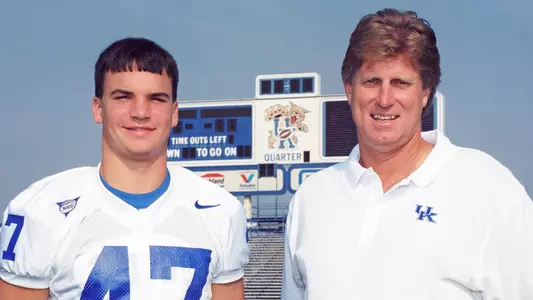
Mumme Tree Adds Another Branch At WVU With Brown
May 09, 2019 12:00 PM | Football
MORGANTOWN, W.Va. – A couple of branches from Hal Mumme's "Air Raid" tree have sprouted in West Virginia.
The first offshoot came in 2011 when former WVU athletic director Oliver Luck tapped into his Houston roots to hire Dana Holgorsen. And now, another limb has sprouted after Shane Lyons hired Neal Brown away from Troy this past January.
Considering that a generation of Mountaineer fans were raised on Don Nehlen/Bo Schembechler/Woody Hayes/Big Ten/Midwestern-style football, it's been a dramatic departure.
But has it really?
Are Holgorsen and Brown fully committed Air Raiders from the Mumme mold?
Mike Leach certainly is.
So is Samford's Chris Hatcher, whose quarterback Devlin Hodges attempted 53 passes in the Bulldogs' final game of the 2018 season against East Tennessee State and 69 the week prior in a 15-point loss to The Citadel.
 That's in line with what Mumme was doing all the way back in the mid-1980s at Copperas Cove High in Copperas Cove, Texas, when everybody else then was either running the I, the wishbone or the veer.
Mumme wanted to throw the football on every snap and make the game accessible to players of all sizes, not just the brutes up front.
"For me, I had to take all of these jobs that nobody wanted because the art was more important than the venue," Mumme recalled recently. "In 1986, I went to be the head coach and AD at Copperas Cove High School in Central Texas, a big 5A school that had zero success. When I got there the four best athletes in the school all played sports other than football. One of them ran a 10.28 electronically timed 100 meters, and we had lots of good basketball and baseball players.
"So, I sat all four of them down in this room and showed them film of BYU and then June Jones when he was with the Houston Gamblers in the USFL and I said, 'How would y'all like to do this for an offense?' They got excited and I said, 'I'll let you play the other sports but come out for football and this is what we're going to do.'"
From Copperas Cove, the school that later produced Robert Griffin III, to Iowa Wesleyan (where Holgorsen played) to Valdosta State to Kentucky (where Brown played), Mumme was driving opposing coaches nuts with all of his passing.
Howard Schnellenberger - one of Mumme's coaching heroes because he frequently took programs nobody else wanted and made them winners – was never a big fan of Mumme's way of playing football.
On one occasion, Schnellenberger ran into Mumme and Hatcher at the football coaches' convention and he fixed a hard stare on Mumme, "I know what you're doing," he growled. "You're ruining the game. Nobody gets knocked down anymore!"
When Mumme got to Iowa Wesleyan and teamed with a young and somewhat eccentric aspiring lawyer named Mike Leach, that's when his system really took off.
At the time, the Houston Cougars were operating the Run 'n' Shoot and Steve Spurrier had an offense at Duke he called "Airball" before he did the Fun 'n' Gun stuff at Florida.
In addition to coordinating Mumme's offense, Leach had the extra duties of sports information director for football (because he could write, says Mumme), and he convinced him to let him come up with a name for their offense to get people's attention.
"He comes into my office one day and he said, 'You know, we need a name for our offense.' I said. 'What do you mean? We just say offense, and they run onto the field,'" Mumme recalled. "He said, 'No, not for games. I'm talking about for stories.' I said, 'What do you have in mind?' He said, 'Well, Steve Spurrier calls his 'Airball' so I was thinking about calling ours 'Air Raid.' I said, 'Go for it! That sounds good to me!'"
By the time Mumme got to Valdosta State, his name was becoming synonymous with 'Air Raid' in football circles. Mumme had a slot receiver named Sean Pendry who caught more than 200 passes during his last two years there and his father had a hand-cranked, World War II-era air raid siren that he brought to the games and wound up whenever Mumme got wound up.
Soon, the entire Gulf South Conference was miffed about the air raid siren Valdosta was using at its home games and eventually the league banned the team from using it. Undeterred, Pendry's father got a couple of students at a fraternity house next to the stadium to wind that thing up every time the Blaze scored a touchdown.
Mumme's big victory over Central Florida at Valdosta State caught the attention of Kentucky athletic director C.M. Newton, who was looking for someone to reinvigorate his struggling football program. Mumme's offense was like basketball on grass and it seemed to fit perfectly with Kentucky's hoop-crazed fans, so Newton hired the 45-year-old Air Raider to coach the Wildcats in 1997.
 During his first season at Kentucky, Mumme upset Alabama 40-34, and the Air Raid went national.
"Obviously, Kentucky is in the SEC so it's a fishbowl and everything you do gets noticed and they hadn't beat Alabama in 75 years, so they tore down the goal posts and all that," Mumme recalled.
The goal posts were safe for the remainder of Mumme's career at Kentucky, however, as the Wildcats slipped to 6-6 in 1999 and 2-9 in 2000, leading to his dismissal.
From there it's been an odyssey for Mumme with stops at Southeastern Louisiana, New Mexico State, McMurry, SMU, Belhaven, Jackson State and most recently, with the Memphis Express of the short-lived Alliance of American Football.
Now 67, he is still seeking coaching opportunities.
In the meantime, Mumme can more closely follow two of his most well-known proteges – Holgorsen, now at Houston, and Brown at West Virginia.
"As I recall, Dana was ahead of Neal by five or six years. When I got the job at Iowa Wesleyan (Holgorsen) was the first guy I went to see because he played at Mount Pleasant High School, the hometown high school," Mumme said. "The head coach there said he had some offers from some smaller schools, and I didn't get him (Holgorsen went to St. Ambrose University instead).
"But at the end of the first semester, Dana figured out that we really were going to throw the ball on every play, and they were trying to turn him into a DB so he transferred back to us."
Brown's story was a little different.
"Neal had an offer from Indiana, and we wanted him, but we didn't have a scholarship to give him so he agreed to walk on at Kentucky, and then he earned one pretty quickly," Mumme said.
Mumme remembers Holgrosen and Brown being very similar type players. Brown played two seasons for Mumme at Kentucky before transferring to Massachusetts to complete his collegiate eligibility for Mark Whipple in 2001 and 2002.
Whipple, by the way, is now Pat Narduzzi's offensive coordinator at Pitt.
"They both had all of the intangibles," Mumme said. "They love the game, and they have a passion for it. They work hard, they're not afraid to take chances, they understand totally what they want to get done and in recruiting it helps to know what you're shopping for. Those guys have their own systems and they know exactly what they're looking for.
"I think that's something that gets overlooked a lot in recruiting," he added. "People tend to recruit off lists and stuff like that. I think those two will take them if they fit the system and not be afraid to take some guys that maybe aren't as highly recruited."
So the question, alluded to previously, is what are their systems?
Are Holgorsen and Brown truly Air Raid disciples?
 They certainly began their coaching careers that way. Holgorsen's quarterbacks threw the ball all over the place when he coordinated Kevin Sumlin's Houston offenses, Holgorsen once calling 76 passes in a game against UTEP. However, when Dana went to Oklahoma State to work for Mike Gundy he drifted toward a more balanced attack.
At West Virginia, Holgorsen continued to rein in his passing when Clint Trickett and Skyler Howard were his quarterbacks. The Mountaineers ran the ball 51 times in a 38-20 victory over Texas in 2015, and the one game Holgorsen invited Mumme to come here to see in person against Baylor in 2016, the Mountaineers ran 61 times in a 24-21 victory.
WVU completed just 10 passes for 111 yards. Mumme hadn't seen that many handoffs since Woody Hayes was still taking swings at Charlie Bauman.
When they got back to Holgorsen's place out in Cheat Lake, he threatened to kick him out of the Air Raid club.
"We were speaking at a clinic last year and one of the basic routes in our offense is 'mesh' and it was the subject of that book The Perfect Pass (a New York Times best seller by S.C. Wynne). Mesh is the perfect pass and Dana goes, 'You know, we're not running mesh anymore.' I said, 'You might want re-think that' and I noticed that he put it back in because that's what they scored on against Texas to win the game."
When Brown was Troy's offensive coordinator in 2008, the Trojans once tried 72 passes in a 40-31 loss to LSU. Brown's aerial attack had helped Troy to a stunning 31-3 lead, but he continued to call passes when the Tigers made their comeback.
Brown also called lots of passes when he was Tommy Tuberville's offensive coordinator at Texas Tech, but when he got to Kentucky the Wildcats never tried more than 50 passes in a game during the two years he was there.
And when he became Troy's head coach, the most passes his quarterbacks attempted there were 47 in a 2017 loss to South Alabama.
As was the case with Holgorsen, Brown also drifted toward more of a balanced offense once he became the head coach and was responsible for everything - not just scoring points.
Sometimes you have to win football games by not trying to score, as strange as that sounds. Brown hinted to that during his introductory press conference back on Jan. 10.
"We're a get-it-done offense, by any means necessary to win the game," he said. "We're going to take shots down the field, create explosive plays, but we're also going to be physical up front and we're going to run the football."
Those are not the words typically associated with pure Air Raid disciples.
"Neal is a really intelligent guy, and he really thinks things out," Mumme said. "He's playing chess with you all the time."
When Holgorsen left to take the Houston job, Mumme thought Brown would be a terrific candidate to replace him at West Virginia.
"I thought Dana did such an incredible job there at West Virginia, but I know he loves Houston, and he had a lot of reasons to go back there," Mumme said. "When I saw that it came open I said to myself, 'I wonder if they are going to hire Neal? Neal would be the perfect hire.'
"And they did!"
 What Holgorsen did offensively at West Virginia and what Brown is planning to do here will likely be very similar, Mumme predicts, even if their personalities are completely opposite.
According to Mumme, the biggest difference between Neal Brown and Dana Holgorsen can be summed up thusly - Brown always takes his phone calls, Dana may or may not answer them.
"The one thing about Dana is he's going to turn that cell phone off and you're not going to be able to get a hold of him," Mumme laughed. "Leach and I talk every week and I'll go, 'Well, have you heard from Dana?' He said, 'No, he won't call me back.' If we text him 'call right now we need you' he will call. If you text him 'how is it going?' He isn't going to get back."
Although Brown probably won't throw it 50 times a game anymore, he will have to play an aggressive style to keep pace with the other explosive offenses in the Big 12.
You can't completely turn off the spigot in this league.
"You play in a conference where you've got to be able to score points," Mumme pointed out. "You're not going to get much done by scoring 20 points a game. It lends itself to our style of play, and there are a lot of people in the Big 12 that run our stuff."
With their own twists, of course.
The first offshoot came in 2011 when former WVU athletic director Oliver Luck tapped into his Houston roots to hire Dana Holgorsen. And now, another limb has sprouted after Shane Lyons hired Neal Brown away from Troy this past January.
Considering that a generation of Mountaineer fans were raised on Don Nehlen/Bo Schembechler/Woody Hayes/Big Ten/Midwestern-style football, it's been a dramatic departure.
But has it really?
Are Holgorsen and Brown fully committed Air Raiders from the Mumme mold?
Mike Leach certainly is.
So is Samford's Chris Hatcher, whose quarterback Devlin Hodges attempted 53 passes in the Bulldogs' final game of the 2018 season against East Tennessee State and 69 the week prior in a 15-point loss to The Citadel.
That's in line with what Mumme was doing all the way back in the mid-1980s at Copperas Cove High in Copperas Cove, Texas, when everybody else then was either running the I, the wishbone or the veer.Mumme wanted to throw the football on every snap and make the game accessible to players of all sizes, not just the brutes up front.
"For me, I had to take all of these jobs that nobody wanted because the art was more important than the venue," Mumme recalled recently. "In 1986, I went to be the head coach and AD at Copperas Cove High School in Central Texas, a big 5A school that had zero success. When I got there the four best athletes in the school all played sports other than football. One of them ran a 10.28 electronically timed 100 meters, and we had lots of good basketball and baseball players.
"So, I sat all four of them down in this room and showed them film of BYU and then June Jones when he was with the Houston Gamblers in the USFL and I said, 'How would y'all like to do this for an offense?' They got excited and I said, 'I'll let you play the other sports but come out for football and this is what we're going to do.'"
From Copperas Cove, the school that later produced Robert Griffin III, to Iowa Wesleyan (where Holgorsen played) to Valdosta State to Kentucky (where Brown played), Mumme was driving opposing coaches nuts with all of his passing.
Howard Schnellenberger - one of Mumme's coaching heroes because he frequently took programs nobody else wanted and made them winners – was never a big fan of Mumme's way of playing football.
On one occasion, Schnellenberger ran into Mumme and Hatcher at the football coaches' convention and he fixed a hard stare on Mumme, "I know what you're doing," he growled. "You're ruining the game. Nobody gets knocked down anymore!"
When Mumme got to Iowa Wesleyan and teamed with a young and somewhat eccentric aspiring lawyer named Mike Leach, that's when his system really took off.
At the time, the Houston Cougars were operating the Run 'n' Shoot and Steve Spurrier had an offense at Duke he called "Airball" before he did the Fun 'n' Gun stuff at Florida.
In addition to coordinating Mumme's offense, Leach had the extra duties of sports information director for football (because he could write, says Mumme), and he convinced him to let him come up with a name for their offense to get people's attention.
"He comes into my office one day and he said, 'You know, we need a name for our offense.' I said. 'What do you mean? We just say offense, and they run onto the field,'" Mumme recalled. "He said, 'No, not for games. I'm talking about for stories.' I said, 'What do you have in mind?' He said, 'Well, Steve Spurrier calls his 'Airball' so I was thinking about calling ours 'Air Raid.' I said, 'Go for it! That sounds good to me!'"
By the time Mumme got to Valdosta State, his name was becoming synonymous with 'Air Raid' in football circles. Mumme had a slot receiver named Sean Pendry who caught more than 200 passes during his last two years there and his father had a hand-cranked, World War II-era air raid siren that he brought to the games and wound up whenever Mumme got wound up.
Soon, the entire Gulf South Conference was miffed about the air raid siren Valdosta was using at its home games and eventually the league banned the team from using it. Undeterred, Pendry's father got a couple of students at a fraternity house next to the stadium to wind that thing up every time the Blaze scored a touchdown.
Mumme's big victory over Central Florida at Valdosta State caught the attention of Kentucky athletic director C.M. Newton, who was looking for someone to reinvigorate his struggling football program. Mumme's offense was like basketball on grass and it seemed to fit perfectly with Kentucky's hoop-crazed fans, so Newton hired the 45-year-old Air Raider to coach the Wildcats in 1997.
During his first season at Kentucky, Mumme upset Alabama 40-34, and the Air Raid went national."Obviously, Kentucky is in the SEC so it's a fishbowl and everything you do gets noticed and they hadn't beat Alabama in 75 years, so they tore down the goal posts and all that," Mumme recalled.
The goal posts were safe for the remainder of Mumme's career at Kentucky, however, as the Wildcats slipped to 6-6 in 1999 and 2-9 in 2000, leading to his dismissal.
From there it's been an odyssey for Mumme with stops at Southeastern Louisiana, New Mexico State, McMurry, SMU, Belhaven, Jackson State and most recently, with the Memphis Express of the short-lived Alliance of American Football.
Now 67, he is still seeking coaching opportunities.
In the meantime, Mumme can more closely follow two of his most well-known proteges – Holgorsen, now at Houston, and Brown at West Virginia.
"As I recall, Dana was ahead of Neal by five or six years. When I got the job at Iowa Wesleyan (Holgorsen) was the first guy I went to see because he played at Mount Pleasant High School, the hometown high school," Mumme said. "The head coach there said he had some offers from some smaller schools, and I didn't get him (Holgorsen went to St. Ambrose University instead).
"But at the end of the first semester, Dana figured out that we really were going to throw the ball on every play, and they were trying to turn him into a DB so he transferred back to us."
Brown's story was a little different.
"Neal had an offer from Indiana, and we wanted him, but we didn't have a scholarship to give him so he agreed to walk on at Kentucky, and then he earned one pretty quickly," Mumme said.
Mumme remembers Holgrosen and Brown being very similar type players. Brown played two seasons for Mumme at Kentucky before transferring to Massachusetts to complete his collegiate eligibility for Mark Whipple in 2001 and 2002.
Whipple, by the way, is now Pat Narduzzi's offensive coordinator at Pitt.
"They both had all of the intangibles," Mumme said. "They love the game, and they have a passion for it. They work hard, they're not afraid to take chances, they understand totally what they want to get done and in recruiting it helps to know what you're shopping for. Those guys have their own systems and they know exactly what they're looking for.
"I think that's something that gets overlooked a lot in recruiting," he added. "People tend to recruit off lists and stuff like that. I think those two will take them if they fit the system and not be afraid to take some guys that maybe aren't as highly recruited."
So the question, alluded to previously, is what are their systems?
Are Holgorsen and Brown truly Air Raid disciples?
They certainly began their coaching careers that way. Holgorsen's quarterbacks threw the ball all over the place when he coordinated Kevin Sumlin's Houston offenses, Holgorsen once calling 76 passes in a game against UTEP. However, when Dana went to Oklahoma State to work for Mike Gundy he drifted toward a more balanced attack.At West Virginia, Holgorsen continued to rein in his passing when Clint Trickett and Skyler Howard were his quarterbacks. The Mountaineers ran the ball 51 times in a 38-20 victory over Texas in 2015, and the one game Holgorsen invited Mumme to come here to see in person against Baylor in 2016, the Mountaineers ran 61 times in a 24-21 victory.
WVU completed just 10 passes for 111 yards. Mumme hadn't seen that many handoffs since Woody Hayes was still taking swings at Charlie Bauman.
When they got back to Holgorsen's place out in Cheat Lake, he threatened to kick him out of the Air Raid club.
"We were speaking at a clinic last year and one of the basic routes in our offense is 'mesh' and it was the subject of that book The Perfect Pass (a New York Times best seller by S.C. Wynne). Mesh is the perfect pass and Dana goes, 'You know, we're not running mesh anymore.' I said, 'You might want re-think that' and I noticed that he put it back in because that's what they scored on against Texas to win the game."
When Brown was Troy's offensive coordinator in 2008, the Trojans once tried 72 passes in a 40-31 loss to LSU. Brown's aerial attack had helped Troy to a stunning 31-3 lead, but he continued to call passes when the Tigers made their comeback.
Brown also called lots of passes when he was Tommy Tuberville's offensive coordinator at Texas Tech, but when he got to Kentucky the Wildcats never tried more than 50 passes in a game during the two years he was there.
And when he became Troy's head coach, the most passes his quarterbacks attempted there were 47 in a 2017 loss to South Alabama.
As was the case with Holgorsen, Brown also drifted toward more of a balanced offense once he became the head coach and was responsible for everything - not just scoring points.
Sometimes you have to win football games by not trying to score, as strange as that sounds. Brown hinted to that during his introductory press conference back on Jan. 10.
"We're a get-it-done offense, by any means necessary to win the game," he said. "We're going to take shots down the field, create explosive plays, but we're also going to be physical up front and we're going to run the football."
Those are not the words typically associated with pure Air Raid disciples.
"Neal is a really intelligent guy, and he really thinks things out," Mumme said. "He's playing chess with you all the time."
When Holgorsen left to take the Houston job, Mumme thought Brown would be a terrific candidate to replace him at West Virginia.
"I thought Dana did such an incredible job there at West Virginia, but I know he loves Houston, and he had a lot of reasons to go back there," Mumme said. "When I saw that it came open I said to myself, 'I wonder if they are going to hire Neal? Neal would be the perfect hire.'
"And they did!"
What Holgorsen did offensively at West Virginia and what Brown is planning to do here will likely be very similar, Mumme predicts, even if their personalities are completely opposite.According to Mumme, the biggest difference between Neal Brown and Dana Holgorsen can be summed up thusly - Brown always takes his phone calls, Dana may or may not answer them.
"The one thing about Dana is he's going to turn that cell phone off and you're not going to be able to get a hold of him," Mumme laughed. "Leach and I talk every week and I'll go, 'Well, have you heard from Dana?' He said, 'No, he won't call me back.' If we text him 'call right now we need you' he will call. If you text him 'how is it going?' He isn't going to get back."
Although Brown probably won't throw it 50 times a game anymore, he will have to play an aggressive style to keep pace with the other explosive offenses in the Big 12.
You can't completely turn off the spigot in this league.
"You play in a conference where you've got to be able to score points," Mumme pointed out. "You're not going to get much done by scoring 20 points a game. It lends itself to our style of play, and there are a lot of people in the Big 12 that run our stuff."
With their own twists, of course.


Nate Gabriel | April 8
Wednesday, April 08
Coach Rod West | April 8
Wednesday, April 08
Coach Rich Rodriguez | April 8
Wednesday, April 08
Ryan Ward | April 6
Monday, April 06