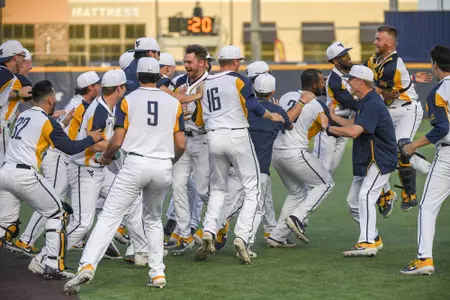
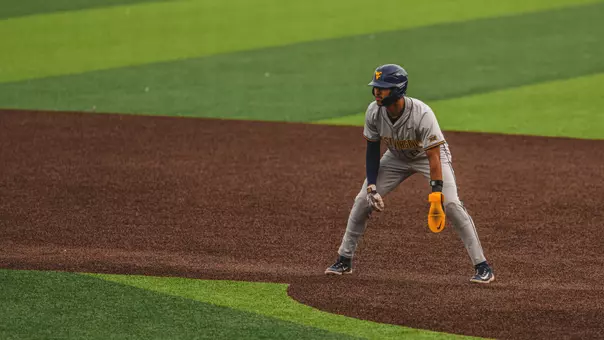
Photo by: All Pro Photography/Dale Sparks
Mazey’s Mountaineers Playing Must-See Baseball
April 16, 2019 07:40 AM | Baseball
MORGANTOWN, W.Va. – It's been a long, long time since people outside of West Virginia have really paid attention to West Virginia University baseball.
Back in the 1960s, when Steve Harrick's Mountaineers were competing for Southern Conference championships and NCAA Tournament appearances, WVU was a regular occupant in college baseball's top 20.
Then, one year after Harrick retired in 1967, new coach Dale Ramsburg saw his baseball field become the WVU Coliseum and that began the long and torturous decline of college baseball in the University city.
Ramsburg's teams did have some pockets of success in the 1980s and early 1990s, but it was never sustainable because he had little funding or fan support.
It was the same deal with his successor Greg Van Zant, whose second season in 1996 was his best when he rode first-round draft pick Chris Enochs' right arm into the NCAA regionals.
It took 21 long years until current coach Randy Mazey was able to put a team on the field good enough to get back there.
And now, two years later, it looks like he's got another one.
This year's team is built around outstanding starting pitching. The staff's stellar 3.26 earned run average following last weekend's series win over then-11th-ranked Texas Tech ranks third in the pitching-centric Big 12 this week behind just Baylor and Oklahoma.
 Mazey's Friday guy, junior Alek Manoah, is a husky righthander with a consistent 95-mph fastball and two complementary pitches that he developed this past summer in the Cape Cod League. Manoah was virtually unhittable last Friday night against .300-hitting Texas Tech when he fanned 15 Red Raider batters in an impressive 2-0 shutout victory.
Manoah even touched 96 on the 20 or so radar guns pointed at him in the ninth inning and more pro scouts, cross checkers and general managers will be putting Monongalia County Ballpark's address in their GPS's to watch his three remaining regular-season starts here against Kansas, TCU and George Washington as WVU's most coveted power arm since Enochs.
By the way, another flame thrower, Michael Grove, was given big money to sign in the second round of last summer's draft by the Dodgers or else he could have teamed with Manoah to give the Mountaineers the best pair of righthanders this side of PNC Park.
Manoah leads the Big 12 in strikeouts with 11.87 per game and opponents are hitting just .182 against him, good for second in the league. Right behind Manoah is Sunday starter Kade Strowd and his .185 opponent batting average which is almost as impressive.
Mazey has even got a Midweek Big Unit in 6-foot-7, 220-pound lefthander Nick Snyder, whose five victories equals Manoah for tops on the staff. Snyder's outstanding mound work in Tuesday-Wednesday games has really been the difference this year compared to some of Mazey's near-miss NCAA teams in 2014 and 2016.
Right now, every conceivable metric has the 22-13 Mountaineers trending among the top teams in college baseball. Website WarrenNolan.com has West Virginia's RPI at 16 heading into Wednesday night's game at Penn State, while Boyd's World, another pseudo NCAA Tournament website, has WVU at 23. Mazey jokes that those numbers are almost as important to him as the numbers that make up the wedding date to his wife Amanda.
The influential people who cover college baseball such as Kendall Rogers and Aaron Fitt of D1Baseball.com, and even Northern-baseball-phobic Baseball America, have taken notice as well.
This week, West Virginia has cracked five of the six college baseball polls, including the coaches at No. 24. The remaining holdout is Tucson, Arizona-based Collegiate Baseball, which does not have the Mountaineers in its top 30 this week despite mentioning WVU's series win over Texas Tech and listing Manoah as one of its national pitchers of the week.
 This is what Baseball America's Teddy Cahill had to say about West Virginia in the publication's top 25 chat yesterday morning, which has WVU in its rankings at No. 25 for just the second time ever (the other BA appearance coming on April 24, 2017):
"Manoah matches up well with anyone in the country and the rest of the Mountaineers' top-end arms are solid. They probably still have another level to get to offensively, but even if they don't, their pitching is good enough to win a regional," Cahill wrote.
"They're dangerous in a super-regional too because of Manoah. What WVU has done over the last three weeks (winning conference series against Oklahoma, Oklahoma State and Texas Tech) has been very impressive, and it's a credit to Randy Mazey that we're even having this conversation.
"That program has come a long way," Cahill concluded.
It has, perhaps even farther than many around here realize.
What is now lost to history is then-athletic director Oliver Luck arranging a meeting of college and professional baseball experts to determine the future viability of the baseball program when West Virginia was about to join the Big 12 eight years ago.
One of the alternatives that Luck considered was dropping the program altogether because of the enormous cost in getting it competitive with the other schools in the Big 12.
In fact, there was such a significant gap between West Virginia and the rest of the conference at the time that the remaining baseball programs in the league were not happy the Mountaineers were one of the two schools chosen to replace departing Texas A&M and Missouri.
In their minds, TCU was the only incoming baseball program of equal value in return, but Luck opted to invest in WVU baseball, rallied support for a new ballpark and hired an outstanding coach in Mazey, whose track record of coaching successes at Charleston Southern and East Carolina, plus his local tie of being from nearby Johnstown, Pennsylvania, made him the right man to lead WVU baseball out of the abyss.
 Despite unequal resources, particularly during his early seasons here, Mazey has never had a losing season at West Virginia and his brand of exciting baseball with great starting pitching, highlight-reel defense and an old-school running game reminiscent of Whitey Hertzog's St. Louis Cardinal teams of the 1980s has made the Mountaineers must-see baseball.
Earlier this month, a record 3,487 came out to watch West Virginia rally to defeat Pitt on a weeknight, and 10 days later, 3,494 showed up for the Mountaineers' exciting walk-off victory against No. 11 Texas Tech.
"What a great atmosphere," Mazey said afterward. "I know the (spring) football game had a lot to do with it, but whatever it takes to get people to come to see what is really a fun team to watch. We love to run and we love to hit.
"We've got great pitching, and we're exciting to watch on defense. You can see web gems and highlight-reel plays all of the time, so if you like baseball, this is a great team to watch," was Mazey's postgame pitch for even bigger crowds the rest of the way.
But now that his program is scaling heights rarely attained around here, Mazey offers these words of caution: "We've got some things going in our favor, but complacency is the biggest killer of a good thing, so we can't afford to get complacent and think we can just show up and win games," he warned. "We've got to stick to our identity, and if we can stick to our identity, we can win a lot of games."
So true, and of nearly equal importance is the fact that West Virginia once again has a baseball identity - as it once did back in the 1960s - thanks to the tremendous vision of those who made Monongalia County Ballpark a possibility and Randy Mazey's nurturing ways.
Back in the 1960s, when Steve Harrick's Mountaineers were competing for Southern Conference championships and NCAA Tournament appearances, WVU was a regular occupant in college baseball's top 20.
Then, one year after Harrick retired in 1967, new coach Dale Ramsburg saw his baseball field become the WVU Coliseum and that began the long and torturous decline of college baseball in the University city.
Ramsburg's teams did have some pockets of success in the 1980s and early 1990s, but it was never sustainable because he had little funding or fan support.
It was the same deal with his successor Greg Van Zant, whose second season in 1996 was his best when he rode first-round draft pick Chris Enochs' right arm into the NCAA regionals.
It took 21 long years until current coach Randy Mazey was able to put a team on the field good enough to get back there.
And now, two years later, it looks like he's got another one.
This year's team is built around outstanding starting pitching. The staff's stellar 3.26 earned run average following last weekend's series win over then-11th-ranked Texas Tech ranks third in the pitching-centric Big 12 this week behind just Baylor and Oklahoma.
Mazey's Friday guy, junior Alek Manoah, is a husky righthander with a consistent 95-mph fastball and two complementary pitches that he developed this past summer in the Cape Cod League. Manoah was virtually unhittable last Friday night against .300-hitting Texas Tech when he fanned 15 Red Raider batters in an impressive 2-0 shutout victory.Manoah even touched 96 on the 20 or so radar guns pointed at him in the ninth inning and more pro scouts, cross checkers and general managers will be putting Monongalia County Ballpark's address in their GPS's to watch his three remaining regular-season starts here against Kansas, TCU and George Washington as WVU's most coveted power arm since Enochs.
By the way, another flame thrower, Michael Grove, was given big money to sign in the second round of last summer's draft by the Dodgers or else he could have teamed with Manoah to give the Mountaineers the best pair of righthanders this side of PNC Park.
Manoah leads the Big 12 in strikeouts with 11.87 per game and opponents are hitting just .182 against him, good for second in the league. Right behind Manoah is Sunday starter Kade Strowd and his .185 opponent batting average which is almost as impressive.
Mazey has even got a Midweek Big Unit in 6-foot-7, 220-pound lefthander Nick Snyder, whose five victories equals Manoah for tops on the staff. Snyder's outstanding mound work in Tuesday-Wednesday games has really been the difference this year compared to some of Mazey's near-miss NCAA teams in 2014 and 2016.
Right now, every conceivable metric has the 22-13 Mountaineers trending among the top teams in college baseball. Website WarrenNolan.com has West Virginia's RPI at 16 heading into Wednesday night's game at Penn State, while Boyd's World, another pseudo NCAA Tournament website, has WVU at 23. Mazey jokes that those numbers are almost as important to him as the numbers that make up the wedding date to his wife Amanda.
The influential people who cover college baseball such as Kendall Rogers and Aaron Fitt of D1Baseball.com, and even Northern-baseball-phobic Baseball America, have taken notice as well.
This week, West Virginia has cracked five of the six college baseball polls, including the coaches at No. 24. The remaining holdout is Tucson, Arizona-based Collegiate Baseball, which does not have the Mountaineers in its top 30 this week despite mentioning WVU's series win over Texas Tech and listing Manoah as one of its national pitchers of the week.
This is what Baseball America's Teddy Cahill had to say about West Virginia in the publication's top 25 chat yesterday morning, which has WVU in its rankings at No. 25 for just the second time ever (the other BA appearance coming on April 24, 2017): "Manoah matches up well with anyone in the country and the rest of the Mountaineers' top-end arms are solid. They probably still have another level to get to offensively, but even if they don't, their pitching is good enough to win a regional," Cahill wrote.
"They're dangerous in a super-regional too because of Manoah. What WVU has done over the last three weeks (winning conference series against Oklahoma, Oklahoma State and Texas Tech) has been very impressive, and it's a credit to Randy Mazey that we're even having this conversation.
"That program has come a long way," Cahill concluded.
It has, perhaps even farther than many around here realize.
What is now lost to history is then-athletic director Oliver Luck arranging a meeting of college and professional baseball experts to determine the future viability of the baseball program when West Virginia was about to join the Big 12 eight years ago.
One of the alternatives that Luck considered was dropping the program altogether because of the enormous cost in getting it competitive with the other schools in the Big 12.
In fact, there was such a significant gap between West Virginia and the rest of the conference at the time that the remaining baseball programs in the league were not happy the Mountaineers were one of the two schools chosen to replace departing Texas A&M and Missouri.
In their minds, TCU was the only incoming baseball program of equal value in return, but Luck opted to invest in WVU baseball, rallied support for a new ballpark and hired an outstanding coach in Mazey, whose track record of coaching successes at Charleston Southern and East Carolina, plus his local tie of being from nearby Johnstown, Pennsylvania, made him the right man to lead WVU baseball out of the abyss.
Despite unequal resources, particularly during his early seasons here, Mazey has never had a losing season at West Virginia and his brand of exciting baseball with great starting pitching, highlight-reel defense and an old-school running game reminiscent of Whitey Hertzog's St. Louis Cardinal teams of the 1980s has made the Mountaineers must-see baseball.Earlier this month, a record 3,487 came out to watch West Virginia rally to defeat Pitt on a weeknight, and 10 days later, 3,494 showed up for the Mountaineers' exciting walk-off victory against No. 11 Texas Tech.
"What a great atmosphere," Mazey said afterward. "I know the (spring) football game had a lot to do with it, but whatever it takes to get people to come to see what is really a fun team to watch. We love to run and we love to hit.
"We've got great pitching, and we're exciting to watch on defense. You can see web gems and highlight-reel plays all of the time, so if you like baseball, this is a great team to watch," was Mazey's postgame pitch for even bigger crowds the rest of the way.
But now that his program is scaling heights rarely attained around here, Mazey offers these words of caution: "We've got some things going in our favor, but complacency is the biggest killer of a good thing, so we can't afford to get complacent and think we can just show up and win games," he warned. "We've got to stick to our identity, and if we can stick to our identity, we can win a lot of games."
So true, and of nearly equal importance is the fact that West Virginia once again has a baseball identity - as it once did back in the 1960s - thanks to the tremendous vision of those who made Monongalia County Ballpark a possibility and Randy Mazey's nurturing ways.
Players Mentioned

RHP
/ Baseball
RHP/1B
/ Baseball
LHP
/ Baseball
RHP
/ BaseballCoal Rush Baseball Uniform Reveal
Wednesday, March 11
Steve Sabins | Feb. 16
Monday, February 16
Matthew Graveline | Feb. 16
Monday, February 16
Reese Bassinger | Feb. 9
Monday, February 09