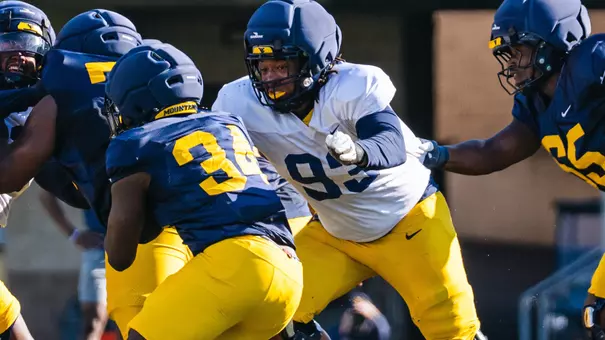
Photo by: WVU Athletic Communications
Moore Trying To Figure Out What He Has Up Front Heading Into Spring
February 21, 2019 03:42 PM | Football
MORGANTOWN, W.Va. – Matt Moore, West Virginia's new co-offensive coordinator and offensive line coach, is in the process of sizing up what he's got to work with heading into spring practice, which means watching lots of video tape.
Surprisingly, a good deal of what he's been watching lately are those Thursday night developmental practices Dana Holgorsen once championed.
That's because the majority of the players he's going to be working with this spring are coming from those end-of-the-week practices last fall.
Right now, he's got two proven players returning in guard Josh Sills and Colton McKivitz and three other positions he's unsure of, including center.
Moore said Monday he'd like to find four players capable of snapping the football with three of them always traveling.
Right now, he's not close to having that.
Last year's No. 1 center, Matt Jones, has decided to transfer closer to home and play at Youngstown State, while Moore said No. 2 center Jacob Buccigrossi is still recovering from offseason shoulder surgery.
Therefore, developing the center position has to be No. 1 on Moore's list of things to do.
"That's huge," he said. "The starting center is gone. The backup center had shoulder surgery so now I've got a redshirt freshman (Briason Mays), and I've got to teach some other guys how to snap."
As for the returning players, Sills is one who has really caught Moore's eye.
"You look at Sills and he's a big, long dude that could play tackle, but he's really good inside because he's physical and nasty," Moore noted. "The same thing with (Kelby) Wickline. He's shown he can play some tackle, and he's played some guard so I'm really trying to figure out where those pieces go right now."
Moore said he will develop left-side and right-side players rather than simply developing guards, tackles and interchangeable guys.
His reasoning is simple: he prefers his guards to have their hand on the ground and being comfortable with their footwork coming out of their stance.
"Your footwork at left guard is no different than it is at left tackle," Moore said. "Now you go to right guard and everything changes and it really messes some kids up. I'll take an older kid that is capable of moving, but I don't like taking a freshman and moving him from right guard to left guard. It just takes them longer to develop."
Moore has plenty of experience developing top-notch offensive linemen going all the way back to his teaching days at North Gwinnett High in Suwanee, Georgia.
He's a teacher first and at each stop along the way, whether it was Texas Tech, Middle Tennessee, Louisiana Tech or Troy, he's always taught before he coached.
Those teaching seeds were first planted when he was a Division II player for Hal Mumme at Valdosta State.
"There was a lot of innovation there when it came to offense because we were the first ones in our conference to really throw it around," Moore explained. "I learned a lot about football, I learned a lot about offensive line play and protection playing in his system and then coaching in it for several years."
The resourcefulness and creativity that he learned as a player carried over to his coaching career as well.
"When you're only given so much and you've got to work with that you've got to make it last a little longer and make things better," Moore explained. "It goes back to developing players. It's like the left tackle this year (Yodny Cajuste). They say he was like 240 when he got here and coach (Mike) Joseph does such a tremendous job.
"That guy has really impressed me about how he does things and how he goes about his business. He doesn't want any accolades; he doesn't care about videoing all of his workouts, he just instills that blue-collar mentality in our players," Moore said.
In Moore's eyes, developing players doesn't just mean taking an undersized three-star prospect and turning him into an NFL draft pick. It can also involve taking a four- or five-star player and helping him reach his full potential.
"They've done such a great job building this brand here and that doesn't mean we aren't going to shoot for those (four- and five-star) guys. It doesn't scare us off at all if they've got an Ohio State offer or a Notre Dame offer," Moore said. "We're going to go after them because so many times today it's about how you develop players that you've had."
Which is exactly what they did at Troy.
Moore pointed out the recruiting class they put together at Troy in 2015 wasn't rated in the Rivals top 100, but four years later it was evaluated as a top-20 class based on on-field performance.
"That's because we developed kids," Moore said. "Maybe they are a three-star, but we don't worry about that. We want guys that fit into what we're trying to do by being selfless and being hard working.
"And sometimes, those guys are four stars," he added. "Sometimes they are long enough and fast enough, and they fit in; sometimes they're not. Sometimes there are guys you see that there is something in them and you've got to figure out how good they are and how good they can be. We've got to get them in here and then we've got to coach them to the point where they can be as good as they can be."
Moore said he prefers having long-armed offensive linemen, but he will take a shorter-armed guy if he's powerful enough and can move people around.
"Athleticism is huge," he explained. "Every day at the end of the day we get together as a staff for about two hours watching players. And we watch every position. We're doing it to watch players, and we're doing it because it's about us talking about what we see and making sure we're all on the same page.
"When we're watching O-linemen, coach (Neal) Brown will ask the defensive back coach, 'What do you think about that kid?' It's just to make sure everybody is on the same page. Recruiting-wise, what are we looking for (in offensive linemen)? The No. 1 thing is to make sure they're not on the ground," he said.
Moore continued, "If we're watching film, and they're falling on the ground all the time, that's not what we're looking for. They don't have balance, good foot speed , and they're not athletic. You've got to have that, and of course body type. We're looking for long, we're looking for athletic and a big part for me is getting to know them and making sure that they're mentally tough kids."
In addition to using West Virginia's brand in recruiting, another aspect that has Moore excited is the number of tight ends with which he has to work. Having a versatile tight end capable of stretching the field in the passing game is a rarity at the Group of 5 level.
"We had a tight end at Troy, but he was never a true guy that could get his hand in the ground and still be a vertical threat," Moore admitted. "There is some stuff you can do when you've got one of those guys. Look at the (New England) Patriots. When you've got a big, athletic tight end that can put his hand in the ground and spread things out, it changes your playbook a lot.
"We've got three dudes that are good-looking dudes there that can run and they're 240ish," Moore said. "I don't think they're guys on fourth and 1 you just line up and power block them, but they can do some stuff out there to set the edge and do things to make defensive coordinators nervous."
Moore concluded, "I've got to figure out who is going to go where. I don't want to go into the summer going 'is he a tackle or a guard?' I've got to make a decision who is going to be at what position so now they can compete for that position through the summer and through camp," he explained. "Then, who is the backup on the left side and the backup on the right side because I think that's one of our biggest issues right now is our depth with our younger players.
"I don't know enough about those guys because I don't have a lot of film on some of these younger guys," he added.
So it's back to watching some more of those Thursday night developmental practices until Moore can actually get them out on the field.
Surprisingly, a good deal of what he's been watching lately are those Thursday night developmental practices Dana Holgorsen once championed.
That's because the majority of the players he's going to be working with this spring are coming from those end-of-the-week practices last fall.
Right now, he's got two proven players returning in guard Josh Sills and Colton McKivitz and three other positions he's unsure of, including center.
Moore said Monday he'd like to find four players capable of snapping the football with three of them always traveling.
Right now, he's not close to having that.
Last year's No. 1 center, Matt Jones, has decided to transfer closer to home and play at Youngstown State, while Moore said No. 2 center Jacob Buccigrossi is still recovering from offseason shoulder surgery.
Therefore, developing the center position has to be No. 1 on Moore's list of things to do.
"That's huge," he said. "The starting center is gone. The backup center had shoulder surgery so now I've got a redshirt freshman (Briason Mays), and I've got to teach some other guys how to snap."
As for the returning players, Sills is one who has really caught Moore's eye.
"You look at Sills and he's a big, long dude that could play tackle, but he's really good inside because he's physical and nasty," Moore noted. "The same thing with (Kelby) Wickline. He's shown he can play some tackle, and he's played some guard so I'm really trying to figure out where those pieces go right now."
Moore said he will develop left-side and right-side players rather than simply developing guards, tackles and interchangeable guys.
His reasoning is simple: he prefers his guards to have their hand on the ground and being comfortable with their footwork coming out of their stance.
"Your footwork at left guard is no different than it is at left tackle," Moore said. "Now you go to right guard and everything changes and it really messes some kids up. I'll take an older kid that is capable of moving, but I don't like taking a freshman and moving him from right guard to left guard. It just takes them longer to develop."
Moore has plenty of experience developing top-notch offensive linemen going all the way back to his teaching days at North Gwinnett High in Suwanee, Georgia.
He's a teacher first and at each stop along the way, whether it was Texas Tech, Middle Tennessee, Louisiana Tech or Troy, he's always taught before he coached.
Those teaching seeds were first planted when he was a Division II player for Hal Mumme at Valdosta State.
"There was a lot of innovation there when it came to offense because we were the first ones in our conference to really throw it around," Moore explained. "I learned a lot about football, I learned a lot about offensive line play and protection playing in his system and then coaching in it for several years."
The resourcefulness and creativity that he learned as a player carried over to his coaching career as well.
"When you're only given so much and you've got to work with that you've got to make it last a little longer and make things better," Moore explained. "It goes back to developing players. It's like the left tackle this year (Yodny Cajuste). They say he was like 240 when he got here and coach (Mike) Joseph does such a tremendous job.
"That guy has really impressed me about how he does things and how he goes about his business. He doesn't want any accolades; he doesn't care about videoing all of his workouts, he just instills that blue-collar mentality in our players," Moore said.
In Moore's eyes, developing players doesn't just mean taking an undersized three-star prospect and turning him into an NFL draft pick. It can also involve taking a four- or five-star player and helping him reach his full potential.
"They've done such a great job building this brand here and that doesn't mean we aren't going to shoot for those (four- and five-star) guys. It doesn't scare us off at all if they've got an Ohio State offer or a Notre Dame offer," Moore said. "We're going to go after them because so many times today it's about how you develop players that you've had."
Which is exactly what they did at Troy.
Moore pointed out the recruiting class they put together at Troy in 2015 wasn't rated in the Rivals top 100, but four years later it was evaluated as a top-20 class based on on-field performance.
"That's because we developed kids," Moore said. "Maybe they are a three-star, but we don't worry about that. We want guys that fit into what we're trying to do by being selfless and being hard working.
"And sometimes, those guys are four stars," he added. "Sometimes they are long enough and fast enough, and they fit in; sometimes they're not. Sometimes there are guys you see that there is something in them and you've got to figure out how good they are and how good they can be. We've got to get them in here and then we've got to coach them to the point where they can be as good as they can be."
Moore said he prefers having long-armed offensive linemen, but he will take a shorter-armed guy if he's powerful enough and can move people around.
"Athleticism is huge," he explained. "Every day at the end of the day we get together as a staff for about two hours watching players. And we watch every position. We're doing it to watch players, and we're doing it because it's about us talking about what we see and making sure we're all on the same page.
"When we're watching O-linemen, coach (Neal) Brown will ask the defensive back coach, 'What do you think about that kid?' It's just to make sure everybody is on the same page. Recruiting-wise, what are we looking for (in offensive linemen)? The No. 1 thing is to make sure they're not on the ground," he said.
Moore continued, "If we're watching film, and they're falling on the ground all the time, that's not what we're looking for. They don't have balance, good foot speed , and they're not athletic. You've got to have that, and of course body type. We're looking for long, we're looking for athletic and a big part for me is getting to know them and making sure that they're mentally tough kids."
In addition to using West Virginia's brand in recruiting, another aspect that has Moore excited is the number of tight ends with which he has to work. Having a versatile tight end capable of stretching the field in the passing game is a rarity at the Group of 5 level.
"We had a tight end at Troy, but he was never a true guy that could get his hand in the ground and still be a vertical threat," Moore admitted. "There is some stuff you can do when you've got one of those guys. Look at the (New England) Patriots. When you've got a big, athletic tight end that can put his hand in the ground and spread things out, it changes your playbook a lot.
"We've got three dudes that are good-looking dudes there that can run and they're 240ish," Moore said. "I don't think they're guys on fourth and 1 you just line up and power block them, but they can do some stuff out there to set the edge and do things to make defensive coordinators nervous."
Moore concluded, "I've got to figure out who is going to go where. I don't want to go into the summer going 'is he a tackle or a guard?' I've got to make a decision who is going to be at what position so now they can compete for that position through the summer and through camp," he explained. "Then, who is the backup on the left side and the backup on the right side because I think that's one of our biggest issues right now is our depth with our younger players.
"I don't know enough about those guys because I don't have a lot of film on some of these younger guys," he added.
So it's back to watching some more of those Thursday night developmental practices until Moore can actually get them out on the field.

Players Mentioned

OL
/ Football
OL
/ Football
OL
/ Football
OL
/ Football
OL
/ FootballNate Gabriel | April 8
Wednesday, April 08
Coach Rod West | April 8
Wednesday, April 08
Coach Rich Rodriguez | April 8
Wednesday, April 08
Ryan Ward | April 6
Monday, April 06