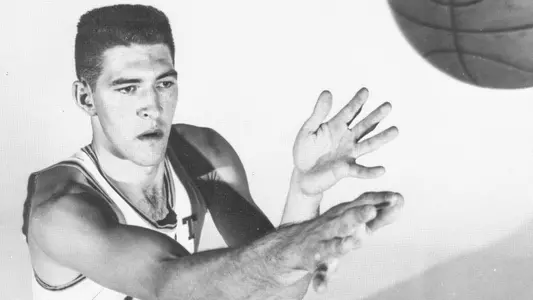
Photo by: WVU Athletic Communications
Cat Fight: WVU’s Catlett Recalls Old Brawl Battles
November 14, 2019 07:00 AM | Men's Basketball, Blog
MORGANTOWN, W.Va. – On Friday night, West Virginia and Pitt are going to play a college basketball game for the 187th time.
A lot has happened since that first official game at Duquesne Gardens on a frigid February night in 1906 when Pitt, then known as Western University of Pennsylvania, played West Virginia.
With the exception of two interruptions between 1908 and 1915 when West Virginia dropped basketball, and a two-year pause following the 1915 game in Pittsburgh, the two teams played every year from 1918 until 2012 when former Panther coach Jamie Dixon put the kibosh on things.
When the two teams played annually, usually one program was up and the other was down, or vice versa.
That was the case when Pitt dominated the series by winning 14 of the first 18 games and later claiming nine victories in a row between 1931-35 when Doc Carlson benefited from having all those pro football players Jock Sutherland brought to Pitt.
It was also that way when the pendulum swung West Virginia's way once the Mountaineers finally began awarding basketball scholarships the year after Dyke Raese's stunning NIT championship in 1942. From 1945 until 1969 when West Virginia basketball began its decade-long decline, the Mountaineers beat Pitt an eye-opening 38 times in 47 games.
To many, perhaps the most combustible period of this volatile series began in 1975 when the two programs finally joined the same conference and continued until 1982 when Pitt left the Eastern 8 for the Big East.
 For a good portion of those years, the person standing right in the middle of the flames holding a lit match in one hand and a can of gasoline in the other was Wendell Gale Catlett, Pitt basketball's Public Enemy No. 1. Catlett was involved in more games against the Panthers than any other Mountaineer, 39 in all as a player and coach.
The Cat's first run-in with the Panthers dates back to 1959 as a player when he got a strong dose of poor Pitt manners during a freshman game at old Fitzgerald Field House.
"They would holler things at us such as, 'Hey you dumb coal miners, you barefoot hillbillies!' Well, I grew up in the Shenandoah Valley in the Eastern Panhandle where it's the orchard country, had never seen a coal mine in my life, didn't know what they meant about barefoot hillbilly where I was from, so it was kind of strange to hear that," Catlett recalled last week.
His opinion of Pitt soon crystalized when varsity coach Fred Schaus barged into the locker room at halftime and began berating the players for how poorly they were playing.
Keep in mind, this was a freshman game!
"We're sitting around and they are spraying water on us and so forth, and he says, 'You guys don't understand this but, by God, I'm not very happy with what's going on,'" Catlett recalled. "I can't say the exact words because Fred cussed a lot, but he said, 'You don't understand, THIS IS AN IMPORTANT GAME and now you better get your asses out there and play!' We ended up beating them, but I had no clue it was THAT important, and I learned from Fred Schaus how to hate Pitt because of his presence and what that game meant."
When Catlett moved up to the varsity, his personal battles with Pitt forward Brian Generalovich became legendary. Generalovich was a much better player than Catlett - one of the better players in Pitt history, actually - but it was Catlett who usually drew the assignment of guarding him.
In those days, it wasn't uncommon to see coaches put their toughest guy on the opposing team's best player. That certainly happened to Jerry West when he played at West Virginia, and it also happened a lot to Rod Thorn. Catlett recalled watching Willie Akers and Pitt's Mike Ditka going after each other during a game at the old Field House.
"Something happened and Willie hit him (Ditka) in the face, knocked him backward and then ran over to the bench behind Fred Schaus, and Ditka started after him before everybody grabbed each other," Catlett laughed. "But (Ditka) didn't go past Fred Schaus for some reason."
A couple years later in 1963, it was Catlett doing the enforcing and Generalovich doing the reacting. During a mid-February game at the Field House, the two players went after a loose ball and collided. The referee called a jump ball and afterward Generalovich picked up the basketball and fired it right into Catlett's back, at least that's Catlett's version of the beginning of a melee that last several minutes and resulted in six free throws being attempted by both teams.
The Pitt supporters swear it was Catlett who face-planted the ball right into Generalovich's nose, igniting the brawl.
"I just turned, spun around and hit him across the face – across the jaw – and he went down," Catlett said. "Everybody grabbed him before it could continue on, but here's the secret … we both got kicked out of the game. Well hell, here's Generalovich, their best player and here I am, a defensive player … so the boys cruised on home with another victory that night!"
Years later, Catlett recalled meeting Generalovich's son, a walk on player at Pitt, after a WVU-Pitt game and he couldn't have been more gracious.
"A wonderful young man, " Catlett said.
Nevertheless, hit the fast forward button 19 years to 1982 when Catlett was now coaching the Mountaineers.
After a couple of transition seasons, Gale had finally gotten West Virginia basketball relevant again with the Mountaineers soaring up the rankings into the top 10 for the first time since he was a player in the early 1960s. Among West Virginia's wins that season was an emotional, hard-fought game in Pittsburgh that the Mountaineers managed to pull out 48-45.
 Those from Pittsburgh who remember the game maintain it was given to West Virginia by the referees.
That was the infamous affair when official Jack Prettyman called a lane violation on Pitt's Clyde Vaughan as Steve Beatty was attempting a game-tying free throw with 14 seconds remaining. West Virginia got the basketball, plus two free throws, when an unhinged Roy Chipman drew a technical foul for protesting the call.
"I deserved the technical, and he deserved what I said about him to get the technical," Chipman growled afterward.
As soon as the game ended, an irate Chipman chased Prettyman off the floor right into the locker room shouting, "That was a chicken!@@#$, Mickey Mouse call, Jack!"
Chipman was still steaming during his postgame press conference.
"We haven't got a call in this league since we told them were leaving (for the Big East)," he said. "It's a Mickey Mouse call. You've got to be looking for something like that to make that call.
"The guy took the game out of the players' hands and decided it himself. He's got to get up in the morning and he has to answer to himself," Chipman added.
The two teams met again in Morgantown a month later on Feb. 24 before the largest crowd to ever watch a college basketball game in the state – 16,704. West Virginia's winning streak had continued with victories over South Alabama, Rutgers, George Washington, Duquesne, St. Bonaventure, Stetson and another against G.W.
Pitt was also playing well, winning five of six following the West Virginia loss and owning a 14-8 overall record at the time.
"That game concerned me because we had won so many games in a row and the guys can't get up for every game," Catlett pointed out.
The Panthers had a couple of players who were difficult matchups, plus a unique 1-3-1 zone defense that was hard to attack. It's the same zone John Beilein later used with great success at West Virginia two decades later.
"Clyde Vaughan always gave us trouble," Catlett recalled. "And then the (Dwayne) Wallace guy, he later coached up there at Duquesne or someplace, he was good too. Chipman brought something to Pittsburgh that nobody else did. Man-to-man, he was a good coach and ran good stuff offensively, but he also played a 1-3-1 half-court trap, and it was the most unusual 1-3-1 half-court trap I ever coached against.
"If you weren't careful you could get caught the way they kept the ball on one side of the court and played the gaps," Catlett continued. "You spent about half your time trying to get the ball into shooting position, and it was hard to play against."
Several hours before the game, the WVU students were already lined up to get into the Coliseum. Back then there was no validation process for student ticketing and all that was needed was a student ID to get into the arena. Any student (or person) with a student ID was admitted and consequently, they were sitting in the aisles by game time.
Traffic was so congested leading into the Coliseum in all directions that Catlett was nearly late for the tip off.
"The only other game like that was the UNLV game," he said. "Jerry Tarkanian walked up to me before that game and said, 'Gale, how in the hell did you ever get me to come here? I'll never come back. I couldn't sleep last night at the Holiday Inn because those damned kids waiting to get into the area were so loud.' Well, it was like that for the Pitt game, too."
"Whatever the announced attendance was you can add 1,000 to it," Craig Walker, then West Virginia's assistant athletic director in charge of the business office, said. "I dropped it exactly 1,000. It was a matter of what we could come up with that we wouldn't get completely dinged on (by the state fire marshal)."
Catlett said that was one of the few games when a home crowd completely took things over and made it easy for him to coach.
"When we had those big crowds and the noise was going and the people were so loud, it just made it great for us because it motivated our players, and it intimidated the other team," he said. "I didn't even have to coach in that UNLV game because we were so pumped up and everything we did was right, and the Pitt game was a little bit like that.
"It was one of those games when I just sat there and enjoyed it."
Catlett also heartily enjoyed his postgame press conference by taking a good portion of it to get in some digs on the Panthers. He took issue with the manner in which Pitt was leaving the Eastern 8 for the Big East.
"I read where Pitt is only going to play us one game a year from now on," he said. "Who are they … with a mediocre program … to dictate to me? It's mediocre, right? They aren't going to sit up there and tell me how many times we're going to play."
Catlett was just getting started. It was pure gold (and blue).
"The competition is pretty good in our league. I don't like Penn State dropping out and saying bad things about the league, or Villanova doing that, or Pitt," he said.
"There's been enough said at Pitt about the league and their bad-mouthing our league doesn't show any class at all. If I made remarks about the league like those other coaches have, I'd get called in by our administration and asked to explain myself," Catlett added.
The coach even pivoted briefly to Duquesne coach Mike Rice, who had taken some snipes at him in the press earlier in the year. By then, all things Pittsburgh were fair game to Catlett.
"If I were Mike Rice, I'd be more concerned about keeping my job at Duquesne," he joked.
Then, Catlett lobbed one more grenade into the Fitzgerald Field House men's room.
"I couldn't care less what Pitt and Duquesne do," he said, "but Chipman never discussed any future games with me. How many games did they sell out besides ours? Maybe we won't play them at all – we really don't need Pitt."
Cherry-picked Catlett quotes, including him calling Pitt a "mediocre program" taken from Pittsburgh Press reporter (and Pitt grad) Jim O'Brien's sidebar story were posted on the bulletin board in the Pitt basketball locker room and remained there throughout Chipman's coaching tenure.
Today, Catlett chuckles when recalling his verbal sparring matches with the Pittsburgh media.
 "There were two papers in Pittsburgh at that time, and we always had better luck with the people from the Post-Gazette than we did with the Press for some reason," he said. "The Pittsburgh Press always seemed to be controversial and antagonistic. I'd look at my phone messages a day or two before we played Pitt, and I'd always return the Post-Gazette calls, but I didn't return my messages from the Press.
"I didn't think basketball was really important to (Pitt) for a long time and at West Virginia, basketball was always important, so I had a chance to point these things out (to the Pittsburgh media) through the years," he continued. "Plus, when I coached there was always a player or two in Pittsburgh that considered either us or Pitt, so I always wanted to make sure that we had the supreme basketball program, and we were going to let them know that."
Catlett said he is amazed at the direction Eastern college basketball has taken, especially since the early 1980s when the cracks in solidarity were really beginning to become exposed.
"I thought when I coached the Mountaineers, particularly during that era in the 80s, I had in the back of my mind no doubt West Virginia, Pittsburgh, Syracuse, Penn State, Boston College, Rutgers and Maryland … I thought we would have an Eastern Conference, but I didn't think it would come out the way it has now.
"To think we're in the Big 12, Penn State is in the Big Ten and Pitt is in the ACC is amazing to me where these programs went and how they got there because it's totally different than I had anticipated," he said.
Catlett said he is glad to see West Virginia and Pitt playing once again on the hardwood and he will be watching the game this Friday night as long as it's not on the ACC Network.
Like just about everyone else, he said he doesn't get the channel. Fortunately, it is on ESPNU.
"I never tried to run the score up on them," he concluded, "but at the same time I never had any sympathy for them because it was always a good rivalry.
"You tell the Mountaineers I said, 'Beat the hell out of Pitt!'"
A lot has happened since that first official game at Duquesne Gardens on a frigid February night in 1906 when Pitt, then known as Western University of Pennsylvania, played West Virginia.
With the exception of two interruptions between 1908 and 1915 when West Virginia dropped basketball, and a two-year pause following the 1915 game in Pittsburgh, the two teams played every year from 1918 until 2012 when former Panther coach Jamie Dixon put the kibosh on things.
When the two teams played annually, usually one program was up and the other was down, or vice versa.
That was the case when Pitt dominated the series by winning 14 of the first 18 games and later claiming nine victories in a row between 1931-35 when Doc Carlson benefited from having all those pro football players Jock Sutherland brought to Pitt.
It was also that way when the pendulum swung West Virginia's way once the Mountaineers finally began awarding basketball scholarships the year after Dyke Raese's stunning NIT championship in 1942. From 1945 until 1969 when West Virginia basketball began its decade-long decline, the Mountaineers beat Pitt an eye-opening 38 times in 47 games.
To many, perhaps the most combustible period of this volatile series began in 1975 when the two programs finally joined the same conference and continued until 1982 when Pitt left the Eastern 8 for the Big East.
For a good portion of those years, the person standing right in the middle of the flames holding a lit match in one hand and a can of gasoline in the other was Wendell Gale Catlett, Pitt basketball's Public Enemy No. 1. Catlett was involved in more games against the Panthers than any other Mountaineer, 39 in all as a player and coach.The Cat's first run-in with the Panthers dates back to 1959 as a player when he got a strong dose of poor Pitt manners during a freshman game at old Fitzgerald Field House.
"They would holler things at us such as, 'Hey you dumb coal miners, you barefoot hillbillies!' Well, I grew up in the Shenandoah Valley in the Eastern Panhandle where it's the orchard country, had never seen a coal mine in my life, didn't know what they meant about barefoot hillbilly where I was from, so it was kind of strange to hear that," Catlett recalled last week.
His opinion of Pitt soon crystalized when varsity coach Fred Schaus barged into the locker room at halftime and began berating the players for how poorly they were playing.
Keep in mind, this was a freshman game!
"We're sitting around and they are spraying water on us and so forth, and he says, 'You guys don't understand this but, by God, I'm not very happy with what's going on,'" Catlett recalled. "I can't say the exact words because Fred cussed a lot, but he said, 'You don't understand, THIS IS AN IMPORTANT GAME and now you better get your asses out there and play!' We ended up beating them, but I had no clue it was THAT important, and I learned from Fred Schaus how to hate Pitt because of his presence and what that game meant."
When Catlett moved up to the varsity, his personal battles with Pitt forward Brian Generalovich became legendary. Generalovich was a much better player than Catlett - one of the better players in Pitt history, actually - but it was Catlett who usually drew the assignment of guarding him.
In those days, it wasn't uncommon to see coaches put their toughest guy on the opposing team's best player. That certainly happened to Jerry West when he played at West Virginia, and it also happened a lot to Rod Thorn. Catlett recalled watching Willie Akers and Pitt's Mike Ditka going after each other during a game at the old Field House.
"Something happened and Willie hit him (Ditka) in the face, knocked him backward and then ran over to the bench behind Fred Schaus, and Ditka started after him before everybody grabbed each other," Catlett laughed. "But (Ditka) didn't go past Fred Schaus for some reason."
A couple years later in 1963, it was Catlett doing the enforcing and Generalovich doing the reacting. During a mid-February game at the Field House, the two players went after a loose ball and collided. The referee called a jump ball and afterward Generalovich picked up the basketball and fired it right into Catlett's back, at least that's Catlett's version of the beginning of a melee that last several minutes and resulted in six free throws being attempted by both teams.
The Pitt supporters swear it was Catlett who face-planted the ball right into Generalovich's nose, igniting the brawl.
"I just turned, spun around and hit him across the face – across the jaw – and he went down," Catlett said. "Everybody grabbed him before it could continue on, but here's the secret … we both got kicked out of the game. Well hell, here's Generalovich, their best player and here I am, a defensive player … so the boys cruised on home with another victory that night!"
Years later, Catlett recalled meeting Generalovich's son, a walk on player at Pitt, after a WVU-Pitt game and he couldn't have been more gracious.
"A wonderful young man, " Catlett said.
Nevertheless, hit the fast forward button 19 years to 1982 when Catlett was now coaching the Mountaineers.
After a couple of transition seasons, Gale had finally gotten West Virginia basketball relevant again with the Mountaineers soaring up the rankings into the top 10 for the first time since he was a player in the early 1960s. Among West Virginia's wins that season was an emotional, hard-fought game in Pittsburgh that the Mountaineers managed to pull out 48-45.
Those from Pittsburgh who remember the game maintain it was given to West Virginia by the referees.That was the infamous affair when official Jack Prettyman called a lane violation on Pitt's Clyde Vaughan as Steve Beatty was attempting a game-tying free throw with 14 seconds remaining. West Virginia got the basketball, plus two free throws, when an unhinged Roy Chipman drew a technical foul for protesting the call.
"I deserved the technical, and he deserved what I said about him to get the technical," Chipman growled afterward.
As soon as the game ended, an irate Chipman chased Prettyman off the floor right into the locker room shouting, "That was a chicken!@@#$, Mickey Mouse call, Jack!"
Chipman was still steaming during his postgame press conference.
"We haven't got a call in this league since we told them were leaving (for the Big East)," he said. "It's a Mickey Mouse call. You've got to be looking for something like that to make that call.
"The guy took the game out of the players' hands and decided it himself. He's got to get up in the morning and he has to answer to himself," Chipman added.
The two teams met again in Morgantown a month later on Feb. 24 before the largest crowd to ever watch a college basketball game in the state – 16,704. West Virginia's winning streak had continued with victories over South Alabama, Rutgers, George Washington, Duquesne, St. Bonaventure, Stetson and another against G.W.
Pitt was also playing well, winning five of six following the West Virginia loss and owning a 14-8 overall record at the time.
"That game concerned me because we had won so many games in a row and the guys can't get up for every game," Catlett pointed out.
The Panthers had a couple of players who were difficult matchups, plus a unique 1-3-1 zone defense that was hard to attack. It's the same zone John Beilein later used with great success at West Virginia two decades later.
"Clyde Vaughan always gave us trouble," Catlett recalled. "And then the (Dwayne) Wallace guy, he later coached up there at Duquesne or someplace, he was good too. Chipman brought something to Pittsburgh that nobody else did. Man-to-man, he was a good coach and ran good stuff offensively, but he also played a 1-3-1 half-court trap, and it was the most unusual 1-3-1 half-court trap I ever coached against.
"If you weren't careful you could get caught the way they kept the ball on one side of the court and played the gaps," Catlett continued. "You spent about half your time trying to get the ball into shooting position, and it was hard to play against."
Several hours before the game, the WVU students were already lined up to get into the Coliseum. Back then there was no validation process for student ticketing and all that was needed was a student ID to get into the arena. Any student (or person) with a student ID was admitted and consequently, they were sitting in the aisles by game time.
Traffic was so congested leading into the Coliseum in all directions that Catlett was nearly late for the tip off.
"The only other game like that was the UNLV game," he said. "Jerry Tarkanian walked up to me before that game and said, 'Gale, how in the hell did you ever get me to come here? I'll never come back. I couldn't sleep last night at the Holiday Inn because those damned kids waiting to get into the area were so loud.' Well, it was like that for the Pitt game, too."
"Whatever the announced attendance was you can add 1,000 to it," Craig Walker, then West Virginia's assistant athletic director in charge of the business office, said. "I dropped it exactly 1,000. It was a matter of what we could come up with that we wouldn't get completely dinged on (by the state fire marshal)."
Catlett said that was one of the few games when a home crowd completely took things over and made it easy for him to coach.
"When we had those big crowds and the noise was going and the people were so loud, it just made it great for us because it motivated our players, and it intimidated the other team," he said. "I didn't even have to coach in that UNLV game because we were so pumped up and everything we did was right, and the Pitt game was a little bit like that.
"It was one of those games when I just sat there and enjoyed it."
Catlett also heartily enjoyed his postgame press conference by taking a good portion of it to get in some digs on the Panthers. He took issue with the manner in which Pitt was leaving the Eastern 8 for the Big East.
"I read where Pitt is only going to play us one game a year from now on," he said. "Who are they … with a mediocre program … to dictate to me? It's mediocre, right? They aren't going to sit up there and tell me how many times we're going to play."
Catlett was just getting started. It was pure gold (and blue).
"The competition is pretty good in our league. I don't like Penn State dropping out and saying bad things about the league, or Villanova doing that, or Pitt," he said.
"There's been enough said at Pitt about the league and their bad-mouthing our league doesn't show any class at all. If I made remarks about the league like those other coaches have, I'd get called in by our administration and asked to explain myself," Catlett added.
The coach even pivoted briefly to Duquesne coach Mike Rice, who had taken some snipes at him in the press earlier in the year. By then, all things Pittsburgh were fair game to Catlett.
"If I were Mike Rice, I'd be more concerned about keeping my job at Duquesne," he joked.
Then, Catlett lobbed one more grenade into the Fitzgerald Field House men's room.
"I couldn't care less what Pitt and Duquesne do," he said, "but Chipman never discussed any future games with me. How many games did they sell out besides ours? Maybe we won't play them at all – we really don't need Pitt."
Cherry-picked Catlett quotes, including him calling Pitt a "mediocre program" taken from Pittsburgh Press reporter (and Pitt grad) Jim O'Brien's sidebar story were posted on the bulletin board in the Pitt basketball locker room and remained there throughout Chipman's coaching tenure.
Today, Catlett chuckles when recalling his verbal sparring matches with the Pittsburgh media.
"There were two papers in Pittsburgh at that time, and we always had better luck with the people from the Post-Gazette than we did with the Press for some reason," he said. "The Pittsburgh Press always seemed to be controversial and antagonistic. I'd look at my phone messages a day or two before we played Pitt, and I'd always return the Post-Gazette calls, but I didn't return my messages from the Press."I didn't think basketball was really important to (Pitt) for a long time and at West Virginia, basketball was always important, so I had a chance to point these things out (to the Pittsburgh media) through the years," he continued. "Plus, when I coached there was always a player or two in Pittsburgh that considered either us or Pitt, so I always wanted to make sure that we had the supreme basketball program, and we were going to let them know that."
Catlett said he is amazed at the direction Eastern college basketball has taken, especially since the early 1980s when the cracks in solidarity were really beginning to become exposed.
"I thought when I coached the Mountaineers, particularly during that era in the 80s, I had in the back of my mind no doubt West Virginia, Pittsburgh, Syracuse, Penn State, Boston College, Rutgers and Maryland … I thought we would have an Eastern Conference, but I didn't think it would come out the way it has now.
"To think we're in the Big 12, Penn State is in the Big Ten and Pitt is in the ACC is amazing to me where these programs went and how they got there because it's totally different than I had anticipated," he said.
Catlett said he is glad to see West Virginia and Pitt playing once again on the hardwood and he will be watching the game this Friday night as long as it's not on the ACC Network.
Like just about everyone else, he said he doesn't get the channel. Fortunately, it is on ESPNU.
"I never tried to run the score up on them," he concluded, "but at the same time I never had any sympathy for them because it was always a good rivalry.
"You tell the Mountaineers I said, 'Beat the hell out of Pitt!'"
College Basketball Crown Recap
Thursday, April 16
Ross Hodge, Honor Huff & Brenen Lorient | Oklahoma Postgame
Sunday, April 05
Ross Hodge, Treysen Eaglestaff & Brenen Lorient | Creighton Postgame
Saturday, April 04
Ross Hodge & Honor Huff | Stanford Postgame
Thursday, April 02