Old Meets New As Joseph And Staff Use Technology To Maximize Performance
September 15, 2018 10:59 AM | Football, Blog
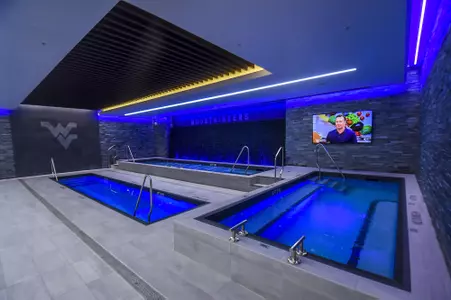
MORGANTOWN, W.Va. - Go downstairs to Mountaineer football's weight training facility and it's more like entering the Starship Enterprise or exploring Frankenstein's laboratory than it is going into a regular weight room we were once accustomed to seeing.
There are Cryosaunas, NovoThors, Halosports, Active Recoveries, GPS monitors, areas to practice "mindfulness" and, soon, a Float Tank made available through the athletic department's relationship with the Rockefeller Neuroscience Center. In it, the players can submerge in salt water for about an hour to regenerate their bodies and get their minds right.
Back in the day, the guys used to do that with the help of The Beatles' Tomorrow Never Knows ... "Turn off your mind, relax and float downstream …" or, Pink Floyd's Comfortably Numb.
These days, the players don't need The Beatles or Pink Floyd anymore to float downstream. It's pure science now and their practitioner/guru is assistant athletic director for strength and conditioning Mike Joseph.
"The old days of meathead strength coaches … those days are way, way gone," West Virginia coach Dana Holgorsen said on his weekly radio show last Monday night. "They are so much more technically advanced right now. They've got more gadgets down in the weight room than I've ever seen."
It's pointless to explore in-depth everything that Joseph's people are doing with the Mountaineer football players because the attention span of today's typical reader won't allow it, but in lay terms, it's without question cutting edge.
I realized this a couple of weeks ago when we were talking to USC transfer Kenny Bigelow Jr., and he mentioned all of the things that he now has access to here at WVU to maximize performance that he didn't have at USC.
In fact, it's unlikely any team in the country is doing all of the things Joseph and his staff are doing right now to enhance the performance level of West Virginia's student-athletes.
"There are some teams that have some of this, but not all of it collectively," Joseph noted.
So, what exactly are Joseph's guys doing?
It's a combination of a variety of different techniques and available technologies to help the Mountaineer players recover more quickly from workouts and games, and ultimately, live healthier lives.
"When we bring in recruits and explain to their mothers, fathers, grandmothers and grandfathers that we are going to take care of their kids when they come here, well, this is a clear example of this," Joseph explained. "We're legitimately trying to be a leader in terms of athlete safety and having a heathier environment for them."
Joseph's recovery process includes such things as entering a Cryosauna to help with blood flow to vital organs, enabling improved sleep quality and energy levels.
A NovoThor is utilized to reduce free radicals attached to mitochondria that restrict energy production and this process is supposed to improve endurance and relieve pain.
Compression boots are worn to help restore players' legs, a process that begins at the cellular level, while Active Recovery is touted as an instrument to jumpstart the body's ability to flush waste and recover faster.
Halosports are headphones the players wear to help stimulate the motor cortex and aid with their focus and attention spans.
Massage therapy is utilized to assist in the regeneration process while those old-fashioned ice bins are still available to help cool the body temperature and reduce pain and inflammation.
And then there is mindfulness, which entails a mental training process that helps the players "find their center" and "control their attention by focusing on the present moment."
Those of us who spend each week around the WVU players have heard quarterback Will Grier mention mindfulness many times already.
To monitor the players' sleep habits, West Virginia University last year switched to Whoop technology and Arden Omegawave monitoring to check heart rate variability (HRV) and nervous system functioning. Joseph said this has really helped the guys take better care of their bodies when they are away from the Puskar Center.
"It gives them efficiency-of-sleep and strain of the day, and it gives us red, yellow and green indicators to let us know how much sleep they are getting," he explained. "Obviously, red is not very good and means they are in a bad state. If they are in yellow, it's not optimal, but during the season the stresses they have preparing for a game, their academics and so forth, a lot of them are going to be in the yellow. Our goal during the season is to get them to green as much as possible.
"The biggest thing with Whoop or any sleep technology is not necessarily how much sleep they get, but rather changing their behaviors and sleep quality," Joseph pointed out. "We want to make sure our guys are living better and making better choices."
That also includes eating healthier foods, which is where team nutritionist Taylor Lile enters this process. She's responsible for helping plan the daily meals Sodexo prepares for the players in their impressive, recently renovated training table area upstairs.
"Taylor is doing a great job," Holgorsen said. "It's just a way of life for them right now. It used to be where we had to say, 'Okay, this is what it is.' We don't have to explain it anymore. They come in and they know that they are going to have to lift weights on Sunday evening, Tuesday morning and Thursday afternoon. Now, they know they are going to have to grab their GPS monitors and put them on before practice.
"They know they are going to have to sit in the cryo or cold tubs after every single practice. They are going to have to turn in their sleep monitor every Friday morning," Holgorsen continued. "It's part of their routine. They've bought into it because they've seen the results. They feel better on game day."
The most popular gadget the players wear is the Catapult GPS system that measures their workload such as distance run, max effort, change of direction, velocity and miles per hour. That data is provided to the coaching staff to help them determine each players' work rate.
The players are interested in it for another reason.
"All they want to see is who the fastest guy is," Holgorsen said. "They compete on who can run the fastest. Gary (Jennings Jr.) and Marcus (Simms) hit 22 miles per hour and a lot of them hit 21, 20 miles per hour. The O-linemen compete to see who can get into double digits at 10."
Holgorsen said the data they are using is much, much more detailed than that, however.
"We get information on how many yards these guys are giving maximum effort, and we compare it from Tuesday to Tuesday," he said. "There are short bursts, long bursts, total yards, total time at a certain level, total time at a resting level and so many other things you can do with this. The more we look into the data that we consume and the more we study it the more we find that we can use."
Joseph admits there is so much information now to collect that it's taken his staff a while to understand what it all means.
Darl Bauer has become the staff's tech guy as director of applied performance. His job now with Chad Snodgrass and Alex Mitchell each day after practice also includes inputting the data the strength staff acquires on every player.
 That is a massive undertaking in itself, meaning the strength staff works just as hard after practice as it does when it operates WVU's offseason conditioning program.
"Our No. 1 goal is to develop the student-athlete," Joseph explained. "The resources that we have allows us to progressively stress the athlete in the offseason and during practice, physiologically. We are able to monitor and recover faster and continue to see positive physiological changes faster.
"Over the last few years, we are much more knowledgeable to the positive and negative trends to hopefully guide coaches and players to be more efficient on a daily basis. At the end of this year, we are going to have much more data to analyze," he added.
Plus, they are about to get even more gadgets to play with, such as the Float Tank on the way that widens Will Grier's eyes.
"I can't wait to get into that thing," he said. "I'm excited about that – I think it's good stuff."
"I think it's good for us," senior wide receiver David Sills V said. "I think it definitely gets our body back to where we need it."
"You have to consistently do it, though," linebacker David Long Jr. added. "People think you get in there once every week and it's supposed to make you feel better instantly. You've got to get in there to make your body feel better."
"I'm not a scientist, but it makes sense," Grier concluded. "People really believe in it. I do it."
I recall Don Nehlen once doing something similar many years ago when he really got the strength program off the ground here in the early 1980s.
What he didn't wasn't scientific but rather psychological.
He would instruct strength coach Dave Van Halanger to fudge things a little bit - maybe give the bar a little boost when they were lifting heavier weight or stick his toe on the scale to add a few extra pounds during weigh-ins to give the impression to the players that they were always getting bigger and stronger.
Nehlen felt them believing they were getting bigger and stronger was just as important as them actually getting bigger and stronger.
And it worked, just as Mike Joseph's recovery and applied performance approach has become a big hit with the players today.
The difference now, of course, is that Joseph has the science and the data to back it up.
There are Cryosaunas, NovoThors, Halosports, Active Recoveries, GPS monitors, areas to practice "mindfulness" and, soon, a Float Tank made available through the athletic department's relationship with the Rockefeller Neuroscience Center. In it, the players can submerge in salt water for about an hour to regenerate their bodies and get their minds right.
Back in the day, the guys used to do that with the help of The Beatles' Tomorrow Never Knows ... "Turn off your mind, relax and float downstream …" or, Pink Floyd's Comfortably Numb.
These days, the players don't need The Beatles or Pink Floyd anymore to float downstream. It's pure science now and their practitioner/guru is assistant athletic director for strength and conditioning Mike Joseph.
"The old days of meathead strength coaches … those days are way, way gone," West Virginia coach Dana Holgorsen said on his weekly radio show last Monday night. "They are so much more technically advanced right now. They've got more gadgets down in the weight room than I've ever seen."
It's pointless to explore in-depth everything that Joseph's people are doing with the Mountaineer football players because the attention span of today's typical reader won't allow it, but in lay terms, it's without question cutting edge.
I realized this a couple of weeks ago when we were talking to USC transfer Kenny Bigelow Jr., and he mentioned all of the things that he now has access to here at WVU to maximize performance that he didn't have at USC.
In fact, it's unlikely any team in the country is doing all of the things Joseph and his staff are doing right now to enhance the performance level of West Virginia's student-athletes.
"There are some teams that have some of this, but not all of it collectively," Joseph noted.
So, what exactly are Joseph's guys doing?
It's a combination of a variety of different techniques and available technologies to help the Mountaineer players recover more quickly from workouts and games, and ultimately, live healthier lives.
"When we bring in recruits and explain to their mothers, fathers, grandmothers and grandfathers that we are going to take care of their kids when they come here, well, this is a clear example of this," Joseph explained. "We're legitimately trying to be a leader in terms of athlete safety and having a heathier environment for them."
Joseph's recovery process includes such things as entering a Cryosauna to help with blood flow to vital organs, enabling improved sleep quality and energy levels.
A NovoThor is utilized to reduce free radicals attached to mitochondria that restrict energy production and this process is supposed to improve endurance and relieve pain.
Compression boots are worn to help restore players' legs, a process that begins at the cellular level, while Active Recovery is touted as an instrument to jumpstart the body's ability to flush waste and recover faster.
Halosports are headphones the players wear to help stimulate the motor cortex and aid with their focus and attention spans.
Massage therapy is utilized to assist in the regeneration process while those old-fashioned ice bins are still available to help cool the body temperature and reduce pain and inflammation.
And then there is mindfulness, which entails a mental training process that helps the players "find their center" and "control their attention by focusing on the present moment."
Those of us who spend each week around the WVU players have heard quarterback Will Grier mention mindfulness many times already.
To monitor the players' sleep habits, West Virginia University last year switched to Whoop technology and Arden Omegawave monitoring to check heart rate variability (HRV) and nervous system functioning. Joseph said this has really helped the guys take better care of their bodies when they are away from the Puskar Center.
"It gives them efficiency-of-sleep and strain of the day, and it gives us red, yellow and green indicators to let us know how much sleep they are getting," he explained. "Obviously, red is not very good and means they are in a bad state. If they are in yellow, it's not optimal, but during the season the stresses they have preparing for a game, their academics and so forth, a lot of them are going to be in the yellow. Our goal during the season is to get them to green as much as possible.
"The biggest thing with Whoop or any sleep technology is not necessarily how much sleep they get, but rather changing their behaviors and sleep quality," Joseph pointed out. "We want to make sure our guys are living better and making better choices."
That also includes eating healthier foods, which is where team nutritionist Taylor Lile enters this process. She's responsible for helping plan the daily meals Sodexo prepares for the players in their impressive, recently renovated training table area upstairs.
"Taylor is doing a great job," Holgorsen said. "It's just a way of life for them right now. It used to be where we had to say, 'Okay, this is what it is.' We don't have to explain it anymore. They come in and they know that they are going to have to lift weights on Sunday evening, Tuesday morning and Thursday afternoon. Now, they know they are going to have to grab their GPS monitors and put them on before practice.
"They know they are going to have to sit in the cryo or cold tubs after every single practice. They are going to have to turn in their sleep monitor every Friday morning," Holgorsen continued. "It's part of their routine. They've bought into it because they've seen the results. They feel better on game day."
The most popular gadget the players wear is the Catapult GPS system that measures their workload such as distance run, max effort, change of direction, velocity and miles per hour. That data is provided to the coaching staff to help them determine each players' work rate.
The players are interested in it for another reason.
"All they want to see is who the fastest guy is," Holgorsen said. "They compete on who can run the fastest. Gary (Jennings Jr.) and Marcus (Simms) hit 22 miles per hour and a lot of them hit 21, 20 miles per hour. The O-linemen compete to see who can get into double digits at 10."
Holgorsen said the data they are using is much, much more detailed than that, however.
"We get information on how many yards these guys are giving maximum effort, and we compare it from Tuesday to Tuesday," he said. "There are short bursts, long bursts, total yards, total time at a certain level, total time at a resting level and so many other things you can do with this. The more we look into the data that we consume and the more we study it the more we find that we can use."
Joseph admits there is so much information now to collect that it's taken his staff a while to understand what it all means.
Darl Bauer has become the staff's tech guy as director of applied performance. His job now with Chad Snodgrass and Alex Mitchell each day after practice also includes inputting the data the strength staff acquires on every player.
That is a massive undertaking in itself, meaning the strength staff works just as hard after practice as it does when it operates WVU's offseason conditioning program."Our No. 1 goal is to develop the student-athlete," Joseph explained. "The resources that we have allows us to progressively stress the athlete in the offseason and during practice, physiologically. We are able to monitor and recover faster and continue to see positive physiological changes faster.
"Over the last few years, we are much more knowledgeable to the positive and negative trends to hopefully guide coaches and players to be more efficient on a daily basis. At the end of this year, we are going to have much more data to analyze," he added.
Plus, they are about to get even more gadgets to play with, such as the Float Tank on the way that widens Will Grier's eyes.
"I can't wait to get into that thing," he said. "I'm excited about that – I think it's good stuff."
"I think it's good for us," senior wide receiver David Sills V said. "I think it definitely gets our body back to where we need it."
"You have to consistently do it, though," linebacker David Long Jr. added. "People think you get in there once every week and it's supposed to make you feel better instantly. You've got to get in there to make your body feel better."
"I'm not a scientist, but it makes sense," Grier concluded. "People really believe in it. I do it."
I recall Don Nehlen once doing something similar many years ago when he really got the strength program off the ground here in the early 1980s.
What he didn't wasn't scientific but rather psychological.
He would instruct strength coach Dave Van Halanger to fudge things a little bit - maybe give the bar a little boost when they were lifting heavier weight or stick his toe on the scale to add a few extra pounds during weigh-ins to give the impression to the players that they were always getting bigger and stronger.
Nehlen felt them believing they were getting bigger and stronger was just as important as them actually getting bigger and stronger.
And it worked, just as Mike Joseph's recovery and applied performance approach has become a big hit with the players today.
The difference now, of course, is that Joseph has the science and the data to back it up.



Players Mentioned

DL
/ Football
QB
/ Football
LB
/ Football
WR
/ FootballCoach Pat Kirkland | April 15
Thursday, April 16
Andrew Powdrell | April 15
Wednesday, April 15
Coach Rich Rodriguez | April 15
Wednesday, April 15
Mic'd Up with Coach Rich Rodriguez
Wednesday, April 15