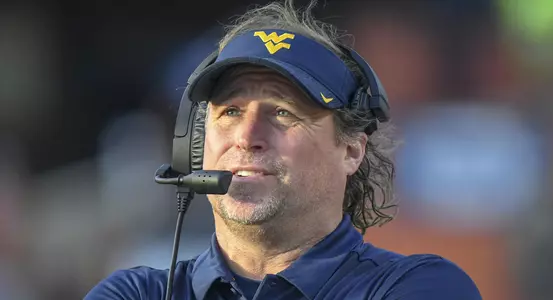
Photo by: All Pro Photography/Dale Sparks
Hot Reads: Playing the Odds
November 09, 2018 11:00 AM | Football
Radio sideline reporter Jed Drenning provides periodic commentary on the Mountaineer football program for WVUsports.com. Be sure to follow him on Twitter @TheSignalCaller.
Some things surprise me.
A lion's roar can be heard from five miles away, John Denver's real name was Henry John Deutschendorf Jr.and you can't hum while holding your nose closed.
Go ahead. Try it.
Maybe you didn't notice, but one thing noton that list of surprises was Dana Holgorsen's decision to go for two in Austin, Texas, last Saturday.
If you didn't see that one coming, maybe you should have.
Holgorsen arrived in Morgantown seven years ago as the Red Bull-swilling engineer of a jet-fueled offense that had succeeded everywhere he'd landed.
He was appointed head football coach at West Virginia on June 10, 2011 and less than a week later he was skydiving over the New River Gorge with a parachute team from the U.S. Army.
Why? Because that's who he is. A guy, and a coach, who zigs when most folks zag. That bold disposition is a big part of what's got him to where he is his today, tied for No. 2 on WVU's all-time victories list behind only Don Nehlen. His aggressive philosophy is forged by confidence, and I still recall the first time I truly understood how assertive he could be.
It was late in Holgorsen's first season at West Virginia on a Saturday night in early December of 2011. With a Big East title and BCS bid hanging in the balance, Holgorsen's Mountaineers were at Raymond James Stadium in Tampa, trading blows with the South Florida Bulls.
Trailing 27-20 with eight minutes left in the game, West Virginia faced a fourth down at its own 32-yard line following a Geno Smith incompletion. The decision seemed like an easy one. Old school convention dictated you punted the ball away, swelled up on defense and took your chances with the next hand you were dealt offensively.
Instead, Holgorsen eschewed convention and stacked the deck. I would say he rolled the dice, but unless those galloping dominoes came to an immediate stop on the craps table that act would've taken longer than Holgorsen's real-time decision.
Without missing a beat, the coach signaled a play in to Smith, tapping his shoulder and moving his hand to his side as if mimicking a third-base coach. The quarterback read him loud and clear. He checked the defense and took the shotgun snap, firing a quick shot to Stedman Bailey who spun his way for a 10-yard pick up and a critical first down in front of the WVU bench. West Virginia went on to score the final 10 points of the game, earning a trip to the Orange Bowl to face Clemson and the rest, as they say, is history.
Imagine if that call had played out differently. Imagine if the fourth-down attempt had failed and WVU handed the football to the Bulls deep in Mountaineer territory, late in a one-score game.
Now keep imagining it. You'll have to, because it never happened. And that's sort of the point.
What some coaches – shackled by conservative thinking -- might regard as a high-risk proposition on fourth down, Holgorsen saw as a practical opportunity to get the numbers working back in WVU's favor. Brazenly looking past the field position and the time on the clock, Holgorsen weighed a routine pitch-and-catch by his offense, fourth down or not, as a more viable option than desperately asking his defense, which was running on fumes after enduring in recent minutes lengthy USF drives of 12 and 15 plays, to force a punt.
His decision in Tampa that night paid off. Just like his decision in Austin last week, which was made for similar reasons. Seeing the West Virginia defense with hands firmly on their hips after being on the field for nearly 18 minutes in the second half, the optimal choice figured to be asking the best quarterback in the country to go get three yards and win the game. And he did.
To suggest it was a good call only because it worked simply supports the notion that you never get credit for disaster averted. Imagine if WVU had opted against the two-point play and instead lined up for a game-tying point after attempt. Now imagine that Longhorns safety Caden Sterns repeated the play he made against USC earlier in the season and slipped through to block the kick, thereby handing Evan Staley the first failed PAT attempt of his career.
Now keep imagining it. Because it never happened.
Instead of hearing the folks at the office Monday morning lament that the Mountaineers had broken their heart again, you were treated to one of the greatest finishes in the history of West Virginia football. Why? Because when the chips were down, Dana Holgorsen played the odds, making the decision that gave his team the greatest likelihood to win.
This isn't to suggest that two points are always niftier than one or that -- when given four downs -- you should never spend one on a punt. You can always throw caution to the wind with one hand while holding a finger to the wind with the other. That's smart coaching. The larger point is, if you peel back the layers, you'll identify a basis for Holgorsen's decision to incorporate – or not incorporate – an ostensibly bold tactic.
For example, in 2012, West Virginia's maiden season in the Big 12 Conference, Holgorsen elected to go for it on fourth down an eye-grabbing 35 times – the most in the league. Compare that to this year, which has seen the Mountaineers involved in a mere four attempts on fourth down, the fewest in the conference.
Why such a stark difference? The biggest factor has been the evolution of the Mountaineer roster. In 2018, WVU simply has a deeper complement of talent in its two-deep on both sides of the football. West Virginia boasts a more Big 12-ready roster, with depth at key positions, than it did six years ago. As such, Holgorsen doesn't have the need to press for so many extra opportunities on fourth down. Sure, a well-placed attempt to move the chains instead of kicking is always on the table, but not with the same regularity as 2012. What once was a necessity is now a luxury.
This isn't about being brash in times of crisis. Instead, it's a simple matter of setting aside what we've all been conditioned to see as conventional when that gets in the way of what might actually gives your squad its best shot to succeed. In short, it's about weighing the unique variables of each situation and playing the odds.
Speaking of guys who aren't afraid to take chances, into Morgantown rolls the inimitable Gary Patterson and the TCU Frogs. When you've won 164 games at a single school – accounting for more than 25 percent of the victories in TCU history, in fact, you can afford to roll the dice a time or two, and Patterson does just that.
Remember TCU opting to go for two in the second overtime in 2012 at Mountaineer Field to win the game? And who can forget the 48-yard touchdown against WVU last year in Fort Worth on a gadget throwback pass to Frogs quarterback Kenny Hill?
Patterson isn't afraid to dip into his bag of tricks and take some chances, but the TCU program isn't built on subterfuge. The Frogs foundation is good coaching, sound fundamentals and smart players on both sides of the football. Injuries and attrition have taken their toll on Patterson's 2018 squad, but the Frogs still pose plenty of problems. This is, after all, a team that held its own against Ohio State, knocked off Iowa State and was hanging tough with Oklahoma into the fourth quarter.
Defense continues to be the lifeblood of Patterson's program as the Frogs lead all Big 12 units against the pass (191 yards per game) while ranking No. 2 in the league in total defense, third-down defense and red-zone touchdown defense. I have to admit, breaking down tape on Patterson's defense each year is a bit of a guilty pleasure. It's easy to admire how well trained his kids are in the art of recognition, particularly in the secondary.
Pass routes, you see, are typically designed to complement one another and create a point of conflict in one area of a coverage. For example, a basic curl paired with a quick out route is intended to apply pressure against a zone coverage on the defender responsible for the flat to that side, forcing him to choose one or the other.
Concepts can create stress on a coverage horizontally, vertically, or both. If you grasp the framework of this, you can often predict what general type of route one receiver might be running before he makes his cut based on the quicker route being run by the other receiver paired with him in the given concept.
This is how Patterson teaches his defensive backs to anticipate route combos before they unfold. It's also why he's so often recruited former high school quarterbacks to populate the safety positions in his 4-2-5 defense. TCU's mastery of this technique is what makes the Frogs ability to match routes such an unusual challenge.
TCU is primarily a zone coverage team, but with a twist. The Frogs might not feature the elite backend talent they've had in years past with safeties like Derrick Kindred, Chris Hackett or Denzel Johnson, but they adhere to the aforementioned principles, helping them recognize pass concepts and match routes. This can convince even discerning offenses that TCU's zone looks are man coverage, creating problems.
Up front, the Frogs will use stunting and movement to chop things up, calling on
a pair of thick defensive tackles with good pad level and two athletic edge rushers, including Big 12 Preseason Defensive Player of the Year Ben Banogu. Throw into this mix Patterson's specifically tailored pressure packages – each designed to exploit a specific opponent's tendencies – and you quickly have your hands full.
TCU figures to present a stiff test for a West Virginia offensive line that could be peaking at the perfect time. Assistant Coach Joe Wickline's unit is fresh off a performance that saw them keep Will Grier sack-free (with swing man Kelby Wickline at left tackle) while paving the way for 232 rushing yards – the most allowed by the Texas defense since the 2017 season opener.
In six head-to-head matchups since joining the Big 12, Holgorsen's offenses have collectively averaged 3.6 yards per rush against Patterson's defense. Improving on that number Saturday could loosen things up on the backend for Grier as he looks to build on his fourth-quarter heroics last week at Texas.
As the game wears on with Grier crossing swords with the league's top-ranked pass defense, here are a couple things to consider. First, despite their overall success against the pass, in the second half of games this year TCU has allowed nine touchdown strikes and is one of only two Power 5 teams (Arkansas) not to intercept a single throw in quarters three and four. Second, Grier boasts the best fourth-quarter passer rating (201.6) and completion percentage (74.2) in the Big 12. Tape a "break glass in case of emergency" label on those two nuggets and keep them somewhere safe.
Don't expect TCU to blink when it steps onto Mountaineer Field at high noon in front of a sea of blue 60,000 deep. Patterson's crew has held all nine opponents below their offensive season total averages and defense, as the old adage goes, travels well. Since 2009, the Frogs have racked up an impressive 38 wins on the road – the third highest total in college football during that span.
The first three Big 12 meetings between these two teams were all decided on the very last play. Last year at Amon G. Carter Stadium, it came down to the final minute. Whatever kind of matchup awaits us this time around, there's a fair to middling chance the advantage might be tipped one way or the other by the coach willing to nudge convention aside, weigh the situation and play the odds with a decision that – in the moment – won't be the easy one. Gary Patterson has a reputation for doing so. But I'll bet he's never jumped from a plane.
Forget the outside noise. If there's a reason to do so, Dana Holgorsen will always have the conviction to take a bold chance at an opportune time.
And – unlike the fact that snails have 14,000 teeth and Blow Pops are the most popular candy in West Virginia -- it won't surprise me when he does.
I'll see you at the 50.
Some things surprise me.
A lion's roar can be heard from five miles away, John Denver's real name was Henry John Deutschendorf Jr.and you can't hum while holding your nose closed.
Go ahead. Try it.
Maybe you didn't notice, but one thing noton that list of surprises was Dana Holgorsen's decision to go for two in Austin, Texas, last Saturday.
If you didn't see that one coming, maybe you should have.
Holgorsen arrived in Morgantown seven years ago as the Red Bull-swilling engineer of a jet-fueled offense that had succeeded everywhere he'd landed.
He was appointed head football coach at West Virginia on June 10, 2011 and less than a week later he was skydiving over the New River Gorge with a parachute team from the U.S. Army.
Why? Because that's who he is. A guy, and a coach, who zigs when most folks zag. That bold disposition is a big part of what's got him to where he is his today, tied for No. 2 on WVU's all-time victories list behind only Don Nehlen. His aggressive philosophy is forged by confidence, and I still recall the first time I truly understood how assertive he could be.
It was late in Holgorsen's first season at West Virginia on a Saturday night in early December of 2011. With a Big East title and BCS bid hanging in the balance, Holgorsen's Mountaineers were at Raymond James Stadium in Tampa, trading blows with the South Florida Bulls.
Trailing 27-20 with eight minutes left in the game, West Virginia faced a fourth down at its own 32-yard line following a Geno Smith incompletion. The decision seemed like an easy one. Old school convention dictated you punted the ball away, swelled up on defense and took your chances with the next hand you were dealt offensively.
Instead, Holgorsen eschewed convention and stacked the deck. I would say he rolled the dice, but unless those galloping dominoes came to an immediate stop on the craps table that act would've taken longer than Holgorsen's real-time decision.
Without missing a beat, the coach signaled a play in to Smith, tapping his shoulder and moving his hand to his side as if mimicking a third-base coach. The quarterback read him loud and clear. He checked the defense and took the shotgun snap, firing a quick shot to Stedman Bailey who spun his way for a 10-yard pick up and a critical first down in front of the WVU bench. West Virginia went on to score the final 10 points of the game, earning a trip to the Orange Bowl to face Clemson and the rest, as they say, is history.
Imagine if that call had played out differently. Imagine if the fourth-down attempt had failed and WVU handed the football to the Bulls deep in Mountaineer territory, late in a one-score game.
Now keep imagining it. You'll have to, because it never happened. And that's sort of the point.
What some coaches – shackled by conservative thinking -- might regard as a high-risk proposition on fourth down, Holgorsen saw as a practical opportunity to get the numbers working back in WVU's favor. Brazenly looking past the field position and the time on the clock, Holgorsen weighed a routine pitch-and-catch by his offense, fourth down or not, as a more viable option than desperately asking his defense, which was running on fumes after enduring in recent minutes lengthy USF drives of 12 and 15 plays, to force a punt.
His decision in Tampa that night paid off. Just like his decision in Austin last week, which was made for similar reasons. Seeing the West Virginia defense with hands firmly on their hips after being on the field for nearly 18 minutes in the second half, the optimal choice figured to be asking the best quarterback in the country to go get three yards and win the game. And he did.
To suggest it was a good call only because it worked simply supports the notion that you never get credit for disaster averted. Imagine if WVU had opted against the two-point play and instead lined up for a game-tying point after attempt. Now imagine that Longhorns safety Caden Sterns repeated the play he made against USC earlier in the season and slipped through to block the kick, thereby handing Evan Staley the first failed PAT attempt of his career.
Now keep imagining it. Because it never happened.
Instead of hearing the folks at the office Monday morning lament that the Mountaineers had broken their heart again, you were treated to one of the greatest finishes in the history of West Virginia football. Why? Because when the chips were down, Dana Holgorsen played the odds, making the decision that gave his team the greatest likelihood to win.
This isn't to suggest that two points are always niftier than one or that -- when given four downs -- you should never spend one on a punt. You can always throw caution to the wind with one hand while holding a finger to the wind with the other. That's smart coaching. The larger point is, if you peel back the layers, you'll identify a basis for Holgorsen's decision to incorporate – or not incorporate – an ostensibly bold tactic.
For example, in 2012, West Virginia's maiden season in the Big 12 Conference, Holgorsen elected to go for it on fourth down an eye-grabbing 35 times – the most in the league. Compare that to this year, which has seen the Mountaineers involved in a mere four attempts on fourth down, the fewest in the conference.
Why such a stark difference? The biggest factor has been the evolution of the Mountaineer roster. In 2018, WVU simply has a deeper complement of talent in its two-deep on both sides of the football. West Virginia boasts a more Big 12-ready roster, with depth at key positions, than it did six years ago. As such, Holgorsen doesn't have the need to press for so many extra opportunities on fourth down. Sure, a well-placed attempt to move the chains instead of kicking is always on the table, but not with the same regularity as 2012. What once was a necessity is now a luxury.
This isn't about being brash in times of crisis. Instead, it's a simple matter of setting aside what we've all been conditioned to see as conventional when that gets in the way of what might actually gives your squad its best shot to succeed. In short, it's about weighing the unique variables of each situation and playing the odds.
Speaking of guys who aren't afraid to take chances, into Morgantown rolls the inimitable Gary Patterson and the TCU Frogs. When you've won 164 games at a single school – accounting for more than 25 percent of the victories in TCU history, in fact, you can afford to roll the dice a time or two, and Patterson does just that.
Remember TCU opting to go for two in the second overtime in 2012 at Mountaineer Field to win the game? And who can forget the 48-yard touchdown against WVU last year in Fort Worth on a gadget throwback pass to Frogs quarterback Kenny Hill?
Patterson isn't afraid to dip into his bag of tricks and take some chances, but the TCU program isn't built on subterfuge. The Frogs foundation is good coaching, sound fundamentals and smart players on both sides of the football. Injuries and attrition have taken their toll on Patterson's 2018 squad, but the Frogs still pose plenty of problems. This is, after all, a team that held its own against Ohio State, knocked off Iowa State and was hanging tough with Oklahoma into the fourth quarter.
Defense continues to be the lifeblood of Patterson's program as the Frogs lead all Big 12 units against the pass (191 yards per game) while ranking No. 2 in the league in total defense, third-down defense and red-zone touchdown defense. I have to admit, breaking down tape on Patterson's defense each year is a bit of a guilty pleasure. It's easy to admire how well trained his kids are in the art of recognition, particularly in the secondary.
Pass routes, you see, are typically designed to complement one another and create a point of conflict in one area of a coverage. For example, a basic curl paired with a quick out route is intended to apply pressure against a zone coverage on the defender responsible for the flat to that side, forcing him to choose one or the other.
Concepts can create stress on a coverage horizontally, vertically, or both. If you grasp the framework of this, you can often predict what general type of route one receiver might be running before he makes his cut based on the quicker route being run by the other receiver paired with him in the given concept.
This is how Patterson teaches his defensive backs to anticipate route combos before they unfold. It's also why he's so often recruited former high school quarterbacks to populate the safety positions in his 4-2-5 defense. TCU's mastery of this technique is what makes the Frogs ability to match routes such an unusual challenge.
TCU is primarily a zone coverage team, but with a twist. The Frogs might not feature the elite backend talent they've had in years past with safeties like Derrick Kindred, Chris Hackett or Denzel Johnson, but they adhere to the aforementioned principles, helping them recognize pass concepts and match routes. This can convince even discerning offenses that TCU's zone looks are man coverage, creating problems.
Up front, the Frogs will use stunting and movement to chop things up, calling on
a pair of thick defensive tackles with good pad level and two athletic edge rushers, including Big 12 Preseason Defensive Player of the Year Ben Banogu. Throw into this mix Patterson's specifically tailored pressure packages – each designed to exploit a specific opponent's tendencies – and you quickly have your hands full.
TCU figures to present a stiff test for a West Virginia offensive line that could be peaking at the perfect time. Assistant Coach Joe Wickline's unit is fresh off a performance that saw them keep Will Grier sack-free (with swing man Kelby Wickline at left tackle) while paving the way for 232 rushing yards – the most allowed by the Texas defense since the 2017 season opener.
In six head-to-head matchups since joining the Big 12, Holgorsen's offenses have collectively averaged 3.6 yards per rush against Patterson's defense. Improving on that number Saturday could loosen things up on the backend for Grier as he looks to build on his fourth-quarter heroics last week at Texas.
As the game wears on with Grier crossing swords with the league's top-ranked pass defense, here are a couple things to consider. First, despite their overall success against the pass, in the second half of games this year TCU has allowed nine touchdown strikes and is one of only two Power 5 teams (Arkansas) not to intercept a single throw in quarters three and four. Second, Grier boasts the best fourth-quarter passer rating (201.6) and completion percentage (74.2) in the Big 12. Tape a "break glass in case of emergency" label on those two nuggets and keep them somewhere safe.
Don't expect TCU to blink when it steps onto Mountaineer Field at high noon in front of a sea of blue 60,000 deep. Patterson's crew has held all nine opponents below their offensive season total averages and defense, as the old adage goes, travels well. Since 2009, the Frogs have racked up an impressive 38 wins on the road – the third highest total in college football during that span.
The first three Big 12 meetings between these two teams were all decided on the very last play. Last year at Amon G. Carter Stadium, it came down to the final minute. Whatever kind of matchup awaits us this time around, there's a fair to middling chance the advantage might be tipped one way or the other by the coach willing to nudge convention aside, weigh the situation and play the odds with a decision that – in the moment – won't be the easy one. Gary Patterson has a reputation for doing so. But I'll bet he's never jumped from a plane.
Forget the outside noise. If there's a reason to do so, Dana Holgorsen will always have the conviction to take a bold chance at an opportune time.
And – unlike the fact that snails have 14,000 teeth and Blow Pops are the most popular candy in West Virginia -- it won't surprise me when he does.
I'll see you at the 50.
Players Mentioned


Gold-Blue Spring Festival Fan Recap
Sunday, April 19
John Neider | April 18
Saturday, April 18
Coach Zac Alley | April 18
Saturday, April 18
Coach Rich Rodriguez | April 18
Saturday, April 18