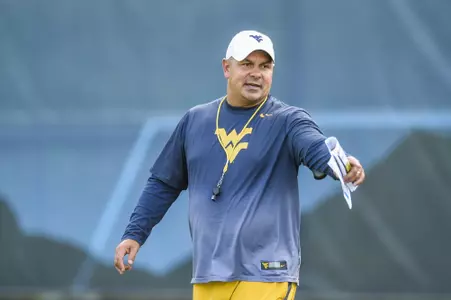
Photo by: All Pro Photography/Dale Sparks
Hot Reads: Jed's Virginia Tech Breakdown
August 31, 2017 07:00 PM | Football
Radio sideline reporter Jed Drenning provides periodic commentary on the Mountaineer football program for WVUsports.com. Be sure to follow him on Twitter @TheSignalCaller.
In physics, they call it repulsion.
When two magnetic objects are similarly charged and have similar poles facing each other, those objects are pushed in opposite directions. The similarities force them to repel one another.
Maybe this isn't confined to the realm of science. Familiarity, as they say, does breed contempt and many of history's most bitter competitions were not borne from the differences between the two sides, but rather from their similarities.
Consider some of the most intense rivalries in industry, pop culture and literature. There's a tendency to assume they would be opposites, but that's not always true. And I don't mean just Left Twix versus Right Twix. I'm talking about foes like Coke and Pepsi; UPS and FedEx; Marvel Comics and DC. You could just as easily list as many traits common among each pair as you could their divergences.
Shakespeare's first line in the Prologue of Romeo and Juliet described the infamously adversarial Montagues and Capulets as "Two households, both alike in dignity." Heck, even the Hatfields were known to marry a McCoy now and then, and vice versa.
With West Virginia and Virginia Tech poised to square off for the first time since 2005, resuming a rivalry as nasty as any that Mountaineer football has ever known, it's a good time to have this conversation. These are two programs with no shortage of love lost, but also a pair with more in common than either is inclined to admit.
Two communities nestled neatly into opposite ends of Appalachia, gridiron settlements like Morgantown and Blacksburg are what give college football its inimitable zest. They are at once populated and surrounded by rabid, blue-collar fan bases that passionately love their brand and just as passionately loathe most everything else. Especially each other.
West Virginia University and Virginia Polytechnic and State University were established as land-grant universities during the postbellum era, WVU in 1867 and VPI in 1872, and both played their first ever football games with Benjamin Harrison presiding over the nation - WVU in 1891, Virginia Tech in 1892.
Since that time, both have etched their names into history with more than 700 wins apiece. But the parallels don't stop there. WVU and VPI were each introduced to an insufferable neighbor to the north in October of 1895: Virginia Tech on Oct. 5 of 1895 when they played their inaugural game against the Virginia Cavaliers and West Virginia, three weeks later, on Oct. 26 when they scored a shutout in their first ever meeting with Western University of Pennsylvania (which of course later became Pitt).
Both programs enjoyed a renaissance in the modern era under the leadership of head coaches destined to become icons, each of whom retired with 200-plus career wins: West Virginia's Don Nehlen (202) and Virginia Tech's Frank Beamer (238).
Both schools were propelled to new heights by dynamic, dual-threat quarterbacks who finished No. 3 in the voting for the Heisman Trophy: WVU's Major Harris in 1989 and Tech's Michael Vick in 1999.
And then there was last season when the Mountaineers and Hokies each won 10 games. Both finished the year ranked in the Associated Press Top 20 and both enter this weekend's matchup in the preseason Top 25.
So, one logical question would seem to arise. With so many rival groups, much like the Mountaineers and the Hokies, sharing so much in common . . . why all the hate?
Sigmund Freud called it "the narcissism of minor differences."
Addressing this tribal phenomenon in a 1930 essay, Freud theorized that we're all saddled with an extreme desire to establish a unique identity. We bristle quickly when that distinctive sense of self is threatened. In short, things heat up fast when our neighbors start to mirror us too closely.
Freud discussed, "…communities with adjoining territories, and related to each other in other ways as well, who are engaged in constant feuds and in ridiculing each other."
If that doesn't sound like the two teams – and the two fan bases -- about to grapple for the Black Diamond Trophy, I'm not sure what does.
This series – this rivalry – has always delivered on the intensity scale. What new memories might unfold Sunday evening? Here are a few things to monitor.
1) WILL GRIER UNDER PRESSURE
When West Virginia's signal caller steps up into the pocket Sunday night against the Hokies, it will mark the first time in nearly 23 months he'll be facing a pass rush barreling down on him without the fear of reprisal. Sure, Grier has faced some aggressive blitz looks from Tony Gibson's defense in a practice setting, but Dana Holgorsen has had his whistle at the ready for a reason. Unlike the WVU defense, Bud Foster's unit won't be looking to pull up and keep Grier intact.
Regardless of how seasoned a quarterback might be, ignoring the chaotic street fight that plays out around him in the pass pocket is learned behavior. Disregarding the messy turmoil of the pocket instantly when a QB has been away from it for even a single offseason – much less nearly two full years – is difficult. The last time Grier faced an actual pass rush was as Florida's starter on October 10, 2015 at Missouri. The Tigers sacked him five times that night, but he kept his cool and connected on better than 60 percent of his throws to help the Gators win in a challenging environment. Grier is a tough cat who will acclimate to the long layoff and settle in quickly . . . the question is how quickly?
2) THE FOSTER FACTOR
In a sport renowned for its unpredictable nature and short-lived trends, Bud Foster's "Lunch Pail Defense" is one of the closest things to a true north that you'll find in college football. For decades, his Virginia Tech units have remained physical, technically sound and well-versed in the high art of situational football.
When Clemson converted more than 50 percent (55.6%) of its third-down attempts against the Hokies in last year's ACC Championship Game, it marked the first time in more than five full seasons that an opposing offense achieved that feat against the Hokies. Take a couple seconds to let that sink in.
This year Foster has a toy box overflowing with options, particularly on the backend. With all due respect to 6-foot-5, 250-pound Tremaine Edmunds -- the colossal yet nimble force of nature holding down Tech's Will linebacker spot -- the strength of this Hokies defense figures to be a secondary that held seven opponents less than 150 yards passing last season and limited opposing QBs to a completion percentage of just 50.1 (fifth-best in the nation). Eight starters return from that defense, including three long-bodied, battle-tested cornerbacks.
That trio of seniors Brandon Facyson (6-2) and Greg Stroman (6-0) and junior Adonis Alexander (6-3) rotate regularly and they just as regularly frustrate quarterbacks, combining for 63 career pass break ups and 16 interceptions. Might Foster drop those studs into coverage and complicate things for Grier with Tech's trademark "Robber" look, or will he lock those corners down and load the box to disarm WVU's most apparent offensive strength – Justin Crawford and a deep stable of backs?
The latter approach was the one Foster took to help the Hokies engineer their 2014 upset win at Ohio State. That afternoon at The Horseshoe, Foster went for broke. He choked out Ezekiel Elliot and the Buckeyes ground game with man coverage and a "Bear" front (covering up the center and both guards) that was complemented by blitzing defenders at every turn. In doing so, Virginia Tech dared OSU's J.T. Barrett to win the game with his arm. The Buckeye signal-caller melted under the challenge, connecting on just 9-of-29 throws and tossing three interceptions.
Will the Hokies be equally aggressive against West Virginia, or will they reel things in and hedge their bets – skeptical that the Mountaineers can sustain long, mistake-free drives? The Virginia Tech secondary is teeming with talent and experience. That kind of personnel arms Foster with boundless tactical choices and makes it tough to forecast exactly what strategy he'll opt for Sunday night.
3) SIXES INSTEAD OF THREES
Since 2013, West Virginia has struggled to turn red-zone trips into touchdowns, finishing seventh or worse in the Big 12 in this category in each of the last four seasons. One major factor contributing to WVU's futility in this area of the field, an area that sees defenses tighten and throwing lanes get squeezed, has been missed opportunities in the passing game. West Virginia quarterbacks have combined to complete just 50.3% of their red-zone throws during this four-year stretch (2013-16).
The last time the Mountaineers were a true force in the red zone was 2012 when they hit pay dirt on 69.5% of their trips (No. 2 in the Big 12). By no coincidence, West Virginia quarterback Geno Smith led these efforts with incredible precision, connecting on 69 percent of his throws inside the opposition's 20-yard line.
Enter Will Grier. The limited sample size we have from him is drawn from his six games at Florida in 2015, during which time he connected on an efficient 64 percent of his red-zone throws. Couple that upgraded accuracy for West Virginia with the size of the primary receivers Grier will be targeting (including 6-3 David Sills V) and – with a little luck -- more touchdowns in the scoring zone might be on the horizon.
The help couldn't come at a better time as WVU faces a Hokie defense that, remarkably, has held opposing QBs to a red zone pass completion rate of less than 50-percent in at least nine straight seasons (which is as far back as you can track their numbers in this category at CFBstats.com).
4) MEET JOSH JACKSON
Blessed with pop in his arm, twitch in his feet and the Football IQ of a coach's son, redshirt freshman quarterback Josh Jackson is immensely talented. But he's also completely untested as he prepares to make his first collegiate start Sunday night against West Virginia.
The last thing Hokies offensive coordinator Brad Cornelsen wants to do is toss Jackson to the wolves, or in this case, the Dawgs. The idea of his young signal caller staring deep into a complex wilderness of mirrors like Gibson's odd stack defense doesn't appeal to him.
"Their scheme gives you problems; it's something that you don't see, usually the whole year. Certainly, if you do see it, it's one time a year," Cornelsen said. "That in itself creates some problems."
These are the words of a play caller concerned with his novice quarterback facing such an atypical scheme. His unease is likely genuine but with a hint of coach-speak sprinkled in for effect. Don't expect Justin Fuente and Cornelsen to keep the training wheels on Jackson – he won the starting job for a reason -- but don't expect them to let him careen out into rush hour traffic either.
When calling plays for a young QB, it's sometimes best to take the approach of a shrewd lawyer during cross examination: Never ask a question you don't already know the answer to. Control the situation to the greatest degree possible then hope for the best.
There are universal things that can be done within the scope of any offense to nurture a young signal caller:
These aren't State secrets. They've been used by coaches everywhere to help young quarterbacks find a rhythm and gain confidence. Don't be surprised if we see Virginia Tech utilize a few of them Sunday night. But there's another side of this coin . . . What might Tony Gibson's defense, replete with a host of its own fresh faces, have in store for the Hokie signal-caller?
So here we go.
Maybe Freud was right. Maybe our most intense rivals really are those who are so much like us. After all, anyone who wondered if a 12-year hiatus would cool things off between these programs had that question answered on Aug. 23 when Virginia Tech posted on Twitter a video of the Hokies at practice with "Take Me Home, Country Roads" booming over their PA system.
The video went viral and fans on both sides were immediately talking the kind of smack that might've had you thinking a 1990-something Big East title was at stake. Hokie Nation roared. Mountaineer Nation roared back.
The truth is, we should forgive those poor folks from Blacksburg. They don't know that we have an old saying around these parts . . .
If you hear Country Roads, it's too late.
Then again, maybe they do know and the whole thing was simply an unintentional error that revealed the Hokies' subconscious feelings. Was Virginia Tech intuitively preparing for a postgame environment Sunday night at FedEx Field that will feature vocals by John Denver?
Psychoanalysts have a name for that.
It's called a Freudian slip.
Give 'em hell, Sigmund.
I'll see you at the 50.
In physics, they call it repulsion.
When two magnetic objects are similarly charged and have similar poles facing each other, those objects are pushed in opposite directions. The similarities force them to repel one another.
Maybe this isn't confined to the realm of science. Familiarity, as they say, does breed contempt and many of history's most bitter competitions were not borne from the differences between the two sides, but rather from their similarities.
Consider some of the most intense rivalries in industry, pop culture and literature. There's a tendency to assume they would be opposites, but that's not always true. And I don't mean just Left Twix versus Right Twix. I'm talking about foes like Coke and Pepsi; UPS and FedEx; Marvel Comics and DC. You could just as easily list as many traits common among each pair as you could their divergences.
Shakespeare's first line in the Prologue of Romeo and Juliet described the infamously adversarial Montagues and Capulets as "Two households, both alike in dignity." Heck, even the Hatfields were known to marry a McCoy now and then, and vice versa.
With West Virginia and Virginia Tech poised to square off for the first time since 2005, resuming a rivalry as nasty as any that Mountaineer football has ever known, it's a good time to have this conversation. These are two programs with no shortage of love lost, but also a pair with more in common than either is inclined to admit.
Two communities nestled neatly into opposite ends of Appalachia, gridiron settlements like Morgantown and Blacksburg are what give college football its inimitable zest. They are at once populated and surrounded by rabid, blue-collar fan bases that passionately love their brand and just as passionately loathe most everything else. Especially each other.
West Virginia University and Virginia Polytechnic and State University were established as land-grant universities during the postbellum era, WVU in 1867 and VPI in 1872, and both played their first ever football games with Benjamin Harrison presiding over the nation - WVU in 1891, Virginia Tech in 1892.
Since that time, both have etched their names into history with more than 700 wins apiece. But the parallels don't stop there. WVU and VPI were each introduced to an insufferable neighbor to the north in October of 1895: Virginia Tech on Oct. 5 of 1895 when they played their inaugural game against the Virginia Cavaliers and West Virginia, three weeks later, on Oct. 26 when they scored a shutout in their first ever meeting with Western University of Pennsylvania (which of course later became Pitt).
Both programs enjoyed a renaissance in the modern era under the leadership of head coaches destined to become icons, each of whom retired with 200-plus career wins: West Virginia's Don Nehlen (202) and Virginia Tech's Frank Beamer (238).
Both schools were propelled to new heights by dynamic, dual-threat quarterbacks who finished No. 3 in the voting for the Heisman Trophy: WVU's Major Harris in 1989 and Tech's Michael Vick in 1999.
And then there was last season when the Mountaineers and Hokies each won 10 games. Both finished the year ranked in the Associated Press Top 20 and both enter this weekend's matchup in the preseason Top 25.
So, one logical question would seem to arise. With so many rival groups, much like the Mountaineers and the Hokies, sharing so much in common . . . why all the hate?
Sigmund Freud called it "the narcissism of minor differences."
Addressing this tribal phenomenon in a 1930 essay, Freud theorized that we're all saddled with an extreme desire to establish a unique identity. We bristle quickly when that distinctive sense of self is threatened. In short, things heat up fast when our neighbors start to mirror us too closely.
Freud discussed, "…communities with adjoining territories, and related to each other in other ways as well, who are engaged in constant feuds and in ridiculing each other."
If that doesn't sound like the two teams – and the two fan bases -- about to grapple for the Black Diamond Trophy, I'm not sure what does.
This series – this rivalry – has always delivered on the intensity scale. What new memories might unfold Sunday evening? Here are a few things to monitor.
1) WILL GRIER UNDER PRESSURE
When West Virginia's signal caller steps up into the pocket Sunday night against the Hokies, it will mark the first time in nearly 23 months he'll be facing a pass rush barreling down on him without the fear of reprisal. Sure, Grier has faced some aggressive blitz looks from Tony Gibson's defense in a practice setting, but Dana Holgorsen has had his whistle at the ready for a reason. Unlike the WVU defense, Bud Foster's unit won't be looking to pull up and keep Grier intact.
Regardless of how seasoned a quarterback might be, ignoring the chaotic street fight that plays out around him in the pass pocket is learned behavior. Disregarding the messy turmoil of the pocket instantly when a QB has been away from it for even a single offseason – much less nearly two full years – is difficult. The last time Grier faced an actual pass rush was as Florida's starter on October 10, 2015 at Missouri. The Tigers sacked him five times that night, but he kept his cool and connected on better than 60 percent of his throws to help the Gators win in a challenging environment. Grier is a tough cat who will acclimate to the long layoff and settle in quickly . . . the question is how quickly?
2) THE FOSTER FACTOR
In a sport renowned for its unpredictable nature and short-lived trends, Bud Foster's "Lunch Pail Defense" is one of the closest things to a true north that you'll find in college football. For decades, his Virginia Tech units have remained physical, technically sound and well-versed in the high art of situational football.
When Clemson converted more than 50 percent (55.6%) of its third-down attempts against the Hokies in last year's ACC Championship Game, it marked the first time in more than five full seasons that an opposing offense achieved that feat against the Hokies. Take a couple seconds to let that sink in.
This year Foster has a toy box overflowing with options, particularly on the backend. With all due respect to 6-foot-5, 250-pound Tremaine Edmunds -- the colossal yet nimble force of nature holding down Tech's Will linebacker spot -- the strength of this Hokies defense figures to be a secondary that held seven opponents less than 150 yards passing last season and limited opposing QBs to a completion percentage of just 50.1 (fifth-best in the nation). Eight starters return from that defense, including three long-bodied, battle-tested cornerbacks.
That trio of seniors Brandon Facyson (6-2) and Greg Stroman (6-0) and junior Adonis Alexander (6-3) rotate regularly and they just as regularly frustrate quarterbacks, combining for 63 career pass break ups and 16 interceptions. Might Foster drop those studs into coverage and complicate things for Grier with Tech's trademark "Robber" look, or will he lock those corners down and load the box to disarm WVU's most apparent offensive strength – Justin Crawford and a deep stable of backs?
The latter approach was the one Foster took to help the Hokies engineer their 2014 upset win at Ohio State. That afternoon at The Horseshoe, Foster went for broke. He choked out Ezekiel Elliot and the Buckeyes ground game with man coverage and a "Bear" front (covering up the center and both guards) that was complemented by blitzing defenders at every turn. In doing so, Virginia Tech dared OSU's J.T. Barrett to win the game with his arm. The Buckeye signal-caller melted under the challenge, connecting on just 9-of-29 throws and tossing three interceptions.
Will the Hokies be equally aggressive against West Virginia, or will they reel things in and hedge their bets – skeptical that the Mountaineers can sustain long, mistake-free drives? The Virginia Tech secondary is teeming with talent and experience. That kind of personnel arms Foster with boundless tactical choices and makes it tough to forecast exactly what strategy he'll opt for Sunday night.
3) SIXES INSTEAD OF THREES
Since 2013, West Virginia has struggled to turn red-zone trips into touchdowns, finishing seventh or worse in the Big 12 in this category in each of the last four seasons. One major factor contributing to WVU's futility in this area of the field, an area that sees defenses tighten and throwing lanes get squeezed, has been missed opportunities in the passing game. West Virginia quarterbacks have combined to complete just 50.3% of their red-zone throws during this four-year stretch (2013-16).
The last time the Mountaineers were a true force in the red zone was 2012 when they hit pay dirt on 69.5% of their trips (No. 2 in the Big 12). By no coincidence, West Virginia quarterback Geno Smith led these efforts with incredible precision, connecting on 69 percent of his throws inside the opposition's 20-yard line.
Enter Will Grier. The limited sample size we have from him is drawn from his six games at Florida in 2015, during which time he connected on an efficient 64 percent of his red-zone throws. Couple that upgraded accuracy for West Virginia with the size of the primary receivers Grier will be targeting (including 6-3 David Sills V) and – with a little luck -- more touchdowns in the scoring zone might be on the horizon.
The help couldn't come at a better time as WVU faces a Hokie defense that, remarkably, has held opposing QBs to a red zone pass completion rate of less than 50-percent in at least nine straight seasons (which is as far back as you can track their numbers in this category at CFBstats.com).
4) MEET JOSH JACKSON
Blessed with pop in his arm, twitch in his feet and the Football IQ of a coach's son, redshirt freshman quarterback Josh Jackson is immensely talented. But he's also completely untested as he prepares to make his first collegiate start Sunday night against West Virginia.
The last thing Hokies offensive coordinator Brad Cornelsen wants to do is toss Jackson to the wolves, or in this case, the Dawgs. The idea of his young signal caller staring deep into a complex wilderness of mirrors like Gibson's odd stack defense doesn't appeal to him.
"Their scheme gives you problems; it's something that you don't see, usually the whole year. Certainly, if you do see it, it's one time a year," Cornelsen said. "That in itself creates some problems."
These are the words of a play caller concerned with his novice quarterback facing such an atypical scheme. His unease is likely genuine but with a hint of coach-speak sprinkled in for effect. Don't expect Justin Fuente and Cornelsen to keep the training wheels on Jackson – he won the starting job for a reason -- but don't expect them to let him careen out into rush hour traffic either.
When calling plays for a young QB, it's sometimes best to take the approach of a shrewd lawyer during cross examination: Never ask a question you don't already know the answer to. Control the situation to the greatest degree possible then hope for the best.
There are universal things that can be done within the scope of any offense to nurture a young signal caller:
- Establish a ground game -- or at least a pretense of one. This is paramount. If you don't do so, you're left with a one-dimensional offense and that's a tough ask for any quarterback, but especially for a guy making his first start.
- Lean on a heavy dose of the quick game (3-step packages and perimeter screens). Sure, this gets the ball out of your quarterback's hand fast, but it has the added benefit of helping capitalize on any numerical advantage that might surface on the perimeter if the defense does stack the box to stymie the above-mentioned efforts at a rushing attack.
- Move the quarterback's launch point with a variety of protections inside the pocket and out. This helps prevent him from becoming a stationary target for potential blitz packages.
- Utilize play action to create extra stress points in the defense.
- Get your young QB on the move outside the pocket to shrink the field and limit the number of defenders involved in his read progression.
These aren't State secrets. They've been used by coaches everywhere to help young quarterbacks find a rhythm and gain confidence. Don't be surprised if we see Virginia Tech utilize a few of them Sunday night. But there's another side of this coin . . . What might Tony Gibson's defense, replete with a host of its own fresh faces, have in store for the Hokie signal-caller?
So here we go.
Maybe Freud was right. Maybe our most intense rivals really are those who are so much like us. After all, anyone who wondered if a 12-year hiatus would cool things off between these programs had that question answered on Aug. 23 when Virginia Tech posted on Twitter a video of the Hokies at practice with "Take Me Home, Country Roads" booming over their PA system.
The video went viral and fans on both sides were immediately talking the kind of smack that might've had you thinking a 1990-something Big East title was at stake. Hokie Nation roared. Mountaineer Nation roared back.
The truth is, we should forgive those poor folks from Blacksburg. They don't know that we have an old saying around these parts . . .
If you hear Country Roads, it's too late.
Then again, maybe they do know and the whole thing was simply an unintentional error that revealed the Hokies' subconscious feelings. Was Virginia Tech intuitively preparing for a postgame environment Sunday night at FedEx Field that will feature vocals by John Denver?
Psychoanalysts have a name for that.
It's called a Freudian slip.
Give 'em hell, Sigmund.
I'll see you at the 50.
Players Mentioned

Gold-Blue Spring Festival Fan Recap
Sunday, April 19
John Neider | April 18
Saturday, April 18
Coach Zac Alley | April 18
Saturday, April 18
Coach Rich Rodriguez | April 18
Saturday, April 18