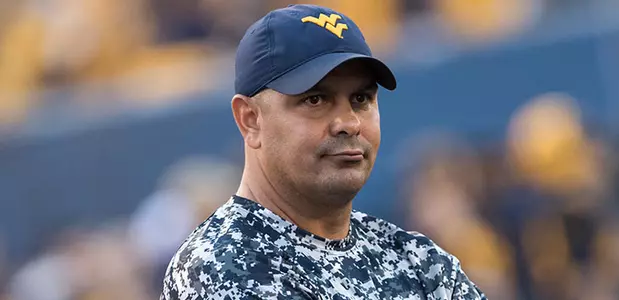
Gibson-Main-12315.jpg
Who Are These Cougars?
September 22, 2016 12:34 PM | Football
Radio sideline reporter Jed Drenning provides periodic commentary on the Mountaineer football program for WVUsports.com. Be sure to follow him on Twitter @TheSignalCaller.
The Houston veer. The Delaware Wing-T. The Navy flexbone.
In the spontaneous word association game of college football, certain programs are indelibly linked to certain schemes – even if they’ve long since strayed from those schemes.
Such is the case with Brigham Young University. Mention BYU to most fans and they envision high-voltage offenses and record-setting passing attacks. This is despite the fact that the ringmaster of that flying circus – Hall of Fame coach LaVell Edwards – hasn’t patrolled the sidelines in 16 years.
For decades, Edwards’ teams used wide splits and scat routes to carve up defenses in the Western Athletic Conference and beyond. During his tenure, the Cougars played in 17 straight bowl games and led the nation in passing eight times, churning out a who’s who of quarterbacking royalty that ranged from multiple Consensus All-Americans to top-five draft picks (Jim McMahon) and NFL MVPs (Steve Young).
Some of football’s most fertile offensive minds – from Mike Holmgren and Norm Chow to Andy Reid and Brian Billick – logged time at BYU during this golden era before dispersing across the country to help shape the modern game. Even the coaching tree that produced Dana Holgorsen was influenced by what Edwards had cooking in the Wasatch Mountains all those years ago.
Before helping Kentucky lead the Southeastern Conference in passing four times in four seasons as the Wildcats coach, Air Raid aficionado Hal Mumme was a young high school coach in Copperas Cove, Texas. It was during that time he spent every free minute commuting to and from Provo, soaking in all he could from the Cougars staff about their cutting-edge system. And before becoming Mumme’s offensive coordinator (and ultimately the coach at Texas Tech who hired Holgorsen for his first major college coaching position), Mike Leach was impacted by what he saw from Edwards’ offenses as a student at BYU in the early 1980s.
“We still, to this day, have some stuff in our playbook that goes back to the BYU days,” Holgorsen said this week.
What was unfolding in Provo inspired the think tank that led to the modern Air Raid offense when Leach and Mumme joined forces in Mt. Pleasant, Iowa – rewriting the NAIA record books with a quarterback named Dustin Dewald and a couple receivers named Bruce Carter and Dana Holgorsen.
“Coach Leach joined us at Iowa Wesleyan, which obviously he’s got a degree from BYU, so I was aware of it,” Holgorsen added. “I was dumb and young and just kind of learning the game of football at that time but a lot of the principles in the passing game all those great quarterbacks were doing back then at BYU and we took them, stole them and maintain them to this day.”
Brigham Young’s high-water mark came in 1984 when the Cougars navigated their way to a 13-0 mark, capturing the mythical national championship with a No. 1 ranking in the Associated Press and Coaches’ Polls. The fun was far from over though. Six years later it was this same pass-happy system that enabled BYU to stun top-ranked Miami and help the catalyst of that epic victory, a scrappy quarterback named Ty Detmer, land the Heisman Trophy.
But that age of aerial thrills was a generation ago. Footballs, after all, aren’t the only things that can fly. Years can too. It’s now been a quarter century since Detmer last donned his royal blue No. 14 jersey, and two decades since Brigham Young produced a 4,000-yard passer (Steve Sarkisian in 1996).
Times have changed. In fact, since the start of the 2011 season when Dana Holgorsen took over at West Virginia the Mountaineers have thrown for 2,511 more yards than BYU. That would’ve been inconceivable 30 years ago. In many ways the Cougars of today barely resemble the same species as those coached by LaVell Edwards, despite the nucleotides of that old DNA still coursing through the program. BYU rookie head coach Kalani Sitake was a fullback for Edwards in the late 1990s -- and one of Sitake’s first hires last December was Detmer as offensive coordinator, plucked from the Texas high school coaching ranks.
But Detmer’s return to campus has so far fallen short of triumphant. The BYU offense has struggled to find an identity with the West Coast system he has installed. Through three games the Cougars have punted 21 times and scored just six touchdowns in 40 possessions. They’ve conspicuously lacked both of the “Big E’s” that help offenses win -- efficiency (less than 40 percent third-down success in their last two contests, both losses) and explosiveness (just five plays from scrimmage of 20-plus yards, tied with Vanderbilt for fewest in the country).
From the outside looking in, Detmer would appear to have some functional pieces in place. The Cougars feature a massive offensive line (average size of 6-4, 302 pounds); a veteran quarterback with a track record of production (Taysom Hill: more than 5,000 career yards passing and more than 2,000 rushing); an exceptional feature back (Jamaal Williams: 682 yards away from breaking Harvey Unga’s career rushing record at BYU) and a trio of serviceable receivers – each with double digits catches through three games.
But the sluggish start owes to several things. The Cougars early season schedule has been unforgiving: three Pac 12 bowl teams, including two on the road. Moreover, the transition to Detmer’s scheme has been bumpy, made tougher by the fact that Hill is a step slower since recovering from the third season-ending injury of his career last September at Nebraska.
Before suffering buzzard’s luck on the injury front, Hill was on the verge of becoming a transformative player. In 2013 he became one of only eight quarterbacks in history to eclipse 400 yards passing and 100 yards rushing in the same game (vs. Houston, 417/128 on 10-19-2013). A year later, after guiding BYU to a 4-0 start with big numbers as a passer and a runner, Hill was thrust into the Heisman race.
The injuries have impacted Hill’s game as a runner, but central to BYU’s woes has been a patent inability to stretch the field through the air. As such, the Cougars fan base has grown divided, with a big chunk calling for Detmer to make the switch to sophomore Tanner Mangum – once again lending credence to Archie Manning’s old observation about the backup quarterback being the most popular guy in town. In this case, however, Mangum isn’t your garden variety clipboard holder. A year ago he threw for more than 3,000 yards and earned freshman All-American honors, along the way catapulting himself into folk hero status by notching game-winning Hail Mary throws in each of his first two collegiate appearances.
The deep ball was indeed Mangum’s weapon of choice last season. All told, he finished 2015 with 29 pass completions of 30-plus yards, the eighth-best mark in the country. Contrast that with this year as the Cougars have managed just one completion of that length through three games. It’s not surprising that so many fans are demanding the change, convinced that the solution to BYU’s big-play drought is parked on the bench. Their logic seems simple enough. After all, why keep getting bad reviews on your chicken cacciatore when you have Bobby Flay in the back of the restaurant as a dishwasher?
But the truth is somewhere in the middle. In short, the blame can’t all be hurled at Taysom Hill.
It’s not Hill’s fault that BYU’s receivers have struggled to make key catches or to beat press coverage, getting bounced off track by physical defensive backs bent on disrupting the timing of the Cougars passing game. West Coast offenses are heavily predicated on footwork and rhythm. When knocked off schedule the results can be ugly – accounting in part for the feeble 5.4 yards per pass attempt (118th nationally) the Cougars have mustered so far. Ironic when you consider that Detmer – the guy dialing up the plays -- is still the NCAA single season record holder in that category (11.1 yards per attempt in 1989).
It’s not Taysom Hill’s fault that BYU couldn’t squeeze an ounce from its running game last Saturday night against UCLA. The Bruins stacked the box and smothered the Cougars ground game. BYU finished with just 23 yards on 25 attempts – its lowest rushing output since a 2005 loss to Boston College. Sure a more operational passing game could’ve helped force a couple of those defenders out of the box, but consistently being that ineffective on the ground, even when outnumbered, will always make life difficult to the extreme for a quarterback.
It’s not Hill’s fault that he’s had little help up front in the way of protection. When BYU headed into its season opener against Arizona, it was already short two projected starters on the offensive line (Brad Wilcox due to injury; Kyle Johnson due to academics), forcing the Cougars to roll out a patchwork unit put together like a ransom note. No one has paid a steeper price for this than Hill. By the time the UCLA game was over last weekend, the Bruins had landed more than 20 solid hits on him. I’m sure Hill felt the four UCLA sacks the next morning, but I’m also pretty certain he felt the 15-plus ‘remember me’ shots too.
When analyzing the Cougars QB controversy, it’s worth noting that Hill is the far more athletic of the two available options. Without better play up front, simply inserting Mangum into the lineup may do little more than dress the stage for defensive target practice on a more stationary bull’s eye.
Hill might not be the same elusive jackrabbit he was before his injuries, but throw in some BYU game tape and you’ll see he’s still nifty enough to escape a broken pocket and give you a puncher’s chance at extending the play. It’s not by accident that he has scrambled for 51 successful conversions on third down during his career, including six so far this season (eighth-most nationally).
Behind a ragtag offensive line that has struggled to withstand the onslaught of three active defenses, it’s made sense for Sitake and his staff to go with Hill – a cagey veteran who flashes a quicker release and greater mobility. But will that decision stick against the Mountaineers this weekend at FedExField?
Sitake was asked that question this week.
“Taysom will be the starting quarterback. It would be foolish right now to make him a scapegoat when it wasn’t entirely his fault.”
Meanwhile, 1,900 miles away at his own presser in Morgantown, Dana Holgorsen was asked the same question: Hill or Mangum?
“We’ll be prepared for either one of them.”
Despite Brigham Young’s deficiencies on offense, the Cougars have been oh-so-close to a 3-0 start, battling their way to three tight finishes decided by six total points. This has been due in large measure to an opportunistic defense led by sophomore linebacker Butch Pau’u, the country’s No. 3 tackler (including 19 last week against UCLA) and senior free safety Kai Nacua, tied for the national lead with three interceptions. Under Sitake and coordinator Ilaisa Tuiaki, BYU has transitioned from Bronco Mendenhall’s 3-4 defense, a staple for years in Provo, to an even front scheme in an effort to tighten up against the run and force more turnovers.
Feel free to place a bright red checkmark in both of those boxes.
Through 12 quarters, the Cougars defense has allowed just 3.3 yards per rush and ranks No. 5 in the nation with nine takeaways. A figure like that latter one is a black box warning for any offense, including West Virginia’s. Unlike some teams, though, the Mountaineers benefit from a defense with a remarkable knack for bringing its best when backed into a corner following a turnover.
Dating back to the start of the 2015 season, the last 24 times the WVU defense has been confronted with a so-called “sudden change” situation (‘suddenly’ rushed onto the field following a turnover by the Mountaineer offense), Tony Gibson’s “Dawgs” have surrendered just one touchdown. That’s right – one – in 24 possessions.
The deeper you dig into these numbers the more impressive they become, including the fact that no fewer than nine of these drives saw the opponent begin inside the Mountaineer 30-yard line. On average -- during the course of those 24 possessions -- WVU has yielded a paltry 2.4 yards per play while allowing the opposition, on average, to advance the football a mere 10 yards. That, ladies and gentlemen, is called rising to the occasion when your team needs it most.
Against a ball-hawking BYU defense on Saturday, the Mountaineers might need it again.
I’ll see you at the 50.



Nate Gabriel | April 8
Wednesday, April 08
Coach Rod West | April 8
Wednesday, April 08
Coach Rich Rodriguez | April 8
Wednesday, April 08
Ryan Ward | April 6
Monday, April 06