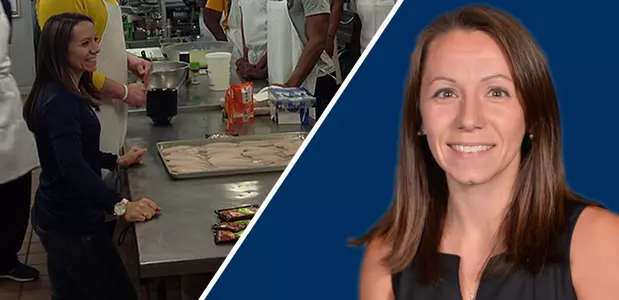
Nettieblog-091615.jpg
Meet the Team: Nettie Freshour
September 23, 2015 04:15 PM | Wrestling
One of the most significant parts of a wrestling match occurs before the official has blown the whistle to start. Before a wrestler steps on the mat, he must step on the scale. As many wrestlers compete at a weight that is below what they weigh on a daily basis, half of the battle is seeing the right numbers on that scale. And that scale has no mercy – as little as an ounce too much can be all the difference between a bout and a forfeit.
At West Virginia, team dietitian Nettie Freshour plays a crucial role in keeping the Mountaineers on track when it comes to managing their weight. Freshour offers one-on-one counseling, body composition analysis, diet analysis, team education, food tastings and grocery store tours as part of her services for WVU student-athletes. However, her tenure with the WVU wrestling program starting long before she joined the department as a full-time staff member.
“I actually started working with the wrestling program when I was in undergrad here at WVU, so roughly 12 years (ago),” says Freshour. “I worked with a graduate student in my program that also had a strong desire to become a sports dietitian, and she and I would give team talks and did monthly newsletters to the wrestling team specifically. When I graduated and started working for Dining Services, I would still consult with a few teams and wrestling was one of them. However, since Coach Henson was hired, my involvement with the team as greatly increased.”
Cutting weight was once a dangerous process in college wrestling, forcing the NCAA to put heavy restrictions on the process over the last 20 years. Saunas, rubber suits and diuretics have all been banned in collegiate wrestling since 1998. Even with today’s measures, the process of shedding pounds quickly prior to a match can leave athletes drained of strength and energy. WVU wrestling head coach Sammie Henson relies heavily on Freshour to help his wrestlers maintain their weight during the season. It can be a challenge to work with an athlete that needs to be at a very specific weight, she admits.
“Most of the time, an athlete will think ‘I need to lose weight, so I have to cut calories.’ Well, that’s not always the right answer and, in fact, can make it more difficult to make their wrestling weight,” she says. “This can lead to fatigue, decrease in performance, injury, or an inability to actually make weight. I tell them all the time ‘small and often,’ because I want them eating to avoid fatigue, fat storage, muscle breakdown, etc. I also have them do this to increase metabolism, to keep them fueling all throughout the day instead of just once and to potentially make weight a lot easier. This avoids those ‘hard cuts’ that can be dangerous to their overall health.”
Freshour frequently meets with the Mountaineers to discuss their eating habits and food selections, both in season and in the offseason. Freshman are introduced to her as the set foot on campus, as college weights differ from prep weights. In the offseason Freshour works closely with wrestlers that are transitioning from one weight to another, creating new habits and laying the nutritional foundation for the season to come.
“When I see a wrestler out of season we talk about general healthy eating habits, pre-workout snacks, recovery, hydrations, etc.,” says Freshour. “We tend to talk more broad-based information but creating a framework and a plan for then and for the season that they can stick with. When we meet now (right before weight certification) and in season, it’s all about fueling properly, keeping their meals nutrient dense and balanced, eliminating empty calories that could prevent weight loss but really making sure they are getting the fuel their bodies need to participating in high intensity practices while ultimately making the weight they plan to compete at during the season. It’s also about eliminating the feeling of hunger. It’s extremely hard to focus on technique, performance, and class when you can constantly hungry, so we work to make sure they are eating all throughout the day but it’s the good foods their bodies will respond positively to.”
Henson and Freshour, who travels to select road contest with the team, collaborate during the season to keep the Mountaineers at optimal weights. Freshour advises the coaching staff and student-athlete on food selections, particularly post weigh-in snacks, and makes arrangements for WVU’s meals on the road.
“Some wrestlers have only have a short time after weigh-ins before they compete, so we need to find the best fueling regimen that will give them the most amount of energy while not upsetting their stomachs. Another key area we focus on is after a dual in general. Most athletes’ response to a win and even a loss is to go out and ‘enjoy’ themselves and most of the time that is going to involve food they wouldn’t typically eat during the week. We discuss how to keep the weight fluctuations to a minimum so it’s not difficult week after week making weight. For me, that has been one of the best components of Sammie’s coaching. He doesn’t allow them to fluctuate any higher than 6 pounds during the season. I try to get them to understand that if they are consistent about their diet with that framework we built in the offseason, ‘cutting weight’ won’t be that difficult and let’s face it, they will make weight but what good would they be if they lost all strength along with it? Again, that’s where I have been able to work so well with Sammie’s philosophy.”
Though not ideal, a wrestler will occasionally have to make a weight change mid-season. Last year, Freshour guided Ross Renzi, Tim Wheeling and Roman Perryman, among others, while they moved down a weight class. Renzi and Wheeling dropped down to 165 and 157, respectively, in December while Perryman made the move from 157 to 149 in January. After winning his debut in his new weight, Perryman went on to take the runner-up spot at the 2015 Big 12 Championship.
“Most people don’t realize that a wrester competing at say 149 pounds doesn’t weigh that the week leading up to competition. So when you need him to drop a weight class in 2-3 weeks, you are asking him to change his body dramatically. What Roman and I did was meet daily to make sure he was in fact continuing to give his body the calories it need to function, while also making sure they were the best calories possible. We eliminated anything that wasn’t necessary - liquid calories, empty calories, etc. - while also making sure his balance, grams of nutrients - carbs, fats and proteins - were specific for his weight loss goals. It wasn’t easy at all, but he put in the effort with his food and his training and made it happen. We met every day until that first competition at the lower weight class and since I didn’t travel to that event, we spoke on the phone after the weigh in to make sure he was eating what he needed to be ready to compete.”
As Henson looks to move the Mountaineers into the upper echelon of the NCAA rankings, Freshour will continue to play a key role in preparing the squad for battle – both on the scale and on the mat.
“My goal for any team is that they are as successful as they can be, of course,” says Freshour. “However, I also try to educate them and build on their knowledge every year. As soon as this freshmen class got here this summer, they were meeting with me and getting some good habits started. My goal is to see that they continue with those habits all throughout the year so we don’t have those ‘hard cuts.’ This year I’m focusing on recovery with every team, making sure that after each time they are active, they are doing the proper techniques to refuel, rebuild, rehydrate and reinforce their bodies to win.”

You Can Never Have Too Many Headlocks
Wednesday, April 01
WRES: NCAA Championships Hype Video
Wednesday, March 18
2026 Big 12 Wrestling Championships Hype
Thursday, March 05
WRES: 2026 Senior Recognition Ceremony
Tuesday, February 10