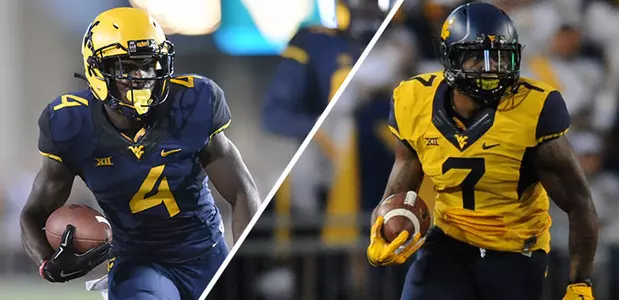
HotReads-Main-82615.jpg
Hot Reads: On The Run
August 26, 2015 08:56 AM | Football
Radio sideline reporter Jed Drenning provides periodic commentary on the Mountaineer football program for WVUsports.com. Be sure to order a copy of Jed’s 2015 season preview magazine at TheSignalCaller.com.
When in doubt, run the football.
It’s a mantra that has served West Virginia University well for ages. The annals of WVU football are brimming with big moments forged on the ground.
We’ve read about it with Ira Errett Rodgers rushing for 19 touchdowns en route to becoming the first Mountaineer ever to earn consensus All-America honors in 1919.
We know of it through the legendary tale of Jim Carlen’s West Virginia squad ambushing South Carolina in the 1969 Peach Bowl with 356 yards rushing out of a wishbone set that was covertly installed in the weeks leading up to the game.
We saw it when John Gay bounced off tacklers into an end zone overflowing with fans to give WVU a fourth-quarter lead over Doug Flutie and the unbeaten Boston College Eagles in 1984.
We were amazed by it in 1988 when Major Harris stiff armed and danced his way through the Penn State defense on a 22-yard touchdown scamper that has grown into one of the most celebrated plays in West Virginia history.
And how can we forget Robert Walker’s 19-yard game-winning score against No. 4 Miami in 1993? Or Steve Slaton’s Sugar Bowl-record 204 yards against the Southeastern Conference champion Georgia Bulldogs? Or the exploits of a runaway beer truck named Owen Schmitt in the Fiesta Bowl? Or Tavon Austin running like a bat out of hell for a school-record 344 yards against Oklahoma in 2012?
Formidable rushing attacks are part of the fiber of West Virginia football – and they have been for a long, long time.
In fact, if we regard the 1,000-yard season as the benchmark that ushered in the ground game’s modern era, West Virginia landed farther ahead of the curve than many of college football’s most renowned blue bloods when -- in 1966 -- Garrett Ford, Sr. became the first Mountaineer in history to eclipse the 1,000-yard mark. That was three years before Ohio State’s first ever 1,000-yard rusher (Jim Otis in 1969), four years before Alabama’s first (Johnny Musso in 1970) and a full decade before Georgia (Kevin McLee), Notre Dame (Al Hunter) and LSU (Terry Robiskie) saw their first players reach that milestone in 1976.
From 1992 through 2009 – a span of eighteen seasons – West Virginia produced no fewer than 17 1,000-yard runners. That total included two each in 2006 and 2007.
And that’s where things start to get interesting. The most prolific ground games in Mountaineer history, you see, have always been powered by four legs, not two. They’ve come in all shapes and sizes and have included a variety of positions.
Fullback Tommy Allman and running back Joe Marconi pooled their talents for coach Pappy Lewis and tore through the Southern Conference in the 1950s. Fullback Jim Braxton and running back Bob Gresham were a force to be reckoned with under Carlen in the late 1960s. Artie Owens and Ron Lee piled up numbers under Bobby Bowden in the mid-70s. Tailbacks Anthony Brown and Undra Johnson helped carry Don Nehlen’s Mountaineers to an unbeaten regular season in 1988. Slaton and quarterback Pat White helped the spread offense of Rich Rodriguez hit its stride nearly two decades later as the toast of the Big East.
And here we go again.
In junior Wendell Smallwood and redshirt-junior Rushel Shell, the Mountaineers feature two of the Big 12’s most productive backs. With this tandem spearheading the ground game last season, West Virginia churned out 182.8 rushing yards per game – the most ever by a Dana Holgorsen-coached offense. Shell and Smallwood helped West Virginia move the chains in multiple ways as the pair combined for 95 touches that resulted in first downs in 2014.
At 5-11 and 221 pounds, Shell presents as equal parts thunder and lightning, exploding with a quick first step but also packing enough of a wallop to rip through arm tackles and escape traffic. By now we all know that those skills served him well as a famously unstoppable force of nature at Hopewell High where he became the most prolific ground gainer in Pennsylvania prep history with 9,078 yards and along the way established a national record with 39 consecutive 100-yard games.
Yes, Rushel Shell runs angry but there are also those moments when he changes direction with the dexterity of a scat back. Watch him catch a third quarter flare pass into the boundary against Alabama last season. Appearing to be hemmed in for a three-yard loss, Shell jump cuts on a dime to make Crimson Tide linebacker Reuben Foster whiff before throwing a shoulder into defensive back Bradley Sylve – running through him like an open doorway on his way to a 19-yard pick up.
Shell often calls on his vision and his balance but first and foremost he is about raw physicality. Take a look at the third quarter of West Virginia’s win at Maryland last September. With WVU on the move at the Terrapins 29-yard line, Shell takes a handoff in the shotgun and explodes upfield. At the 24 he is met by defensive back Sean Davis -- not a small man at 6-1 and 200 pounds -- but Shell plows through him like two inches of fresh snow. Next comes Avery Thompson, a 230-pound Terps’ linebacker who tries to take Shell down at the 22-yard line. But Shell is too strong, spinning Thompson to the turf with a lowered shoulder before blasting headlong into defensive back William Likely, who he carries four-and-a-half more yards to the 16-yard line. It was a simple but not unremarkable play that picked up 13 yards – eight coming after first contact – but a play nonetheless that showcased Shell’s full array of talents, from his burst to his brawn.
Wendell Smallwood, meanwhile, is in some respects a classic slot receiver who just happens to be blessed with a running back’s frame. He’s an elusive playmaker who wields some of the best ball skills on the West Virginia roster.
“He’s potentially the most versatile guy I’ve ever been around,” said Dana Holgorsen.
That’s a telling comment from a coach who has mentored the likes of Charles Sims and Tavon Austin in recent years.
Smallwood has the speed to put stress on a defense and Holgorsen moves him all over the field to maximize those opportunities from multiple angles. This tactic was deployed on the first play of the game against Maryland.
West Virginia came out with an empty set at the 25-yard line, splitting Smallwood to the far right side of the formation, eight yards outside Kevin White. On the snap Smallwood tunneled back underneath, snagging the throw from Clint Trickett on a perfectly executed jailbreak screen. He caught the ball in a flat stride along the line of scrimmage, immediately darting upfield and breaking back outside the hash to veer away from a Terrapin defender as he crossed over the 40. Smallwood made another Terp miss as he raced for a gain of 50 yards before tightroping the sidelines and getting forced out of bounds by Maryland’s last line of defense – cornerback Likely.
Smallwood’s hands are exceptional, as evidenced by the acrobatic grab he made down the seam to convert a third and long in the first quarter of West Virginia’s win over fourth-ranked Baylor. But don’t make the mistake of becoming spellbound by his prowess as a pass catcher and selling him short as a pure runner.
Smallwood is decisive and reacts quickly to a crease but he can also deliver the boom. He might tip the scales at 20 pounds lighter than Shell, but he isn’t afraid to go into the briar patch for the tough yards. Go to the game tape and you’ll see that several of Smallwood’s carries on his way to 123- and 132-yard performances at Texas Tech and Oklahoma State last season came between the tackles. He doesn’t shy away from contact.
Another guy who didn’t shy away from contact during his career was Quincy Wilson, now in his fourth year as West Virginia’s assistant director of football operations.. And Wilson also knows a thing or two about dynamic running back combos. As a standout runner himself, he teamed up with WVU career rushing leader Avon Cobourne in 2002 as a lethal one-two punch, piling up a combined 2,611 yards on the ground.
So what’s the secret to a successful pairing of ball carriers?
“The biggest thing is knowing each other’s strengths,” said Wilson. “I knew I was the power guy and Avon was more of the slasher. We would work in tandem. He’d go tire them out and then I’d go bang on them. We knew our strengths and we used those strengths to attack the defense.”
And selfish players need not apply.
“Obviously you want to be ‘the’ guy but ultimately you think of the greater good of the team,” Wilson said. “Avon and I figured out early on that we could both rush for a hundred (yards) and be successful so it became a competition between us to see who could get there first – and the whole team benefits from that kind of thinking.”
As someone who sees Shell and Smallwood up close and personal on a regular basis, Wilson brings a unique perspective to the conversation. He believes there are parallels between the way the two complement one another and the way he and Cobourne did the same.
“Wendell is definitely a slasher – a versatile guy who can be used in the backfield or out in the slot to help things out in the passing game. Rushel is more of your traditional downhill runner. Together, they’re a perfect combination,” said Wilson. “You can get Rushel in there banging them between the tackles and you can get Wendell wearing them out all over the field.”
At their best, Shell and Smallwood are a daunting pair that can create major problems for Big 12 defenses, but neither is a finished product.
Shell, for instance, lacks the consistency in some areas of the game to make the leap from one-dimensional power runner to every down back. But Holgorsen believes Shell has the tools to get there.
“I know he has it in him. The perception of him being a dominant force is far greater than what reality is. I’ll be the first to tell him that,” said Holgorsen. “He’s a big, physical, determined kid that doesn’t play like that all the time. My job is to get him to do that starting in game one.”
Don’t confuse Holgorsen’s tough love with discontent, though. The coach simply wants Shell to realize his full potential as a more complete running back.
“By no means am I disappointed in him whatsoever. I want to see him be dominant every time we give him the ball.”
Smallwood, on the other hand, is already a multi-faceted player, but he desperately needs to convert his explosive talents into more game-breaking results. On too many occasions in 2014 he found himself a whisker away from daylight only to get tripped up. The aforementioned catch against Maryland was one of just three plays last year in which he managed to pick up 30 yards or more (two receptions and one rush). Moreover, Smallwood has reached the end zone merely three times as a Mountaineer and that figure includes just one touchdown in 23 career games against FBS teams. Expect that to change.
Smallwood recognizes the shortage of big plays in his portfolio and he’s eager to rectify it. He spent the offseason working on his speed and his route running. Further refining his game in those two areas, neither of which was a major liability to begin with, could put Smallwood in better position to get by that final defender who so often has stood between himself and the kinds of plays that can quickly change a game.
Then there’s the simple matter of experience. Nothing helps a player ratchet up the speed with which he does everything -- from read, to cut, to run -- more than a lucid understanding of what’s going on around him. In short, the easiest way to play faster is by slowing the game down. With two seasons of meaningful experience under his belt, that’s a transition that Smallwood should benefit from in 2015.
“Last year things weren’t as natural to me, some of my movements and some of my routes, but I think this year I’ve stepped it up and got down the offense – who’s who and what’s going on with the defense,” he said.
A season ago Smallwood and Shell rushed and received their way to a joint total of 1,976 yards from scrimmage. Expect that number to climb higher this year for West Virginia’s promising duo as more touches, more experience and more coaching figure to translate into more production.
If healthy, they might even have a shot at becoming the first running back twosome in the Big 12 Conference since 2010 to combine for more than 2,500 yards from scrimmage. That year, Oklahoma State’s Kendall Hunter and Joseph Randle teamed up to finish with 2,528 yards rushing and receiving.
Does 2,500 yards seem too lofty a goal for Shell and Smallwood this fall? It would require, after all, a chunky increase of more than 500 yards over last season’s total. That’s a lot of long runs and a lot of big catches.
If you think it’s too tall of an order, however, you might want to remember that the coordinator calling the shots for that Cowboys offense the last time it was accomplished in the Big 12 five years ago was some guy named Dana Holgorsen.
Ever heard of him?
I’ll see you at the 50.
Gold-Blue Spring Festival Fan Recap
Sunday, April 19
John Neider | April 18
Saturday, April 18
Coach Zac Alley | April 18
Saturday, April 18
Coach Rich Rodriguez | April 18
Saturday, April 18