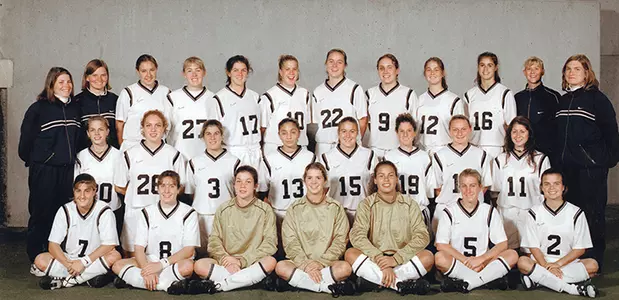
1996team-main-81615.jpg
A Youthful Beginning
August 16, 2015 09:30 AM | Women's Soccer
Jenn (DePrez) Spiker can accurately pinpoint the moment her adult life took shape.
An assistant women’s soccer coach at West Virginia Wesleyan in 1995, the then-23-year-old’s best friend, Nikki Izzo, had just been named the first head coach of the West Virginia University women’s soccer team. As Izzo progressed through the daunting paces of starting an NCAA Division I program, Spiker watched from the outside, fully aware that if Izzo, now Nikki Izzo-Brown, had the opportunity to hire an assistant coach, she would jump at the chance to apply. For, as Spiker tells it, where Izzo-Brown went, she followed.
“Nikki and I played youth soccer together (in Western New York), and then we played club soccer together throughout high school,” the Hilton, New York, native explained. “Nikki went on to play for Rochester, and I joined her there. When she took the coaching job at West Virginia Wesleyan, I was in my fifth year of school. Then, when she got the job at WVU, I moved down to Wesleyan for an assistant coaching position. Where Nikki was, I went.”
In 1996, the time came for Izzo-Brown to hire an assistant coach for the Mountaineers’ inaugural season. Spiker knew what she had to do.
“Coaching soccer was my ultimate goal – I always wanted to coach soccer and give back because the sport had given me so much,” she said. “To do that with Nikki – she had to sell me on the job, but really she didn’t have to.”
And with that, a coaching tandem that would last 11 seasons was formed.
The duo, accustomed to winning together at all levels as teammates, refused to take the easy route in 1996. While other start-up programs opted to defer from Big East Conference competition their first season, Izzo-Brown and Spiker did what they thought was best for their young team.
“Nikki is driven and a great motivator, and we are both so competitive,” Spiker, fondly nicknamed “Duper” by friends and athletes alike, said. “We never saw anything more than winning. We wanted to build the program to be successful, and we knew we had to get the team competitive right away.”

Spiker and Izzo-Brown on the sideline during the program's inaugural 1996 season.
The Mountaineers followed their coaches’ passion, and the 19 freshmen and three sophomores put together a winning 10-7-2 mark that inaugural season. What the 10 wins hid were the first-year bumps that the coaches encountered throughout the first year.
“I wrote the lineup for our first game at Rutgers (the Mountaineers’ first-ever game on Sept. 1, 1996), and it was filled with typos,” laughed Spiker. “We were such rookies at everything. I remember looking at the Rutgers players and thinking they looked so different than our athletes. We just told our team to go out there and battle. We wanted our girls to fight. We were a fit team, and we knew we would beat opponents because we would outlast them.”
The Mountaineers fell 3-0 to the Scarlet Knights that day, but the team did not dwell on the defeat long, earning a 1-1 draw at Duquesne on Sept. 4 and the program’s first victory three days later, a 4-0 win against Providence in Morgantown. Yet, it’s not the wins that Spiker remembers from that first season. Twenty years later, the losses still sting the most.
“We lost 12-0 at Connecticut and 11-0 at Notre Dame that first year,” she said. “There was a lack of respect in that first season, and we knew it, but it just fueled our fire.”
Spiker and Izzo-Brown used their own student-athlete experiences to help the Mountaineers push through that first season. Just five or six years older than their players, the coaches wore many hats those first years.
“We served a lot of different roles. We used to say, ‘I’m Aunt Duper, and you’re Aunt Nikki’,” she recalled. “We were their counselors and their parents away from home. You have so much to adjust to when you’re away from home for the first time. Nikki and I laugh about it now, but every time we thought something couldn’t or wouldn’t happen, it did!
“We had to roll with the punches. We didn’t have a lot of leadership early on, so Nikki and I had to provide that leadership for the team. We had to set boundaries and rules, and at times it was very challenging, but the results were almost always positive, and we succeeded. We had to build that winners’ mentality. We had to remind the student-athletes that if you work hard, you will succeed, whether it’s on the field or off the field.
“Hard work is the foundation for everything, and Nikki started that in 1996. If you show hard work through your staff, the players will respect you and will want to perform and work just as hard as you.”
Never satisfied with status-quo, Izzo-Brown assumed the responsibility of growing women’s soccer throughout the state of West Virginia.
“At the time, there was nothing – no women’s soccer anywhere,” Spiker explained. “We helped develop the Olympic Development Program and the youth soccer leagues. Nikki recognized that even though we had a lot on our plates, we had to give back to the community. We had to educate the youth and develop the younger teams. She knew that it would help better our state. There was so much that we tried to develop from the start.”
Spiker doubts many 24-year-olds would be given the responsibilities she and Izzo-Brown shouldered those early years.
“I don’t know if there would ever be a scenario like ours today,” she said. “We had an opportunity to start a soccer program at a BCS-level school with all the resources WVU provided us.
“I really don’t think (former WVU Director of Athletics) Mr. (Ed) Pastilong knew what he was getting himself into when he hired Nikki. He didn’t know what he was getting in this feisty 24-year-old. He got a bargain. I don’t think anyone knew what they were getting into. You couldn’t tell Nikki ‘no.’ If you did, she would think of another way to get the task done. That mentality was instilled in me and anyone that was around her. You always want to be better and do it the right way.”
The Mountaineers did get better after that first season. The squad opened the 1997 season with a 1-0 victory at Big East foe Boston College and earned their first Big East Tournament bid in 1998.
Bigger jumps in the program followed. The Mountaineers earned their first NCAA Tournament bid in 2000 following a 15-win season and finished second in the Big East Mid-Atlantic Division in 2001 before falling 1-0 to Connecticut in the Big East Tournament final. Katie Barnes, the program’s first All-American, earned three combined honors in those two years.

The 2002 team earned the program's first win against Notre Dame and the first conference title.
Then came the 2002 season.
Stacked with talents such as All-Americans Chrissie Abbott, Laura Kane and Lisa Stoia – an “important recruit and key part in taking this program to new heights,” Spiker said of the now WVU associate head coach – the Mountaineers earned their first win against the Fighting Irish, a 3-0 victory in Morgantown, and their first conference title, posting a 5-0-1 mark in Big East play en route to the Big East Mid-Atlantic Division crown. The Huskies again denied WVU the Big East Tournament title, defeating the Mountaineers 1-0 in the final, but the squad pushed on and advanced to the NCAA Tournament second round for the first time.
The program made history in 2003, earning its first NCAA Tournament “Sweet 16” spot with a 3-0 win over Ohio State in a second-round match at the Mountaineer Soccer Complex.
“That 2003 team was so special,” Spiker recalled. “We hosted the NCAA Tournament and won two games in front of our home crowd. I feel like that’s really when the program finally elevated to the next level. What we knew all along about the program’s potential, others finally got to see in-person. It was then that everyone knew WVU women’s soccer was a national contender.”
The Mountaineers never dropped off the national scene, earning bids to each NCAA Tournament since those first four. WVU became a known entity in the women’s soccer recruiting circles, and the Mountaineers took advantage of their good fortune, moving into Dick Dlesk Soccer Stadium prior to the start of the 2004 season.
Spiker married Zach Spiker, the son of former WVU coordinator of athletic services John Spiker, in June of 2006. Following the 2006 season, she moved to Ithaca, New York, to be with her husband, then an assistant coach for Cornell basketball, but she never really left the Mountaineers.
The 2007 season, Spiker’s first away from Morgantown, was undoubtedly one of the team’s most memorable. The Mountaineers won their first of three Big East Tournament titles, knocking off Notre Dame with a 5-3 edge in penalty kicks following a 1-1 draw at Dick Dlesk Soccer Stadium, and advanced all the way to the NCAA Tournament “Elite Eight,” the program’s first and only quarterfinal appearance. WVU played host to No. 8 USC on Nov. 30 in front of a program-record 3,000+ fans. While Spiker wasn’t on the sidelines for the Mountaineers’ narrow 1-0 defeat, she was never more proud of the program she helped develop and grow.
“It was so special to watch the team’s run that season. I obviously wished I was on the sidelines with them, but I don’t think I missed more than three games the whole year. I was at every NCAA Tournament game, and I really felt like I was a part of that run,” she recalled. “That season was so special, and that group of players was just great. It was a really special moment for this program.”
Now a volunteer coach at Army West Point, where her husband is poised to enter his seventh season as the Black Knights’ head coach, and the mother to three boys all under the age of six, Spiker relishes her chances to return to Morgantown and check in on her best friend’s team. She’s thankful for the lessons she learned throughout the early years with the Mountaineers, and she’s cognizant of the impact her time at WVU had on her adult life.
“WVU women’s soccer is still a part of who I am today – it’s a part of my character,” she thoughtfully explained. “If you were to describe me to a stranger, my time as a Mountaineer would be so much a part of my adult, working life. I wouldn’t say it was just a job. Any coach that says that it’s just a job is wrong – you put so much of your heart and soul into it. You sacrifice a lot for the greater good.
“All the blood, sweat and tears were worth it, because where the program is now is where Nikki and I wanted it to be. We wanted WVU women’s soccer to be a top program in the country. We wanted athletes to say, ‘West Virginia called me today.’ We wanted to be an elite school, and that’s where Nikki has WVU right now. It makes me very proud.”

Nikki Izzo-Brown & Alicia Riggins | Wagner Postgame | Nov. 14
Saturday, November 15
Nikki Izzo-Brown | Nov. 10
Monday, November 10
WSOC | Cincinnati Cinematic Recap
Friday, October 31
Ajanae Respass | Cincinnati Postgame | Oct. 30
Thursday, October 30