Howard-Main-81115.jpg
Hot Reads: Red Zone Blues
August 11, 2015 07:04 AM | Football
Radio sideline reporter Jed Drenning provides periodic commentary on the Mountaineer football program for WVUsports.com. Be sure to order a copy of Jed’s 2015 season preview magazine at TheSignalCaller.com
This feels weird.
There’s something patently unnatural about entering a Big 12 season without an abundance of star power at the quarterback position. Sure, TCU’s Trevone Boykin has dominated headlines all summer as a Heisman Trophy candidate of the highest order, but where’s the established depth across the league? Isn’t this the same conference that over the last decade has produced the likes of Vince Young, Robert Griffin III, Geno Smith, Colt McCoy, Sam Bradford, Josh Freeman, Brandon Weeden and Graham Harrell?
Take a cursory glance through the preseason publications and it becomes quickly apparent that the days of grizzled gunslingers like Landry Jones, Seth Doege, Smith and Collin Klein leading their squads into camp are long gone – or are at best on hold. To appreciate how much uncertainty exists behind center at outposts across the Big 12 these days, just consider the fact that – by many accounts -- the league’s second-most heralded signal caller heading into 2015 is a true sophomore (Oklahoma State’s Mason Rudolph) who didn’t play in his team’s first 10 games a year ago.
In effect, the current state of the conference’s quarterback situation can be summarized with one exclamation point (TCU’s Boykin), a series of question marks and maybe a semicolon or two. Three years ago the Big 12 produced four of the nation’s top five leaders in passing yardage while a fifth – K-State’s Klein – finished no. 3 in the Heisman voting. But if 2012 was high cotton at the quarterback position in the Big 12 then 2015 might be considered a pasture of promising shrubs – planted at just the right time and now waiting to show the world what can bloom after a little pollination. In short, a lack of truly battle-tested starters at the most pivotal position in the game might mean the league is without experience, but it certainly doesn’t mean it’s without talent.
In Waco, highly regarded junior Seth Russell takes control of Baylor’s high-flying attack after racking up more than 800 yards and tossing eight scores in limited action behind Bryce Petty a year ago. In Lubbock, sophomore Patrick Mahomes is the Red Raiders’ frontrunner after throwing for nearly 440 yards per game and 14 touchdowns in his final three outings of 2014. In Austin, a pair of former four-star recruits (junior Tyrone Swoopes and redshirt freshman Jerrod Heard) are tussling for the right to lead Texas into its season opener at Notre Dame. In Norman, former Texas Tech starter Baker Mayfield is battling it out with 2014 Sugar Bowl star Trevor Knight for the chance to direct new coordinator Lincoln Riley’s Air Raid offense. In Ames, after averaging a whisker under 240 passing yards per game in Big 12 play, senior Sam Richardson returns to pull the trigger on an offense that features more talent on the perimeter than Iowa State has boasted in years.
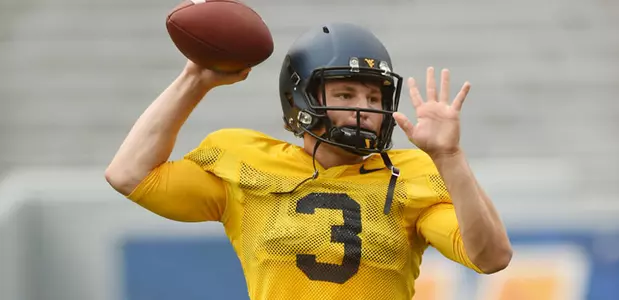
And in Morgantown, junior Skyler Howard leads the pack after directing a productive Mountaineer offense through the final two-and-a-half games of 2014. Howard followed that with a spring performance that was solid enough for Dana Holgorsen to declare the former junior college standout West Virginia’s starter.
If you’ve watched Howard practice this month you know that his body language speaks to you. What you see between the snaps reveals as much or more than what you see after them. His interactions with teammates and coaches are telling. He’s grown into a confident leader of this West Virginia offense and his comfort level resonates with those around him.
Howard now speaks the language and understands the progressions. He has a firm grasp of what to call, how to call it and how to execute it once it’s been called. Perhaps most critical is that Howard’s growth isn’t lost on his teammates. They respond in obvious ways to his guidance, his poise and ostensibly to the work ethic he showed while leading them through a demanding offseason.
There’s a lot to like about Howard’s skill set as well, starting with his clear understanding of ball security. In 210 snaps at the helm of the WVU offense, Howard turned the football over just once (on a lost fumble at Iowa State). Regardless of how limited that sample size might be, there’s plenty of promise to be found in those numbers. What you pull from that is a turnover-free percentage of snaps of 99.5, a figure even more mistake-free than those of shrewd decision makers like Geno Smith (98.9) and Clint Trickett (98.5) when they were running Holgorsen’s offense.
Part of that is the product of coaching, but there’s another part that can’t be coached - that natural born x-factor that so many exceptional signal callers have, a feel for the flow of a defense that so often helps a quarterback steer clear of toxic situations. It’s by no accident that among the bullet points chronicling Howard’s highlights at Riverside City College in the 2015 West Virginia media guide is one telling us that he completed 67 percent of his 325 passes and another one that concludes with the words: “… and only threw 6 interceptions.”
That kind of turnover avoidance at quarterback doesn’t happen overnight.
No one, of course, can play the balance of a 12-game schedule without making his share of mistakes. But if recent and past trends are any indication, Skyler Howard gives West Virginia something to build on with his aptitude for sidestepping the kinds of landmines that can get you beat.

Skyler Howard
Howard’s appeal doesn’t stop there. Another key attribute he brings to the table leaps out at you, in part because it’s one that that not many of Holgorsen’s quarterbacks have traditionally been blessed.
Howard is agile enough to make things happen with his feet.
This aspect of Howard’s game does remind Holgorsen of at least one other signal caller he coached – Case Keenum of Houston, the leading passer in college football history.
“I don’t know if I’d consider Skyler athletic but he is mobile. Case Keenum was mobile. Not athletic but mobile,” said Holgorsen. “Guys like that can get out of bad situations because they’re football players and they can make things happen outside the pocket because they’re mobile.“
Like Keenum, Howard isn’t explosive but he’s nimble. He isn’t dynamic but he’s shifty. In short, he might not have the straight-line speed to outrun a lot of linebackers or defensive backs in a track meet, but if you place a first-down marker at the finish line he’d probably find a shortcut to beat them to it.
This element of Howard’s game can help extend plays and set the stage for big throws downfield as defenses strain to hold their coverage for that additional couple of seconds. But Howard’s feet can do much more than that. They can also help address one of West Virginia’s most pressing offensive needs in 2015 – improved play in the red zone.
If you want to see the impact that Howard’s mobility can have on West Virginia’s offense in or around the scoring zone just throw in the tape of last year’s Kansas State game. A perfect illustration played out midway through the third quarter with the Mountaineers trailing 20-3 and facing a third down and 6 at the Wildcats 23-yard line.
With the ball on the left hash and WVU lining up with a trips formation wide right, Howard took the snap and looked to throw. K-State showed man coverage with a free safety roaming high. The Wildcats matched heads on the perimeter, with four defenders shadowing West Virginia’s four receivers, and they blitzed a linebacker off the edge to create a five-man pressure package. As left tackle Adam Pankey forced hard-rushing defensive end Jordan Willis to run the wide hump around him, Howard sensed the open space, stepping up inside Pankey’s block and fading left to buy time. He scanned the secondary for an open target with both hands wrapped firmly around the football as he continued to drift outside the pocket, extending the play and giving his receivers every chance to break open. Finally, after watching half the K-State defense turn its back and give chase in coverage downfield, Howard tucked the ball and burst up the sidelines. He raced inside the 10-yard line before finally being tracked down at the seven by linebacker Dakorey Johnson after a pick-up of 16.
Breaking containment to run the edge on third down against an incredibly disciplined defense like Kansas State’s is no easy feat – but Howard pulled it off. With a less mobile quarterback on the field the result of that third down play could easily have been a sack, an incompletion or worse – most likely relegating West Virginia to yet another field goal attempt. Instead, Howard’s escape act gave WVU a first down and goal and on the next snap he fired a 7-yard scoring strike to Kevin White, lifting the Mountaineers back into the game.
In the same way that Keenum’s mobility helped him rush for seven touchdowns during his first season under Holgorsen in 2008, Howard can create a few extra red zone headaches for WVU opponents this fall – just as he did against Kansas State.
When the field shrinks, limiting the space with which the offense can operate, the ability to force defenses to account for another potential runner is invaluable. The mere threat of a mobile quarterback taking off with the football, whether he actually does so or not, can impact a defense’s ability to swarm. That’s a dimension the Mountaineer offense was lacking during most of its scoring zone struggles last year.
We all loved seeing West Virginia kicker Josh Lambert grab All-Big 12 First Team honors from the Associated Press, enjoying a season for the ages as he tied an NCAA record for most games (10) with multiple field goals made. The dark side to a kicker booting that many field goals, though, is pretty obvious. Those kinds of records can only be established when your offense is leaving a bucketful of points on the table with red zone failures. That was precisely the case in 2014 as the Mountaineer offense reached the end zone on just 52.0 percent of its trips into the red zone.
It’s tough to be a formidable football team when your touchdown rate inside the 20-yard line is that low. How tough? Thirty squads finished with a worse red zone TD percentage than the Mountaineers last season and only 6 of those 30 managed a winning record.
So, if WVU’s 52 percent red zone TD rate last year wasn’t enough, what is enough? A quick peek at the most successful teams in the country gets us closer to an answer.
In 2014 there were 23 FBS programs that finished with at least 10 wins. Of those 23 teams, 19 scored touchdowns on at least 60 percent of their trips into the red zone. That figure supports what past lessons have taught us – that anything north of 60 percent in this category at least gets you in the conversation. The higher the number, the better your chances of success as the truly efficient offensive teams hit that number and keep on sailing with a percentage in the mid-60s, or the 70s or sometimes even in the 80s.
Browse through some of the most iconic campaigns in West Virginia history and the numbers bear this out. When the Mountaineers finished 10-3 after Dana Holgorsen arrived in town in 2011, the WVU offense reached the end zone on 67 percent of its red zone possessions over the course of the season, including a ridiculously flawless seven touchdowns in seven red zone-trips against Clemson in the Orange Bowl. When West Virginia won 11 games in 2005 and knocked off Georgia in the Sugar Bowl, Pat White and the WVU offense scored touchdowns on 71 percent of their trips into the red zone. Two years later, when West Virginia finished 11-2 and walloped Oklahoma in the Fiesta Bowl the Mountaineers were even more lethal in the red zone, hitting paydirt on 75 percent of their trips inside the 20-yard line.
Two vital ingredients can help an offense leave the red zone with sixes instead of threes – 1) a dependable running game and 2) a quarterback who is not only quick and accurate with his arm but also dangerous enough with his legs to keep a defense engaged. As such, it’s no surprise that the most productive red zone team in the last several years, the 2011 Wisconsin Badgers, had checkmarks in both of those boxes. Featuring a 1,900-yard rusher in Montee Ball and led by Russell Wilson -- an accurate quarterback (73 percent completion rate) blessed with the mobility to make a few plays with his legs (six rushing TDs) – the Badgers scored a touchdown on more than 85 percent of their trips into the red zone. That is what good looks like.
If West Virginia can achieve anything in the same hemisphere as the red zone numbers that we marveled at in the preceding paragraphs, Holgorsen’s crew could make a lot of noise in the Big 12 this fall. With a strong ground game, a little luck and the added mobility of a more seasoned Skyler Howard, maybe they can get there. The Mountaineer offense, after all, won’t have to be perfect but it will have to be opportunistic enough to make plays in key spots and achieve one fundamental goal . . .
Get Josh Lambert kicking extra points instead of field goals.
I’ll see you at the 50.


Coach Pat Kirkland | April 15
Thursday, April 16
Andrew Powdrell | April 15
Wednesday, April 15
Coach Rich Rodriguez | April 15
Wednesday, April 15
Mic'd Up with Coach Rich Rodriguez
Wednesday, April 15