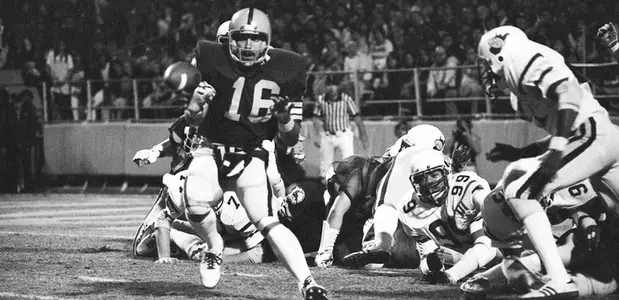
MaloneAZSt-Main-122815.jpg
WVU, Sun Devils Played Once Before in '79
December 28, 2015 08:06 PM | Football
Change was in the air in Tempe, Arizona, when West Virginia traveled out to the desert to conclude the 1979 football season against Arizona State.
Although he hadn’t said so publicly, new West Virginia University athletic director Dick Martin was preparing to lower the boom on coach Frank Cignetti.
Before the ’79 season, Martin indicated that Cignetti, who was battling cancer at the time, needed to have a winning record in order to get his yearly contract renewed.
Cignetti was hired in January, 1976, to replace Bobby Bowden following Bowden’s departure to Florida State. That came just days after the Mountaineers defeated NC State, 13-10, in the Peach Bowl to conclude a ‘75 season that featured a 9-3 record and a top 20 national ranking.
But Bowden’s offensive coordinator could never duplicate that success in ensuing years. Cignetti’s Mountaineer teams got progressively worse in 1976 and 1977 leading to a disastrous 1978 campaign that saw WVU win just two of 11 games. Cignetti, in 2011, recalled some of the obstacles his program was up against in the late 1970s, playing in an aging football stadium and surrounded by top 20 programs.
“You had Penn State to the north with great facilities, you had Ohio State and Michigan and those schools would come into Western Pennsylvania to get the top players,” he recalled. “They had great facilities and were successful. Pitt brings in Johnny Majors in and he opens the door up. You go south and Virginia Tech had beautiful facilities. Coach (Jerry) Claiborne had the program going great over at Maryland so we were surrounded with programs that were established and very successful.”
In addition to playing in a venue that was literally falling apart, Cignetti’s Mountaineer program had to deal with severe budgetary problems the state of West Virginia was going through in the late 1970s.
There were times when he was pulled off the road in late January or early February near the end of the recruiting cycle because the state didn’t have enough money left in its budget to pay for his trips.
“It’s like being in a poker game and you’ve got a good hand and you’ve got it going and you don’t have the money to stay in the game,” Cignetti explained. “That was usually a problem at that time of the year - usually right before signing day.”
Compounding matters, Cignetti was stricken with a rare form of cancer that nearly killed him at Christmastime, 1978, and left him in limbo throughout the spring and summer leading into the ’79 season. There was talk in Morgantown of bringing in former Colorado coach Bill Mallory to coach the team while Cignetti recovered, but Cignetti soldiered on and made a full recovery by the time the ’79 season began.
Immediately, early-season losses to Temple, Syracuse and NC State put West Virginia in a big hole, and subsequent victories over Richmond, Kentucky, Boston College and Tulane only delayed the inevitable – another coaching change for Mountaineer football.
West Virginia fought back from a 23-6 deficit to defeat Virginia Tech, 34-23, in week nine and battled 12th-ranked Pitt to the bitter end in a 24-17 loss to the Panthers in the final game ever played at old Mountaineer Field the following week.
By then, however, the Frank Cignetti Watch was on.
A petition urging Cignetti’s retention was signed by all but four of WVU’s returning players and given to Martin, who told the two players presenting the petition to him that he didn’t care to discuss personnel matters with them.
For that matter, Martin didn’t care to discuss Cignetti’s circumstances with anyone. Throughout the week, he was mum on the coaching situation and when West Virginia traveled to Tempe to play Arizona State, he tried to keep a low profile.
At halftime of the game the Sun Devils were leading, 28-7, Charleston Gazette sports editor Shorty Hardman finally cornered Martin in the press box and asked him what he was going to do about Cignetti.
“Shorty, if you ask me that question again I’m going to punch you right in the nose,” those standing near the two recall Martin saying.
Despite its comfortable lead, Arizona State was actually in the midst of a crisis far worse than West Virginia’s. The Sun Devils were forced to fire highly successful coach Frank Kush at midseason as he attempted to stonewall the school’s investigation into an ugly incident in which he was accused of punching punter Kevin Rutledge during a game against Washington in 1978.
Rutledge sued the school for $2.2 million, and during the discovery process several teammates came forward to say they had witnessed the punch. Kush was initially suspended but was later fired when a couple of assistant coaches came forward to claim that Kush had encouraged them to lie if necessary to rebut Rutledge’s charges.
Kush countered by suing Arizona State for $40 million and eventually settled for $200,000 when he forfeited his job. Kush, who compiled a 176-54-1 record with nine conference championships, six bowl appearances and two undefeated seasons during his 21½-year tenure at Arizona State, never coached in college again.
Arizona State’s 42-7 victory over West Virginia was actually credited to assistant coach Bob Owens, who replaced Kush following the Sun Devils’ 12-7 victory over Washington. Among the notable players on Arizona State’s roster that season were quarterbacks Mark Malone and Mike Pagel and running back Gerald Riggs.
After season-ending losses to Arizona and Hawaii, Owens gave way to Darryl Rogers, who coached the Sun Devils for five seasons before John Cooper replaced him in 1985. Three years after that, when Cooper got the Ohio State job (beating out West Virginia's Don Nehlen), it was Ohio Valley native Larry Marmie, followed by Bruce Snyder, Dirk Koetter, Dennis Erickson and now Todd Graham, who is in fourth season leading the Arizona State program. The Sun Devils have had a number of successful seasons since Kush’s tumultuous departure in 1979, but no coach since then has been able to match the sustained success Kush had in Tempe from 1958-79.
As for West Virginia, Martin, who died of cancer in 2008, fired Cignetti a few days after the Arizona State loss and then went underground to hire Michigan assistant coach Don Nehlen in mid-December, 1979. Nehlen benefitted from a roster full of talented players Cignetti had left him, including All-Pro linebacker Darryl Talley, and a brand new football stadium to sell to recruits. The state’s economy also rebounded, allowing Nehlen and his assistants to stay out on the road to recruit a little bit longer into the winter.
As it turned out, Nehlen was able to do for Mountaineer football what Frank Kush did at Arizona State during his 21½-season tenure there.
Interestingly enough, at the same time one great era was concluding at Arizona State another one was beginning at West Virginia.
And by the way, the main figures in that 1979 West Virginia-Arizona State football game played on November 17, 1979 - Frank Kush, Frank Cignetti and Don Nehlen - are all in the College Football Hall of Fame, Kush for what he did at Arizona State, Nehlen for what he did at West Virginia and Cignetti for what he did later at Division II Indiana, Pennsylvania.
Be sure to check out our daily bowl coverage from Scottsdale, Arizona, leading up to Saturday's 2016 Motel 6 Cactus Bowl, including a report on Wednesday highlighting WVU's prior football games played in the desert.


Nate Gabriel | April 8
Wednesday, April 08
Coach Rod West | April 8
Wednesday, April 08
Coach Rich Rodriguez | April 8
Wednesday, April 08
Ryan Ward | April 6
Monday, April 06