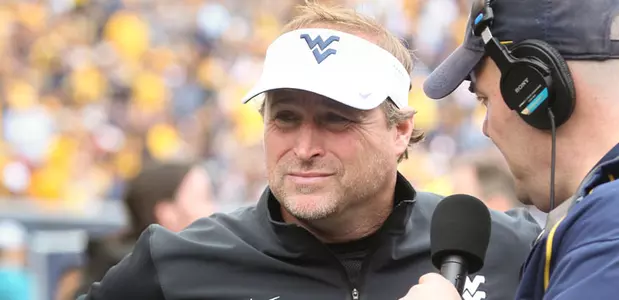
Holgorsen-Main-112415.jpg
Campus Connection: WVU's Run-Game Success
November 23, 2015 07:10 PM | Football
MORGANTOWN, W.Va. - Close to 50 years ago, when Jim Carlen took the West Virginia coaching job in 1966, he wanted an offensive coordinator, who, in his words, “knew the throwin’ game.”
Carlen came to this conclusion after sitting in Georgia Tech coach Bobby Dodd’s office and listening to Dodd and Alabama coach Bear Bryant talk about the passing game like it was some sort of disease.
Carlen figured if two legendary coaches felt that way about throwing the football, then it might be worth doing one day when he became a head coach. So when Carlen came to Morgantown he sought out a guy named Bobby Bowden from Florida State, the same Bobby Bowden who coached a guy named Fred Biletnikoff - today the namesake of the college football award presented to the best wide receiver in the country.
With Bowden calling the plays for Carlen, West Virginia was going to be putting footballs in the air the same way NASA was launching rockets into space in the 1960s.
Well, Bowden’s first year attempting to do this at WVU didn’t turn out too well, and, after a couple of better years throwing the football in 1967 and 1968, the Mountaineers went in an entirely different direction in 1969.
The reason they did this was simple - West Virginia’s personnel at the time with running backs Jim Braxton, Bob Gresham and Eddie Williams was better suited for running the wishbone.
In fact, during Carlen’s final game as the Mountaineers’ coach (and Bowden’s last game as Carlen’s play caller) WVU ran it 79 times and threw it only twice in a 14-3 victory over South Carolina in the 1969 Peach Bowl.
Bowden began his head coaching career at West Virginia throwing the ball once again with Mike Sherwood, Bernie Galiffa, Danny Buggs and Marshall Mills, but by the time he departed for Florida State following the 1975 season he was primarily running the ball behind a big, physical offensive line and a talented backfield that featured Artie Owens, Dwayne Woods and 6-foot-4-inch fullback Ron Lee.
Twenty-five years later, spread offense guru Rich Rodriguez came to West Virginia in 2000 with the idea of using a no-huddle attack to throw the ball all over the lot the same way Houston once did with its famous Run-n-Shoot offense.
But after enduring a humiliating three-win season in 2001, Rodriguez realized the best way to move the football, score points and, most importantly, win tough football games was by running the ball with Avon Cobourne, Quincy Wilson and quarterback Rasheed Marshall out of the spread.
That’s partly because of the personnel he inherited from Don Nehlen, and also partly because of the players he had access to in this part of the country.
You see, most of the high school football players in the Northeast today are not accustomed to playing the style of offenses that are being used in the Southwest and the Big 12. They don’t have the weather in the Northeast to be able to go outside and practice the passing game year-round, and, in the case of West Virginia with its restrictive training rules that limit the amount of time high school coaches are allowed to work with their athletes, football coaches in this state simply don’t have the means to prepare their players to play this way.
It doesn't mean they can't be trained to play in a modern college passing offense in the Northeast, it just takes a little longer to perfect sometimes in this part of the country.
“We ran all the time and the teams we played against ran all of the time,” said tight end Cody Clay, who played his prep ball at Charleston’s George Washington High.
There are lots of Cody Clays on West Virginia’s roster coming from this part of the country, one of the few exceptions being running back Wendell Smallwood.
Smallwood played in a spread offensive attack at Eastern Christian Academy in Elkton, Maryland, and he was recruited by West Virginia primarily because of his skills as a running back in the spread passing game.
“I was lining up empty a lot running routes and I was turned into a seven-on-seven guy, basically,” Smallwood recalled.
Consequently, Smallwood was more prepared than many of his WVU teammates to play in a sophisticated, modern college passing offense. Yet, despite Smallwood’s high school background in the passing game, he admits he still wasn’t ready for what he was asked to do in Holgorsen’s system. It’s taken him three years to become fully comfortable.
“I don’t think we had a lot of guys from around here ready to play in this offense and learn it,” Smallwood explained. “There is so much involved in every little part. I didn’t know that much about it when I first came here.”
Of course, throwing the football is not rocket science or brain surgery, but there are a lot of moving parts that have to function in unison to make it work. When even one facet of the passing game is not working well that screws up the entire process.
Quarterback Skyler Howard explains.
“People look at it and say, ‘I can do that. I can throw the ball’ – and I’m sure they can – but when the bullets are flying you’ve still got to be able to do it,” he said. “There is a lot that goes into it on both sides. It takes two people. Actually, it takes 11 people really because I have to have time to get the ball off. The amount of work that goes into something as simple as completing a post route, it’s repetition over the spring, the summer and it continues throughout the season.”
With that in mind, go back and look at West Virginia’s opening day two-deep roster and count all of the new players the Mountaineers were relying on in the passing game. It looked good early but the hiccups began to happen once the schedule got much tougher in October.
Therefore, Holgorsen went from once throwing the football 76 times in a game at Houston to passing it 12 times two weeks ago in West Virginia’s 18-point victory over Texas. Last Saturday against Kansas, Holgorsen’s so-called “Air Raid” offense got 426 yards … on the ground.
Call it Ground Raid.
“It’s weird because you hear of Dana Holgorsen’s offense and you think ‘Air Raid’ immediately right off the bat and up until this year really that’s what we have been,” said Clay. “I can’t really say what’s changed necessarily because we have the backs that can do it, we have the lines that can do it and the tight ends can help with that, so really that’s the difference.”
“It’s a result of a lot of things,” explained offensive line coach Ron Crook. “We’ve recruited strong, tough kids who want to play that way and it’s just a result of (Holgorsen) wanting to change the mentality of this team and it’s a result of playing to the team’s strengths right now. It’s not like he doesn’t want to throw the ball and it’s not like he doesn’t know how to throw the ball all of a sudden, it’s just what our team is good at so we’re going to take advantage of it.”
Holgorsen deserves a lot of credit for modifying his approach to match what his West Virginia players are capable of doing to win football games, right now.
This is the same guy who played for Hal Mumme and coached with Mike Leach, but it also shows that Dana Holgorsen is his own guy when it comes to doing what he feels is necessary to be successful.
It also speaks to how badly Holgorsen wants to win football games.
“It’s what good people do, regardless of what field they are in,” said Crook. “They are able to adapt what they are doing to suit what works for their team, what works for their company or whatever it is. I’ve learned a lot by watching it.”
We’ve all learned a lot by watching Holgorsen’s offensive transformation this season – not only what it often takes to win football games in this part of the country - but we are also learning a lot more about what makes Dana Holgorsen tick as a football coach.

Jaden Bray | April 13
Monday, April 13
Coach Travis Trickett | April 13
Monday, April 13
Coach Rich Rodriguez | April 13
Monday, April 13
Nate Gabriel | April 8
Wednesday, April 08