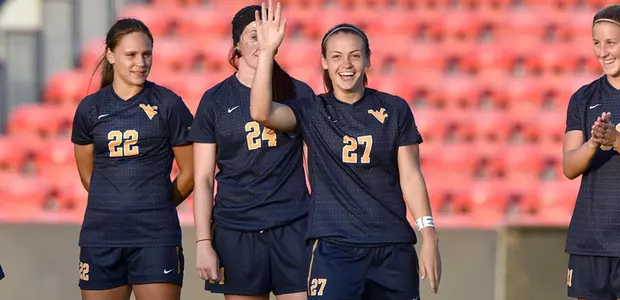
Hill-Main-11215.jpg
WVU Hopes to Build on Big 12 Success
November 02, 2015 05:20 PM | Women's Soccer
There has certainly been a learning curve during the four years West Virginia University has been in the Big 12 Conference, from the extensive travel to learning new players and new venues to adapting to the different styles of play within the league.
We’ve seen it in football, where the Mountaineers are now dealing with wide-open, passing-style offenses predicated on getting more possessions and scoring lots of points.
We’ve seen it in men’s basketball, where veteran coach Bob Huggins has had to flip his roster to match the more athletic style of play he’s now facing on a nightly basis in the Big 12 instead of the back-alley brawling that used to take place in the Big East.
And the same holds true for women’s soccer, where veteran coach Nikki Izzo-Brown is contending with a much more physical brand of soccer than what the Mountaineers were accustomed to playing in the Big East.
Some coaches in women’s soccer joke that the big in Big 12 is there for a reason – because everyone has big players.
Generally speaking, East Coast soccer is a little bit different than what the Mountaineers are now encountering in the Big 12 where the players are generally more athletic and play a more direct style of soccer.
Again, in general terms, East Coast teams typically place high value on technical skill, or what West Virginia senior forward Kailey Utley refers to as “pretty soccer.”
Utley, one of the top prep players in the country growing up in St. Louis, Missouri, has become well acquainted with the varying styles of play within the Big 12 during her four years at WVU.
“I think Big 12 soccer is a little more physical,” she admitted. “The girls might be a little stronger and more athletic, but I think ultimately we’re trying to play more finesse soccer rather than direct.”
Unlike sports such as basketball and football that utilize precise playing field dimensions, soccer is similar to baseball in that it allows a little leeway with its surface proportions. Schools are permitted to have fields anywhere from 120 yards long and 80 yards wide to 110 yards long and 65 yards wide, although 120x75 is the NCAA’s preferred size (that is the size of the field West Virginia is playing on during this week’s Big 12 Championship in Kansas City).
For instance, TCU’s field is the smallest in the Big 12 at 110x65 while West Virginia’s is the largest at 120x80, which can make a big difference in the way a team plays – or the types of players it recruits to suit those specific venue sizes.
Can you imagine what Nick Saban could do with his Alabama defense if his football field was only 40 yards wide instead of 53 1/3 yards, for example?
To a degree, that can happen in soccer – and regularly does.
“The Big 12 venues are different,” said senior midfielder Amanda Hill, a Washington, Pennsylvania, resident, pictured above. “The fans are not what we’re accustomed to and some of the stadiums are set up in a way to try and have an advantage by having narrow fields or the stands are so close to the field. It’s definitely different than what we’re accustomed to here.”
Which makes what the Mountaineers have been able to accomplish in the Big 12 under Izzo-Brown so impressive, especially to those within the sport who really know and understand soccer tactics.
West Virginia (15-1-1) has won four straight regular season titles with an eye-catching 27-1-3 record since joining the Big 12 while facing a brand of soccer that most of Izzo-Brown’s players growing up were not trained to play.
Hill, from Washington, Pennsylvania, believes the secret to West Virginia’s success in the Big 12 has been Izzo-Brown’s ability to get her teams to adapt to whatever style of soccer they are facing on a nightly basis.
“I think one of the reasons we’re doing well and we’re effective is we have a good combination (of athleticism and technical skill). We’ve got some East Coast kids who grew up with that kind of training and we’ve also got some kids from the Big 12 area that are used to the athleticism, so I think we bring the right mixture to the table and that’s why we’ve had some success,” she said.
Now, the second-ranked Mountaineers have to figure out how to transfer their impressive Big 12 success to the NCAA tournament coming up next weekend. Hill admitted earlier today that performing better in the NCAA tournament was one of the team’s top goals heading into this season.
“We want to take it each game at a time, but since our first game and our first scrimmage the NCAA tournament is what really counts,” she noted.
“We’re aware that last three years haven’t been where we want to be at in the NCAA tournament,” added Utley. “But I think this year our team is special and we’re different. I think we have what it takes to make a longer run, but we’re just going to have to take it one game at a time.”
Because women’s soccer takes finances into consideration when seeding the national tournament, West Virginia is probably going to remain in the East when the tournament pairings are announced next Monday.
If you look at this week’s RPI, announced earlier today, No. 6 West Virginia is right on the cusp of earning one of the four No. 1 seeds for the tournament, meaning they could host games at Dick Dlesk Stadium all the way to the College Cup if they can stick around that long.
That’s the good news.
The bad news is seven of the top eight schools in this week’s RPI are also Eastern teams, meaning West Virginia has by far the most difficult path to the College Cup of any Big 12 program – even if the Mountaineers can land one of the tournament’s four top seeds.
Even Texas Tech, at No. 33, or No. 42 Oklahoma has a much more favorable road to Cary, North Carolina, site of this year’s College Cup, than sixth-rated West Virginia does based solely on where they are located geographically.
It’s historically been that way in women’s soccer as well.
Twenty-four of the sport’s 33 NCAA champions have been East Coast schools (most of those being North Carolina, of course), and all but five of the 33 national championship games have involved at least one East Coast school.
For those not paying attention, that’s West Virginia’s region for the NCAA tournament.
Again, it’s a built-in aspect of the sport that West Virginia has to contend with - something the older players realize and understand.
“We’re going to take every opponent and view them the same. We are going to worry about how we play soccer and we’re going to be confident and not worry about what our seeding is,” said Utley.
Or, what style they have to play.
“I think we’re more focused on the teams we’re playing and at the end of the day, a soccer field is a soccer field and we just want to get on it and take care of business, whoever we play,” said Hill.
The process begins early Wednesday afternoon when West Virginia takes on Oklahoma State in the opening round of the Big 12 Championship in Kansas City.

Nikki Izzo-Brown & Alicia Riggins | Wagner Postgame | Nov. 14
Saturday, November 15
Nikki Izzo-Brown | Nov. 10
Monday, November 10
WSOC | Cincinnati Cinematic Recap
Friday, October 31
Ajanae Respass | Cincinnati Postgame | Oct. 30
Thursday, October 30