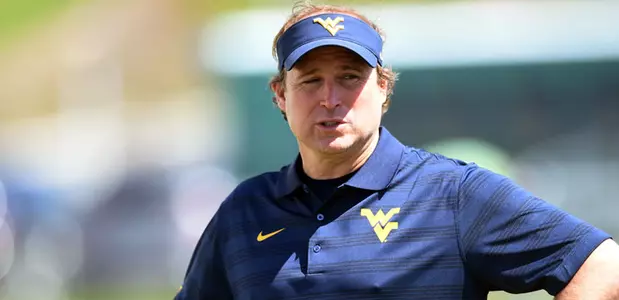
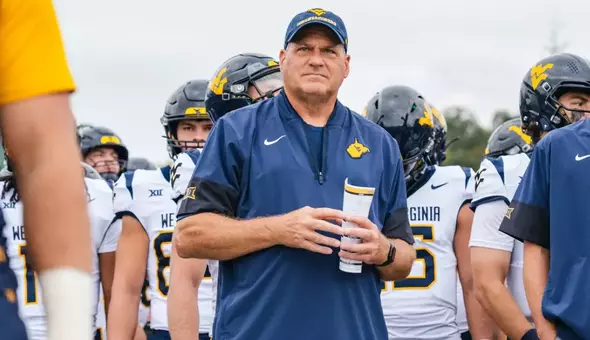
Holgorsen-Main-61515.jpg
Drenning: Bear Down
October 17, 2014 02:38 PM | Football
Radio sideline reporter Jed Drenning is providing periodic commentary on the Mountaineer football program for WVUsports.com. For more from Jed, you can follow him on Twitter http://twitter.com/TheSignalCaller
They say everything’s bigger in Texas.
Whoever coined that phrase hasn’t been inside the visitor’s locker room at Jones AT&T Stadium in Lubbock.
Texas Tech – an otherwise gracious host - plants its gridiron guests in an area small enough to strap onto a carhaul unit between a Mini Cooper and a Fiat 500.
To reach the deepest corner of that space to round up the folks needed for postgame interviews, I navigated through a 48-inch passage separating two rows of players’ lockers that included an obstacle course of wet towels, bare feet, duffle bags and discarded shoulder pads.
It was cramped. Very cramped. And the thing about cramped spaces is – even in the high carnival that follows a last second win – you’re packed close enough together to hear things. A lot of things. Things ranging from small talk to war stories. You hear laughter and wise cracks. You hear defenders complimenting running backs, running backs complimenting linebackers and everyone complimenting the folk hero kicker.
That was the scene last Saturday in West Texas in the minutes following West Virginia’s improbable comeback win over the Red Raiders. As the Mountaineers cleaned up and packed their bags, dozens of celebratory conversations registering at varying levels on the decibel scale faded in and out as I slid sideways through the congested mass of humanity.
But one comment lingered in my ear more than any other. The funny thing is I don’t even know who said it.
As a player in the crowd some 10 feet in front of me rounded the corner in the opposite direction, I heard him exclaim (with the excitement that can only stem from escaping the jaws of defeat) a simple phrase that summed up the afternoon.
“That was a *team* win! A *team* win!”
A team win indeed. A concept Dana Holgorsen preaches at every turn to all who will listen, brimming with constant reminders about the need to win on “all three sides of the ball.”
It’s reassuring to hear first-hand evidence that Holgorsen’s message is in fact resonating in the West Virginia locker room.
Literally.
Against Texas Tech that held as true as ever. All three phases pitched in to pull off a frenzied, come-from-behind thriller of a triumph.
Offensively, the Mountaineers established a school record by churning out more than 500 yards for the fifth straight game. This time, West Virginia saved its best for last as 225 of WVU’s 565 total yards came in the final quarter of play.
Defensively, Tony Gibson’s squad bowed up when it mattered most. After Tech’s Justin Stockton extended the Red Raiders lead to 14 once again midway through the fourth quarter, the Mountaineers slammed the door. In all – between the time of Stockton’s 69-yard scoring burst and the final gun – Tech ran nine plays. In those nine plays the Raiders managed a total of just 29 yards, 17 of which came on Jakeem Grant’s show-stopping circus catch – laying flat on his back -- with just under two minutes remaining. In short, the WVU defense held Davis Webb and the T-Tech offense in check at the perfect time, making the comeback possible.
Then of course there was the special teams gem for the ages by kicker Josh Lambert. The 55-yard shot might not have been heard around the world but it certainly was heard loud and clear throughout Lubbock and as far east as Lambert’s hometown of Garland, Texas. It marked the third time in WVU’s last five wins (dating back to last year’s overtime victory at TCU) that Lambert’s toe delivered a walk-off game-winner for West Virginia.
Offense, defense and special teams. When the smoke settled in West Texas, the Mountaineers had clawed, scratched and kicked their way to a 37-34 win that won’t soon be forgotten. It was indeed, just as that faceless voice from somewhere across the crowded locker room labeled it, a team win.
It couldn’t have come at a better time because WVU will need another ‘all hands on deck’ effort from all three phases if it hopes to topple No. 4 Baylor Saturday afternoon in Morgantown.
Despite the 58 points surrendered to TCU last week (with the footnote that 14 of those points were actually allowed by the Baylor offense and special teams), the job Phil Bennett has done with the Bears defense the last two years shouldn’t go unnoticed. Sure, Baylor spends each September pummeling the Woffords and Buffalos of the world, bloating their early season defensive numbers in the process, but one thing that can’t be ignored is how sturdy the Bears have been at the point of attack – even against Power 5 Conference teams.
Despite our memories of Storm Davis (124 yards), Blake Bortles (93 yards) and the UCF Knights running all over the Bears last season in the Fiesta Bowl, Baylor has held up well against big boy ground games – yielding less than four yards per carry to Power 5 teams since the start of last season. That doesn’t happen without difference makers with their hand on the ground. Art Briles has said he would stack Baylor’s top six defensive linemen against any in the country. With Jimmys and Joes like that, it’s little wonder the Bears have already racked up 67 negative yardage plays (21 sacks, 46 tackles for loss).
The improved Baylor defense is an ingredient, but it’s not the Bears identity. That distinction belongs to the nation’s No. 1 ranked offense, an offense that’s averaged more than 600 yards per outing each of the last two seasons and has eclipsed the 60-point barrier nine times in its last 19 games.
It wasn’t long ago Baylor was the laughingstock of the Big 12, a perennial doormat that suffered through 14 consecutive losing seasons. But Art Briles changed that by forging an ethos of confidence in Waco; a culture built on the swagger of a lethal offense that piles up so many points it makes the scoreboard look smaller.
Art Briles’ offense feeds off big plays, and they stockpile them in bunches. In fact, in its last 19 games Baylor has ripped off 50 plays of 40-plus yards – the most in college football.
To survive the Bears offense you first must minimize those big plays. If you can do so, Baylor starts to press and gets knocked out of rhythm.
That’s how a depleted Texas team managed to hang with the Bears for three quarters in Austin two weeks ago. Throw in the tape and you can see that the Longhorns defense was far from overwhelming, but they did play fundamentally sound football, keeping things in front of them, not allowing Baylor to record a run play of 20 yards and preventing the Bears from connecting on a throw of longer than 30 yards. Sure Texas got pushed around at times (BU rushed for 278 yards) but by and large the ‘Horns tackled in space enough to matter and they didn’t let the Bears off the hook with anything cheap. The end result was a career worst 7-for-22 passing performance by Bryce Petty and a mere 21 points scored by the Baylor offense (the Bears other touchdown came on a blocked field goal return).
Last week in Waco, TCU’s 4-2-5 defense was stretched apart at the seams in a 61-58 loss to Baylor. The Bears got back to the business of racking up explosive plays as Petty threw for 510 yards and four different BU pass catchers registered a reception of 47 yards or longer. Time and again we saw the Frogs defense faced with the same poisonous conundrums that Baylor presents each week.
The Bears weapon of choice is their alignment. They send slot receivers to each side of the formation all the way outside the hash marks, forcing the defense to declare a pre-snap numbers commitment one way of the other. Shift bodies outside and Baylor gashes you with the inside run game; move six or more defenders in to load the box and the Bears counter with their perimeter screen game. It’s the offensive equivalent of three thugs accosting you in a dark alley. One stands to each side of you, firmly securing your arms, while the third relentlessly pummels you in the gut.
Making this even more toxic to defenses is Baylor’s use of packaged plays – those that interlace multiple run/pass possibilities that are determined by the quarterback’s read. It might be an inside zone run, it might be a perimeter screen, it might be the quarterback pulling the ball to throw a fill route. And it’s all governed by the alignment and/or flow of the defense.
Combination concepts are nothing new to football – and certainly not to Dana Holgorsen. Teams have for decades been throwing spontaneous “bingo” or “smoke” routes in which the signal caller takes the snap and immediately flips the ball to an uncovered receiver – or a receiver with a leverage advantage – even when a run play was the active call. Baylor’s spacing, coupled with its tempo, simply takes this approach to a new level and increases the stress on a defense even more.
Art Briles’ squad isn’t ranked in the top 5 by accident. They are a good football team. A very, very good football team that does everything at a torrid pace. That being said, the Bears might be bullet-like . . . but they aren’t bulletproof.
Like all good football teams, they do have some blemishes. Here are a few to mull over as kickoff quickly approaches.
1) WEARY TRAVELERS
Like a lot of dynamic programs, Baylor isn’t quite itself on the road. That might sound strange when discussing a team that’s 3-0 when it packs its bag this year but if you dig a little deeper, you start to unearth some interesting material. Overall, the Bears have posted a 22-5 record in their last 27 games. All five of those losses came outside of Waco. Moreover, even when Baylor does win on the road -- which it more often than not does – it often looks far more mortal in doing so. In the 10 home games played since the start of last season, the Bears have averaged a whopping 60 points per outing. In their last four Big 12 road games, however, they’ve averaged “only” 34 points per contest. Despite the fact that West Virginia didn’t quite slide into the polls following its win in Lubbock last week (though the Mountaineers are receiving considerable votes) it’s worth noting that Baylor has never – as in ever – knocked off a ranked Big 12 opponent on the road.
2) DIRTY LAUNDRY
How do you lose as 16.5 favorites in the Fiesta Bowl? A lot of things factor in, but perhaps none more so than losing your cool enough to get flagged a preposterous 17 times. That’s what Baylor did in last January’s disorderly effort against a feisty UCF squad. A year ago the Bears -- by a considerable margin -- were penalized more times (120) than any team in college football. You might think that’s a tough act to follow, but maybe not. This season Baylor is actually on pace to surpass that figure. Last Saturday against TCU, the Bears had to navigate through 12 penalties totaling 117 yards (several of course came at pivotal points in the game) on their way to overcoming a 21-point deficit to shellshock the Frogs. That’s exactly the kind of undisciplined play that will eventually cost you a football game. You can’t juggle chainsaws forever without losing a finger or two.
3) THIRD DOWN
Search further into the numbers and a troubling pattern starts to emerge for the Bears in one key area. On the surface, Baylor has the look of an acceptably efficient third down offense, converting 45 percent of its tries to rank in the middle of the pack in the Big 12. Look more closely, however, and you recognize that number is inflated by exceptional performances against SMU, Northwestern State and Buffalo (a combined success rate of 59 percent in those three games). Against actual Big 12 competition, Bryce Petty and the Bears have converted a mere 32 percent of their third down tries, a figure that ranks next-to-last in the league. On the flipside, West Virginia has converted 50 percent of its third down tries against Big 12 teams, good enough for a No. 2 conference ranking in that category.
For those inclined to dismiss this as a non-factor, believing the Bears are far too explosive offensively to let a little thing like third down inefficiency slow them down, consider the following - in the last three years, the time period in which Baylor has risen to prominence as an offensive juggernaut, the Bears never finished with a third down success rate lower than 44 percent. In other words, staying ahead of the chains at a respectable clip is part of what keeps the Baylor offensive machine humming along, but in recent weeks the “check engine” light has been popping on when the sticks read third down.
Of course this offensive shortcoming of Baylor’s is mitigated at least in part by the fact the Bears followed many of those failed down attempts with successful fourth down tries. In all, BU has attempted (23) and converted (18) more fourth downs than any team in the country. That makes the proposition of them going for it no less risky though.
Either way, if you’re looking for a few numbers going into the weekend that might put a bounce in your step we might have just the tonic you need. Check this out, courtesy of the diligent folks over at CFBStats.com:
THIRD DOWN PASSING COMP PCT. YDS PER ATTEMPT
Bryce Petty 47% 4.7
Trickett 74% 10.1
The question is . . . In a matchup between two teams coming off such emotionally draining wins last week, which squad can come back down to earth in time to sort things out first?
With half a season in the rear view, there’s still a lot of mystery surrounding this 2014 West Virginia team, a team that in some respects has received as much praise for the two games it’s lost as for the four it’s won. An upset win over the Baylor Bears Saturday afternoon would change all that in an instant.
Some wins – team wins -- can only be found on the other side of effective play in all three phases of the game. Toppling the Bears would call for an explosive and spotless showing by the Mountaineer offense, the defense’s most complete performance to date and a difference making effort by the special teams units.
Who knows? If all that comes together we might just see Josh Lambert lining up for another potential game winner around a quarter ‘til four on Saturday, a kick that would break the Big 12 title race wide open and send shockwaves across the college football landscape.
This time let’s go ahead and bump it back a bit more to 60 yards. Just to keep things interesting.
Until then, I’ll see you at the 50.
Gold-Blue Spring Festival Fan Recap
Sunday, April 19
John Neider | April 18
Saturday, April 18
Coach Zac Alley | April 18
Saturday, April 18
Coach Rich Rodriguez | April 18
Saturday, April 18