Radio Crew Making The Best Out Of A Unique Situation
January 20, 2021 04:34 PM | Men's Basketball, Blog
MORGANTOWN, W.Va. – From Weirton to Welch, Martinsburg to Matewan and all points in between, hardly anyone is noticing that Tony Caridi's descriptions of West Virginia University men's basketball road games are coming from a television monitor at Waterfront Place in Morgantown.
But that's the hand the Mountaineer Sports Network from Learfield IMG College has been dealt this year as a result of the COVID-19 pandemic.
Matt Wells, West Virginia's senior associate athletics director for external affairs who oversees the athletics department's relationship with Learfield IMG College, said extensive planning to do remote radio broadcasts began last summer.
They first had to figure out what was feasible for football and how the announcers could fit into the team's protective travel bubble. Then, they had to work through even more stringent restrictions for men's basketball with only 30 people being permitted in the travel party this year.
The solution they came up with is unique, to say the least.
For football road games, Caridi, radio sideline reporter Jed Drenning and onsite engineer Pat Sergent traveled with the team while analyst Dwight Wallace, who resides in Indianapolis, Indiana, and studio hosts Dan Zangrilli and Dale Wolfley remained in Morgantown to provide coverage from television monitors set up in the football press box.
"We went to work and put together a plan and started looking at it from a travel standpoint of what makes sense, and what makes sense technically for the broadcast itself?" Wells said.
The LTN fiber feed WVU uses for its mobile production unit to televise athletic sporting events on the Big 12 Now on ESPN + streaming service is also being utilized by the radio network to air football and men's basketball games.
The video feed, which is delayed by less than a second, is basically serving as the eyes and ears for the broadcasters who are not on site.
That's what Wallace, Zangrilli and Wolfley were using during road football games this year, and that's what Caridi and analyst Jay Jacobs are also using right now when the Mountaineers are playing road men's basketball games.
"We kind of worked through each phase of this to get to the end result," Wells explained. "Eight or nine months ago, considering a remote broadcast was not something any of us thought much about. Now, it's becoming more commonplace than not. Most schools are not traveling their radio crews with everything that's going on."
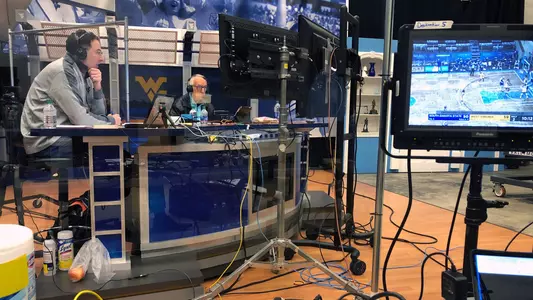
So instead of traveling with the team, Tony and Jay are calling the games from West Virginia University's studio at Waterfront Place in front of a setup that looks like something straight out of NORAD.
The main monitor in front of them is a center-court camera shot provided by the school. They have another monitor of the on-air television broadcast set up next to the main feed, plus a third monitor that delivers the real-time Statbroadcast feed.
Sergent also gets a natural-sound audio feed from the arena, which he mixes into his audio board with Tony and Jay to complete the broadcast.
Making this even more complicated is the fact that all of these things are arriving at different times. There is a noticeable delay between the LTN and TV network feed, which are both slower than the Statbroadcast feed.
Caridi has to play traffic cop with all of the information coming at him at different times.
"If it all works, you are in business," he said.
Unfortunately, it doesn't always work.
If a school doesn't have a dedicated camera operator to provide the mid-court LTN feed then the TV feed is used instead. That means Tony and Jay are watching all of the camera cuts that take them away from the action, as well as the studio-drops and the promotional panels.
"When you only have that, you are flying blind at times," Caridi admitted.
There was also an instance during the Oklahoma game when the mid-court camera froze and all Tony and Jay saw was an out-of-focus shot of the floor. They could still hear the crowd reaction and the public address announcer, but were forced to follow the action on the stat monitor.
"I had to transition and go back and try and re-describe something that I had already described in real-time 14 seconds ago and now I'm waiting for it to happen on (the regular television broadcast)," Caridi explained. "That's a challenge. When it works well, people can't tell the difference. I've had people tell me they had no idea we weren't on the road with them, but when things screw up it can be difficult.
"I had to say, 'Hey folks, I apologize. We've lost our video feed, and we can't see exactly what is happening,'" he added.
 The schools in the Big 12 are providing the center-court feeds to opposing teams on a reciprocal basis. WVU Athletics' television productions unit, coordinated by Scott Bartlett, is responsible for providing the LTN feed to the opposing radio network for games played at the Coliseum, while Zangrilli and Tim Bickford have the responsibility of making sure the away game feeds are getting to the Waterfront Place.
Caridi said the process is automated, so the feed arrives on their main monitor one hour before tipoff.
"I have to give a lot of credit to Dan because he's been the guy who is coordinating the LTN feed with each institution," Caridi said.
"There is a lot of cooperation among our Big 12 peers, and also with the networks," Wells noted.
The current setup has been workable, but not ideal.
Caridi said there are so many things that go on during a game that broadcasters can't see when they are not on site.
He also said pre- and postgame interviews can be challenging because they are relying on video conferencing that is being coordinated by sports information director Bryan Messerly.
Coach Bob Huggins did his postgame press conference at Oklahoma State sitting on a water cooler and holding an iPad.
But according to Caridi, perhaps the most detrimental thing to the broadcast is the everyday access that has been lost because the announcers are not traveling with the team. That's when they can talk to the players on the bus, observe team shootarounds or study scouting reports.
"You gain your most valuable information by being embedded with the team," Caridi explained. "When you are watching shootaround you see things they are trying to do and then during the game you can communicate some of that when it happens."
In order to make up for this, Caridi has had to do more pregame preparation than normal.
"It's important to make those phone calls during the day of the game and ask, 'Hey, what happened during shootaround? What are you guys trying to do?'" he said.
"Because our radio broadcast crew has done this for so long and those relationships exist, they are still able to get the important information they need that helps add to the broadcast," Wells added.
On the flip side, Caridi admits it's nice to be home in bed when the team is still flying home from an away game.
"After the South Dakota tournament I'm pulling out of the Waterfront parking lot thinking, 'Man, I just did a road game.'"
Strange times, for sure!
But that's the hand the Mountaineer Sports Network from Learfield IMG College has been dealt this year as a result of the COVID-19 pandemic.
Matt Wells, West Virginia's senior associate athletics director for external affairs who oversees the athletics department's relationship with Learfield IMG College, said extensive planning to do remote radio broadcasts began last summer.
They first had to figure out what was feasible for football and how the announcers could fit into the team's protective travel bubble. Then, they had to work through even more stringent restrictions for men's basketball with only 30 people being permitted in the travel party this year.
The solution they came up with is unique, to say the least.
For football road games, Caridi, radio sideline reporter Jed Drenning and onsite engineer Pat Sergent traveled with the team while analyst Dwight Wallace, who resides in Indianapolis, Indiana, and studio hosts Dan Zangrilli and Dale Wolfley remained in Morgantown to provide coverage from television monitors set up in the football press box.
"We went to work and put together a plan and started looking at it from a travel standpoint of what makes sense, and what makes sense technically for the broadcast itself?" Wells said.
The LTN fiber feed WVU uses for its mobile production unit to televise athletic sporting events on the Big 12 Now on ESPN + streaming service is also being utilized by the radio network to air football and men's basketball games.
The video feed, which is delayed by less than a second, is basically serving as the eyes and ears for the broadcasters who are not on site.
That's what Wallace, Zangrilli and Wolfley were using during road football games this year, and that's what Caridi and analyst Jay Jacobs are also using right now when the Mountaineers are playing road men's basketball games.
"We kind of worked through each phase of this to get to the end result," Wells explained. "Eight or nine months ago, considering a remote broadcast was not something any of us thought much about. Now, it's becoming more commonplace than not. Most schools are not traveling their radio crews with everything that's going on."
So instead of traveling with the team, Tony and Jay are calling the games from West Virginia University's studio at Waterfront Place in front of a setup that looks like something straight out of NORAD.
The main monitor in front of them is a center-court camera shot provided by the school. They have another monitor of the on-air television broadcast set up next to the main feed, plus a third monitor that delivers the real-time Statbroadcast feed.
Sergent also gets a natural-sound audio feed from the arena, which he mixes into his audio board with Tony and Jay to complete the broadcast.
Making this even more complicated is the fact that all of these things are arriving at different times. There is a noticeable delay between the LTN and TV network feed, which are both slower than the Statbroadcast feed.
Caridi has to play traffic cop with all of the information coming at him at different times.
"If it all works, you are in business," he said.
Unfortunately, it doesn't always work.
If a school doesn't have a dedicated camera operator to provide the mid-court LTN feed then the TV feed is used instead. That means Tony and Jay are watching all of the camera cuts that take them away from the action, as well as the studio-drops and the promotional panels.
"When you only have that, you are flying blind at times," Caridi admitted.
There was also an instance during the Oklahoma game when the mid-court camera froze and all Tony and Jay saw was an out-of-focus shot of the floor. They could still hear the crowd reaction and the public address announcer, but were forced to follow the action on the stat monitor.
"I had to transition and go back and try and re-describe something that I had already described in real-time 14 seconds ago and now I'm waiting for it to happen on (the regular television broadcast)," Caridi explained. "That's a challenge. When it works well, people can't tell the difference. I've had people tell me they had no idea we weren't on the road with them, but when things screw up it can be difficult.
"I had to say, 'Hey folks, I apologize. We've lost our video feed, and we can't see exactly what is happening,'" he added.
The schools in the Big 12 are providing the center-court feeds to opposing teams on a reciprocal basis. WVU Athletics' television productions unit, coordinated by Scott Bartlett, is responsible for providing the LTN feed to the opposing radio network for games played at the Coliseum, while Zangrilli and Tim Bickford have the responsibility of making sure the away game feeds are getting to the Waterfront Place.Caridi said the process is automated, so the feed arrives on their main monitor one hour before tipoff.
"I have to give a lot of credit to Dan because he's been the guy who is coordinating the LTN feed with each institution," Caridi said.
"There is a lot of cooperation among our Big 12 peers, and also with the networks," Wells noted.
The current setup has been workable, but not ideal.
Caridi said there are so many things that go on during a game that broadcasters can't see when they are not on site.
He also said pre- and postgame interviews can be challenging because they are relying on video conferencing that is being coordinated by sports information director Bryan Messerly.
Coach Bob Huggins did his postgame press conference at Oklahoma State sitting on a water cooler and holding an iPad.
But according to Caridi, perhaps the most detrimental thing to the broadcast is the everyday access that has been lost because the announcers are not traveling with the team. That's when they can talk to the players on the bus, observe team shootarounds or study scouting reports.
"You gain your most valuable information by being embedded with the team," Caridi explained. "When you are watching shootaround you see things they are trying to do and then during the game you can communicate some of that when it happens."
In order to make up for this, Caridi has had to do more pregame preparation than normal.
"It's important to make those phone calls during the day of the game and ask, 'Hey, what happened during shootaround? What are you guys trying to do?'" he said.
"Because our radio broadcast crew has done this for so long and those relationships exist, they are still able to get the important information they need that helps add to the broadcast," Wells added.
On the flip side, Caridi admits it's nice to be home in bed when the team is still flying home from an away game.
"After the South Dakota tournament I'm pulling out of the Waterfront parking lot thinking, 'Man, I just did a road game.'"
Strange times, for sure!
Ross Hodge | Utah Preview
Tuesday, February 17
Honor Huff | Utah Preview
Tuesday, February 17
UCF Game Recap
Tuesday, February 17
Steve Sabins | Feb. 16
Monday, February 16