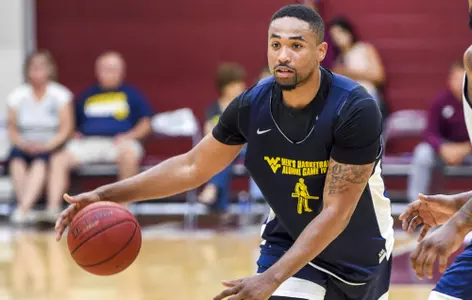
Photo by: All Pro Photography/Dale Sparks
Still Hooping, Butler Waits for the Right Call
June 18, 2018 04:59 PM | Men's Basketball, Blog
MORGANTOWN, W.Va. - Da'Sean Butler is spending another summer in Morgantown waiting for the right phone call informing him where he is going to be spending the rest of this year.
Whenever that call comes, he's pretty sure it's going to be taking him out of the country once again.
Ever since leading West Virginia to the NCAA Final Four in 2010 - and then seriously injuring his knee once he got there - Butler's basketball career has taken him to such faraway places as Aalstar, Belgium, Reims, France and Ulm, Germany.
In between was a year-long stop in Austin, Texas, playing for the San Antonio Spurs' D-League team and another year in Morgantown working as Bob Huggins' graduate assistant coach while recovering from a second serious knee injury.
"I had a blast that year," Butler recalled recently before taking part in Huggins' annual fantasy camp.
Perhaps so, but a year as a GA, a year of D-League basketball and three different trips across the pond is not what most of us had envisioned Butler's post-WVU career to be. That's particularly true given the way he played during his brilliant senior season in 2010 when he averaged 17.2 points per game and earned John Wooden All-America honors.
Who can ever forget what he did that season?
Four times Butler hit game-winning shots, two of those coming in the BIG EAST Tournament to give West Virginia its only hoop title in the 16 years the Mountaineers participated in the league.
He also made a game-winning 3 with 2.3 seconds left to defeat Marquette and a length-of-the-floor driving basket with 1.2 seconds remaining to keep Cleveland State from upsetting the Mountaineers during the regular season.
Someone once told me that Butler called his game-winner against Marquette, one of his patented length-of-the-floor basketball displays that required a couple of changes of direction before spinning back to his shooting hand for a fadeaway 3 with a hand in his face - not exactly the easiest shot to make at the park, let alone during a high-pressure BIG EAST game in front of 14,000 fans at the WVU Coliseum.
"Whatever people told you happened, happened," Butler laughed. "I don't want to ruin their stories."
As for his game-winner to beat Georgetown, Butler maneuvered through a couple of Hoya players before passing up a chance to dump the ball off to teammate Deniz Kilicli underneath the rim to hit the go-head basket with 4.6 seconds left.
He's watched that play about a hundred times since on Youtube, and he admits he still doesn't see Kilicli standing wide open in front of him.
"I remember he told me and I was like, 'Oh really?'" Butler joked. "I look at it from time to time when people play it and I still don't see it. Are you kidding me? He brings it up all of the time, 'Hey, you could have passed the ball to me.' I tell him, 'To be honest, we needed the shot.' Deniz is a good dude, though."
Butler's game-winner against Georgetown goes down as one of the most important individual plays in the 114-year history of Mountaineer basketball, and his All-America performance in leading WVU to just its second Final Four appearance in school history is enough to put his face on West Virginia's hoop Mount Rushmore along with the likes of West, Hundley and Thorn.
His team-high 18 points, all from 3, helped West Virginia upset No. 1-seeded Kentucky in the East Regional finals in Syracuse, New York.
That was the Wildcat team that had the No. 1 (John Wall), No. 5 (DeMarcus Cousins), No. 14 (Patrick Patterson), No. 18 (Eric Bledsoe) and No. 29 (Daniel Orton) picks in the first round of the NBA Draft, which should have been the equivalent of the Gas-House Gorillas doing the conga line against the Tea Totallers in that old Bugs Bunny cartoon.
Considering the circumstances, it was probably the most unlikely victory in school history and the greatest by a West Virginia team playing a game without a guy named West in the lineup.
So, after beating Kentucky anything seemed possible, including a victory a week later against Duke in the national semifinals in Indianapolis. And even when West Virginia was trailing the Blue Devils by 15 points with less than nine minutes remaining, there was still hope of another comeback victory because Da'Sean Butler was on the floor.
But then, as he was dribbling toward the basket to take a medium-range jump shot Butler ran into Duke's 7-foot center Brian Zoubek and went crashing to the ground in agony, his left knee ligament torn in pieces. When Huggins walked out onto the floor and then got down on his knees to comfort his star player, it was clear to everyone that another Da'Sean Butler miracle was not going to happen.
The sight of Huggins caressing Butler's forehead and whispering in his ear is forever in the minds of college basketball fans who witnessed it there or on national television. He had been there once before to comfort Kenyon Martin when his broken leg in the 2000 Conference USA Tournament ended his season and Cincinnati's national title hopes.
For Butler, it was a moment that changed his basketball career forever.
He was never the most athletic person on the floor before the injury, but he was still nimble enough at 6-feet-7 inches tall to get past players his own size or strong enough to overpower players smaller than him.
Then a year later, another serious knee injury playing for the Austin Toros completely wiped out his 2013 season. Those two knee injuries within a span of two seasons more than six years ago left scars that will never go away.
"I tried my best to come back from it, and I actually found a place where I could come back to rehab, relax and get my thoughts in order during my GA year to see what I wanted to do," Butler recalled. "I loved to coach, but I like to play a little bit more. I had a kid and I wanted to make a little more money so I decided to rehab, get stronger and try and get my game together and go play."
First it was off to Belgium, and then to France and, most recently, to Germany for the last three years.
His best year as a professional came in 2014 when he averaged 16.2 points, 4.3 rebounds and 1.2 assists in 48 games in Belgium. Last year, playing just 23 games in Ulm, Germany, the forward averaged 10.3 points per game, including an 11 points per game average in 10 Eurocup games.
All six professional seasons have seen him average double figures, including an 11.1 average in 37 D-League games in 2012, making what he's done a success by any measure. But for Butler, there will always be an element of what if?
What if he hadn't gotten hurt against Duke? What would have happened in the last nine minutes of that game?
 What if he hadn't gotten hurt a second time, would he have made it to the league and had a lot more money in his pocket today? The Miami Heat thought enough of him following his first knee injury to use its second-round pick on him in the draft. Some might consider it a compassionate decision, but the Heat is not in the business of taking on charity cases.
Butler said he wanted to give professional basketball his best shot to at least try and answer some of those lingering questions.
"I just didn't want to go out on terms where I wasn't playing well or I wasn't happy with the way I played," he said. "I went to the D-League and I got hurt and I didn't want that to be the end of the story … 'He could of played but he just got hurt.' So I continued to play, and I enjoy it."
And he still continues to play.
Butler is in town right now staying in shape, waiting for another call from his agent for a place to go. Playing, even if it's at only at half the way he once could play, is still far better than wondering.
What he has lost in footspeed, jumping ability and agility he's made up for in knowledge - which has always been a big part of his game anyway.
"I felt I was always a smart player, but I feel like I've become a little bit smarter to make up for the … I was already lacking in athleticism, but it was a little bit worse after the injury," Butler admitted. "I've learned what I can and can't do against more explosive, grown men as opposed to 18, 19-year-old kids.
"I've been doing this for a long time, regardless of injury, so I know how to maneuver and work my way around a game. And if I'm playing bad, I know enough to stay out of the way."
So, he continues to play. He continues to wait for that next call to play for another team, perhaps in yet another faraway country. Wherever he goes, he's fortunate enough to be able take his two young boys with him when the right call comes.
"It can by any time," Butler said. "I've gotten offers already, but nothing that I want to do at this moment."
Whenever that call comes, he's pretty sure it's going to be taking him out of the country once again.
Ever since leading West Virginia to the NCAA Final Four in 2010 - and then seriously injuring his knee once he got there - Butler's basketball career has taken him to such faraway places as Aalstar, Belgium, Reims, France and Ulm, Germany.
In between was a year-long stop in Austin, Texas, playing for the San Antonio Spurs' D-League team and another year in Morgantown working as Bob Huggins' graduate assistant coach while recovering from a second serious knee injury.
"I had a blast that year," Butler recalled recently before taking part in Huggins' annual fantasy camp.
Perhaps so, but a year as a GA, a year of D-League basketball and three different trips across the pond is not what most of us had envisioned Butler's post-WVU career to be. That's particularly true given the way he played during his brilliant senior season in 2010 when he averaged 17.2 points per game and earned John Wooden All-America honors.
Who can ever forget what he did that season?
Four times Butler hit game-winning shots, two of those coming in the BIG EAST Tournament to give West Virginia its only hoop title in the 16 years the Mountaineers participated in the league.
He also made a game-winning 3 with 2.3 seconds left to defeat Marquette and a length-of-the-floor driving basket with 1.2 seconds remaining to keep Cleveland State from upsetting the Mountaineers during the regular season.
Someone once told me that Butler called his game-winner against Marquette, one of his patented length-of-the-floor basketball displays that required a couple of changes of direction before spinning back to his shooting hand for a fadeaway 3 with a hand in his face - not exactly the easiest shot to make at the park, let alone during a high-pressure BIG EAST game in front of 14,000 fans at the WVU Coliseum.
"Whatever people told you happened, happened," Butler laughed. "I don't want to ruin their stories."
As for his game-winner to beat Georgetown, Butler maneuvered through a couple of Hoya players before passing up a chance to dump the ball off to teammate Deniz Kilicli underneath the rim to hit the go-head basket with 4.6 seconds left.
He's watched that play about a hundred times since on Youtube, and he admits he still doesn't see Kilicli standing wide open in front of him.
"I remember he told me and I was like, 'Oh really?'" Butler joked. "I look at it from time to time when people play it and I still don't see it. Are you kidding me? He brings it up all of the time, 'Hey, you could have passed the ball to me.' I tell him, 'To be honest, we needed the shot.' Deniz is a good dude, though."
Butler's game-winner against Georgetown goes down as one of the most important individual plays in the 114-year history of Mountaineer basketball, and his All-America performance in leading WVU to just its second Final Four appearance in school history is enough to put his face on West Virginia's hoop Mount Rushmore along with the likes of West, Hundley and Thorn.
His team-high 18 points, all from 3, helped West Virginia upset No. 1-seeded Kentucky in the East Regional finals in Syracuse, New York.
That was the Wildcat team that had the No. 1 (John Wall), No. 5 (DeMarcus Cousins), No. 14 (Patrick Patterson), No. 18 (Eric Bledsoe) and No. 29 (Daniel Orton) picks in the first round of the NBA Draft, which should have been the equivalent of the Gas-House Gorillas doing the conga line against the Tea Totallers in that old Bugs Bunny cartoon.
Considering the circumstances, it was probably the most unlikely victory in school history and the greatest by a West Virginia team playing a game without a guy named West in the lineup.
So, after beating Kentucky anything seemed possible, including a victory a week later against Duke in the national semifinals in Indianapolis. And even when West Virginia was trailing the Blue Devils by 15 points with less than nine minutes remaining, there was still hope of another comeback victory because Da'Sean Butler was on the floor.
But then, as he was dribbling toward the basket to take a medium-range jump shot Butler ran into Duke's 7-foot center Brian Zoubek and went crashing to the ground in agony, his left knee ligament torn in pieces. When Huggins walked out onto the floor and then got down on his knees to comfort his star player, it was clear to everyone that another Da'Sean Butler miracle was not going to happen.
The sight of Huggins caressing Butler's forehead and whispering in his ear is forever in the minds of college basketball fans who witnessed it there or on national television. He had been there once before to comfort Kenyon Martin when his broken leg in the 2000 Conference USA Tournament ended his season and Cincinnati's national title hopes.
For Butler, it was a moment that changed his basketball career forever.
He was never the most athletic person on the floor before the injury, but he was still nimble enough at 6-feet-7 inches tall to get past players his own size or strong enough to overpower players smaller than him.
Then a year later, another serious knee injury playing for the Austin Toros completely wiped out his 2013 season. Those two knee injuries within a span of two seasons more than six years ago left scars that will never go away.
"I tried my best to come back from it, and I actually found a place where I could come back to rehab, relax and get my thoughts in order during my GA year to see what I wanted to do," Butler recalled. "I loved to coach, but I like to play a little bit more. I had a kid and I wanted to make a little more money so I decided to rehab, get stronger and try and get my game together and go play."
First it was off to Belgium, and then to France and, most recently, to Germany for the last three years.
His best year as a professional came in 2014 when he averaged 16.2 points, 4.3 rebounds and 1.2 assists in 48 games in Belgium. Last year, playing just 23 games in Ulm, Germany, the forward averaged 10.3 points per game, including an 11 points per game average in 10 Eurocup games.
All six professional seasons have seen him average double figures, including an 11.1 average in 37 D-League games in 2012, making what he's done a success by any measure. But for Butler, there will always be an element of what if?
What if he hadn't gotten hurt against Duke? What would have happened in the last nine minutes of that game?
What if he hadn't gotten hurt a second time, would he have made it to the league and had a lot more money in his pocket today? The Miami Heat thought enough of him following his first knee injury to use its second-round pick on him in the draft. Some might consider it a compassionate decision, but the Heat is not in the business of taking on charity cases.Butler said he wanted to give professional basketball his best shot to at least try and answer some of those lingering questions.
"I just didn't want to go out on terms where I wasn't playing well or I wasn't happy with the way I played," he said. "I went to the D-League and I got hurt and I didn't want that to be the end of the story … 'He could of played but he just got hurt.' So I continued to play, and I enjoy it."
And he still continues to play.
Butler is in town right now staying in shape, waiting for another call from his agent for a place to go. Playing, even if it's at only at half the way he once could play, is still far better than wondering.
What he has lost in footspeed, jumping ability and agility he's made up for in knowledge - which has always been a big part of his game anyway.
"I felt I was always a smart player, but I feel like I've become a little bit smarter to make up for the … I was already lacking in athleticism, but it was a little bit worse after the injury," Butler admitted. "I've learned what I can and can't do against more explosive, grown men as opposed to 18, 19-year-old kids.
"I've been doing this for a long time, regardless of injury, so I know how to maneuver and work my way around a game. And if I'm playing bad, I know enough to stay out of the way."
So, he continues to play. He continues to wait for that next call to play for another team, perhaps in yet another faraway country. Wherever he goes, he's fortunate enough to be able take his two young boys with him when the right call comes.
"It can by any time," Butler said. "I've gotten offers already, but nothing that I want to do at this moment."

College Basketball Crown Recap
Thursday, April 16
Ross Hodge, Honor Huff & Brenen Lorient | Oklahoma Postgame
Sunday, April 05
Ross Hodge, Treysen Eaglestaff & Brenen Lorient | Creighton Postgame
Saturday, April 04
Ross Hodge & Honor Huff | Stanford Postgame
Thursday, April 02