Photo by: WVU Athletic Communications
Mountaineers Looking To Add to Their Madison Square Garden Legacy
December 03, 2018 03:31 PM | Men's Basketball, Blog
MORGANTOWN, W.Va. – When the late Eddie Barrett was West Virginia University's wet-behind-the-ears, 21-year-old basketball publicist – that's what they used to be called – he once held court in front of a horde of sportswriters from New York City's seven biggest daily newspapers.
This happened moments after West Virginia had knocked off sixth-ranked NYU by 25 points in 1952 in front of about 10,000 bewildered college basketball fans/gamblers/bookies at the old Madison Square Garden.
The Daily News' Dick Young, who had a reputation for being one of the city's more abrasive sports scribes, paid Barrett's employer a very tall compliment.
"West Virginia and Kentucky have the two best reputations in college basketball," Young told Barrett, a statement that stuck with Eddie for the rest of his life.
In the early 1950s, as it still is today, reputations can be made at Madison Square Garden.
Conquer the Garden and you can conquer the world.
That's what the late Roy "Legs" Hawley set out to do in 1942 when he practically begged famous New York City promoter Ned Irish to take Dyke Raese's West Virginia University basketball team to play in his National Invitation Tournament.
Hawley wore Irish down to the point where he finally relented, and Raese's last-seeded Mountaineers stunned the nation by upsetting Long Island, Toledo and Western Kentucky to win what was then-considered the national championship.
Those three basketball games at Madison Square Garden completely transformed West Virginia University basketball. For one, the school began giving out scholarships for the first time ever and, more importantly, young kids in West Virginia, listening to those NIT games on the radio, started nailing baskets to sycamore trees out in their backyards and began playing the sport.
By the late 1940s and into the 1950s, the Mountain State was developing some of the best basketball players in the country – big-name guys such as George King, Hot Rod Hundley, Jerry West, Hal Greer and Rod Thorn.
The goal for most of them was to play basketball at the University and one day go to Madison Square Garden and do what Raese's '42 team did.
And Hawley did whatever he could to make sure they got there.
Whenever Legs went to New York City for basketball meetings, his most important piece of luggage was a small briefcase that contained just one item – a full bottle of scotch. Once that bottle of scotch was done, so were the deals.
West Virginia played at least one college basketball game at Madison Square Garden each year from 1942 until 1963 as the Mountaineers enhanced their national brand, an overused term we now hear so much these days.
Scotty Hamilton, Leland Byrd and Mark Workman became All-Americans based mainly on their outstanding performances at Madison Square Garden.
Hamilton, a pudgy 5-foot-10-inch guard who was as wide as he was tall, became a New York City fan favorite because the people there had never seen a short, fat guy play like Hamilton could.
In 1952, the New York City sportswriters began calling WVU's 6-foot-9-inch Mark Workman the "Galloping Goon from West Virginia" after his 24 points and 19 rebounds completely dismantled undefeated and sixth-ranked NYU.
After they were done making fun of Workman, they also made him an All-American.
 Hot Rod Hundley became a nationally known figure once the New York City writers caught wind of his antics and great sense of humor. Those guys were always looking for characters about whom to write, and there was no bigger character – before or since – than Hundley.
Jerry West was so admired by the Big Apple scribes because of his grit, determination and will to win, and his supporting cast of players at WVU was just as tough, if not quite as talented as West was.
"Nothing ever bothered Bucky (Bolyard), Ronnie Retton, Bobby Joe Smith, Jimmy Ritchie, Lloyd Sharrar or Don Vincent," West Virginia coach Fred Schaus once marveled. "They just went out and played hard; I don't think the bright lights bothered them at all.
"The only thing I used to tell them about going into New York City was to get off your feet," the late Schaus added. "Those were the hardest sidewalks in the world. If they're walking too far and they're looking up at the tall buildings, they leave the best part of their game on the street."
That rarely ever happened, except for once in 1958 when top-ranked West Virginia was unceremoniously knocked out of the NCAA Tournament by unranked Manhattan 89-84.
UMBC's victory over No. 1-seeded Virginia in last year's Big Dance may be considered the greatest upset victory in NCAA Tournament history, but that WVU loss to Manhattan at Madison Square Garden in 1958 was easily one of the biggest tournament upsets of that era.
The following year, West Virginia exorcised that demon by defeating Dartmouth 82-68 at MSG to grease its path to the NCAA Tournament finals in Louisville, Kentucky.
WVU continued to play games in the Garden through 1963 until the program began to decline following the graduation of Rod Thorn. West Virginia didn't play there in 1964 or 1965, and lost badly to NYU in the Garden in 1966 to begin a 13-game Garden losing streak over the next 25 years.
It finally ended in 1997 when West Virginia knocked off Seton Hall in the first round of the Big East Tournament.
Then, the Madison Square Garden Magic returned in 2005 when John Beilein led West Virginia to upset victories over seventh-ranked Boston College and 19th-ranked Villanova to reach the Big East tournament finals.
For some Garden old-timers, WVU's 3-point shooting center Kevin Pittsnogle brought back memories of the old "Galloping Goon from West Virginia" - Mark Workman.
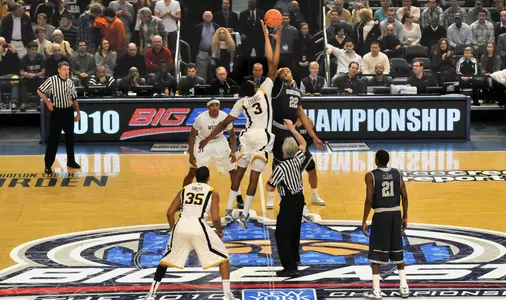
Four years later, Bob Huggins' Mountaineers upset second-ranked Pitt in a 2009 Big East tournament game at the Garden, and a year after that, he used a team full of metropolitan New York City players such as Da'Sean Butler, Wellington Smith, Devin Ebanks, Truck Bryant and Kevin Jones to win the school's only Big East tournament championship in 2010.
 Hearing "Take Me Home, Country Roads" played in the World's Most Famous Basketball Arena while the Mountaineer players celebrated their Big East championship on the floor remains one of the school's most heart-warming moments.
A picture of that West Virginia team rests on the wall at Harrington's, located on Seventh Avenue right across the street from the hotel where the Mountaineers always stay when they play in New York City.
It's where West Virginians will go to in the city before WVU faces Florida tomorrow night at Madison Square Garden in this year's Jimmy V Classic.
"They're great people in there," Huggins said. "They have treated West Virginia people terrifically when West Virginia people go in there – and they go in there a lot. They've got all of the pictures of New York sports teams up there and the only one that's not a New York sports team is a picture of us in the Big East tournament.
"You can't find one of those in P.J. Clarke's," he added.
Tomorrow night's game against the Gators will be West Virginia's 88thappearance at the World's Most Famous Basketball Arena, and its 18th since Bob Huggins' return to WVU in 2008.
Like Legs Hawley so many years ago, Huggins has always revered the great history and tradition of Madison Square Garden.
"It's pretty neat when you go in and you think about the history," he said. "The games that have been there, the players that were there and the people you played in front of. And more national media than you've ever been in front of.
"When you walk into the building and you get into that elevator and they have just had some elephants in there from the circus or sometimes you get on there and they're taking the trash out …," he continued, "and then it opens up into the most famous basketball arena in the world."
It's a place where great reputations are often made.
This happened moments after West Virginia had knocked off sixth-ranked NYU by 25 points in 1952 in front of about 10,000 bewildered college basketball fans/gamblers/bookies at the old Madison Square Garden.
The Daily News' Dick Young, who had a reputation for being one of the city's more abrasive sports scribes, paid Barrett's employer a very tall compliment.
"West Virginia and Kentucky have the two best reputations in college basketball," Young told Barrett, a statement that stuck with Eddie for the rest of his life.
In the early 1950s, as it still is today, reputations can be made at Madison Square Garden.
Conquer the Garden and you can conquer the world.
That's what the late Roy "Legs" Hawley set out to do in 1942 when he practically begged famous New York City promoter Ned Irish to take Dyke Raese's West Virginia University basketball team to play in his National Invitation Tournament.
Hawley wore Irish down to the point where he finally relented, and Raese's last-seeded Mountaineers stunned the nation by upsetting Long Island, Toledo and Western Kentucky to win what was then-considered the national championship.
Those three basketball games at Madison Square Garden completely transformed West Virginia University basketball. For one, the school began giving out scholarships for the first time ever and, more importantly, young kids in West Virginia, listening to those NIT games on the radio, started nailing baskets to sycamore trees out in their backyards and began playing the sport.
By the late 1940s and into the 1950s, the Mountain State was developing some of the best basketball players in the country – big-name guys such as George King, Hot Rod Hundley, Jerry West, Hal Greer and Rod Thorn.
The goal for most of them was to play basketball at the University and one day go to Madison Square Garden and do what Raese's '42 team did.
And Hawley did whatever he could to make sure they got there.
Whenever Legs went to New York City for basketball meetings, his most important piece of luggage was a small briefcase that contained just one item – a full bottle of scotch. Once that bottle of scotch was done, so were the deals.
West Virginia played at least one college basketball game at Madison Square Garden each year from 1942 until 1963 as the Mountaineers enhanced their national brand, an overused term we now hear so much these days.
Scotty Hamilton, Leland Byrd and Mark Workman became All-Americans based mainly on their outstanding performances at Madison Square Garden.
Hamilton, a pudgy 5-foot-10-inch guard who was as wide as he was tall, became a New York City fan favorite because the people there had never seen a short, fat guy play like Hamilton could.
In 1952, the New York City sportswriters began calling WVU's 6-foot-9-inch Mark Workman the "Galloping Goon from West Virginia" after his 24 points and 19 rebounds completely dismantled undefeated and sixth-ranked NYU.
After they were done making fun of Workman, they also made him an All-American.
Hot Rod Hundley became a nationally known figure once the New York City writers caught wind of his antics and great sense of humor. Those guys were always looking for characters about whom to write, and there was no bigger character – before or since – than Hundley.Jerry West was so admired by the Big Apple scribes because of his grit, determination and will to win, and his supporting cast of players at WVU was just as tough, if not quite as talented as West was.
"Nothing ever bothered Bucky (Bolyard), Ronnie Retton, Bobby Joe Smith, Jimmy Ritchie, Lloyd Sharrar or Don Vincent," West Virginia coach Fred Schaus once marveled. "They just went out and played hard; I don't think the bright lights bothered them at all.
"The only thing I used to tell them about going into New York City was to get off your feet," the late Schaus added. "Those were the hardest sidewalks in the world. If they're walking too far and they're looking up at the tall buildings, they leave the best part of their game on the street."
That rarely ever happened, except for once in 1958 when top-ranked West Virginia was unceremoniously knocked out of the NCAA Tournament by unranked Manhattan 89-84.
UMBC's victory over No. 1-seeded Virginia in last year's Big Dance may be considered the greatest upset victory in NCAA Tournament history, but that WVU loss to Manhattan at Madison Square Garden in 1958 was easily one of the biggest tournament upsets of that era.
The following year, West Virginia exorcised that demon by defeating Dartmouth 82-68 at MSG to grease its path to the NCAA Tournament finals in Louisville, Kentucky.
WVU continued to play games in the Garden through 1963 until the program began to decline following the graduation of Rod Thorn. West Virginia didn't play there in 1964 or 1965, and lost badly to NYU in the Garden in 1966 to begin a 13-game Garden losing streak over the next 25 years.
It finally ended in 1997 when West Virginia knocked off Seton Hall in the first round of the Big East Tournament.
Then, the Madison Square Garden Magic returned in 2005 when John Beilein led West Virginia to upset victories over seventh-ranked Boston College and 19th-ranked Villanova to reach the Big East tournament finals.
For some Garden old-timers, WVU's 3-point shooting center Kevin Pittsnogle brought back memories of the old "Galloping Goon from West Virginia" - Mark Workman.
Four years later, Bob Huggins' Mountaineers upset second-ranked Pitt in a 2009 Big East tournament game at the Garden, and a year after that, he used a team full of metropolitan New York City players such as Da'Sean Butler, Wellington Smith, Devin Ebanks, Truck Bryant and Kevin Jones to win the school's only Big East tournament championship in 2010.
Hearing "Take Me Home, Country Roads" played in the World's Most Famous Basketball Arena while the Mountaineer players celebrated their Big East championship on the floor remains one of the school's most heart-warming moments.A picture of that West Virginia team rests on the wall at Harrington's, located on Seventh Avenue right across the street from the hotel where the Mountaineers always stay when they play in New York City.
It's where West Virginians will go to in the city before WVU faces Florida tomorrow night at Madison Square Garden in this year's Jimmy V Classic.
"They're great people in there," Huggins said. "They have treated West Virginia people terrifically when West Virginia people go in there – and they go in there a lot. They've got all of the pictures of New York sports teams up there and the only one that's not a New York sports team is a picture of us in the Big East tournament.
"You can't find one of those in P.J. Clarke's," he added.
Tomorrow night's game against the Gators will be West Virginia's 88thappearance at the World's Most Famous Basketball Arena, and its 18th since Bob Huggins' return to WVU in 2008.
Like Legs Hawley so many years ago, Huggins has always revered the great history and tradition of Madison Square Garden.
"It's pretty neat when you go in and you think about the history," he said. "The games that have been there, the players that were there and the people you played in front of. And more national media than you've ever been in front of.
"When you walk into the building and you get into that elevator and they have just had some elephants in there from the circus or sometimes you get on there and they're taking the trash out …," he continued, "and then it opens up into the most famous basketball arena in the world."
It's a place where great reputations are often made.
Ross Hodge, Honor Huff & Brenen Lorient | Oklahoma Postgame
Sunday, April 05
Ross Hodge, Treysen Eaglestaff & Brenen Lorient | Creighton Postgame
Saturday, April 04
Ross Hodge & Honor Huff | Stanford Postgame
Thursday, April 02
Ross Hodge | College Basketball Crown Preview
Monday, March 30