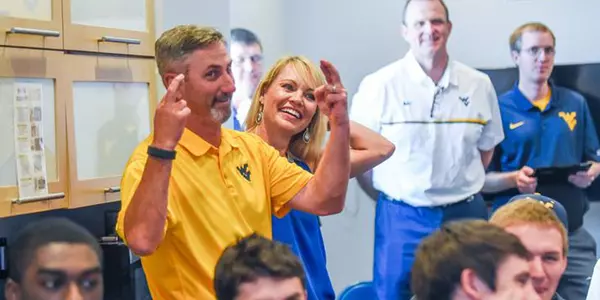
Mazey-Main-6117.jpg
The Bar Has Now Been Raised for WVU Baseball
June 01, 2017 01:40 PM | Baseball
MORGANTOWN, W.Va. - Randy Mazey had a tough time fighting back tears when he addressed the media after learning on Monday afternoon that his West Virginia University baseball team was invited to play in the NCAA Tournament for the first time since Bill Clinton was president.
The last time it happened was in 1996 - five years before 9-11.
Twenty-one years is an awful long time between NCAA Tournament appearances for a school with West Virginia University’s pedigree, and although Mazey has only been around here since 2013, he is the one who had to do the explaining when impressionable young recruits asked him why it has taken so long to get back.
So, why did it take so long?
“If you look back at some of the programs that go to Omaha consistently, when they made the decision as a University to be good at baseball, they became good at baseball,” Mazey explained.
The decision to become good in baseball at West Virginia University came to a head in 2012 when it joined the Big 12 Conference. It was either sink or swim.
Then, a year later, construction began on a new, $21 million ballpark at the University Town Centre that was dedicated in 2015. Building that ballpark was the seminal moment in the program’s history.
Sure, a new stadium translating into on-field success is not guaranteed, but there are plenty of examples where the two have intersected. Mazey touched on some of them Monday afternoon.
“It didn’t happen at the Vanderbilts and the Virginias until they hired new staffs and built new facilities,” he said.
“Part of it is the changing of our home field,” added senior first baseman Jackson Cramer, who took a leap of faith by traveling from his native Coppell, Texas, to play college baseball in Morgantown, West Virginia. “That helped a lot with recruiting.”
I used to subscribe to the climate theory of college baseball, which meant fielding a baseball team north of the Mason-Dixon Line was basically an exercise in futility.
Then I saw what happened at Notre Dame in 2002 when the Fighting Irish made the College World Series playing in the same conference as the Mountaineers.
But when it happened in 2012 at Kent State and Stony Brook (of all places), my mind was completely changed. College baseball programs can be successful anywhere if the right commitment is made.
Louisville and Virginia play in essentially the same climates as Morgantown, and those two baseball programs have exploded in the last 10 years.
After the construction of Virginia’s 5,000-seat Davenport Field in 2002, it took the Cavaliers seven years to reach their first College World Series in 2009. The Cavs have made it back to Omaha three times since then in 2011, 2014 and 2015.
Louisville broke ground on 4,000-seat Jim Patterson Stadium in 2004 and three years later, the Cards made their first trip to the College World Series in 2007. Louisville returned in 2013 and 2014, and it has a good chance of getting back to Omaha this season.
Soon after Oliver Luck became WVU athletic director in 2010, he brought in a blue-ribbon panel of former college coaches, players, administrators, professional baseball executives and Mountaineer Athletic Club contributors to discuss the future of Mountaineer baseball.
Out of those meetings came the unanimous decision to build a new ballpark. Hawley Field, they determined, simply was not going to cut it no matter what was done to it.
So, when West Virginia joined the Big 12, Luck made a major commitment to WVU baseball - a commitment current director of athletics Shane Lyons has continued.
Certainly, having an extra $20 million or more per year in conference revenue sharing helps, but still it takes courage and vision to stick your neck out there and spend some of it on college baseball.
Lyons was with the team early Monday afternoon when it learned its postseason fate, and afterward, he took a few minutes to congratulate the Mountaineers on their tremendous accomplishment.
These guys were so close in 2014 when they finished the season with an RPI of 38 and were one of the last teams out, and they were so close once again last year when they made it to the Big 12 championship game before falling in extra innings to TCU, which, by the way, ended up making it to Omaha.
Another win or two during the regular season would have gotten the Mountaineers over the top. This spring it finally happened.
“Seeing our name pop up, that’s one of the best feelings I’ve had in my life knowing we worked so hard and fought through so much adversity to get to this point of being the first team in the history of the program to earn an at-large bid to a regional,” senior pitcher Jackson Sigman said.
Shortstop Jimmy Galusky, from nearby Arthurdale, West Virginia, grew up following Mountaineer sports - especially West Virginia University baseball because his uncle Ernie was once an assistant coach for the team and has remained involved in local youth baseball.
Galusky admitted it is difficult to put into words what reaching a regional means to him.
“I’m kind of the guy out there that everybody watches now so it’s kind of a big deal to me,” he said.
Senior pitcher B.J. Myers credits Mazey’s “family-type atmosphere” for helping the players achieve their No. 1 preseason goal of reaching the national tournament.
“There are no stragglers; we’re all in this together,” Myers said. “They’ve built it from the ground up. When we got here we weren’t very good, and now we’re playing in the postseason.”
Mazey said he knew this day was coming, he just wasn’t sure when. Even Monday morning, after winning two games at the Big 12 championship against Baylor and third-ranked Texas Tech, he kept his fingers crossed until he saw West Virginia finally come up on the screen.
“We were teased the last couple of years because we thought we had a chance to get in but didn’t,” he said. “That was frustrating.
“It’s frustrating at times when you have to be super-patient when you don’t want to be, but, realistically, looking back on it, this is the timeline when it should have been,” he added. “I think we got so good so early that we kind of messed with that timeline a little bit, but in our fifth season to get where we came from before our first season when we joined the Big 12, it looks like we are right on track.”
For Cramer, he said the bar for WVU baseball has now been raised.
“They’ve got to keep changing the culture and continue to bring in better players every year and hopefully you can expect to see West Virginia in the postseason every year,” Cramer said.
Why not?
West Virginia University has made a commitment to fielding a first-class college baseball program, and now it is finally beginning to reap the rewards of that decision.
Steve Sabins | April 14
Tuesday, April 14
Coal Rush Baseball Uniform Reveal
Wednesday, March 11
Steve Sabins | Feb. 16
Monday, February 16
Matthew Graveline | Feb. 16
Monday, February 16