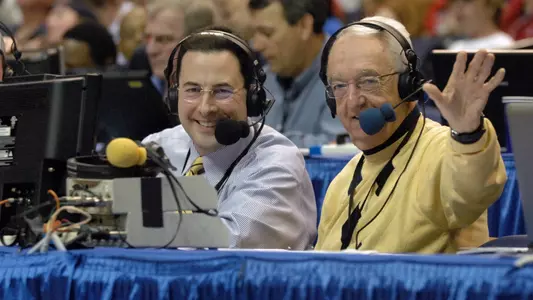
Last Call: Jacobs to Take One Final Turn Behind the Mic on Saturday
February 01, 2024 02:43 PM | Men's Basketball, Blog
MORGANTOWN, W.Va. – Jay Jacobs became a college basketball analyst almost by accident.
The way he remembers it, Paul Miller, in charge of broadcasting for West Virginia University Athletics in the mid-1970s, was in the Baltimore area for some sort of University function and happened to see Jacobs on television working a local high school broadcast.
Miller, wanting to expand the television network and needing a basketball analyst to work with local TV personality Woody O’Hara, called Jacobs and asked him if he could send him a tape.
Jacobs, recalling the conversation years later, wasn’t sure what Miller meant.
“Well, Paul, I probably have some Scotch tape sitting around the house somewhere. I will ask my wife Bonnie if she can find some,” Jacobs joked.
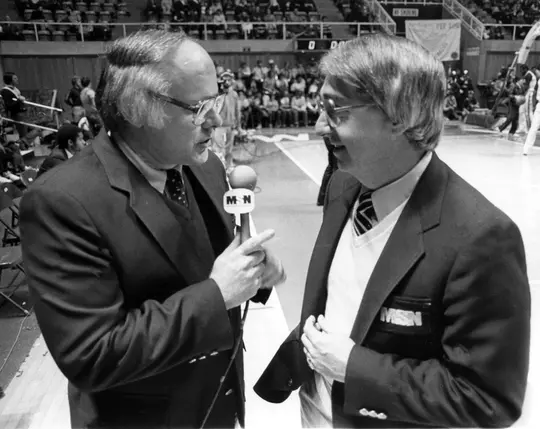
Of course, Miller was looking for a demo tape of the high school broadcasts Jacobs worked. Born out of that was a nearly 50-year career for Jacobs broadcasting WVU men’s and women’s basketball games for the Mountaineer Sports Network, ending with last year’s NCAA Tournament loss to Maryland.
Jacobs, a Morgantown High graduate who played with Jerry West during the Golden Era of Mountaineer basketball, grew up at the old Field House watching every All-American player from Mark Workman on.
He said his first game at the Field House was with his father when he was just six, but he can barely remember it. He does remember sneaking into the arena for one game, falling through the roof and landing right in the middle of Duke’s pregame meeting a floor below. Security was ready to usher him out of the building until Duke coach Vic Bubas told them to let him go.
His Mountaineer playing career consisted of the crucial role of making sure star players West, Willie Akers and Bobby Joe Smith didn’t catch a cold whenever they came out of the game and were sitting on the bench. There was a strong draft of cold air that came through the back of the Field House, and it was Jacobs’ job to sit at the end of the bench and block it, so the good players didn’t get sick.
The one occasion when coach Fred Schaus ordered him to go into the game, Jacobs refused. He didn’t think he was going to play, because he never did, and he wasn’t wearing any shorts underneath his warmup pants.
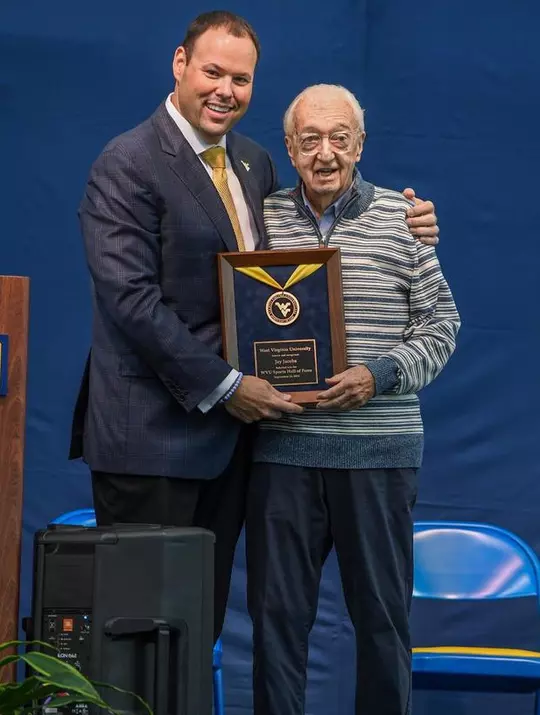
More than 60 years later, this guy was inducted into the WVU Sports Hall of Fame!
“When Wren Baker called to tell me, I thought it was some sort of prank,” Jacobs laughed.
After coaching boys basketball in West Virginia and then in Frederick, Maryland, Jacobs transitioned to an administrative position in the Frederick County school system, which afforded him the opportunity to explore his broadcasting career.
For the first 20 years or so, Jacobs did solely television, working mostly with O’Hara, and then Jack Fleming on split radio-television broadcasts - a common practice in the late 1970s and 1980s. What that entailed was Jacobs and O’Hara on television for the first half and then Fleming and O’Hara switching at halftime. Jacobs would call the second half on television with Fleming.
Most of the time, the transition worked seamlessly.
Most of the time.
At Cassell Coliseum, where Virginia Tech plays, the broadcast position for radio was at the top of the arena, meaning to transition to television, Fleming had to walk down to the floor through the crowd to get to the broadcast location courtside.
Well, the night before the game, Fleming practiced getting from the radio broadcast position down to the floor and had Jacobs time his trek using a stopwatch. They did this a couple of times and calculated that it took Fleming approximately two minutes to get from the top of the arena down to the floor.
“Even though Jack was pretty big and wasn't in great shape, we determined it took him about two to two-and-a-half minutes to get down there,” Jacobs recalled. “The only problem was we forgot that there were 10,000 people in the arena the next day.
“He never made it down in time because he got stuck in a crowd of people wanting to talk to him and so forth,” Jacobs said.
That meant Jacobs was standing down on the floor all alone waiting for Fleming to do the halftime television hit. Jay asked Nick Smith, the producer sitting in the truck, what he should do.
“’I’m not sure, Jay,’” he answered, before counting down, “FIVE, FOUR, THREE, TWO, ONE …!”
Jacobs, who didn’t have a stat sheet in hand or a monitor to look at in front of him, had to wing it. He turned around, noticed that there was a group of dancers out on the floor doing a halftime performance, and began describing it.
“Look here, I believe this is Louise from Winchester, Virginia, who is part of the routine. And this looks like Betty from Richmond. Look at those moves! Isn’t she really something?” he deadpanned.
“Oh boy, I caught hell for that one!” he admitted.
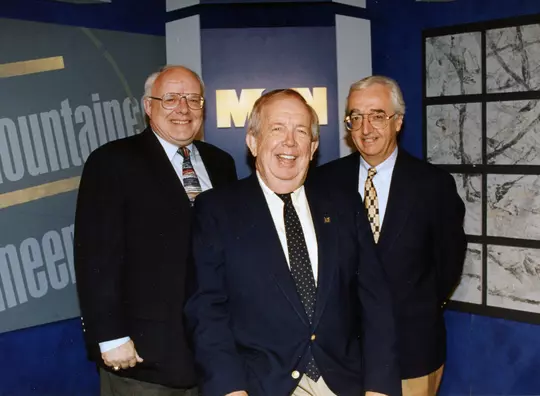
On another occasion, Jacobs, Fleming and O’Hara were working a game at Penn State’s old Rec Hall, and at halftime, Fleming decided to get something to drink. While doing so, he bumped his head on a steel beam next to their broadcast position and when he returned to the court to do his live shot, he unknowingly had a steady stream of blood coming down the side of his head.
“It was just pouring down the side of his face as if someone had stabbed him with a knife and somebody in the truck yelled, ‘For God’s sake, don’t just stand there, wipe him off, Jay!’” Jacobs said. “Fortunately, a stage manager was there, and they were able to switch to another shot and got him cleaned up.”
With Jacobs and O’Hara, the games were always fun because they made the broadcasts fun. You never quite knew what they were going to say, and there were probably times when Fleming, and later Tony Caridi, held their breath hoping it wasn’t something too far out of line.
Mostly, they didn’t, but not always.
O’Hara once got into a little bit of hot water for saying Jim Calhoun’s Connecticut Huskies were “the best team that money can buy” back during the pre-Name, Image and Likeness days.
“That was at least a two-hour meeting,” Jacobs said.
Jay was once called to the principal’s office after a comment he made during a West Virginia-Massachusetts men’s basketball broadcast that was carried on many stations throughout the Northeast.
In this case, the principal was Mike Parsons.
One of the UMass players had a severe acne problem, and when he stepped up to the free throw line during the game, Jacobs, looking at a tight shot of him in the monitor, jokingly said, “And here, folks, is your Clearasil player of the game!”
“Not a good idea,” Jay recalled, shaking his head. “I had to write 70 letters for that one – all handwritten apologies. It was just one of those things that came out and you just couldn’t bring it back in.
“The grandmother living in Brooklyn was crying, the coach’s wife got physically ill watching the game at home on television, so she caught it, called all of his relatives, and it just grew from there,” he said.
Off air, Jacobs could be equally funny.
Jacobs and Caridi worked for more than 35 years together on the radio, calling the final few years of Gale Catlett’s time at West Virginia plus the John Beilein and Bob Huggins years. Tony affectionately refers to Jay as the Silver Fox.
Caridi still chuckles recalling some of Jay’s off-air antics, such as the time they were at LaGuardia Airport in New York City waiting to take a commercial flight back to Pittsburgh.
“We’re sitting around wondering where Jacobs wandered off to and all of a sudden, somebody looks at the baggage carousel and here comes Jay sitting in one of the big plastic containers riding around it and waving to everybody,” Caridi chuckled. “He was small enough that he could fit into it.”
Another time, Tony recalled one of the athletic department staffers sitting in a bathroom stall and noticing a guy peering down at him from the adjacent stall. It was Jacobs standing on top the toilet seat.
“Hey, I’m (7-foot-6 NBA center) Shawn Bradley,” Jacobs told him.
“Jay was the king of asking questions he already knew the answer to,” Caridi laughed. “For instance, he would ask on the air, ‘Tony, is this a good free throw shooting team?’ or ‘Tony, can this team handle the ball?’ He knew. But I have to give him a lot of credit, he was always prepared.”
He was.
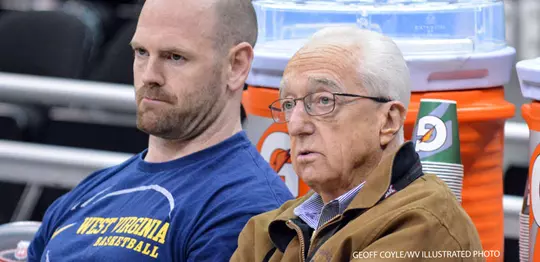
Jay read the scouting reports and religiously attended practices, so what came out on the broadcasts was basically an extension of the pregame walk throughs. If the team was playing well, he conveyed that. And if they weren’t, he conveyed that, too.
Listeners appreciated his frankness and most importantly, his sense of humor. College basketball is a serious business, for sure, but Jay somehow found a way to make the games fun, even the bad ones.
“There was never a dull moment with Jay,” Caridi pointed out.
No, there wasn’t.
For years, Jay made the 2 ½ hour drive across Interstate 68 from Frederick, Maryland, to Morgantown, West Virginia, to call basketball games and to work the Bob Huggins Radio Show. Conservatively, he estimates he’s driven that highway a couple thousand times, mostly without any issues.
Once, however, just as he was getting into a Smokey Robinson song that was playing on the classic soul station that he was listening to on satellite radio, he heard a big loud bang in the front of his car and kept driving.
When he finally pulled into his driveway in Frederick, his wife, concerned because it had taken him longer than usual to return home, met him outside and asked what was sticking out of the front grill of their car.
“Oh, honey, that’s just part of a black bear that I hit outside of Hancock,” he said.
Jay, Bonnie and other members of his family will be returning to Morgantown for this Saturday’s BYU game. After announcing his retirement from the network earlier this year, the University wanted to recognize him prior to the St. John’s game back in December, but unforeseen circumstances forced him to cancel.
But now the celebration is back on for this Saturday and the plan is for Jay to broadcast the entire BYU game, beginning with a half hour on the pregame show reminiscing with Caridi and studio host David Kahn. He will remain on to do a normal game broadcast, just like old times, and then will visit with old friends and colleagues afterward in Club 35.
To and from Morgantown, Jay said he is handing over the car keys to his grandson, Jordan. This time, he will be sitting up front in the passenger seat on the lookout for deer and bears.
And listening to some Smokey Robinson.