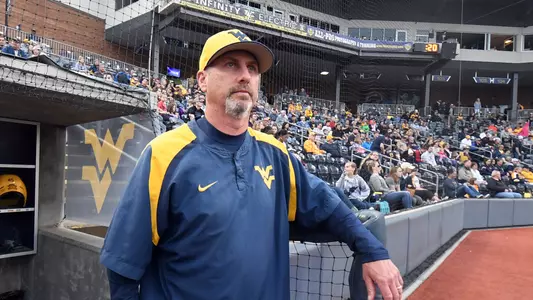
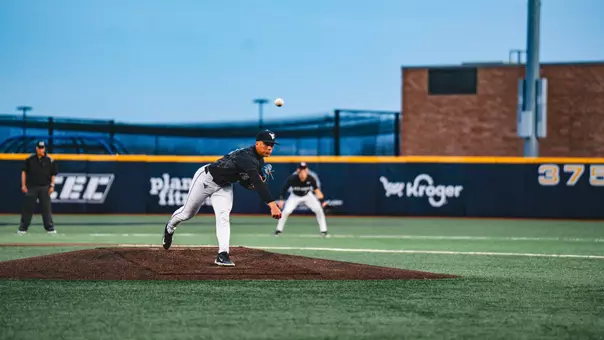
Photo by: All Pro Photography/Dale Sparks
College Baseball Proposal Similar to Mazey’s Gaining Momentum
May 27, 2020 02:09 PM | Baseball, Blog
MORGANTOWN, W.Va. – A proposal to push back the beginning of the college baseball season four weeks is getting endorsements from some of the most prominent coaches in the sport.
Kendall Rogers of D1Baseball.com reported last week that the start date under this new plan would be the third week of March instead of the second week of February. The NCAA Tournament would be pushed back to the end of June with the College World Series taking place in July.
West Virginia coach Randy Mazey has long been a champion of moving college baseball into the summertime and plans similar to his have been proposed in the past but have failed to generate widespread support.
This one, dubbed the New Baseball Model, is led by Michigan coach Erik Bakich and others. The 35-page document addresses four primary reasons for pushing back the college baseball calendar: the COVID-19 virus and potential NIL legislation, financial sustainability, academics and student welfare.
Under financial sustainability the report states, "Division I baseball operates at a significant financial net loss among almost all 299 teams. Games in February and early March eliminate regional competition for Northern and Midwestern programs due to cold weather. Travel budgets are inflated as a result.
"Schools hosting these home series not only compete with colder weather, but college basketball season and March Madness as well, reducing ticket sale and concession revenues from 'actual' attendance," it declared.
In the Executive Summary section, it indicated that cold-weather programs spend more than $200,000 in air travel during the first four weeks of the regular season. Warm-weather programs are spending as much as $10 to $20,000 in guarantees per weekend to bring colder-climate teams in for games.
Pushing the calendar back four weeks could reduce this practice at a considerable savings to many programs, the proposal states. It also argues that increased revenue could be realized at many warmer-climate programs in May and June, citing minor league attendance figures from 2019.
"Once you add the financial component, which has been a missing component to this model for warm-weather schools in the past, now it's a game-changer, especially at this time and where we are in the world, with athletic departments and institutions and schools just really taking a hard look at their budgets," Bakich said in a recent Q&A with Baseball America's Teddy Cahill.
Just 14 Division I baseball teams averaged more than 4,000 fans per game, and only 36 averaged more than 2,000 out of nearly 300 programs, the report states. It claims there are missed revenue opportunities in ticket sales, alcohol, concessions and merchandise under the current college baseball schedule model.
West Virginia's attendance figures from the 2019 season lend support to this.
The Mountaineers drew 5,899 fans for their three-game series against TCU in early May and 4,678 for a two-game series against George Washington on May 16, and May 18.
A Monongalia County Ballpark record 4,355 showed up for West Virginia's NCAA Tournament Regional game against Fordham, and WVU's three NCAA Tournament games drew 12,401 for an average of 4,133 fans per game.
Here was West Virginia's attendance average in 2019 broken down by month:
February – 388
March – 1,182
April – 2,158
May – 2,116
June – 4,134
There are many who believe the Mountaineers could have exceeded 5 or 6,000 for their NCAA Regional game against Fordham if Monongalia County Ballpark had more seating.
For years, Mazey has advocated playing the college baseball season in the warmer weather months in May, June and July, and he spent a good portion of his postgame press conference following a win over Pitt at PNC Park last year touting the benefits.
He mentioned it again a couple of weeks ago during a video conference with media.
"You guys know what my proposal is for playing in the summertime," he said. "The only way we are ever going to get anywhere is by generating revenue in our sport and right now we don't do it."
Opening day this year for West Virginia was Feb. 14 in Jacksonville, Florida.
The Mountaineers played a rare February home game against Canisius and had two early March dates against Kent and Liberty before the season was canceled just prior to the conference opener at Texas Tech on March 13.
Those three games drew sparse crowds.
A mid-May, three-game series at Oklahoma was to conclude the regular season with the Phillips Big 12 Championships taking place last weekend.
The NCAA Tournament was slated to begin this weekend, concluding with the College World Series June 12-24.
"I think three or four years ago, Randy Mazey, the coach at West Virginia, kind of picked up this flag and waved it by himself," Auburn coach Butch Thompson told Auburn Undercover earlier this week. "It didn't get anywhere, but I think everybody listened. I think that helps it this time because he mentioned it a few years ago. It looks like it has some backing from Northern guys, but I don't think this is just a Northern deal. It's something that we all can find some agreement in, even if we're in the South."
There is one other external factor that could give this newest schedule proposal an additional boost – Major League Baseball.
MLB has discussed moving its draft from June to July with the aim of scaling back minor league baseball.
A reduction in minor league teams would require fewer college players and potentially less competition for college baseball in the summertime, should the sport choose to move its calendar back into July.
Stay tuned.
Kendall Rogers of D1Baseball.com reported last week that the start date under this new plan would be the third week of March instead of the second week of February. The NCAA Tournament would be pushed back to the end of June with the College World Series taking place in July.
West Virginia coach Randy Mazey has long been a champion of moving college baseball into the summertime and plans similar to his have been proposed in the past but have failed to generate widespread support.
This one, dubbed the New Baseball Model, is led by Michigan coach Erik Bakich and others. The 35-page document addresses four primary reasons for pushing back the college baseball calendar: the COVID-19 virus and potential NIL legislation, financial sustainability, academics and student welfare.
Under financial sustainability the report states, "Division I baseball operates at a significant financial net loss among almost all 299 teams. Games in February and early March eliminate regional competition for Northern and Midwestern programs due to cold weather. Travel budgets are inflated as a result.
"Schools hosting these home series not only compete with colder weather, but college basketball season and March Madness as well, reducing ticket sale and concession revenues from 'actual' attendance," it declared.
In the Executive Summary section, it indicated that cold-weather programs spend more than $200,000 in air travel during the first four weeks of the regular season. Warm-weather programs are spending as much as $10 to $20,000 in guarantees per weekend to bring colder-climate teams in for games.
Pushing the calendar back four weeks could reduce this practice at a considerable savings to many programs, the proposal states. It also argues that increased revenue could be realized at many warmer-climate programs in May and June, citing minor league attendance figures from 2019.
"Once you add the financial component, which has been a missing component to this model for warm-weather schools in the past, now it's a game-changer, especially at this time and where we are in the world, with athletic departments and institutions and schools just really taking a hard look at their budgets," Bakich said in a recent Q&A with Baseball America's Teddy Cahill.
Just 14 Division I baseball teams averaged more than 4,000 fans per game, and only 36 averaged more than 2,000 out of nearly 300 programs, the report states. It claims there are missed revenue opportunities in ticket sales, alcohol, concessions and merchandise under the current college baseball schedule model.
West Virginia's attendance figures from the 2019 season lend support to this.
The Mountaineers drew 5,899 fans for their three-game series against TCU in early May and 4,678 for a two-game series against George Washington on May 16, and May 18.
A Monongalia County Ballpark record 4,355 showed up for West Virginia's NCAA Tournament Regional game against Fordham, and WVU's three NCAA Tournament games drew 12,401 for an average of 4,133 fans per game.
Here was West Virginia's attendance average in 2019 broken down by month:
February – 388
March – 1,182
April – 2,158
May – 2,116
June – 4,134
There are many who believe the Mountaineers could have exceeded 5 or 6,000 for their NCAA Regional game against Fordham if Monongalia County Ballpark had more seating.
For years, Mazey has advocated playing the college baseball season in the warmer weather months in May, June and July, and he spent a good portion of his postgame press conference following a win over Pitt at PNC Park last year touting the benefits.
He mentioned it again a couple of weeks ago during a video conference with media.
"You guys know what my proposal is for playing in the summertime," he said. "The only way we are ever going to get anywhere is by generating revenue in our sport and right now we don't do it."
Opening day this year for West Virginia was Feb. 14 in Jacksonville, Florida.
The Mountaineers played a rare February home game against Canisius and had two early March dates against Kent and Liberty before the season was canceled just prior to the conference opener at Texas Tech on March 13.
Those three games drew sparse crowds.
A mid-May, three-game series at Oklahoma was to conclude the regular season with the Phillips Big 12 Championships taking place last weekend.
The NCAA Tournament was slated to begin this weekend, concluding with the College World Series June 12-24.
"I think three or four years ago, Randy Mazey, the coach at West Virginia, kind of picked up this flag and waved it by himself," Auburn coach Butch Thompson told Auburn Undercover earlier this week. "It didn't get anywhere, but I think everybody listened. I think that helps it this time because he mentioned it a few years ago. It looks like it has some backing from Northern guys, but I don't think this is just a Northern deal. It's something that we all can find some agreement in, even if we're in the South."
There is one other external factor that could give this newest schedule proposal an additional boost – Major League Baseball.
MLB has discussed moving its draft from June to July with the aim of scaling back minor league baseball.
A reduction in minor league teams would require fewer college players and potentially less competition for college baseball in the summertime, should the sport choose to move its calendar back into July.
Stay tuned.
Ryan Ward | April 6
Tuesday, April 07
Coach Ryan Garrett | April 6
Tuesday, April 07
Coach Rich Rodriguez | April 6
Tuesday, April 07
Alumni Series | Rachel Viglianco Wagner
Monday, April 06