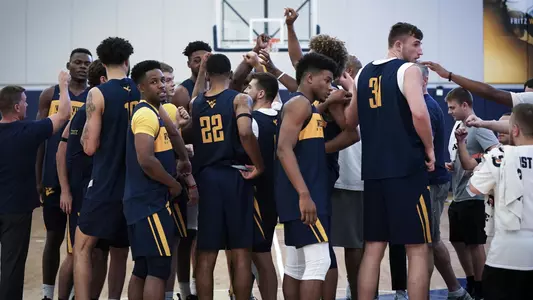
Photo by: Katie MacCrory
Huggins: WVU a Much Improved Shooting Team This Year
October 04, 2019 09:15 AM | Men's Basketball
MORGANTOWN, W.Va. – Ask Bob Huggins what makes this year's West Virginia University men's basketball team different from some of his others and he doesn't mince words.
"We actually make shots," the veteran coach said last week. "We don't have to rely on getting two and three shots a possession or we don't have to rely as much on creating turnovers."
Not only was last year's team unable to create turnovers, it also struggled mightily to make shots. Just once in a victory over St. Joseph's did the Mountaineers make at least half of their shot attempts in a game.
Twelve times West Virginia shot below 40 percent and six times its shooting percentage was below 35 percent.
There was a two-week stretch of Big 12 games in mid-February against Texas Tech, Texas, Kansas and Kansas State when the Mountaineers couldn't hit the Mon River if they dropped basketballs off the Star City Bridge.
Consequently, we saw considerable roster turnover during the offseason as Huggins' staff beat the bushes looking for some outside shooting help.
Their efforts led to the signatures of Sinclair Community College shooting guard Sean McNeil and Collin College shooting guard Taz Sherman.
 Both of those guys were brought in to give West Virginia's perimeter game a much needed IV and so far they've delivered, according to Huggins.
"We look at Sean as an elite shooter," he said. "Taz can really make shots and among our returning guys, Jordan (McCabe) can make shots and Emmitt (Matthews) can make shots. And Chase (Harler) has shot the ball well all summer."
It's difficult to determine how junior college stats translate to Power 5 basketball, but McNeil and Sherman both put up impressive numbers at that level.
McNeil scored 55 in one junior college game and averaged nearly 30 points per contest to earn JC Division II All-America honors. His list of schools grew last spring to include NCAA runner-up Texas Tech, Oregon, OIe Miss and Dayton, according to the Dayton Daily News.
Sherman averaged 26 points per game and shot nearly 40 percent from 3-point range in 29 games last year at Collin College in McKinley, Texas. Like McNeil, his recruitment started to blow up last spring when teams seeking immediate scoring help such as West Virginia came calling.
"Sometimes I look at Taz and I wish he was a little bigger and he's 6-3 or 6-4," Huggins said. "And he shoots it now. As of today he's our most consistent shot maker and he can make hard shots. He's a versatile scorer. He can score it on the perimeter and in junior college they sent him down on the block quite a bit. He can score it down there."
McNeil does most of his scoring from the outside where West Virginia really struggled the most last year.
"Every time Sean shoots it you think it's going in and when it doesn't go in you're looking at him like what's wrong because everything looks like it should go in," Huggins said. "Chase is the same way. Chase has shot it really well."
Despite having much better perimeter shooters this year, Huggins said that the strength of this year's basketball team will likely reside down in the blocks where he's got two really talented bigs in 6-10 sophomore Derek Culver and 6-9 McDonald's All-American forward Oscar Tshiebwe.
These two are probably the most highly rated interior players West Virginia has had on the court at the same time since the mid-1980s when Darryl Prue and Chris Brooks were playing for the Mountaineers.
ESPN analyst Fran Fraschilla tweeted the other day that block-out drills with those two have been like "train wrecks at the rim."
"If we can get Derek a little better and we can get Oscar a little better … because you've still got to score it close and that opens things up outside when you can throw it inside," Huggins said.
Huggins thinks he could have as many as four capable inside scorers with the continued development of senior Logan Routt and the late addition 6-7, 235-pound Arkansas transfer Gabe Osabuohien.
If Osabuohien can gain immediate eligibility this year that gives West Virginia three post guys who can really run the floor, something Huggins wants to take advantage of this season.
"We can wear on other people's bigs and beat them up and down the floor," he explained. "I think that's a great advantage."
When you think about what Culver did last year nearly leading the Big 12 in rebounding despite not playing the early portion of West Virginia's schedule when his rebounding totals could have been far greater, and his overall inexperience facing double- and sometimes triple-teams, it's pretty remarkable.
 Culver was just a percentage point away from averaging a double-double and with Tshiebwe now available to take away some of those extra defenders, that gives West Virginia potentially a Kansas-caliber front line.
Think about what Bob Huggins has been able to do in the past with some of the players he's had and then imagine what Culver and Tshiebwe can accomplish if they will listen and do what he tells them.
If they do, watch out!
And don't forget, the last time we saw a complete roster makeover here in 2015 that turned into Sweet 16 trips in three out of the next four years.
Our first peek at this year's team will take place a week from Friday when the Mountaineers have their annual Gold-Blue Debut on Oct. 11 at 7 p.m.
A charity exhibition game against Duquesne will take place at the WVU Coliseum on Friday, Nov. 1, and then the games begin counting for real on Friday, Nov. 8, when West Virginia opens the regular season against Akron at the Coliseum.
That contest will tip off at 7 p.m.
Other non-conference home opponents include Northern Colorado (Nov. 18), Boston University (Nov. 22), Rhode Island (Dec. 1), Austin Peay (Dec. 12), Nicholls (Dec. 14) and Missouri (Jan. 25) in the annual SEC-Big 12 Challenge.
Games against Pitt, St. John's, Ohio State, and a potential meeting against either South Carolina or Wichita State in the Cancun Challenge, highlight the non-conference road schedule.
West Virginia will open Big 12 play on Saturday, Jan. 4 at Kansas.
"We actually make shots," the veteran coach said last week. "We don't have to rely on getting two and three shots a possession or we don't have to rely as much on creating turnovers."
Not only was last year's team unable to create turnovers, it also struggled mightily to make shots. Just once in a victory over St. Joseph's did the Mountaineers make at least half of their shot attempts in a game.
Twelve times West Virginia shot below 40 percent and six times its shooting percentage was below 35 percent.
There was a two-week stretch of Big 12 games in mid-February against Texas Tech, Texas, Kansas and Kansas State when the Mountaineers couldn't hit the Mon River if they dropped basketballs off the Star City Bridge.
Consequently, we saw considerable roster turnover during the offseason as Huggins' staff beat the bushes looking for some outside shooting help.
Their efforts led to the signatures of Sinclair Community College shooting guard Sean McNeil and Collin College shooting guard Taz Sherman.
Both of those guys were brought in to give West Virginia's perimeter game a much needed IV and so far they've delivered, according to Huggins."We look at Sean as an elite shooter," he said. "Taz can really make shots and among our returning guys, Jordan (McCabe) can make shots and Emmitt (Matthews) can make shots. And Chase (Harler) has shot the ball well all summer."
It's difficult to determine how junior college stats translate to Power 5 basketball, but McNeil and Sherman both put up impressive numbers at that level.
McNeil scored 55 in one junior college game and averaged nearly 30 points per contest to earn JC Division II All-America honors. His list of schools grew last spring to include NCAA runner-up Texas Tech, Oregon, OIe Miss and Dayton, according to the Dayton Daily News.
Sherman averaged 26 points per game and shot nearly 40 percent from 3-point range in 29 games last year at Collin College in McKinley, Texas. Like McNeil, his recruitment started to blow up last spring when teams seeking immediate scoring help such as West Virginia came calling.
"Sometimes I look at Taz and I wish he was a little bigger and he's 6-3 or 6-4," Huggins said. "And he shoots it now. As of today he's our most consistent shot maker and he can make hard shots. He's a versatile scorer. He can score it on the perimeter and in junior college they sent him down on the block quite a bit. He can score it down there."
McNeil does most of his scoring from the outside where West Virginia really struggled the most last year.
"Every time Sean shoots it you think it's going in and when it doesn't go in you're looking at him like what's wrong because everything looks like it should go in," Huggins said. "Chase is the same way. Chase has shot it really well."
Despite having much better perimeter shooters this year, Huggins said that the strength of this year's basketball team will likely reside down in the blocks where he's got two really talented bigs in 6-10 sophomore Derek Culver and 6-9 McDonald's All-American forward Oscar Tshiebwe.
These two are probably the most highly rated interior players West Virginia has had on the court at the same time since the mid-1980s when Darryl Prue and Chris Brooks were playing for the Mountaineers.
ESPN analyst Fran Fraschilla tweeted the other day that block-out drills with those two have been like "train wrecks at the rim."
"If we can get Derek a little better and we can get Oscar a little better … because you've still got to score it close and that opens things up outside when you can throw it inside," Huggins said.
Huggins thinks he could have as many as four capable inside scorers with the continued development of senior Logan Routt and the late addition 6-7, 235-pound Arkansas transfer Gabe Osabuohien.
If Osabuohien can gain immediate eligibility this year that gives West Virginia three post guys who can really run the floor, something Huggins wants to take advantage of this season.
"We can wear on other people's bigs and beat them up and down the floor," he explained. "I think that's a great advantage."
When you think about what Culver did last year nearly leading the Big 12 in rebounding despite not playing the early portion of West Virginia's schedule when his rebounding totals could have been far greater, and his overall inexperience facing double- and sometimes triple-teams, it's pretty remarkable.
Culver was just a percentage point away from averaging a double-double and with Tshiebwe now available to take away some of those extra defenders, that gives West Virginia potentially a Kansas-caliber front line.Think about what Bob Huggins has been able to do in the past with some of the players he's had and then imagine what Culver and Tshiebwe can accomplish if they will listen and do what he tells them.
If they do, watch out!
And don't forget, the last time we saw a complete roster makeover here in 2015 that turned into Sweet 16 trips in three out of the next four years.
Our first peek at this year's team will take place a week from Friday when the Mountaineers have their annual Gold-Blue Debut on Oct. 11 at 7 p.m.
A charity exhibition game against Duquesne will take place at the WVU Coliseum on Friday, Nov. 1, and then the games begin counting for real on Friday, Nov. 8, when West Virginia opens the regular season against Akron at the Coliseum.
That contest will tip off at 7 p.m.
Other non-conference home opponents include Northern Colorado (Nov. 18), Boston University (Nov. 22), Rhode Island (Dec. 1), Austin Peay (Dec. 12), Nicholls (Dec. 14) and Missouri (Jan. 25) in the annual SEC-Big 12 Challenge.
Games against Pitt, St. John's, Ohio State, and a potential meeting against either South Carolina or Wichita State in the Cancun Challenge, highlight the non-conference road schedule.
West Virginia will open Big 12 play on Saturday, Jan. 4 at Kansas.

Players Mentioned

F
/ Men's Basketball
G
/ Men's Basketball
F
/ Men's Basketball
F
/ Men's Basketball
G
/ Men's Basketball
F
/ Men's BasketballCollege Basketball Crown Recap
Thursday, April 16
Ross Hodge, Honor Huff & Brenen Lorient | Oklahoma Postgame
Sunday, April 05
Ross Hodge, Treysen Eaglestaff & Brenen Lorient | Creighton Postgame
Saturday, April 04
Ross Hodge & Honor Huff | Stanford Postgame
Thursday, April 02