New Facility to Boost Women’s Track
February 01, 2018 11:31 AM | Track & Field
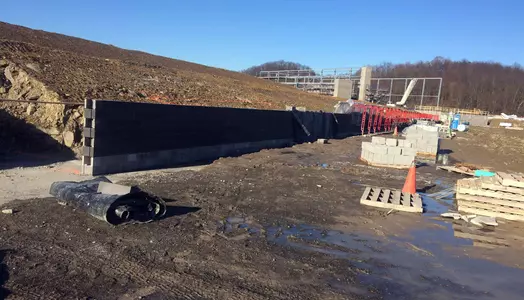
MORGANTOWN, W.Va. - That giant mound of dirt, rock and rubble currently being moved out at Mylan Park represents a rebirth of sorts for the West Virginia University women's track program.
Sean Cleary's Mountaineer women's track and cross country teams have been basically stuck in idle ever since West Virginia joined the Big 12 Conference in 2012. Prior to that, his indoor and outdoor teams enjoyed considerable success with top-20 finishes in 2010 and 2011, including a No. 10 finish at indoor nationals in 2010.
At the time, Cleary's women's cross country program was matching the incredible success Nikki Izzo-Brown's women's soccer program was enjoying at WVU.
A lot of this prosperity could be attributed to an outstanding group of distance runners, which helped West Virginia's women's cross country teams finish 24th or better at nationals six out of seven years from 2007-14, including four top-eight finishes in 2008, 2009, 2011 and 2014 and a fourth-place conclusion in 2008.
That was no different than the heights one of Cleary's predecessors, Dr. Martin Pushkin, once reached in the early 1980s with the men's track and cross country programs when he had that great group of distance runners led by Belgian star Jean-Pierre Ndayisenga and St. Mary's standout Steve Taylor.
WVU's facility and budgetary limitations when Cleary was hired in 2007 forced him to follow a similar path to success when he took over the women's programs. Then, when West Virginia moved to the Big 12, the women's track program fell on hard times. In the Big East, Cleary had developed a niche recruiting world-class Canadians while benefitting from an inordinate number of outstanding local athletes to build a track program that was skewed heavily toward the distance events.
Most of the sprinters, jumpers, hurdlers and throwers he was able to recruit to WVU in those years were good enough to score points in the Big East, but not in the Big 12.
Hurdler Chelsea Carrier was one of the few exceptions.
April Rotilio was another, but it took her five years of development with a Big East and school-record time in the 400 to have a clocking that would have been fast enough just to qualify for the finals of this year's Big 12 outdoor meet.
That's about it.
"When we went to the Big 12, we were exposed," Cleary admitted recently. "Plus, we've had a little bit of bad luck."
The bad luck came in the form of having some scholarships tied up in athletes who either didn't perform up to expectations or were injured and couldn't perform at all.
That has certainly put his programs behind the eight ball. The biggest impediment, however, has been a facility situation that has gotten progressively worse. West Virginia's outdoor track had decayed to the point where Cleary was forced to take his steeplechasers to Wheeling Jesuit or California, Pennsylvania, just to practice.
His jumpers either went to meets a day early to get in their necessary practice time or drove up to Penn State where the Nittany Lions' indoor and outdoor tracks turned into surrogate homes for the Mountaineers.
"They did all the work, and we basically showed up," Cleary said.
A couple of years ago, he even lost a recruit to Marshall because of WVU's substandard track, which was an eye-opener to everybody.
But he received a glimmer of hope when Oliver Luck became athletic director in 2010, and momentum has begun to accelerate under current AD Shane Lyons.
Lyons has made improving West Virginia's athletic facilities his No. 1 priority since arriving from Alabama in 2015, and with so many of them to improve, he's been forced to proceed at a methodical pace.
Once the new Monongalia County Ballpark was completed in the spring of 2015, his attention quickly turned to much-needed enhancements at 38-year-old Milan Puskar Stadium and the 48-year-old WVU Coliseum.
Since those initial refurbishments have been completed, he has now been able to address swimming and track, and Lyons hopes to unveil a comprehensive facility master plan in the coming months.
In the meantime, the community/WVU effort to construct new swimming and outdoor track facilities at Mylan Park, with West Virginia University being the primary paying tenant, is going to be a big shot in the arm to prep runners and swimmers throughout the Mountain State.
The things that come standard with a modern outdoor track these days - nine-lanes, berms to cut down on the wind, double straightaways, steeple and pole vaulting pits, vertical jumps, throwing areas and seating for approximately 1,200 spectators - will certainly help Cleary's ability to recruit better sprinters, hurdlers, jumpers and throwers to WVU.
"Kids are going to see a serious commitment from West Virginia in terms of its caring for women's track and field," he said. "The top-end recruits will give us a much better look than we've had in the past. That's all we want.
"The throwing and pole vault will be incredible in this situation," Cleary continued. "They've done a wonderful job listening to the experts in terms of understanding that track is a wind sport. They are building a big berm, and that was quite a concern of ours in the beginning."
Cleary said it's also a matter of pride for his student-athletes having a nice place to train and call home.
"The kids are going to be able to go to practice in a nice facility, and we're going to be able to have competitions at home," he said. "We're on the road every weekend from January until June and now you get to sleep in our own bed and go out to a facility that is world-class."
And while this new outdoor facility won't be the magic bullet for West Virginia University women's track and field, it will help, according to Lyons.
"When I first got to Alabama, the track program was not very good and we were able to invest in facilities and it got progressively better," Lyons said.
There are still details that need to be ironed out with the new facility, most notably lighting to accommodate all of its occupants. West Virginia is just one of a number of local entities that will have access to the track, including several area high schools and middle schools.
"I want those high school meets to be there," Cleary said. "If they can bring in 30 schools or more that will be great. This will be an open facility and as long as I'm here, it's going to work."
Cleary has always had flexible practice schedules, which permitted his athletes to pursue whatever academic majors they pleased. If an athlete wanted to become an engineer, Cleary worked around her class schedule.
Doctor, nurse or physical therapist?
Same deal.
 "My life would be much easier if we could be done practicing at 10 in the morning, and I could go to work for five hours and then go home and then make four or five recruiting calls a night," Cleary admitted. "But we would not be able to do the things we've been able to accomplish academically with that philosophy."
If the new track doesn't have lights, that means he will be forced to have a set practice schedule each day, which will require the juggling of schedules on everyone's part.
"If we want this to be a community track, which it is, for that to happen there are a few things that still need to happen … and I trust they will happen," Cleary said.
When the facility is completed, West Virginia University will once again have the ability to put on outdoor home meets, something it hasn't been able to do for nearly 10 years because of the poor condition of the current outdoor track.
That's long, long overdue because some of the greatest athletes this University has ever produced - Olympians and All-Americans - were never able to run an outdoor track meet in Morgantown. The new outdoor facility will change that.
"When we prove that we can put on a top-notch meet, weather permitting, we're going to put one on," Cleary predicted.
In short, Cleary is excited about the commitment the area is making to track and field. Soon, his women's track program could benefit from that commitment when the facility opens sometime later this year.
"We got close on some good sprinters this year - way closer than we have in the past," he said.
To Cleary, that's a good start.
Sean Cleary's Mountaineer women's track and cross country teams have been basically stuck in idle ever since West Virginia joined the Big 12 Conference in 2012. Prior to that, his indoor and outdoor teams enjoyed considerable success with top-20 finishes in 2010 and 2011, including a No. 10 finish at indoor nationals in 2010.
At the time, Cleary's women's cross country program was matching the incredible success Nikki Izzo-Brown's women's soccer program was enjoying at WVU.
A lot of this prosperity could be attributed to an outstanding group of distance runners, which helped West Virginia's women's cross country teams finish 24th or better at nationals six out of seven years from 2007-14, including four top-eight finishes in 2008, 2009, 2011 and 2014 and a fourth-place conclusion in 2008.
That was no different than the heights one of Cleary's predecessors, Dr. Martin Pushkin, once reached in the early 1980s with the men's track and cross country programs when he had that great group of distance runners led by Belgian star Jean-Pierre Ndayisenga and St. Mary's standout Steve Taylor.
WVU's facility and budgetary limitations when Cleary was hired in 2007 forced him to follow a similar path to success when he took over the women's programs. Then, when West Virginia moved to the Big 12, the women's track program fell on hard times. In the Big East, Cleary had developed a niche recruiting world-class Canadians while benefitting from an inordinate number of outstanding local athletes to build a track program that was skewed heavily toward the distance events.
Most of the sprinters, jumpers, hurdlers and throwers he was able to recruit to WVU in those years were good enough to score points in the Big East, but not in the Big 12.
Hurdler Chelsea Carrier was one of the few exceptions.
April Rotilio was another, but it took her five years of development with a Big East and school-record time in the 400 to have a clocking that would have been fast enough just to qualify for the finals of this year's Big 12 outdoor meet.
That's about it.
"When we went to the Big 12, we were exposed," Cleary admitted recently. "Plus, we've had a little bit of bad luck."
The bad luck came in the form of having some scholarships tied up in athletes who either didn't perform up to expectations or were injured and couldn't perform at all.
That has certainly put his programs behind the eight ball. The biggest impediment, however, has been a facility situation that has gotten progressively worse. West Virginia's outdoor track had decayed to the point where Cleary was forced to take his steeplechasers to Wheeling Jesuit or California, Pennsylvania, just to practice.
His jumpers either went to meets a day early to get in their necessary practice time or drove up to Penn State where the Nittany Lions' indoor and outdoor tracks turned into surrogate homes for the Mountaineers.
"They did all the work, and we basically showed up," Cleary said.
A couple of years ago, he even lost a recruit to Marshall because of WVU's substandard track, which was an eye-opener to everybody.
But he received a glimmer of hope when Oliver Luck became athletic director in 2010, and momentum has begun to accelerate under current AD Shane Lyons.
Lyons has made improving West Virginia's athletic facilities his No. 1 priority since arriving from Alabama in 2015, and with so many of them to improve, he's been forced to proceed at a methodical pace.
Once the new Monongalia County Ballpark was completed in the spring of 2015, his attention quickly turned to much-needed enhancements at 38-year-old Milan Puskar Stadium and the 48-year-old WVU Coliseum.
Since those initial refurbishments have been completed, he has now been able to address swimming and track, and Lyons hopes to unveil a comprehensive facility master plan in the coming months.
In the meantime, the community/WVU effort to construct new swimming and outdoor track facilities at Mylan Park, with West Virginia University being the primary paying tenant, is going to be a big shot in the arm to prep runners and swimmers throughout the Mountain State.
The things that come standard with a modern outdoor track these days - nine-lanes, berms to cut down on the wind, double straightaways, steeple and pole vaulting pits, vertical jumps, throwing areas and seating for approximately 1,200 spectators - will certainly help Cleary's ability to recruit better sprinters, hurdlers, jumpers and throwers to WVU.
"Kids are going to see a serious commitment from West Virginia in terms of its caring for women's track and field," he said. "The top-end recruits will give us a much better look than we've had in the past. That's all we want.
"The throwing and pole vault will be incredible in this situation," Cleary continued. "They've done a wonderful job listening to the experts in terms of understanding that track is a wind sport. They are building a big berm, and that was quite a concern of ours in the beginning."
Cleary said it's also a matter of pride for his student-athletes having a nice place to train and call home.
"The kids are going to be able to go to practice in a nice facility, and we're going to be able to have competitions at home," he said. "We're on the road every weekend from January until June and now you get to sleep in our own bed and go out to a facility that is world-class."
And while this new outdoor facility won't be the magic bullet for West Virginia University women's track and field, it will help, according to Lyons.
"When I first got to Alabama, the track program was not very good and we were able to invest in facilities and it got progressively better," Lyons said.
There are still details that need to be ironed out with the new facility, most notably lighting to accommodate all of its occupants. West Virginia is just one of a number of local entities that will have access to the track, including several area high schools and middle schools.
"I want those high school meets to be there," Cleary said. "If they can bring in 30 schools or more that will be great. This will be an open facility and as long as I'm here, it's going to work."
Cleary has always had flexible practice schedules, which permitted his athletes to pursue whatever academic majors they pleased. If an athlete wanted to become an engineer, Cleary worked around her class schedule.
Doctor, nurse or physical therapist?
Same deal.
"My life would be much easier if we could be done practicing at 10 in the morning, and I could go to work for five hours and then go home and then make four or five recruiting calls a night," Cleary admitted. "But we would not be able to do the things we've been able to accomplish academically with that philosophy."If the new track doesn't have lights, that means he will be forced to have a set practice schedule each day, which will require the juggling of schedules on everyone's part.
"If we want this to be a community track, which it is, for that to happen there are a few things that still need to happen … and I trust they will happen," Cleary said.
When the facility is completed, West Virginia University will once again have the ability to put on outdoor home meets, something it hasn't been able to do for nearly 10 years because of the poor condition of the current outdoor track.
That's long, long overdue because some of the greatest athletes this University has ever produced - Olympians and All-Americans - were never able to run an outdoor track meet in Morgantown. The new outdoor facility will change that.
"When we prove that we can put on a top-notch meet, weather permitting, we're going to put one on," Cleary predicted.
In short, Cleary is excited about the commitment the area is making to track and field. Soon, his women's track program could benefit from that commitment when the facility opens sometime later this year.
"We got close on some good sprinters this year - way closer than we have in the past," he said.
To Cleary, that's a good start.
T&F: DMR Team Big 12 Championship Post-Race Interview
Saturday, March 01
Petal Palmer - 2024 Wilma Rudolph Award Recipient
Monday, June 10
A Conversation with Wren Baker
Monday, December 05
Life as a Mountaineer - Haley Jackson
Monday, May 16